Process server for San Francisco Superior Court cases
Process Server San Francisco, CA
Arrange service of process anywhere in San Francisco online
Serving papers in San Francisco for a case on the city’s mandatory e-filing system: we log every trip to the building and return the proof in a form the e-filing system accepts.
Civil cases from San Francisco route through San Francisco Superior Court, with the specific courthouse confirmed at filing. We serve Financial District high-rises around Market and Montgomery during business hours, SoMa and Mission Bay corporate campuses with visitor procedures, and residential addresses citywide. Every attempt is logged and the signed proof comes back ready to file.
San Francisco’s address mix runs from Financial District high-rises to SoMa and Mission Bay tech-employer addresses to controlled-access apartment buildings to residential neighborhoods. Order intake captures the address along with any access information that matters for the building — suite or floor, recipient department, lobby concierge, building reception. The order routes to a registered process server, and visit notes appear on the order as the work happens.
What shapes a San Francisco process server order
Every San Francisco serve we take ends with a proof filed at 400 McAllister Street or through the court’s e-filing system. The numbers below explain how those orders are planned, and each row links to where the figure comes from.
Key figures for a San Francisco order
Figure
What it means for a serve
Source
30.8%
What it means for a serveof the city’s 414,602 homes sit in buildings with 20 or more units, and only 18.0% are detached houses. Large apartment buildings are the setting for a big share of the city’s residential serves.
What it means for a serveof San Francisco households have no vehicle at all. The parked-car clue servers lean on elsewhere is missing for nearly a third of homes, so the attempt notes rest on what was said at the door or through the intercom.
What it means for a serveof San Francisco’s civil filings in 2024-25 were evictions, against 12.4% statewide. Unlawful detainer papers move through the court on their own route, which the filing section below lays out.
What it means for a serveof occupied homes are rented, so most residential serves happen at a tenant’s door, often with a Rent Ordinance notice somewhere in the file.
What it means for a serveof residents five and older speak an Asian or Pacific Island language at home, and 13.2% of residents speak one of those languages with limited English, which belongs in the order notes.
What it means for a serveactive on-street parking meters sit in the city, most enforced six days a week, so parking for a long attempt is planned before the server leaves.
Upload the papers, the recipient’s address with the unit as written on the lease, and any building access details. We route it to a registered process server and post the signed proof to your account when the serve is done.
San Francisco eviction notices on file at the Rent Board, and what they tell a server
In San Francisco, the notice that starts most evictions becomes a filing with the city before any lawsuit exists. The Rent Board keeps the copies, and the city publishes them as the Eviction Notices dataset on DataSF, going back to 1997. For a firm sending a server out on an unlawful detainer, that record shows how much eviction work runs through the city each year, and where in the city it lands.
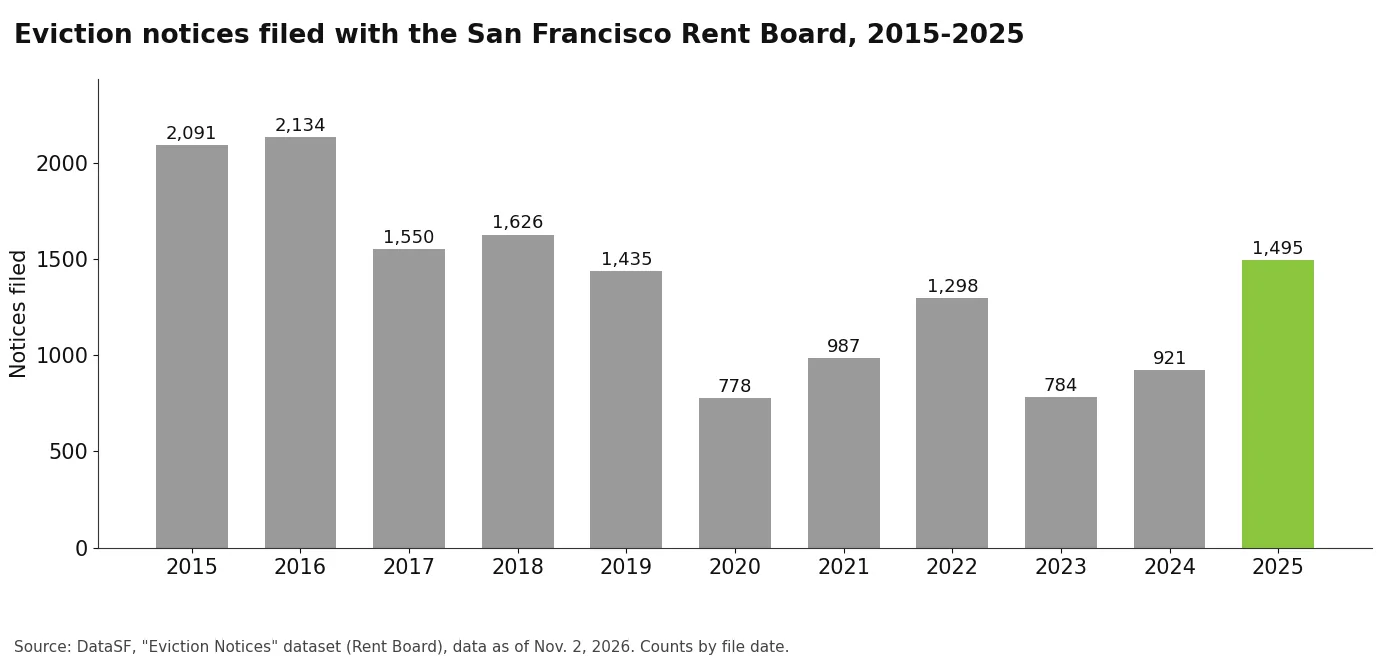
1,495 notices in 2025, the most since 2018
Notices filed with the Rent Board in 2025 came to 1,495, up from 921 in 2024 and 784 in 2023. The total for 2026 had already reached 1,223 by early November. Counts in the dataset follow the filing date, so they track notices served and filed, not lawsuits.
Notices filed with the Rent Board by year. After dropping to 778 in 2020, filings climbed back to 1,495 in 2025, the highest count since 2018, which is roughly the volume of notices San Francisco servers are asked to deliver and prove. Source: DataSF Eviction Notices dataset.
Where in the city the 2025 filings landed
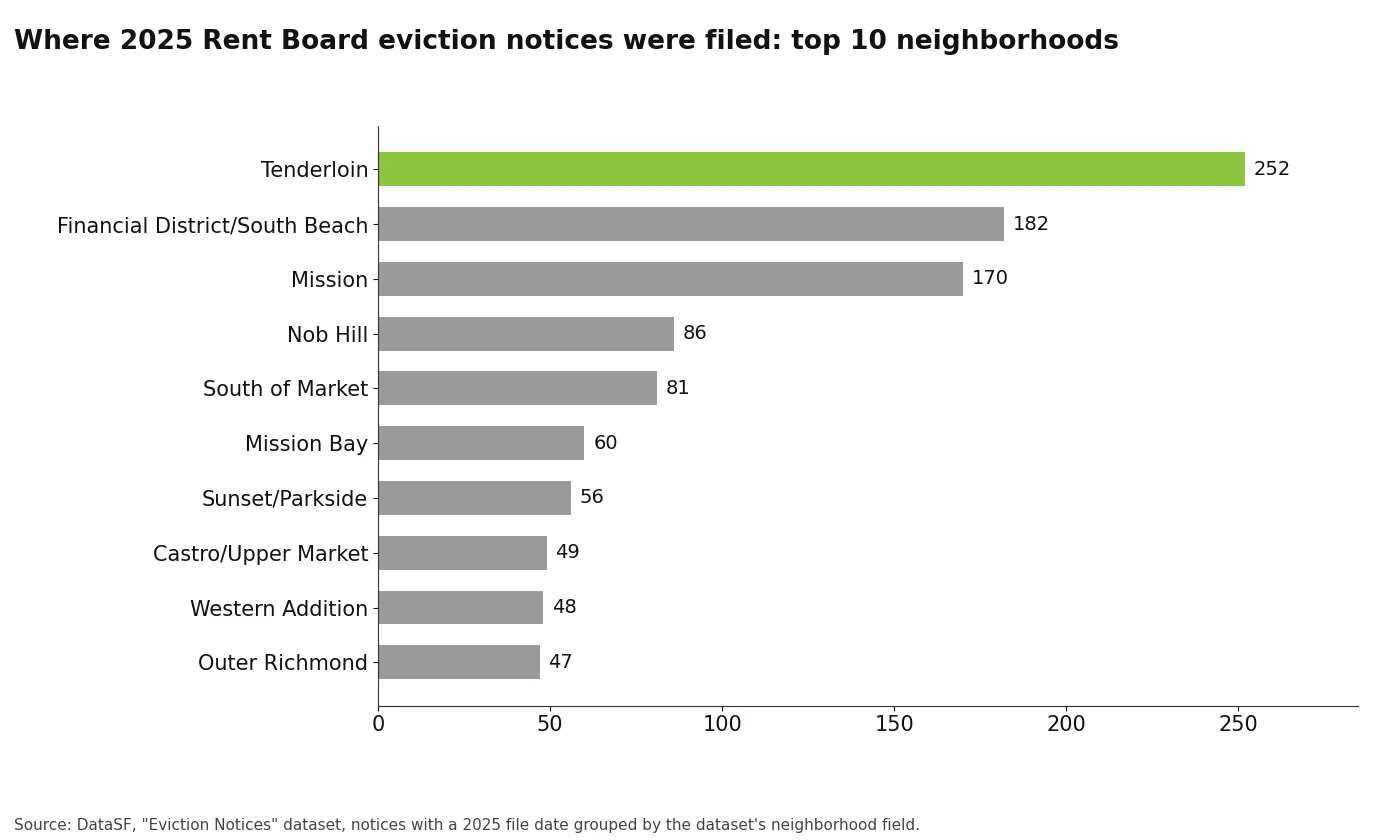
The Tenderloin led 2025 with 252 notices, followed by Financial District/South Beach with 182 and the Mission with 170. Those three neighborhoods hold 604 of the year’s notices. Nob Hill (86) and South of Market (81) come next, so five neighborhoods account for 771 notices, just over half of the citywide total.
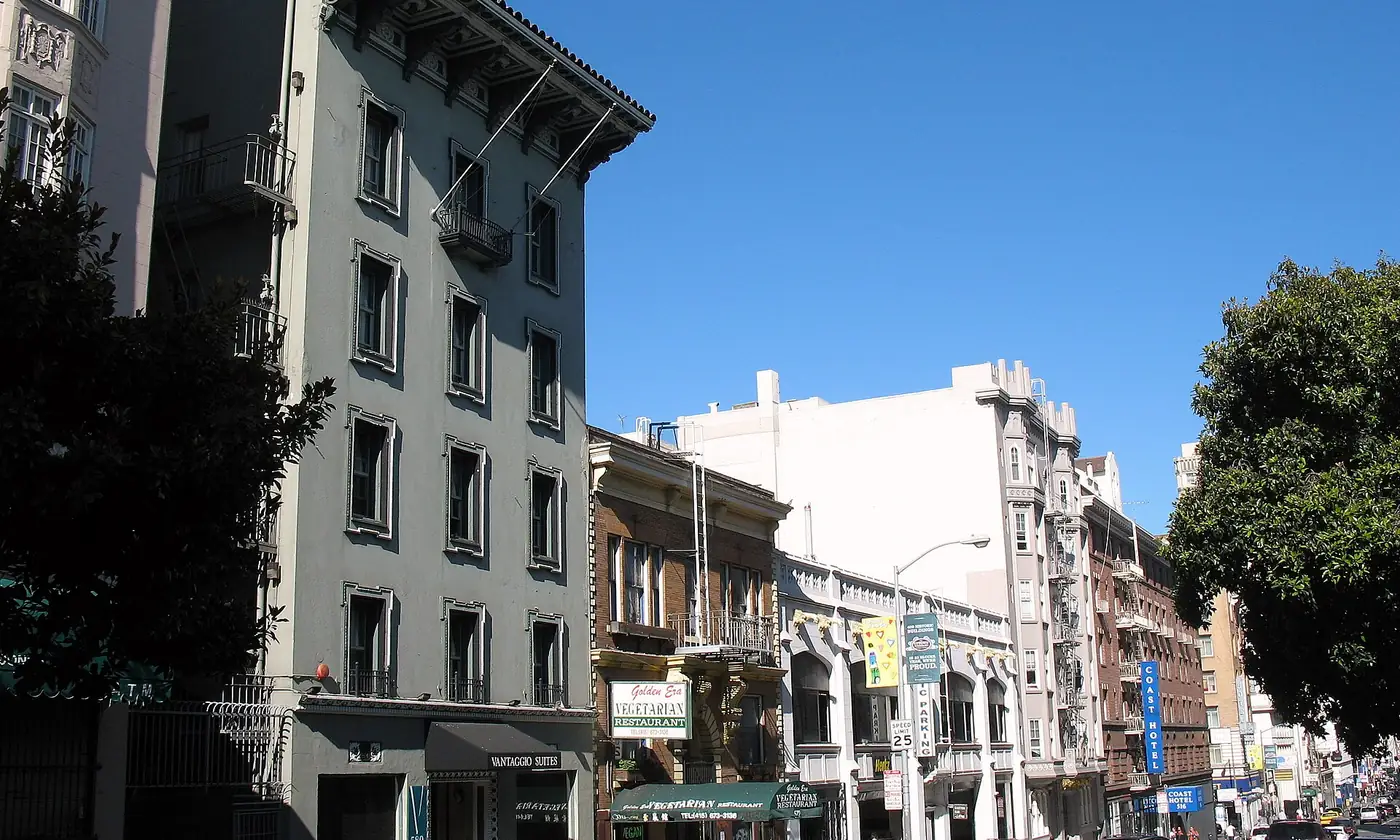
The ten neighborhoods with the most notices filed in 2025. The Tenderloin, Financial District/South Beach and the Mission together account for 604. Source: DataSF Eviction Notices dataset.O’Farrell Street between Leavenworth and Jones, in the Tenderloin. The neighborhood had 252 eviction notices filed with the Rent Board in 2025, more than any other part of the city. Photo: Sanfranman59, CC BY-SA 3.0, via Wikimedia Commons.
What the grounds on the notices look like
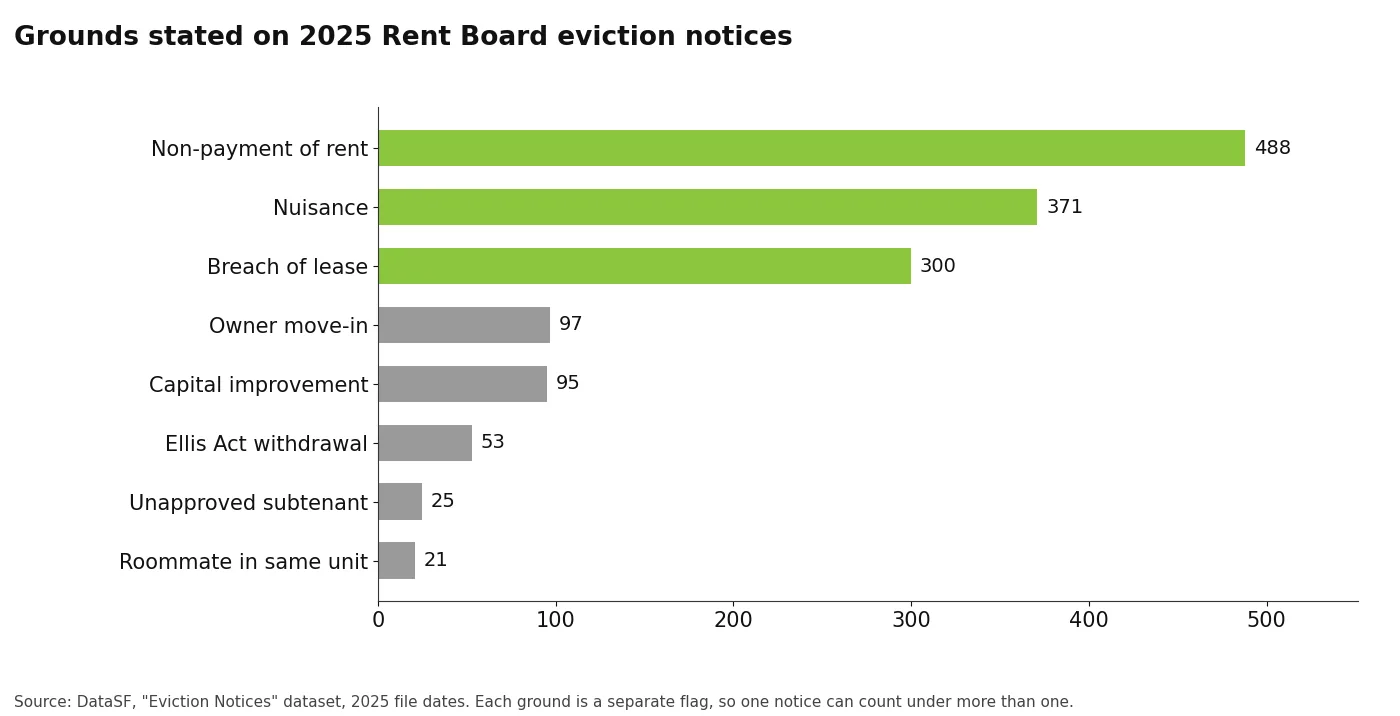
Each notice in the dataset carries flags for the grounds the landlord gave, and one notice can carry several. In 2025, non-payment of rent appears on 488 notices, nuisance on 371 and breach of the lease on 300. No-fault grounds are smaller in number: owner move-in on 97, capital improvement work on 95 and withdrawal of the building from the rental market under the Ellis Act on 53.
Grounds flagged on 2025 notices. At-fault grounds (non-payment, nuisance, breach) dominate; no-fault grounds such as owner move-in and Ellis Act withdrawals are the ones that also trigger relocation payments. Source: DataSF Eviction Notices dataset.
The paperwork a San Francisco notice has to carry
The Rent Board’s eviction notice requirements add steps on top of state law for most residential tenancies in the city:
The notice must be in writing, list a specific time frame (usually 3, 10, 30, 60 or 120 days) and state the “just cause” reason, which has to be the landlord’s dominant motive.
A copy of Rent Board Form 1007 must be attached to the notice. The Rent Board keeps the current version in its Forms Center.
A copy of the notice, with every document attached to it, goes to the Rent Board within ten days after it is served on the tenant.
Owner or relative move-in, Ellis Act and condominium-conversion evictions also require relocation payments to the tenant.
non-payment of rent, habitual late payment or frequent bounced checks;
failure to cure a substantial breach of the rental agreement;
a nuisance or substantial interference that is severe, continuing or recurring;
illegal use of the unit, with exceptions for an unwarranted unit and a single cured short-term rental violation;
refusing, after a written request, to sign an extension or renewal on materially the same terms;
refusing access after written notice to stop refusing;
an unapproved subtenant left as the only occupant at the end of the term;
the landlord moving in, or in limited cases a member of the landlord’s immediate family;
sale under an approved condominium conversion;
demolishing or permanently removing a unit from housing use;
capital improvements or rehabilitation that make the unit temporarily uninhabitable, with the tenant allowed back right after;
substantial rehabilitation of a building at least 50 years old, costing at least 75% of new construction;
taking every unit in the building off the rental market under the Ellis Act;
lead remediation required by Health Code Articles 11 or 26;
removal under a development agreement under Administrative Code Chapter 56;
the end of a “Good Samaritan” occupancy agreement, with notice served within 60 days;
a development project requiring demolition under Planning Code section 317.
What does not count, and what else needs a cause
The overview is explicit that the end of a lease term or a change in ownership is not by itself a just cause. A landlord also needs a just cause to take away housing services such as parking, storage or laundry rooms, apart from a temporary removal for mandatory soft-story seismic work. And units that first got a certificate of occupancy after June 13, 1979, which are outside the rent increase limits, are still under the eviction rules, so a newer building does not mean a notice-free eviction.
Why the date of service matters twice
Because the ten-day filing window runs from the day the notice is served, the date on the proof of service is the date the landlord’s office works back from. A proof that names the wrong day, or leaves the method of service unclear, causes trouble before the case is ever filed. Our servers record the date, time and method of each notice served in San Francisco on the proof, so the landlord or counsel can file the copy with the Rent Board inside the window.
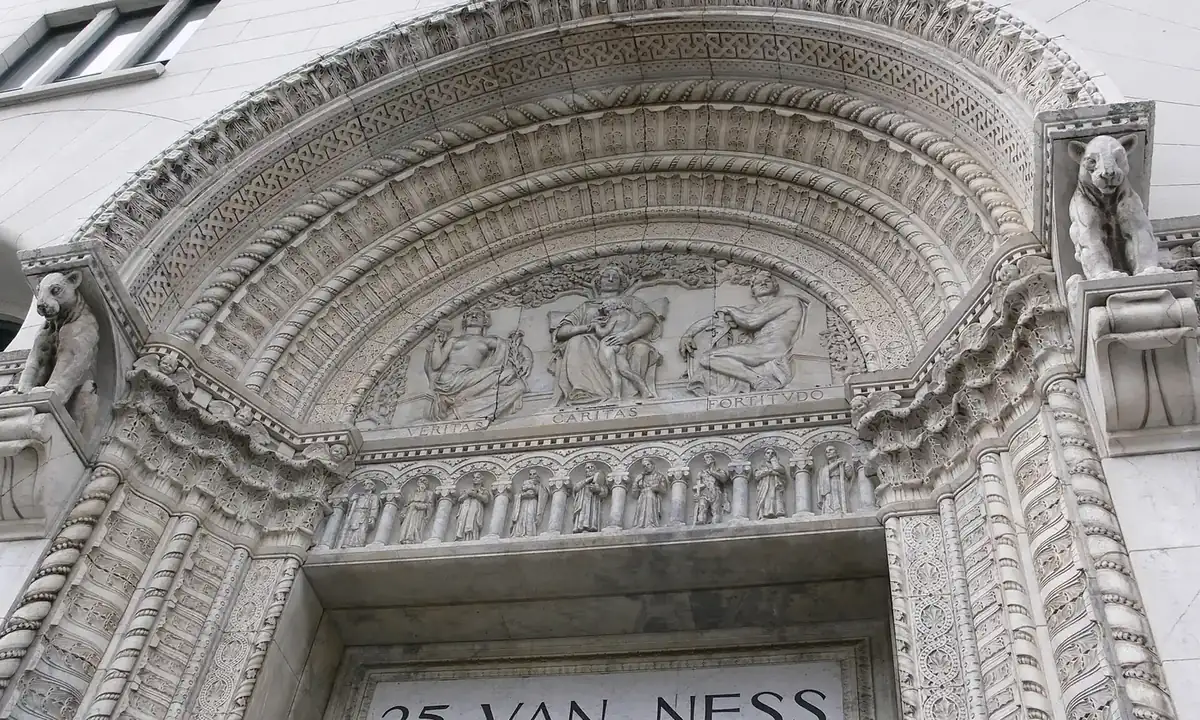
25 Van Ness Avenue, home of the Rent Board. The ten-day filing window for most notices starts on the service date written on our proof. Photo: Andreas Praefcke, CC BY 3.0, via Wikimedia Commons.
A San Francisco notice to serve
Upload the notice with Form 1007 and every attachment already stapled in, the unit as it appears on the lease, and the date your office needs the proof back for the Rent Board filing.
The address mix matters at the door — a Financial District high-rise office, a SoMa tech-employer address, a controlled-access apartment building, or a residential address each call for different intake details. The registered process server takes those details into the visit, identifies the recipient, and adds visit notes back to the account.
“Hands down ? the best attorney service out there!”
– Vernon C. Tucker, Esq.
“Highly recommended! By far the best company we have used. Very fast service of process. Website is easy to use and the people there know what they are doing.”
– Ashley B
“They are very reliable and prompt. I like the ease of using the service.”
– Jay Rahimi
Filing the proof at the Civic Center Courthouse
E-filing is the default for represented parties
San Francisco has required represented parties to file and serve electronically since December 8, 2014, under Local Rule 2.11, rule 2.253(b)(2) of the California Rules of Court and Code of Civil Procedure section 1010.6. Since January 4, 2021 that has covered new complaints in general civil cases too. Filings run through File & ServeXpress, the court’s e-filing manager since June 3, 2024, and any of its approved vendors can submit them. Self-represented parties are not bound by the mandate under rule 2.253.
Department 501 hears the eviction calendar
The Real Property Court, Department 501, takes unlawful detainer matters from settlement conferences to trial calls, and the court lists requests for posting and mailing among them. Its motions are heard at 9:30 a.m. on court days, and the moving party delivers courtesy copies to the department on the day of filing.
Default prove-ups on Wednesday and Friday mornings
After service, if no response comes in, the Default Unit handles the judgment paperwork, and prove-up hearings are heard in Department 505 on Wednesdays and Fridays at 9:00 a.m. A motion in an e-filed case goes in without a hearing date. The Note to Clerk field takes up to three preferred dates, 60 to 90 days out, and the clerk sets the hearing from calendar space.
Civil clerk’s office
Courthouse
Civic Center Courthouse
Address
400 McAllister St., Room 103, between Polk and Van Ness
The Civic Center Courthouse opens to the public from 8:15 a.m. to 5:00 p.m., but its filing rooms keep shorter hours. The Civil Division in Room 103 handles civil filings and records, small claims, appeals, probate, unlawful detainers, defaults, case management, dispute resolution, name changes and civil restraining orders. Family matters belong to the Unified Family Court, and the court lists Room 402 as the second filing room with the same morning hours.
Who to write to before a paper is walked in
The court’s civil clerks publish a separate inbox for each desk: [email protected] for new and later paper filings, [email protected] for e-filing questions, [email protected] for defaults and [email protected] for case management. When a filing is part of an order and something about it is unusual, the question goes to the right inbox first, so the trip to McAllister Street happens once.
Pulling a San Francisco file before you serve
Civil Records, also in Room 103, gives access to limited and unlimited civil, probate and family law files. The clerks offer case-search computers, file viewing, copies, certified copies and retrieval from off-site storage, and requests can be filed online through GovQA. Sealed and confidential files, and files in use by the court, are not available, and the records page asks people to wait 30 days before sending a second request on the same case.
The Hall of Justice is not where civil papers go
The Hall of Justice at 850 Bryant Street hears criminal and traffic cases, with the Criminal Division in Room 101, Traffic in Room 145 and Jury Services in Room 307, and the building is open from 8:30 a.m. to 4:00 p.m. A civil summons, a proof of service or an unlawful detainer filing has no counter there. When a client asks us to “take it to the courthouse,” the San Francisco answer for civil work is 400 McAllister Street.
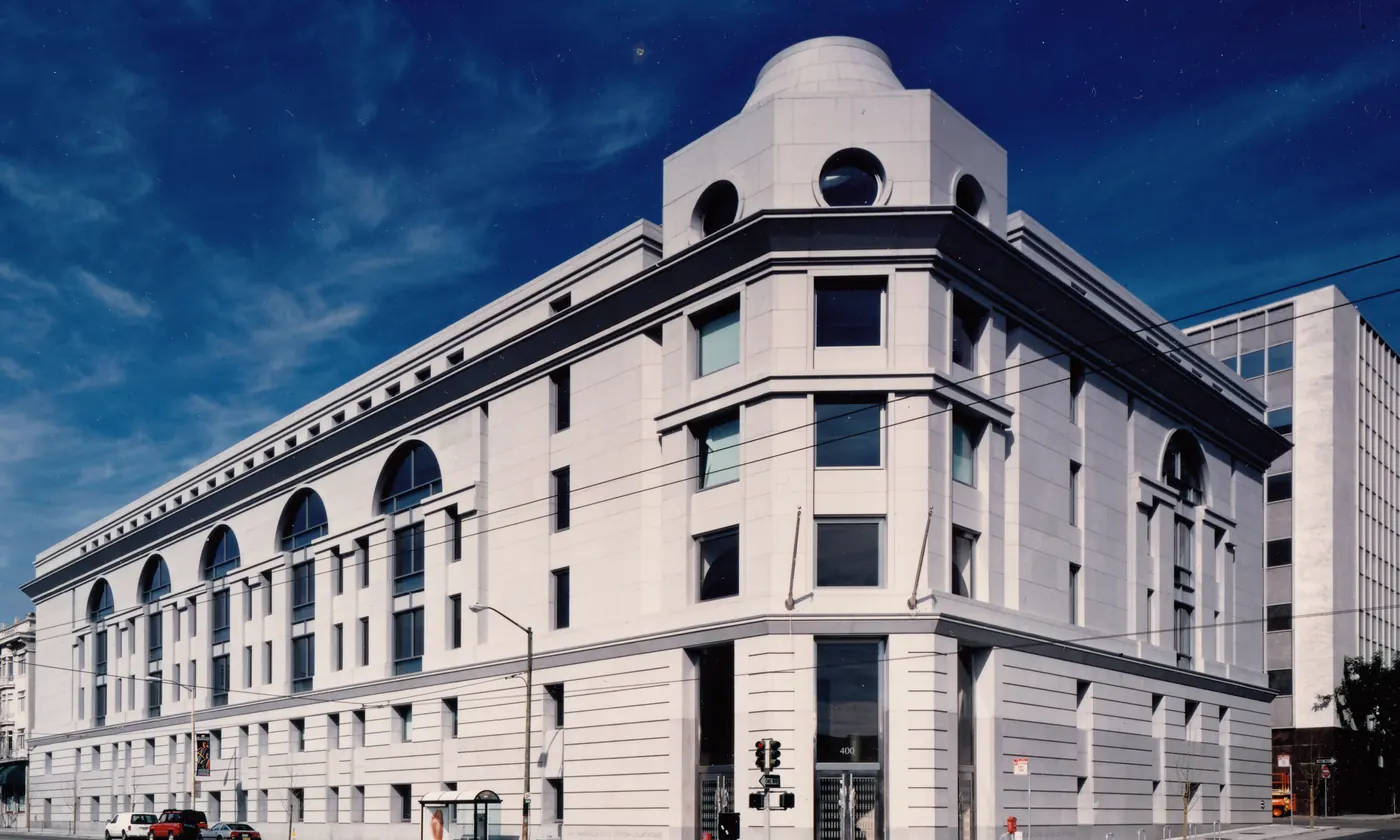
The Civic Center Courthouse at 400 McAllister Street. Proofs from San Francisco serves are e-filed for represented parties, and the Room 103 counter takes the paper filings that remain, such as the opening papers in an eviction. Photo: Cocoablini, CC BY-SA 4.0, via Wikimedia Commons.
The Department 501 calendar a San Francisco eviction moves through after service
Once the summons and complaint are served and the proof is on file, an unlawful detainer in San Francisco runs on the Real Property Court schedule in Department 501. The court posts that schedule in detail, and a few of its fixed days decide when papers, and sometimes witnesses, have to be ready.
Which morning a Department 501 application is heard
Most Real Property Court ex parte applications are heard at 9 a.m. on Monday, Wednesday, Thursday and Friday.
Tuesday at 10 a.m. is reserved for requests to stay execution in unlawful detainer cases, plus requests for orders shortening time on motions to vacate a judgment.
Requests for entry of judgment after a breached stipulation are heard Wednesday through Friday at 9 a.m. only.
A granted stay order goes from Department 501 to the Clerk’s Office in Room 103, where the defendant files it with the required rent deposit.
Settlement conferences are in person
Since July 1, 2024, pre-trial mandatory settlement conferences in unlawful detainer cases are set in person on Tuesday, Wednesday or Thursday afternoons in the week before trial call. A second conference happens on the day of trial assignment. Each party must send someone with full authority to settle without phoning anyone who is not in the room.
Trial call and the short call to a trial department
For cases that have not settled, trial counsel and the parties appear in person at trial call with trial briefs, motions in limine, witness and exhibit lists, and jury instructions for a jury trial. A case not sent to a trial department at trial call has to be ready for assignment on two hours’ telephone notice. Witnesses who will testify are usually subpoenaed well before then, and we serve those subpoenas with the trial date and department written on them so the witness knows which morning to keep free.
Checking in from the hallway
Department 501 joined the court’s Courtroom Check-In Application on June 16, 2025. Participants scan a QR code posted at the courthouse, or follow a link given in Zoom, instead of checking in with the clerk. The department generally breaks for lunch at noon and posts a notice outside the courtroom when a morning calendar runs over.
San Francisco filing problems that show up after the serve
Where a finished serve can still stall in San Francisco
The snag
What the court does
What On-Call Legal does
Taking an eviction proof to the counter
What the court doesOnly the opening complaint and summons in an unlawful detainer go in on paper. Since July 1, 2020, every later filing in the case, the proof of service included, has to be e-filed.
What On-Call Legal doesThe proof is prepared in the form the e-filing system takes, and filed electronically for you when filing is part of the order.
Arriving at Room 103 in the afternoon
What the court doesThe civil clerk’s counter is open from 8:30 a.m. to 12:30 p.m. on court days. From 12:30 to 4:00 p.m. paper filings go in the drop box instead.
What On-Call Legal doesPaper filings that are part of an order, such as opening eviction papers, are walked in during the morning counter hours or left in the drop box before 4:00 p.m.
Searching a sealed eviction file by street address alone
What the court doesLimited eviction records are restricted. Online access at ud.sftc.org needs the access code from the Notice to Defendants or the receipt, or a plaintiff, a defendant and the premises address with the unit number exactly as the complaint shows it.
What On-Call Legal doesThe proof records the unit served in the same form the complaint uses, so the case can be found the way the court indexes it.
Eviction papers for a San Francisco unit
Upload the summons and complaint with the order and say whether you want the proof e-filed for you or returned to file yourself.
When the papers belong with the Sheriff’s Civil Section in City Hall
Some San Francisco work belongs to the Sheriff’s Office by law. Its Civil Section works out of City Hall, Room 456, at 1 Dr. Carlton B. Goodlett Place, and describes itself as a full-service county office and a disinterested third party between the person requesting service and the person receiving it. Knowing where its job starts keeps a San Francisco file from stalling between our server and the deputies.
What the Civil Section handles that a registered process server does not
Enforcing a writ is the clearest line. A writ of possession after an unlawful detainer judgment goes to the Sheriff with instructions and fees, and the Civil Section then posts its own eviction notice on the property. Levies on property and wages also run through the Sheriff. Summonses, complaints, subpoenas and the other papers that start or move a case can be served by a registered process server instead.
How the Civil Section takes documents
Requests are accepted in person, by mail or electronically. The office asks for 48 to 72 hours to process documents once they are submitted.
Since January 1, 2026, documents sent electronically to the Civil Section carry a printing fee of $1.35 a page, on top of the service fee. Mailing or dropping off paper copies avoids the printing fee.
Payment has to arrive within five business days or the documents are not processed, and the office takes cash, a cashier’s check or a money order only.
Fees are prepaid before any attempt and are not refundable, according to the Sheriff’s fee schedule page.
The Civil Section states that it does not guarantee service or any requested timeline, and it mails proofs of service to the address on the instruction form.
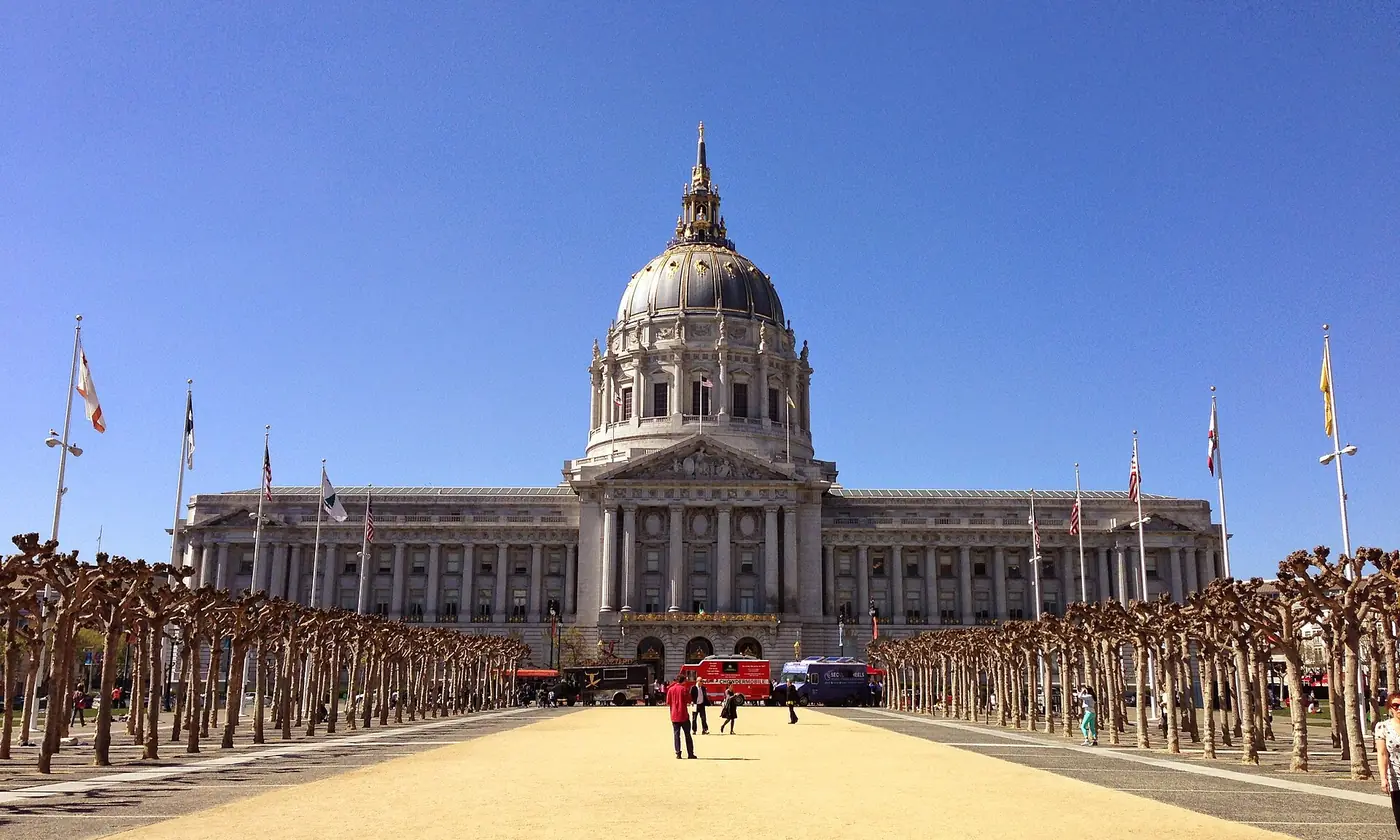
San Francisco City Hall. The Sheriff’s Civil Section in Room 456 takes writs of possession and levies, posts eviction notices and schedules lockouts, the steps that come after our server’s part of an unlawful detainer. Photo: Runner1928, CC BY-SA 4.0, via Wikimedia Commons.
The lockout itself
Once the Civil Section has the writ, instructions and fees, it posts the eviction notice at the property and then calls the agent listed in the instructions with the eviction date and time. The landlord or a representative must be present at that appointment. Tenants often change the locks, so the office asks for a working key or a signed Eviction Services Waiver and Release of Liability form before the scheduled date. Without either one, the deputies may not be able to complete the eviction.
How the two jobs fit together on one case
On a typical San Francisco unlawful detainer, our server handles the notice and, after the complaint is filed, the summons and complaint. The proof of the summons goes back to the court through e-filing. The writ that follows a judgment is the Sheriff’s part. Keeping the instruction form, the agent’s phone number and the key arrangements ready before judgment saves days at the end of the case.
Serving a San Francisco small claims case through the clerk, the Sheriff or a server
The San Francisco Superior Court gives small claims plaintiffs four ways to serve the claim, set out in its own information sheet, SFSCL-002. Each one has a different cost and a different failure point, and the sheet is specific about San Francisco practice.
Certified mail sent by the clerk
Certified mail service costs $15 per service and has to be sent by the Clerk’s Office; a party cannot mail it. The defendant does not have to sign for it. If nobody picks the letter up after the post office leaves a notice, it comes back to the clerk unserved. The court treats a green card signed by someone other than the defendant, or an unreadable signature, as a possible problem, and it suggests allowing at least 20 days before the hearing. Mail service on a P.O. box is described as impractical.
The San Francisco Sheriff, inside the city only
Sheriff service costs $50 per service, the same in every California county, and the plaintiff arranges it with the sheriff of the county where the defendant lives. The San Francisco Sheriff serves only inside the City and County of San Francisco. It sends the original proof to the court before the hearing and mails a copy to the plaintiff, and the court suggests allowing at least 20 days.
Substituted service runs on a longer clock in San Francisco
For substituted service, the sheet sets 25 calendar days before the court date for a defendant who lives in San Francisco and 30 days for one who lives outside the county. The person who serves fills in the proof with the name of the person who took the papers, their relationship to the defendant, the address, the date and the time, and a copy goes in the mail to the defendant.
A process server returns the original proof to the clerk
When a process server serves the claim, the court expects the original proof of service back at the Clerk’s Office before the court date and asks that the plaintiff be told the defendant was served. The clerk cannot recommend one server over another. Filing and service costs are not added to the amount of the claim; the judge decides on costs at the hearing, so the plaintiff should bring the receipts.
A small claims hearing already on the calendar
Tell us the hearing date when you order. If the substituted-service window is close, the order notes say so and attempts are scheduled to leave room for the mailing.
What “registered process server” means on a San Francisco proof
Firms searching for a registered process server in San Francisco usually want two things: a server the court will presume did what the proof says, and a registration they can check. The County Clerk explains that registration makes public the name of anyone who, for pay, serves process more than ten times in a calendar year in California.
Where a San Francisco registration is filed, and what it costs
For servers based in the city, the Clerk’s fee list shows process server registration at $141 plus $18 for recording the bond’s first page, with $18 for each additional ID card and $3 for each added page. Registrations run for two years, and the Clerk processes professional registrations from 8:00 a.m. to 2:00 p.m.
Who does not register
The Clerk lists four exemptions: a sheriff, marshal or government employee acting in the course of the job; an attorney or the attorney’s employees; a person a court specially appoints to serve its process; and a licensed private investigator or that investigator’s employees.
Where the registration shows up on the proof
Item 7 of the Judicial Council’s Proof of Service of Summons (POS-010) asks the server to check one box: not registered, exempt under Business and Professions Code section 22350(b), or registered. The third box carries two more blanks, for the number and the issuing county, and asks whether the server works as owner, employee or independent contractor.
Why the box matters in a contested case
Evidence Code section 647 gives the return of a process server registered under the Business and Professions Code a presumption affecting the burden of producing evidence, covering the facts stated in the return. When a defendant later moves to set aside a default on the ground that service never happened, a proof completed by a registered server shifts the first burden to that defendant.
Timing a San Francisco attempt around how the city lives, rents and parks
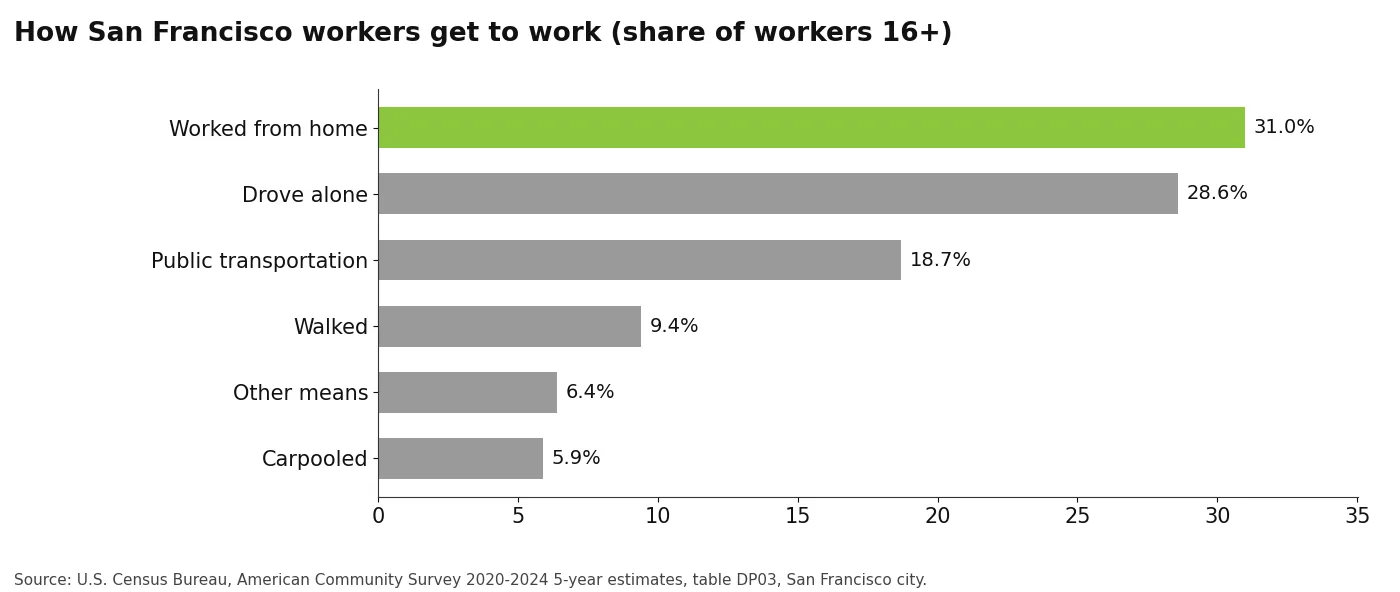
Two survey figures change how a first attempt in San Francisco should be planned. In the Census Bureau’s 2020-2024 estimates (table DP03), 31.0% of San Francisco workers worked from home, more than drove to work alone (28.6%). Another 18.7% took public transportation and 9.4% walked.
How San Francisco workers commute. More of them work from home than drive alone, which is why a weekday daytime visit to the residence is worth booking. Source: Census Bureau, ACS 2020-2024, table DP03.
A weekday daytime visit to the residence is a real first try
With close to a third of workers at home during the workday, a residential attempt on a weekday morning or early afternoon has a reasonable chance in San Francisco. For a recipient who works in an office, the order notes should give the employer address and any known schedule so the next attempt can go there.
Older buildings mean flats, shared doors and unit letters
In table DP04, 45.2% of the city’s housing units are in buildings put up in 1939 or earlier, and 20.1% sit in buildings of two to four units. Buildings of that size often share one street door, and units in them may go by letters or by “upper” and “lower” rather than numbers. Giving the unit exactly as it appears on the lease or the mailbox saves the server from guessing at the bells.
Transit-dependent recipients and the address of record
With 18.7% of workers on transit and 9.4% walking, many recipients keep regular hours at a fixed workplace. Listing the work address next to the home address at intake lets attempts move between the two without a new order.
Residential hotels and the front desk
Many San Francisco tenants live in residential hotels, where a desk stands between the street and the rooms. Those buildings run on the Rent Board’s Uniform Hotel Visitor Policy, amended March 30, 2010, and the desk rules it sets are the ones a server meets when asking for a tenant:
tenants may receive daytime visitors from 9:00 a.m. to 9:00 p.m., and management may cap that at two visitors per room at a time;
the hotel may ask a visitor for one current government-issued photo ID, but cannot make the visitor leave it at the desk;
management keeps a log, and visitors sign in and sign out;
the hotel may restrict visitors on two of the three check days each month, after posting the blackout dates by the entrance or in the lobby at least five days ahead;
the policy itself must be posted in the lobby on a sheet at least 11 by 17 inches.
For an order at a residential hotel, the notes should say so. Attempts are scheduled inside the 9-to-9 window and away from any posted blackout dates, the server carries photo ID for the log, and the desk exchange is written into the attempt notes, which matters if service later has to be proved another way.
Parking in the neighborhoods with the most meters
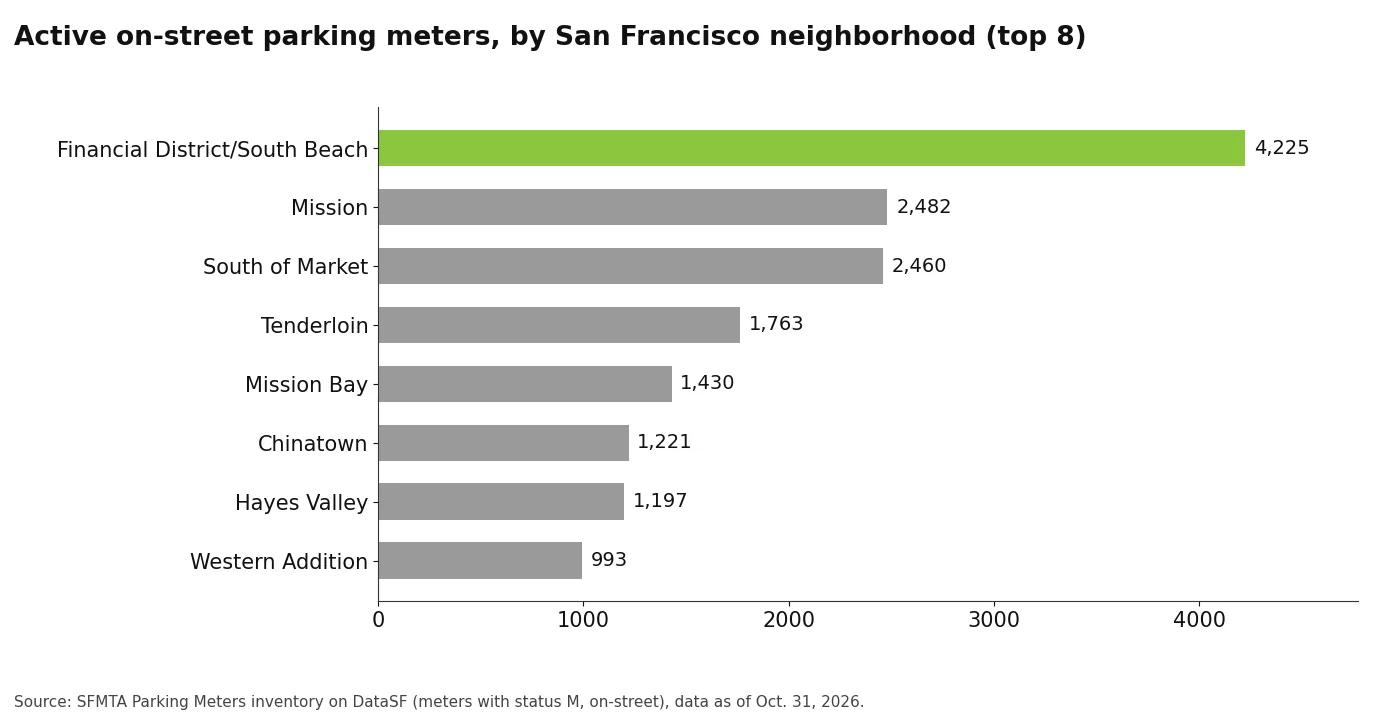
SFMTA’s meter inventory on DataSF lists 26,113 active on-street meters. They are packed into the same districts where much of the eviction and business work sits: 4,225 in Financial District/South Beach, about 2,500 each in the Mission and South of Market, and 1,763 in the Tenderloin.
Active on-street meters by neighborhood. The districts with the most meters overlap the ones with the most eviction notices, so a server’s car needs a legal space planned in advance there. Source: SFMTA meter inventory, DataSF.
According to SFMTA, most meters are enforced from 9 a.m. to 6 p.m. Monday through Saturday, and most carry a four-hour limit, with “feeding the meter” past the limit not allowed. Green meters allow only 15 or 30 minutes, and yellow and red meters are reserved for commercial loading, red for vehicles with six or more wheels. Meters can be prepaid from 4:30 a.m., and residential permits do not lift the rule that a parked car must move every 72 hours. A stakeout window in these districts is planned around a legal space for the whole window, not a quick stop at the curb.
Order a San Francisco serve online
What to have ready for a San Francisco order
Documents and recipient information go in at the start of the order.
The recipient’s full name, the address, and the unit exactly as written on the lease or mailbox.
Any other place the recipient can be found, such as an employer, with the hours they keep there.
For a notice under the Rent Ordinance, Form 1007 attached and the date your office needs the proof back.
For a small claims case, the hearing date.
Same-day handling can be requested when scheduling allows.
Pricing is itemized at intake. The standard serve is one line; rush, stakeout, address confirmation and proof filing each appear as their own lines when they are added.
A stakeout window can be added at order time when the recipient is hard to find at normal hours.
A pre-dispatch address check is available on request to confirm the data before the server goes out.
Filing of the proof of service can be added with the appropriate court.
Visit-by-visit updates appear on the order as the server works the address.
For an evasive recipient, attempt windows shift across days and times.
The signed proof of service is available in the account once the order is finalized.
Upload San Francisco documents
Please fill in the form below. A member of our team will contact you to finalize the order.
Serving and filing in San Francisco, the questions we get
Which San Francisco courthouse takes a civil filing?
Civil cases from San Francisco typically route through the San Francisco Superior Court. Specific courthouse routing depends on the case type and is confirmed at filing.
Can a server work the Financial District high-rises?
Yes. Financial District high-rises around Market Street and Montgomery Street are reachable during business hours. The same rules apply to serving someone at work anywhere in the city. Building name, suite or floor, and the recipient’s department at intake direct the server quickly through lobby reception.
How does service work at a SoMa or Mission tech employer?
SoMa and Mission Bay tech-employer addresses include private corporate campuses with reception or visitor procedures. Service at a private corporate campus may require additional coordination. Include the recipient’s department, employer, and any access details at intake.
How does service work at a SF apartment with controlled access?
Many SF apartment buildings have lobby concierges or buzzer-controlled access, which raises the question of when a recipient avoids the door. The server documents the entry process and uses authorized access where required. Unit numbers and intercom codes at intake help the attempt land.
Does the server need to speak the recipient’s language in San Francisco?
Language can affect communication during an attempt, but the server’s role is to identify the recipient and deliver the documents according to California service rules. Add any language or recipient-identification notes at order intake.
Can the San Francisco address be confirmed before a server goes?
Yes. Address verification can be added before the assignment goes out when the address is uncertain. The check covers public records, and the result is logged to the order.
Does it matter that San Francisco is a consolidated city and county?
Both at once. The City and County of San Francisco is one government, so there is a single Superior Court, a single County Clerk and a single Sheriff, with no separate city and county offices to choose between. An address that reads San Francisco is always inside that one county.
Where is the San Francisco Rent Board, and when can someone walk in?
The Rent Board is at 25 Van Ness Avenue, Suite 700. Drop-in service runs Monday through Friday from 9 a.m. to 4 p.m., except legal holidays, and phone counseling is at (415) 252-4600. Its office also has self-service kiosks with past decisions, petitions and buyout agreements.
Does a notice for non-payment of rent have to be filed with the Rent Board?
The Rent Board’s published requirements say the ten-day filing rule does not apply to evictions based on non-payment of rent. Notices on other grounds, with every attached document, are filed within ten days after service. The DataSF records still include 488 notices filed in 2025 with non-payment marked as a ground.
Can anyone look up eviction notices filed in San Francisco?
Yes, though not in full. DataSF publishes the Rent Board’s eviction notice records with the filing date, the grounds flagged and a block-level address rather than the full street number, so individual tenants are not named. Each record carries a yes-or-no flag for every ground, from non-payment and nuisance to lead remediation, the end of a Good Samaritan tenancy and development projects, which mirrors the ordinance’s list. The dataset is refreshed regularly; the copy we used was dated November 2, 2026.
What is the first-Tuesday night service on the court’s small claims sheet?
For small claims, the court’s information sheet says Sheriff service runs Monday through Friday from 8 a.m. to 5 p.m., with night service on the first Tuesday of the month. A registered process server sets attempt times by the order, including evenings and weekends when the notes call for them.
Can the San Francisco ACCESS Center help a law firm with a filing?
No. The court’s ACCESS (Legal Self-Help) Center in Room 509 at 400 McAllister Street helps self-represented parties with San Francisco cases. It states that it cannot assist or answer questions for third parties, including attorneys, law firms, document preparers and paralegal services, and that conversations with it are not confidential. For an attorney referral, it points people to the Bar Association of San Francisco’s Lawyer Referral Service at (415) 989-1616.
Which days in late 2026 is the San Francisco court closed?
The court lists November 11, November 26, November 27 and December 25, 2026 as court holidays in that stretch. Those days do not count as court days, so a deadline counted in court days, or a filing planned for the Room 103 counter, moves past them.
Can the public watch a Department 501 hearing?
Yes. Since March 1, 2021, the Real Property Court has held hearings by videoconference, and the public can view or listen through the Zoom webinar link the court posts, or by telephone with the meeting ID on its page. The court publishes the hearing notice in Chinese, Tagalog, Russian, Spanish and Vietnamese as well as English.
Do San Francisco parking meters run on Sundays?
Only in some places. SFMTA lists Sunday meter operation at Fisherman’s Wharf, on The Embarcadero, at nine off-street lots, and near Oracle Park and Chase Center during special events, when event rates apply. Meters run every day of the year except Thanksgiving, Christmas and New Year’s Day, but most are enforced only Monday through Saturday.
Can a residential hotel charge a fee to visit a tenant?
No. The Uniform Hotel Visitor Policy says no operator, employee or agent of a residential hotel may impose or collect a charge for anyone to visit a guest or occupant. A hotel that breaks the policy can face a petition at the Rent Board for a rent reduction, and an operator who violates it can be cited for an infraction carrying a $50 to $500 fine under Police Code section 919.1(b).
How do I reach the San Francisco small claims clerks?
The Civil Clerk’s Office lists a court supervisor line for small claims at (415) 551-5795 and the inbox [email protected]. Small claims papers are filed in Room 103 at 400 McAllister Street during the morning counter hours, with the drop box open in the afternoon.
Further reading on San Francisco serves
A few process serving questions come up often on San Francisco assignments — high-rise, secured-building, and evasive-recipient serves alike. These guides help:
I had an exceptional experience with On-Call Legal Process Servers. They were incredibly reliable and efficient, especially when I needed rush service over the weekend. Their website was very user-friendly, providing clear fee information, and their outstanding customer service further boosted my confidence in their services, which made them an easy choice out of the many process server companies I looked into. Thanks to their prompt delivery, the served party contacted me shortly afterward to settle the case. Given their extensive coverage beyond Los Angeles, I plan to use them again soon for a small claims case in Riverside County.
THOMAS DAVID
★★★★★
2 years ago
I had to file a Writ of Review with the California Court of Appeal. I contact several services for assistances most were not interested and others didn't provide the services I needed. I called On-Call Legal Process Servers and spoke to one of their staff. The staff member gave me a list of services they provide everything from a small claims court, to Court of Appeal to the Supreme Court. They will assist you in the filing all court documents and proof of service. To get start with On-Call Legal Process Servers and more an account has to be opened online. Before charges can be posted to the account an Email is sent out listing the proposed charges. The staff returns Email questions and orders during their normal business hours during the same day. On-Call Legal Process Servers file the writ for me and obtain the filing court's case number.
DR. Guita Balakhane
★★★★★
3 years ago
I was fortunate enough to be introduced to On-Call Legal through a family friend for services of process. Not only were the owners Brandon & David incredibly kind, but their process servers were professional, fast and affordable. I would use them again and would recommend them to anyone.
Denise altobelli
★★★★★
3 years ago
On-Call was absolutely AMAZING! Our trial team at Brown Goldstein & Levy flew into LA for a USDC trial from Baltimore. From first contact, On-Call was professional, prompt & handled everything we threw at them from exhibit binders for the Court and parties, to delivery to Court to meet our 8:30 am filing deadline! David A & his team handled everything! Looking forward to working with them again!
We use cookies to run this site, measure traffic, and serve relevant ads. Choose which categories you allow. You can change this any time. See our Privacy Policy.
Cookie preferences
Choose which cookies you allow. You can change these at any time from the "Cookie preferences" link in the footer.
Strictly Necessary
Required for the site to function (session, security, form submissions). Cannot be disabled.
Always on
Analytics
Help us understand how the site is used (e.g., Google Analytics). Aggregated, no individual identification.
Marketing
Used to measure ad effectiveness and show you relevant ads on other sites (e.g., Google Ads, Meta Pixel).
Functional
Enable enhanced features like live chat and remembering preferences.