
How Much Does A Process Server Cost in California?
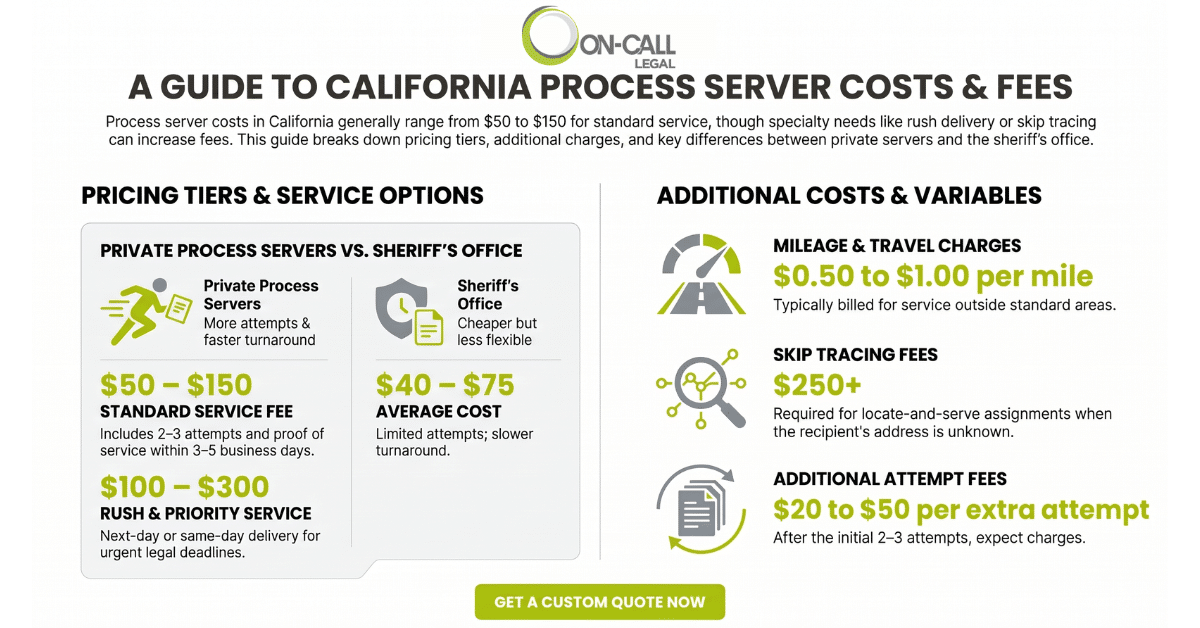
The cost of hiring a process server in California for legal document services typically ranges from about $40 to $200 per service, with most standard services falling between $50 and $150. Rush service, multiple attempts, mileage outside the server’s standard area, after-hours work, and skip tracing for hard-to-find recipients can each add to the process cost. Where a case sits within that range when serving legal documents depends on the urgency, the type of documents, the difficulty of locating the recipient, and the county where the case is filed.
On-Call Legal Process Servers has over 15 years of experience handling service of process for attorneys, law firms, businesses, and individuals across California and nationwide. Every server we dispatch is registered, bonded, and trained on the local rules of the court where the case is filed, with transparent pricing and itemized invoices so there are no surprises. Contact us to discuss your service needs.
This article walks through what a process server typically costs in California, what affects the fees, how to read an itemized invoice, hidden costs to watch for, and how to choose the right server for the job.
Typical Process Server Costs in California
Most process-serving work in California falls into three pricing tiers. Standard service, the most common request, generally runs between $50 and $150 per service for routine documents delivered within three to five business days. Priority service, completed by the next business day, sits slightly higher. Same-day or on-demand service costs more because the server has to drop other work to complete the attempt within a tight window.
Additional charges on the base fee include mileage outside the server’s area, extra attempts beyond two or three, rush fees, after-hours and weekend service, and skip tracing for unlocatable recipients. Cost variations are driven by several factors:
- Location: Service rates vary slightly across Los Angeles, San Diego, San Francisco, San Bernardino, Riverside County, Palm Springs, Indian Wells, and Thousand Palms due to differences in the cost of doing business throughout the state.
- Type of documents: Summons and complaints are typically the simplest to serve. Subpoenas, eviction notices, and temporary restraining orders often require expedited delivery and tighter compliance with strict legal deadlines, and they may carry different rates than standard process orders.
- Urgency: A case with a hearing two weeks out is priced differently from a case with a hearing tomorrow.
Private process servers and the sheriff’s office both serve papers in California, and the pricing differs. Sheriff’s office service is generally cheaper as a base fee (often $40 to $75), but availability, scheduling flexibility, and the number of attempts are limited compared to a private server. Private process servers tend to cost more for the base fee but provide more attempts, faster turnarounds, real-time updates by phone or email notifications, and skip-tracing when needed.
What Affects Process Server Fees in California?
Five variables drive most of the price differences you will see from quote to quote, and process server fees can vary based on each one.
Geographic factors come first. Serving papers in dense urban markets such as Los Angeles, San Diego, and San Francisco involves higher operational costs and traffic delays, which are reflected in the fee. Rural areas can actually cost more per service when the distance the server has to cover is significant.
Service complexity matters next. Hard-to-find individuals, those who deliberately avoid service, or recipients at gated or restricted-access locations all increase the difficulty and time required. The number of attempts a process server makes often tracks directly with how hard the case is. The first attempt at the recipient’s listed address is usually the cheapest; later attempts add up.
The number of attempts and retries required directly affects pricing. Most process servers include two to three service attempts in the base fee. Beyond that, per-attempt charges typically run $20 to $50 each. Documenting each attempt with date, time, and observations is what supports the diligence requirement that makes substitute service available later if personal service eventually fails.
Legal restrictions and the types of documents also drive costs. Some documents, including certain family-law papers, protective orders, and other court documents subject to special handling, require personal service and cannot be completed through alternatives like substitute service or mail. Those documents tend to cost more because they cannot be wrapped up by simpler methods, and the server has to ensure compliance with the local court’s rules.
Premium or specialty services round out the list. Expedited or certified process serving, weekend or holiday service, skip tracing, and out-of-state coordination all carry an additional fee or additional charge. Premium service levels buy you faster turnarounds, real-time updates, and a process server who is on the assignment full-time rather than in rotation.
How to Choose the Right Process Server in California

The cheapest quote is not always the best value. The wrong server can produce defective service that gets challenged in court, which costs far more than the initial fee in re-service, motion practice, and case delays. The factors that distinguish a reliable server from a risky one include:
Registration and licensing.
California law requires anyone who serves more than 10 papers per year to register and post a $2,000 bond in the county where they operate, as mandated by the California Process Server Act (Business and Professions Code §§ 22350-22360). Always confirm that the server is registered. Working with a certified process server ensures the service meets state requirements.
Difference between certified and non-certified servers.
Certified or registered process servers have met the state’s qualification standards and can be looked up in the county clerk’s office or state registry. Non-certified servers can still legally serve papers in California if they meet the basic eligibility requirements (over 18, not a party), but they carry no third-party verification of professionalism, training, or background.
Professional services vs. sheriff’s office.
The sheriff is usually cheaper but slower, with limited attempts and inflexible scheduling. California sheriff’s offices charge a base civil process service fee set by California Government Code §26721 et seq. Most counties charge $40 for the first attempt, with additional fees for subsequent attempts. Furthermore, fees can be waived under California Code of Civil Procedure §68631 for filers granted a fee waiver.
Professional servers cost more but provide better attempt coverage, faster turnaround, evening and weekend availability, and direct communication. For high-volume or multi-jurisdiction work, a professional process-serving firm is usually the right call.
Credentials and reputation.
Look up the server’s business online. Check reviews, complaints with the Better Business Bureau, and any disciplinary records with the county clerk. A reputable firm has a verifiable address, working phone, public reviews, and references from law firms.
Pricing and quality correlation.
A $40 service quote that does not include mileage, multiple attempts, or proof of service filing usually balloons past a more honest $100 quote that includes all of those upfront. Ask for an itemized breakdown before you book.
Additional Fees and Hidden Costs to Watch For

The cost discussion does not end at the base fee. Several optional add-ons or situational charges can substantially raise the final invoice if they were not disclosed upfront.
- Skip tracing: When the recipient cannot be located at the listed address, skip tracing services typically add $250 to $500, with harder searches billed hourly at $95 to $200 per hour and totals starting around $1,500.
- Mileage fees: Mileage outside the server’s standard service area is typically billed at $0.50 to $1.00 per mile. A 100-mile round trip can add $50 to $100; a 500-mile round trip can add $250 to $500.
- After-hours, weekend, and holiday service: Service performed outside normal business hours often starts at around $60 per attempt and can run higher depending on the day and time.
- Notarization fees: California notarization fees for proof of service are typically around $15. Some servers include this in the base fee; others itemize it.
- Court filing fees: When the server files the completed proof of service with the court, there may be an additional charge of $20 to $75, depending on the case and whether a court appearance is required.
- Translation services: Documents that need to be translated for the recipient can add $50 to $150, depending on length.
- Legal research: If the server has to verify the proper procedure for an unusual document type or jurisdiction, $75 to $200 can be added.
The simplest way to avoid surprises is to ask for an upfront, itemized written quote that lists the base fee, the number of attempts included, all anticipated add-ons, and the billing rates for any services beyond the standard scope. Reputable firms provide this without hesitation. For multi-jurisdiction or large-volume work, process service dispatch consolidates billing across markets so the total cost is visible from the start.
Process Server Costs
The cost discussion gets more useful when broken down by category. The sections below cover the three biggest pricing buckets
Standard Fees vs Rush Service Fees
Standard service in California typically falls in the $50 to $150 range and is completed within three to five business days. The fee covers the initial attempt to serve the documents, two to three attempts total in most cases, and the completed proof of service form.
Rush service is anything faster than standard. Priority service runs roughly $100 to $200 and is completed by the next business day. Same-day service typically runs $150 to $300. On-demand service, where the server begins the assignment within two hours of the request, costs more again. Rush service fees typically add $50 to $140 on top of the standard rate.
When timing actually matters in your case, for example, where a deadline for service is approaching, where a hearing is imminent, or where the urgency comes from a court order, the rush fee is almost always worth it.
Mileage and Travel Charges Explained
According to the Internal Revenue Service, the 2025 standard business mileage rate is $0.70 per mile, up from $0.67 in 2024. California process servers commonly use this as the floor for their mileage charges, with most billing at $0.50 to $1.00 per mile.
Mileage is one of the most common add-ons. Most servers operate within a defined service area and bill for travel beyond it. Typical rates run $0.50 to $1.00 per mile. The math:
– 25-mile round trip: roughly $12 to $25 in mileage
– 100-mile round trip: roughly $50 to $100 in mileage
– 500-mile round trip: roughly $250 to $500 in mileage
For service in a remote location, an out-of-county address, or a Riverside County or Palm Springs property when the server is based in Los Angeles, the mileage can be substantial. Hiring a server based in the same county as the address is the easiest way to avoid these charges. Local process servers know the area, know the courts, and can complete the job more efficiently than a server traveling in from elsewhere.
Handling Complex or Difficult Service Requests
Some service requests are simply harder than others. Hard-to-locate recipients, gated communities, restricted commercial buildings, recipients in temporary residences, and recipients who are deliberately avoiding service all increase the time and skill required to complete the job. Harder cases often involve:
– Multiple addresses (home, business, second residence)
– Skip tracing to identify a current address
– Multiple attempts at different times of day
– Coordination with security or building management at restricted locations
– Out-of-state or international service
For high-difficulty service, hourly billing is common. Most professional process servers will quote a flat fee for the first set of attempts plus an hourly rate beyond that, with a not-to-exceed cap so the client can budget. Ask about that structure when the case is harder than routine.
Typical Process Server Fees in California by Service Type
The table below summarizes the cost ranges by service type and the notes that come with each.
| Service Type | Average Cost Range | Notes / Additional Fees |
|---|---|---|
| Standard Service | $50 – $150 | Routine; 3–5 business days; includes 2–3 attempts; mileage beyond standard area billed extra |
| Rush Service | $100 – $300 | Priority next-day or same-day; rush surcharge $50–$140 over standard |
| Certified Service | $75 – $200 | Registered, bonded California server; includes verified proof of service form |
| Sheriff Service | $40 – $75 | Cheapest base fee; limited attempts and scheduling flexibility; fee waivers available |
| Out-of-State Service | $100 – $300+ | Coordination across jurisdictions; mileage and partner-server fees often apply |
Ways to Mitigate the Cost of a Process Server

Several strategies can keep the cost down without sacrificing the quality of service:
- Bundle services. If multiple recipients need service, ask for a bundle discount. Most process servers will reduce the per-service rate for a batch.
- Hire a local server. A server based in the same county as the address avoids most of the mileage charges. Local servers also know the courts and the area.
- Explore alternative methods of service. Where electronic service or service by mail is legally allowed, those methods can be cheaper than personal service. Ensure the method is appropriate for the document type.
- Provide multiple addresses. A workplace, second residence, or alternate daytime address gives the server options and reduces failed attempts. Skip tracing fees often arise because the listed address was stale; providing accurate addresses upfront helps avoid them.
- Obtain multiple quotes. Pricing varies significantly across providers. Obtain quotes from two or three reputable, licensed process servers and ask for an itemized breakdown. Negotiate where appropriate.
- Plan. Last-minute rush service is more expensive than service ordered with a normal lead time. Where the case schedule allows, build in days, not hours.
- Conduct a pre-service investigation. Confirm the recipient is at the address before the server attempts service. A few minutes of verification can save a $50 attempt fee.
What Is the Process of Hiring a Professional Process Server?
Hiring a professional process server is a straightforward process when broken into steps. Here’s a framework we recommend at OnCall Legal Process Servers.
Step 1: Find the Right Professional.
Search for registered, bonded California process servers in your area. Compare qualifications, experience, and pricing. Many directories offer filters by location, expertise, and customer reviews.
Step 2: Initiate Contact.
Reach out to discuss your specific needs: deadlines, document types, recipient information, and any special circumstances. This conversation confirms the server can handle the job effectively. It is also an opportunity to ask about skip tracing, multiple attempts, after-hours service, and rush options.
Step 3: Get an itemized written quote.
Ask for a written quote that lists the base fee, included attempts, mileage policy, rush fees, and any other anticipated charges. Compare it against quotes from other reputable providers.
Step 4: Confirm the Appointment.
Once you have selected a server, schedule the service appointment. Many process servers operate through online platforms where you can schedule and track service in real time. Some require a deposit; others bill after successful delivery.
Step 5: Provide the Documents and Recipient Information.
Send the documents via email or deliver them in person, including the recipient’s name, all relevant addresses (home, work, and any alternatives), a physical description if available, and their known schedule.
Step 6: Track the service through completion.
A good professional process server provides real-time updates by phone, text, or email notifications on each attempt. The completed proof of service is filed with the court, and a copy is returned to you.
Need Reliable Service?
The cheapest process server quote is not always the best value. Defective or incomplete service can lead to motions to quash, case delays, and the need to re-serve, each of which costs far more than the original fee. Working with a registered, professional process server who provides transparent itemized pricing and follows the California Code of Civil Procedure to the letter is the simplest way to make sure your court documents are served the first time correctly.
OnCall Legal Process Servers works with a nationwide network of experienced process servers and registered process servers, every one of them trained on the procedural rules of the jurisdiction they serve in. Over the past 15 years, our team has supported attorneys, businesses, and individuals through court filings, substituted service, skip traces, and personal service across every county in California. Schedule a free consultation with us today for an itemized quote on your next service of process.
Frequently Asked Questions
OnCall Legal has spent years coordinating service of process across California, and the questions below come up most often from clients comparing prices and trying to budget for service. Our experience and expertise with the cost structure of process serving statewide is what allows us to give straight, accurate answers.
How Much Does a Process Server Cost for a Simple Service?
A simple service in California typically runs $50 to $150. Standard service includes the initial attempt, two to three total attempts, the completed proof of service form, and mileage within the server’s standard area. Out-of-area service, rush turnaround, or skip tracing can each add to that figure.
Are There Cheaper Alternatives to Process Servers in California?
The sheriff’s office is the main cheaper alternative, typically charging $40 to $75 for base service. The trade-off is fewer attempts, less scheduling flexibility, and slower turnaround. Service by mail with a Notice and Acknowledgment of Receipt under California Code of Civil Procedure §415.30 is another low-cost option for some documents, but it only works if the recipient signs and returns the form voluntarily.
Does the Sheriff Charge More Than Private Servers?
No, the opposite is usually true. The sheriff is generally cheaper as a base fee, but private process servers typically provide more attempts, faster turnaround, evening and weekend availability, and direct communication. For routine documents on a relaxed timeline, the sheriff can be a good fit. For rush, complex, or multi-jurisdiction work, a private server is usually the right call.
How Many Attempts Are Included in the Cost?
Most process servers include two to three attempts in the base fee. Beyond that, additional attempts typically cost $20 to $50 each. Servers document every attempt with date, time, location, and observations to support the diligence requirement for substitute service if personal service eventually fails.
Can Fees Vary by County in California?
Yes. Pricing for service can vary slightly in Los Angeles, San Diego, San Francisco, San Bernardino, Riverside County, Palm Springs, Indian Wells, and Thousand Palms due to differences in the cost of doing business and the local market.
Legal Disclaimer
This article is general information about process server costs in California and is not legal advice. Pricing varies by provider, county, and case specifics, and the right approach depends on your case. For advice on a specific service, consult a licensed attorney or call a registered process server for a quote.



On-demand legal services with arranging services from eFiling to organizing and preparing your subpoena for records and/or personal appearance and much more.