
I had an exceptional experience with On-Call Legal Process Servers. They were incredibly reliable and efficient, especially when I needed rush service over the weekend. Their website was very user-friendly, providing clear fee information, and their outstanding customer service further boosted my confidence in their services, which made them an easy choice out of the many process server companies I looked into. Thanks to their prompt delivery, the served party contacted me shortly afterward to settle the case. Given their extensive coverage beyond Los Angeles, I plan to use them again soon for a small claims case in Riverside County.
Santa Cruz service of process and court filing
Process Server Santa Cruz, CA
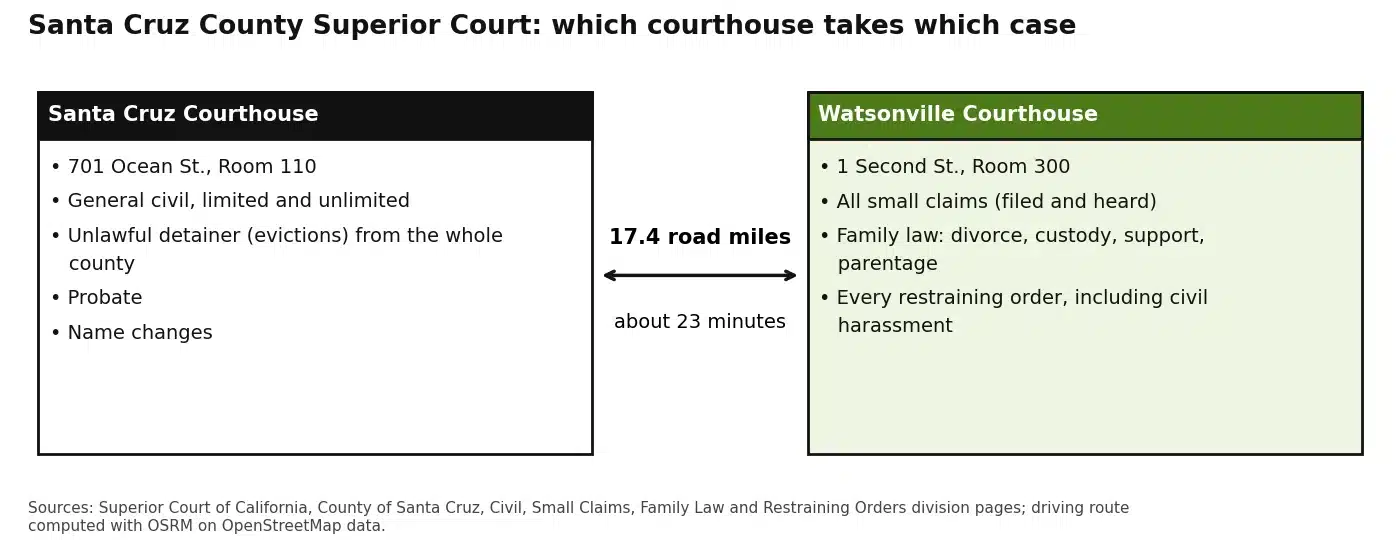
For firms with papers to serve in Santa Cruz: civil, eviction and probate cases are filed at 701 Ocean Street, while small claims, family law and every restraining order go to the county’s courthouse in Watsonville.
Santa Cruz process serving, the short version
Quick answer
A Santa Cruz matter is filed with the Santa Cruz County Superior Court. We serve summonses, subpoenas and eviction papers across the city, including addresses along Pacific Avenue and Water Street. What the server saw at each visit is written up and filed with the proof.
In Santa Cruz a serve can lead to a Pacific Avenue office, the wharf or the Small Craft Harbor, the Boardwalk, UC Santa Cruz or a house on a residential street, and the case type decides whether the proof is filed at 701 Ocean Street or in Watsonville. Process serving orders are placed through your account; the order is reviewed at intake and routed to a registered process server.
Santa Cruz filing and service facts on one screen
A Santa Cruz address does not tell you which courthouse the case belongs to. The case type does. The rows below are the ones that change how we plan a serve or a filing for this city, each with its source.
| Figure | What it means for a serve or filing | Source |
|---|---|---|
| 701 Ocean St., Room 110 | What it means for a serve or filingCivil clerk in Santa Cruz: general civil, unlawful detainer, probate and name changes are filed here. | SourceCivil Division |
| 1 Second St., Room 300 | What it means for a serve or filingWatsonville clerk: all small claims, all restraining orders and family law cases for the whole county. | SourceSmall Claims, Family Law |
| 17.4 miles | What it means for a serve or filingRoad distance between the two courthouses, about 23 minutes. A Santa Cruz party in a family or small claims case travels to Watsonville. | SourceOSRM route on OpenStreetMap |
| Rule 1.3.01 | What it means for a serve or filingAttorneys must e-file in civil, family and probate cases through the court’s e-filing providers; self-represented parties may still file on paper. | SourceLocal Rules, July 1, 2026 |
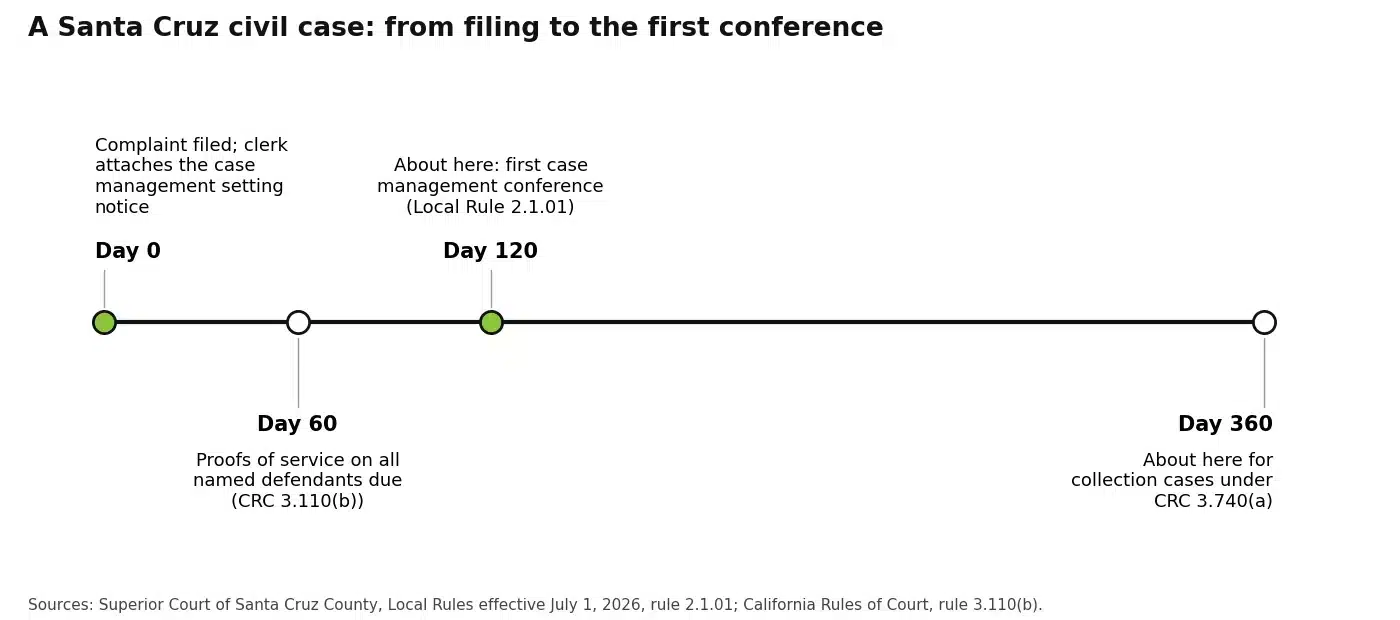
| ~120 days | What it means for a serve or filingRoughly how long a new Santa Cruz civil case runs before its first case management conference; collection cases wait about 360 days. Notice of that date is the plaintiff’s to serve. | SourceLocal Rule 2.1.01 |
| $180 | What it means for a serve or filingSheriff’s deposit to carry out an eviction after judgment: $105 to post, $75 for the notice of restoration. | SourceSheriff fee schedule 2024 |
| $60 | What it means for a serve or filingWhat UC Santa Cruz wants enclosed when a records subpoena is delivered to the campus. | SourceUCSC Information Practices |
Ocean Street or Watsonville, depending on the kind of case
The Superior Court of Santa Cruz County runs two courthouses, and it splits the work between them by case type rather than by where the parties live. The court’s locations page lists the Santa Cruz Courthouse at 701 Ocean Street, (831) 420-2200, and the Watsonville Courthouse at 1 Second Street, (831) 786-7200. Both clerk’s offices are open from 8 a.m. to 3 p.m. For a firm in Los Angeles or Sacramento, the practical point is that a defendant who lives three blocks from Ocean Street may still have to answer a case heard 17 miles south.

What stays in the city
The Civil Division page says the Civil Division in Santa Cruz, at the Santa Cruz Courthouse, “processes all civil matters, including general civil, name change applications, probate and unlawful detainer cases.” Limited and unlimited civil cases, evictions from anywhere in the county and probate petitions all open in Room 110. That is also where the civil clerk takes paper filings, with the mailing address 701 Ocean Street, Room 110, Santa Cruz, CA 95060.
What goes to Watsonville
Three groups of cases leave the city:
- Small claims. The court states that “all Small Claims cases in Santa Cruz County are filed and heard at the Watsonville Courthouse” (Small Claims Division).
- Family law. Divorce, parentage, custody, support, adoptions and emancipations are handled by the Family Law Division at the Watsonville Courthouse (Family Law Division).
- Restraining orders of every kind (Restraining Orders).
A restraining order brought to the wrong counter
If the first request for a restraining order is handed in at Room 110 in Santa Cruz, the clerk scans it to Watsonville. After that, nothing else in the case can be filed in Santa Cruz: modifications, responses and proofs of service all go to 1 Second Street, Room 300. A court runner who files a proof of service for a restraining order at Ocean Street has made a wasted trip.
Phones close before the counters do
Both courthouses answer phones only from 8 a.m. to 1 p.m., Monday to Friday, while the counters stay open until 3 p.m. Questions that need a clerk on the line have to be asked in the morning. For written questions the court publishes division mailboxes, such as [email protected] and [email protected], and warns that an email does not move a deadline.
Parking for a counter filing at Ocean Street
The county lot at the Santa Cruz Courthouse uses ParkMobile from 8 a.m. to 3 p.m. on weekdays. Starting a session gives one or two free hours; after that parking costs $2 an hour up to $10, and it is free after 3 p.m. Cash payers go to General Services on the third floor, Room 330. We note this because a filing that needs a wait at the counter can outlast the free session.
E-filing in Santa Cruz County and the proof of service
Lawyers filing in Santa Cruz County do it electronically. Local Rule 1.3.01 says electronic filing “is required for civil, family, probate, LPS, appellate, criminal (subsequent filings only), juvenile justice (subsequent filings only), and dependency case types,” and that it runs through the court’s electronic filing service providers. The court points filers to the provider list for Odyssey eFileCA.
Who may still file on paper
The same rule lists the exceptions:
- anything a party without a lawyer brings to the counter, since the mandate does not reach them;
- papers a judge has released from the rule after an ex parte application citing hardship, prejudice or other good cause;
- documents lodged provisionally under seal under rule 2.551;
- original documents, subpoenaed documents, criminal bail bonds, and wills and codicils.
Documents with jurisdictional deadlines, such as a notice of appeal or a motion to quash service for lack of personal jurisdiction, are also outside the mandate, though the court encourages e-filing them.
After the submission
The court’s e-filing page describes two emails: one confirming the court received the submission, then, after a clerk reviews it, a second accepting or rejecting it. The acceptance email carries a link to the file-stamped copy. Our servers deliver that conformed version. When a firm uploads a summons that has been submitted but not yet accepted, the order waits for the stamped copy, so the defendant receives the papers as the court filed them.
Proposed orders and multi-case filings
A proposed order goes in as its own PDF. The court says the EFS-020 cover sheet is not required, and if it is used it must be a separate file, not combined with the order. A single document meant for several cases has to be e-filed into each case; the clerk will not copy it across.
Small claims start in Guide & File, then move to a provider
A small claims case can be opened online through Odyssey Guide & File. Anything filed after that, including the proof of service, has to go through one of the listed e-filing providers; the Guide & File login works with them, so no new registration is needed.
Filing the proof for you
When filing is added to a Santa Cruz order, we e-file the signed proof of service in the case and send the accepted, file-stamped copy back to your account. For a restraining order or a family case, the proof goes into that case’s file under its own case number, and the Watsonville clerk reviews it.
Papers the Santa Cruz court expects to travel with a summons
The clerk adds a page of its own to every Santa Cruz civil filing. Local Rule 2.1.01 has the clerk append a document titled “Case Management Program Information and Setting,” which states the date, time and place of the first case management conference, and it makes the filing party responsible “to serve all other parties with notice of the case management conference date.”

The conference date sets the pace
Under the local rule the conference lands roughly four months into the case. Collection cases, as defined in California Rules of Court rule 3.740(a), are set about 360 days out. A statewide deadline sits inside that window: rule 3.110(b) gives the plaintiff 60 days from filing to serve every named defendant and file the proofs, or 30 days for a defendant added by amendment. In a Santa Cruz case that leaves roughly two months between the proof deadline and the conference, and a defendant who still has not been served is likely to be the first thing the judge asks about.
The ADR packet on a cross-complaint
Rule 2.1.02 adds a step for cross-complaints: the cross-complainant must serve every cross-defendant with a copy of the initial “Alternative Dispute Resolution Information Packet” and with notice of any pending case management conference. When a firm sends us a cross-complaint for a Santa Cruz case, the order should include that packet.
What we check before the first attempt
- The summons carries the court’s stamp and the case number.
- The case management setting notice is in the set, with its date.
- On a cross-complaint, the ADR information packet is attached.
- The caption names the right location for that kind of case.
Missing pages are raised with you before dispatch. Serving an incomplete set and then serving the missing pages later produces two proofs and a gap the defendant can point to.
Continuing the conference when a defendant is still unserved
Rule 2.1.03 lets the parties, or the plaintiff alone if no defendant has appeared, apply to continue the conference on local form SUPCV 1014, with a declaration showing good cause, no later than ten calendar days before the conference. Only one such continuance is allowed per case, and it cannot push the conference back more than two months. Our attempt log, with dates, times and what the server saw at each visit, is material a firm can draw on for that declaration.
Eviction papers for Santa Cruz rentals
Because the Civil Division in the city handles unlawful detainers for the entire county, a landlord with a unit in Watsonville or Scotts Valley still files at Ocean Street. The landlord’s side usually reaches us twice: first with the notice to the tenant, then with the summons and complaint. City ordinances can change what has to be in that first envelope.
City rules that reach into the case
Two chapters of the Santa Cruz Municipal Code matter for a rental inside city limits. Chapter 21.07 applies the no-fault just cause protections of Civil Code section 1946.2 to tenants on Section 8 Housing Choice Vouchers or Project Based Vouchers, with relocation assistance of a full month’s rent counting both the tenant’s share and the voucher amount. A landlord who does not comply gives the tenant “an affirmative defense to any unlawful detainer action.” Chapter 21.03 requires relocation payments when tenants must leave because of unsafe or hazardous conditions or illegal use of a unit, and two months of the old rent when a tenant moves out after a rent increase of more than 5% in one year or more than 7% over two years.
Why we ask whether the tenant has a voucher
We do not give legal advice on which notice applies. What we can do is make sure the papers we serve match what you tell us about the unit: if the tenant is a voucher holder, the notice and any relocation payment paperwork your office prepared go out together, and the proof lists each document served.
Demurrers and motions to strike
Local Rule 2.4.07 sets how a tenant’s demurrer or motion to strike in an unlawful detainer must reach the landlord: by personal service at least five calendar days before the hearing, by express mail or overnight delivery at least six calendar days before, or electronically at least five days before if the landlord has counsel or has consented. If the demurrer is overruled, the tenant gets ten court days to answer.
Ex parte requests
Unlawful detainer ex parte matters are decided Monday through Friday on the papers unless the court orders otherwise. Under Local Rule 2.9.03, notice must reach the other side or its attorney before 10 a.m. the court day before. When notice has to be hand-delivered to a tenant’s door, the order needs to be with us the day before that, not the morning of.
The lockout belongs to the Sheriff
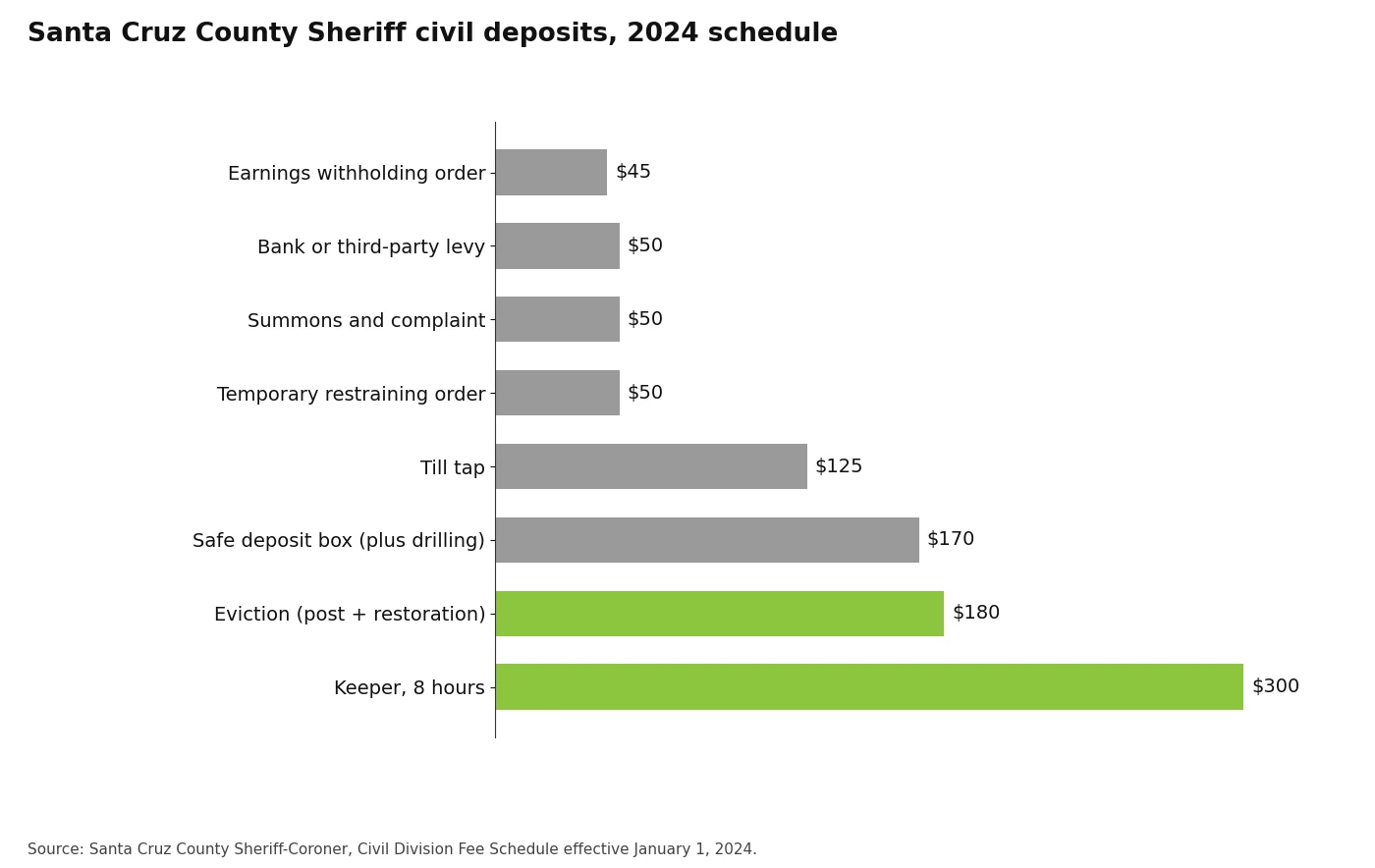
After judgment, the writ of possession goes to the Santa Cruz County Sheriff, not to a private server. The Sheriff’s 2024 fee schedule sets the eviction deposit at $180, made up of $105 for posting and $75 for the notice of restoration, and $125 to repost a notice to vacate. Our part ends with the papers that lead up to the writ and the proofs that show they were served.
Serving UC Santa Cruz, its records and the people who work there
UC Santa Cruz sits on the hill above the city, and it generates three different kinds of service request: a lawsuit against the university, a subpoena for its records, and papers for a student or employee. Each goes to a different office, and the first of them, a lawsuit against the university, is not served on the campus at all.
A lawsuit against the university goes to Oakland
The university is sued as The Regents of the University of California. Under the UC policy on service of process, the Office of the General Counsel at 1111 Franklin Street, 8th Floor, Oakland, CA 94607-5200 is authorized to accept service for The Regents, and naming the campus as a separate defendant is not necessary. UCSC’s Office of Campus Counsel is plain about it: “Campus personnel are not authorized to accept legal service on behalf of The Regents.” A summons for The Regents left at a Santa Cruz campus office is not good service.
Small claims and wage garnishments are different
The same policy sends small claims against the university to the campus Risk Services office instead of Oakland. For UC Santa Cruz that is Risk Services, 1156 High Street, Barn H, (831) 459-3261. Earnings withholding orders for a UCSC employee can be served on the Office of the General Counsel or on the campus office listed in the policy. The Regents are also exempt from the Government Claims Act claim-filing requirements (Government Code section 905.6), so no claim has to be presented before suit.

Records subpoenas go to the Custodian of Records
UCSC’s guidance for process servers asks that a deposition subpoena for business records or a subpoena duces tecum be addressed to “University of California, Santa Cruz, Custodian of Records” and served at the Chancellor’s Office. Practical points from that page:
- papers are taken on weekdays between 9 and 12 and between 1 and 4 in the afternoon;
- the campus does not accept service by mail, fax or email without prior approval;
- a deposit of $60, by check or money order payable to “UC Regents”, goes with the subpoena;
- medical records are handled by Student Health Services and need their own subpoena, with a wet signature; an /s/ signature is not accepted;
- transcripts are handled by the Registrar, 190 Hahn Student Services Building.
A UCSC police officer as a witness
Subpoenas for a UCSC police officer’s personal appearance may be served at the UC Santa Cruz Police Department, at the Emergency Response Center on Carriage House Road near the main campus entrance. The campus has delegated that response to the department itself.
A student or employee named personally
A subpoena for a named person can be handed to that person. If they are unavailable, campus counsel’s guidance says “a person obviously in charge” can accept it. A summons naming an employee or student as a defendant still has to be served on that individual by a method the Code of Civil Procedure allows; the Office of the General Counsel does not accept it for them. For a campus address, the order should carry the department, building and office hours. Our article on serving someone at work covers the workplace side.
Family law papers for a Santa Cruz household
A divorce, custody or support case between two people who live in Santa Cruz is still filed and heard in Watsonville, at 1 Second Street, Room 300. The Family Law Division handles dissolution and domestic partnership cases, parentage, custody and visitation, child and spousal support, domestic violence issues, adoptions and minor emancipations.

Ex parte timing is measured in hours
The court’s family ex parte schedule leaves little room:
- Notice goes to the other party or their attorney by 10 a.m. the day before the hearing.
- The same day, the moving party calls the Watsonville ex parte clerk at (831) 786-7200 by 11 a.m.
- Moving papers are submitted to the Watsonville clerk by 3 p.m. the day before, with a copy given to the other side by 3 p.m. the same day, in person, by fax or by email.
- Objections are due at the clerk’s office by 10 a.m. on the day of the hearing.
The accepted forms of notice are those listed on form FL-303. Hearings are generally at 1 p.m. When the copy has to be hand-delivered in Santa Cruz to meet the 3 p.m. deadline, the papers should reach us by late morning.
Publication or posting comes last
Local Rule 3.1.14 allows a petitioner to serve a family law summons by publication or posting “only if service cannot be effectuated” under Code of Civil Procedure sections 415.10 through 415.40, and posting may be ordered only if the petitioner is found to be indigent. The request uses forms FL-980 and FL-982, plus FL-985 for a proof of service by posting. The judge reading that application wants to see what was tried. A declaration of diligence listing each attempt, its date and time and what the server found is the usual support for it.
Family departments at the Watsonville courthouse
New family cases are assigned for all purposes to one of two family law departments when first filed. A peremptory challenge under Code of Civil Procedure section 170.6 is due within 15 days after notice of that assignment, or within 15 days of a party’s first appearance if they have not appeared yet, so the date a respondent is served also starts the clock on that choice.
Restraining orders from a Santa Cruz address
Every restraining order request in the county is filed and heard in Watsonville. The court’s restraining order page lists domestic violence, elder abuse, civil harassment, workplace violence, private postsecondary school violence and gun violence restraining orders, and says modifications, terminations and “anything else associated with a restraining order filing” go to 1 Second Street, Room 300.
The 10 a.m. cutoff
Restraining order requests must be filed with the clerk by 10 a.m. to be considered the same day. A request filed after that is considered the next court day, which moves the date we can collect the signed temporary order and start serving it.
E-filing a restraining order
All restraining orders may be e-filed through a registered provider, in PDF. Filing a domestic violence restraining order electronically costs nothing if the filer sets up a waiver account, as the court’s instructions describe.
Hearings and remote appearance
Hearings are in Watsonville, with the date, time and department assigned at filing. Either side may ask to join by video using form RA-010, but the court then expects that side’s evidence to be submitted before the hearing day. The clerk’s line for remote appearance help on hearing day is (831) 786-7368.
What the restrained person receives
- the request and the temporary order, if one was granted;
- the notice of court hearing with the Watsonville department and time;
- a blank response form;
- any RA-010 notice of remote appearance already filed.
We serve the set personally and file the proof in the Watsonville case if filing is part of the order.
Small claims for Santa Cruz parties are heard on Thursdays in Watsonville
Santa Cruz itself has no courtroom for small claims. The Small Claims Division files and hears every case at 1 Second Street, Room 300, Watsonville, with trials on Thursdays at 1:00 and 1:30 p.m. in Department A unless a case is assigned elsewhere.
Appearing by Zoom
Parties may appear in person or by Zoom. A party who chooses Zoom files form RA-010 to give notice to the court and the other side, and must submit and serve their evidence before the court date under the court’s evidence guidelines. Only parties may log in to the virtual courtroom; the public watches in person.
The advisor and the forms
The Small Claims Advisor Program is at (831) 786-7370 and asks people to call before submitting papers. Its list of common questions includes how to name a business and who is the agent for service of process for a corporation, which are the same questions that decide whether a small claims serve works.
Serving the claim
Once the claim is filed, the stamped copy is what the defendant receives. A party cannot serve their own claim. A registered process server, the Sheriff or an adult who is not a party can. For a business defendant we serve the agent listed with the Secretary of State, and the order should name the business exactly as it appears there. Our article on finding a registered agent shows where to look.
Santa Cruz enforcement steps that run through the Sheriff
Taking possession is the Sheriff’s job: an eviction lockout, a keeper or till tap at a business, or the seizure and sale of a vehicle or real property. Creditors also send many levies through the Santa Cruz County Sheriff-Coroner’s Civil Division, and its fee schedule effective January 1, 2024 lists the deposit for each.

What the Civil Division asks for up front
- bank levy, book levy, third party levy or monies due: $50;
- earnings withholding order: $45;
- till tap: $125;
- 8-hour keeper, if released by 5 p.m.: $300;
- safe deposit box: $170 plus the cost of drilling;
- real property levy (seize and sell): $2,000 per parcel; vehicle levy: $2,500.
Where a process server comes in
Most enforcement starts with papers that are served, not levied: an order for the debtor to appear for examination, a subpoena for business records, a notice of levy to a third party. Those are the steps we handle. The Sheriff’s schedule charges $50 for a “not found at address provided” result and $50 to cancel before an attempt is complete, so it pays to settle the address before any of these papers go out.
Bench warrants for a debtor who does not appear
When a judgment debtor ignores a served order to appear, the court can issue a bench warrant. The schedule lists $50 or $175 for the Sheriff to act on one, depending on the code section under which it issued. A clean proof of personal service on the original order is what the court looks at before issuing it.
Santa Cruz Harbor, the wharf and the boardwalk
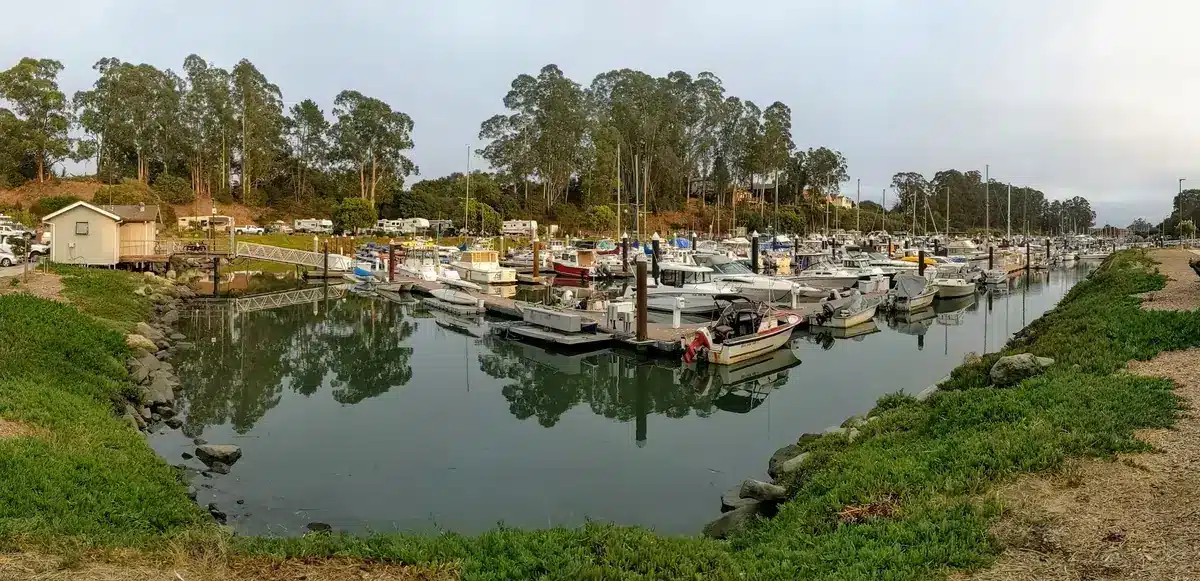
The Santa Cruz Small Craft Harbor is run by the Santa Cruz Port District, a separate public agency, not the City of Santa Cruz. Its office is at 135 5th Avenue, Santa Cruz, CA 95062, open daily from 9 a.m. to 5 p.m., (831) 475-6161 (Port District contact page).

A slip is licensed, not leased
Boat owners hold a slip license from the Port District, and since a 2018 ordinance every vessel must be insured under district policy to keep that license (harbor FAQ). That record helps confirm who is tied to a boat, but papers for a boat owner are still served on the owner.
A claim against the Port District
A dispute with the harbor itself, such as damage blamed on district equipment, is a claim against a public entity. It is presented to the Port District, not to the city or county, before any lawsuit, and the claim and later summons go to the district office on 5th Avenue.
The wharf and the boardwalk
The Municipal Wharf is public, and its restaurants and shops are reachable during business hours. The Beach Boardwalk is a private amusement park with paid entry, so service on an employee there works better at the employee entrance or at home than in the park.
What a waterfront order needs
- the slip number and vessel name, if the person lives aboard;
- the business name and unit for a wharf tenant;
- for someone who works at the boardwalk, which part of the park they work in and their usual hours.
Pulling records from a Santa Cruz County court file
Requests for court records go to the Records Division at 701 Ocean Street, Room 110 (Records and Information). Records retrieval is often part of the same job as service: a firm needs a copy of a prior judgment, a proof of service filed by someone else, or a declaration from an older case.
How the request is made
Anyone can look up records on the court-provided computers at the courthouse or submit the court’s Research and Copy Request Form. Cases opened after June 1985 can be found on the online case portal; earlier cases are on microfiche and need the year and the parties’ last names.
Files that are closed to the public
- Juvenile records are confidential; parties, parents or guardians and attorneys of record get them from the juvenile division in Watsonville, and others must follow rule 5.552(c).
- Sealed records need a court order to view.
- Confidential case types are open only to the parties, who must show government-issued photo ID.
Purged files
The court routinely destroys older records under Government Code section 68152. Before a firm counts on an old file, we check that it still exists.
Certified copies by mail
Certified copies cannot be sent electronically. When copies are requested by mail without a stamped, self-addressed envelope, the clerk holds them for 30 days. We pick them up at the counter when the order includes retrieval.
How a Santa Cruz order moves from intake to the proof
Your intake notes go to the assigned server with the papers: the department and building for someone at UC Santa Cruz, the suite and opening hours for a Pacific Avenue storefront, the slip number for someone who lives aboard at the harbor. You can follow every attempt from the order page while the job is open.

“Hands down 👊 the best attorney service out there!”
– Vernon C. Tucker, Esq.

“Highly recommended! By far the best company we have used. Very fast service of process. Website is easy to use and the people there know what they are doing.”
– Ashley B

“They are very reliable and prompt. I like the ease of using the service.”
– Jay Rahimi
Start a Santa Cruz process serving order
What a Santa Cruz order should carry
The papers and everything known about the recipient are uploaded when the order is opened. On a Santa Cruz job, the details below settle which courthouse gets the proof and when the server should go:
- the case type and courthouse: Ocean Street for civil, eviction and probate; Watsonville for family, small claims and restraining orders;
- the case management conference date, if the complaint has one;
- for a rental inside city limits, whether the tenant holds a Section 8 voucher;
- for a UCSC recipient, whether the papers name The Regents, a campus office or a person;
- a slip number, wharf unit or employer department for waterfront addresses;
- the hearing date for any ex parte or restraining order papers.
Every visit to a Santa Cruz address is written up in the order with what the server saw there. A same-day first attempt can be asked for, and is given when the day’s routes have room. If a recipient keeps a pattern, a stakeout holds a server at the address for a set window, and someone who avoids the door gets attempts moved to other days and hours. An address that looks doubtful can be checked against public records before anyone drives out. Once the proof is signed it is posted to your account as a PDF, and we can file it with the court that has the case.
Contact Us
Court and form links for Santa Cruz filers
Court Websites
Court Forms
California Secretary of State
Superior Court Holidays
Federal Rules and Practice Procedures
Questions firms ask about Santa Cruz service and filing
Where are civil cases from Santa Cruz filed?
Room 110 of the courthouse on Ocean Street takes them, whichever part of the county the parties live in. The section above on Ocean Street or Watsonville lists the case types that leave town.
Can a server work the UC Santa Cruz campus?
Yes, but each kind of paper has its own campus door, and a summons naming The Regents has none, because it is served in Oakland. Records subpoenas, police officer subpoenas and papers for a named student or employee are covered in the UC Santa Cruz section above. When the papers name one person, tell us where on campus they can be found and when; the same workplace rules apply as at any employer.
Can a server work the Santa Cruz Beach Boardwalk?
The paid area is not a good place for it. Ask us to try the person at home or at the start or end of a shift, and tell us which ride, shop or office they work in.
Can a server work Pacific Avenue downtown?
Yes, during opening hours; give the suite or upstairs office number with the street address. A shop sued in its own name is a different job: its registered agent gets the papers, and that agent can be miles from the storefront.
Can a server work at Santa Cruz Wharf or the harbor?
Yes. Wharf shops and restaurants are reached in business hours like any storefront. At the harbor, someone living on a boat is served at the slip, so send the slip and the boat’s name; the district office on 5th Avenue handles slip licenses, not papers for the people who hold them.
Can address verification be added to a Santa Cruz order?
Yes. Ask for it when you order and the address is compared with public records before anyone goes there; what the check found is noted on the order. It is worth asking for with student rentals near UC Santa Cruz, which change hands with the academic year.
How do I hire a process server for a Santa Cruz case?
Open an account online or call (310) 858-9800. The order needs the conformed papers, who is being served, where, and any hearing or production date. A person on our team checks the file and assigns it to a registered server who covers Santa Cruz County, and the attempt notes and signed proof appear in the same account.
Is a same-day serve possible in Santa Cruz?
A first attempt on the day the order arrives is possible when a server covering the county has room that day. On the filing side, the Santa Cruz court deems an e-filed document filed on a court day if it is received by 11:59 p.m. that day and otherwise meets the filing requirements (Local Rule 1.3.01), so a proof served in the afternoon can still be filed the same day.
Is process serving in Santa Cruz priced at a flat rate?
Yes. A standard serve has a single price, shown when the order is placed. Extras such as a rush, a stakeout or filing the proof are listed on their own lines, so the base price for the serve does not change.
Where is an eviction for a Watsonville rental filed?
In Santa Cruz. The Civil Division at 701 Ocean Street, Room 110 processes all unlawful detainer cases in the county; the Watsonville Courthouse takes small claims, family law and restraining orders, not evictions.
Can papers be dropped at the Santa Cruz courthouse after the counter closes?
Yes for paper filers. The Room 110 counter closes at 3:00 p.m., after which a mail slot takes filings, and anything left there has to arrive by 5:00 p.m. E-filed documents can be submitted at any hour under Code of Civil Procedure section 1010.6.
What does the Santa Cruz court charge for copies?
Regular copies are $0.50 a page. Certified copies are $40 to certify the document plus $0.50 a page, according to the Civil Division page.
Will the Santa Cruz court confirm a party’s address over the phone?
No. The court does not confirm personal information such as a date of birth, address or driver’s license number by phone or email unless it has a court business need. Someone looking for that information has to use the courthouse computers or the Research and Copy Request Form.
How long does UC Santa Cruz take to answer a records subpoena?
The campus says it is allowed 15 business days from the date of service to respond to a subpoena for records in a civil matter, so the production date written on the subpoena should leave at least that much time.
What does the Santa Cruz County Sheriff charge to serve a summons?
The Sheriff’s 2024 civil fee schedule lists $50 for a summons and complaint, an unlawful detainer summons, a temporary restraining order, small claims papers or a civil subpoena. The same $50 applies when the person is not found at the address given or the request is cancelled before the attempt.
What if a Santa Cruz Request for Order could not be served before its hearing?
Local Rule 3.1.16 lets the moving party ask for a new date on form FL-306, or FL-307 when temporary emergency orders are involved, together with the FL-309 order. Because the other side was never served, no notice to them is required, and the court sets the new date. Only two continuances may be requested this way, and the request is due no later than five court days before the original hearing.
Who can check restraining order papers before they are filed in Santa Cruz County?
The court’s Self Help Center, at the Watsonville Courthouse, 1 Second Street, Room 301, reviews forms for people without lawyers in person or by email. Staff are there four days a week, Monday to Thursday, in two windows (8:30 to 11:30 in the morning and 1 to 3 in the afternoon), and the phone line is (831) 786-7200, option 4.
How is a name change published in Santa Cruz County?
The petitioner picks one of the newspapers of general circulation on the court’s list and publishes the notice once a week for four weeks in a row. The court’s list shows the approximate cost for the full four weeks.
I had to file a Writ of Review with the California Court of Appeal. I contact several services for assistances most were not interested and others didn't provide the services I needed. I called On-Call Legal Process Servers and spoke to one of their staff. The staff member gave me a list of services they provide everything from a small claims court, to Court of Appeal to the Supreme Court. They will assist you in the filing all court documents and proof of service. To get start with On-Call Legal Process Servers and more an account has to be opened online. Before charges can be posted to the account an Email is sent out listing the proposed charges. The staff returns Email questions and orders during their normal business hours during the same day. On-Call Legal Process Servers file the writ for me and obtain the filing court's case number.
I was fortunate enough to be introduced to On-Call Legal through a family friend for services of process. Not only were the owners Brandon & David incredibly kind, but their process servers were professional, fast and affordable. I would use them again and would recommend them to anyone.
On-Call was absolutely AMAZING! Our trial team at Brown Goldstein & Levy flew into LA for a USDC trial from Baltimore. From first contact, On-Call was professional, prompt & handled everything we threw at them from exhibit binders for the Court and parties, to delivery to Court to meet our 8:30 am filing deadline! David A & his team handled everything! Looking forward to working with them again!
Service of process articles from the On-Call Legal blog
Everything you need to know about service of process.
Santa Cruz County and the cities over the hill
Watsonville is the county’s other city page and the home of its second courthouse. Los Gatos, Saratoga, Campbell, Cupertino and Morgan Hill are across the Santa Cruz Mountains in Santa Clara County, which has its own court.
Filing, subpoenas and records help for Santa Cruz cases
Litigation support beyond service of process:
For cases outside Santa Cruz County, we handle process serving across California and nationwide.