Arrange service of process anywhere in Richmond online
For firms with papers to serve in Richmond, Contra Costa County: West County evictions and small claims belong to the courthouse on 37th Street, and the proof comes back ready for the county’s e-filing system.
Civil matters from Richmond route through the Contra Costa County Superior Court, with much of the calendar heard at the George D. Carroll Courthouse on 37th Street. We serve summonses, subpoenas and eviction papers across the city. Each attempt is logged with the date, the time and what the server observed.
Richmond’s address mix runs from residential neighborhoods to a downtown commercial corridor to a working industrial port. Process serving orders are placed through your On-Call Legal account; the order is reviewed at intake and routed to a registered process server.
The Richmond District is a neighborhood of San Francisco, in a different county with its own court. For a serve there, see our San Francisco service page.
How Richmond housing, rent rules and the port shape a process server order
A Richmond order often ends with a filing somewhere other than the courthouse: the Rent Program, the City Clerk or the Sheriff in Martinez. The numbers below show why, with a source for each.
Key figures for a Richmond order
Figure
What it means for a serve
Source
14
What it means for a servecommunities are served by the Richmond courthouse: Crockett, El Cerrito, El Sobrante, Hercules, Kensington, North Richmond, Pinole, Point Richmond, Port Costa, Richmond, Rodeo, Rollingwood, San Pablo and Tilden Park North. El Sobrante and North Richmond are unincorporated county land, yet their small claims and evictions go to Richmond like the city’s own.
What it means for a serveis the share of Contra Costa’s 2024-25 civil caseload made up of unlawful detainers; across California the share was 12.4%. Eviction papers are a regular part of West County assignments.
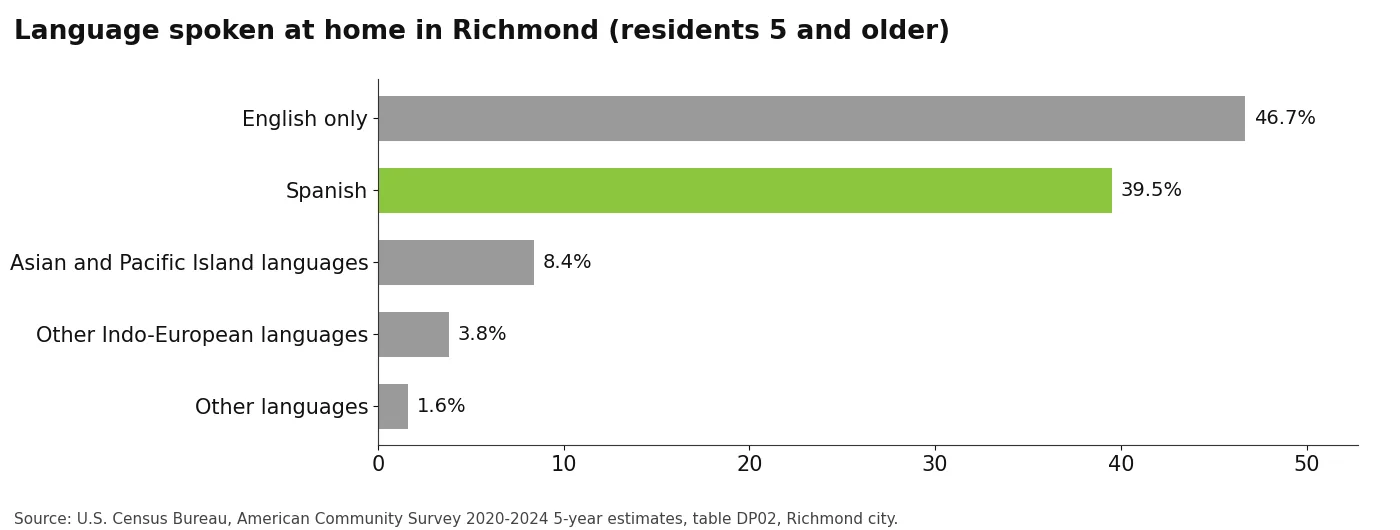
What it means for a serveof Richmond residents aged five and up speak Spanish at home, and 18.7% are Spanish speakers who report limited English. The Judicial Council summons, form SUM-100, prints its 30-day warning in Spanish beside the English, so a Spanish-speaking defendant reads the deadline on the form itself.
What it means for a servebusiness days is the window for filing a termination notice and its proof of service with the Rent Program after the tenant is served.
Upload the papers and the recipient’s address, and tell us whether the unit is inside Richmond city limits. Your order goes to a registered server working West County, and the proof is posted to your account.
Which Contra Costa courthouse gets a Richmond case
Contra Costa routes a filing by the kind of case, and evictions and small claims also by the city they came from. Small claims and unlawful detainer cases are filed and heard in the court serving the city where the dispute started, which for Richmond ZIP codes 94801 to 94808, 94820, 94850 and 94530 is the George D. Carroll Courthouse. Since January 5, 2026 the court has also assigned limited civil cases, those worth $35,000 or less, to Department 14 in Richmond.
Richmond filings, where they go and what we check
Situation
What the court requires
What On-Call Legal does
An eviction or small claims case for a Richmond address
What the court requiresThe case is opened in the court that serves the city, so the summons for a Richmond unit should name the George D. Carroll Courthouse.
What On-Call Legal doesThe order is reviewed at intake, and a summons naming a courthouse that does not match the address is raised with you before the first attempt.
A paper filing in a limited case with little time left
What the court requiresThe Richmond clerk takes limited civil papers only when the next hearing or deadline is at least three court days away. With less time, they go to Room 103 at 725 Court Street in Martinez.
What On-Call Legal doesWhen filing is part of the order and the date is close, the papers are taken to Martinez instead of Richmond.
An attorney filing on paper
What the court requiresAttorneys have had to e-file in every civil case type, evictions and small claims included, since July 5, 2022, under Local Rule 2.87 and the court’s e-filing standing order.
What On-Call Legal doesThe proof comes back ready for e-filing, or is filed electronically for you when filing is added to the order.
George D. Carroll Courthouse
Address
100 37th Street, Richmond, CA 94805
Entrance
Around the corner, off Bissell Avenue, through a security check
Civil window
8:00 a.m. to 4:00 p.m.; phones (925) 608-1000 until 3:00 p.m.
Contra Costa hears small claims in Martinez, Pittsburg and Richmond, and Department 50 covers Richmond and Walnut Creek. Hearings are held in person. A party who wants to appear remotely files form RA-010 under Code of Civil Procedure section 367.75, and the other side opposes on RA-015; written approval is needed only when remote appearance is opposed. For a remote hearing, documents have to be served and delivered to the clerk in person, by drop box or by overnight delivery three court days before the hearing, and electronic delivery is not accepted.
The filing fee is $30 for claims up to $1,500, $50 from $1,501 to $5,000 and $75 from $5,001 to $12,500, rising to $100 per case for anyone filing more than 12 cases in a 12-month period.
Richmond’s Rent Program wants the proof of service within two business days
Most residential evictions inside Richmond city limits run under the Richmond Fair Rent, Just Cause for Eviction, and Homeowner Protection Ordinance, Richmond Municipal Code chapter 11.100. The part that lands on a process server’s desk is short and strict: within two business days after the notice is served on the tenant, the landlord files a copy of the notice and the proof of service with the Richmond Rent Board, according to the city’s Termination of Tenancy page.
The two-business-day filing, step by step
The property is enrolled with the Rent Program, and tenancies in rent-controlled units are registered.
The tenant is served with the notice terminating the tenancy, citing one of the just causes the ordinance allows.
Within two business days after service, the landlord completes the online Notification of Termination of Tenancy form and attaches the proof of service.
For properties with five units or fewer, the notice and proof can instead be mailed to the Rent Program at 440 Civic Center Plaza, Suite 200, Richmond, CA 94804. Other requests are reviewed case by case.
The city warns that failing to file the notice with the Rent Board may be used as a defense to the unlawful detainer that follows (RMC 11.100.050(g)). That makes the date of service on our proof the start of a very short clock, and the proof itself one of the documents the landlord has to upload.
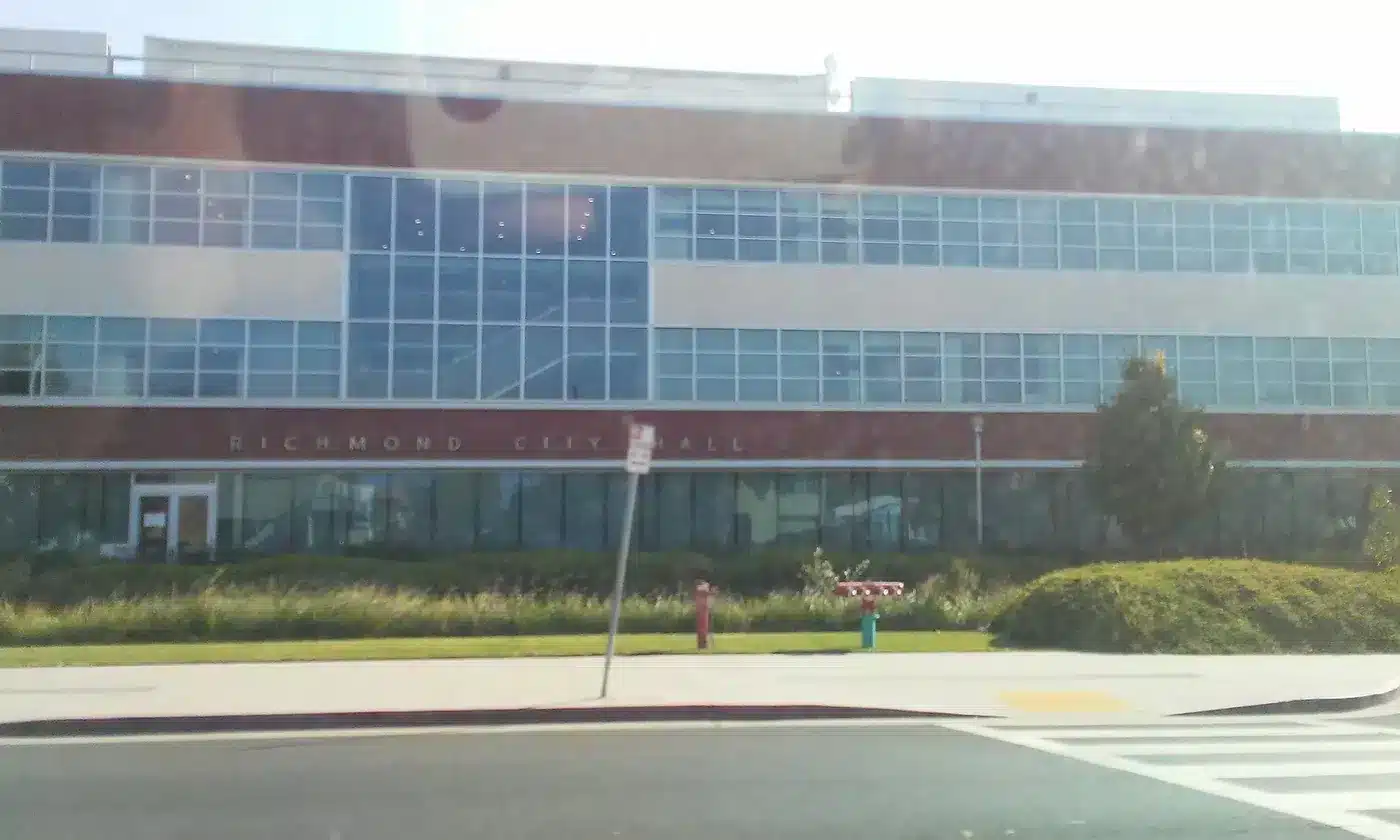
The Civic Center in Richmond. The Rent Program office, at 440 Civic Center Plaza, takes the notice and proof of service within two business days of service, and the Ellis Act filings that follow. Photo: Wikigirl97, CC BY-SA 4.0, via Wikimedia Commons.
Grounds the ordinance accepts
A Richmond landlord may only end a covered tenancy for one of the listed reasons: failure to pay rent, breach of the lease, nuisance, failure to give access, temporarily vacating for substantial repairs, owner or relative move-in, withdrawal from the rental market under the Ellis Act, or the end of a temporary tenancy.
Breach, nuisance and refused access need a written warning first
For breach of the lease, nuisance or failure to give access, the landlord must first serve a Written Warning Notice that gives the tenant a reasonable time to fix the problem (RMC 11.100.050(d)). The Rent Program publishes a template in English and in a combined Spanish and English version. Only after that warning period can the termination notice go out, so these files often involve two deliveries to the same address, and a record of the first one supports the second.
Relocation grounds add papers to the envelope
When the cause is substantial repairs, owner move-in or withdrawal from the rental market, the ordinance requires a relocation payment, and the tenant has to be served with the Notice of Entitlement to Relocation Assistance and the Tenant Assertion Forms along with the termination notice. The city’s templates include all of them. A server handed only the notice for one of those grounds should ask whether the relocation papers belong in the same packet.
Temporary tenancies are declared before they start
A temporary tenancy applies only to single-family homes and condominiums, for up to twelve months, and only when landlord and tenant agree to it when the lease begins. It cannot be renewed, and the landlord files a Declaration of Temporary Tenancy with the Rent Program before the tenancy starts.
Which Richmond units are covered
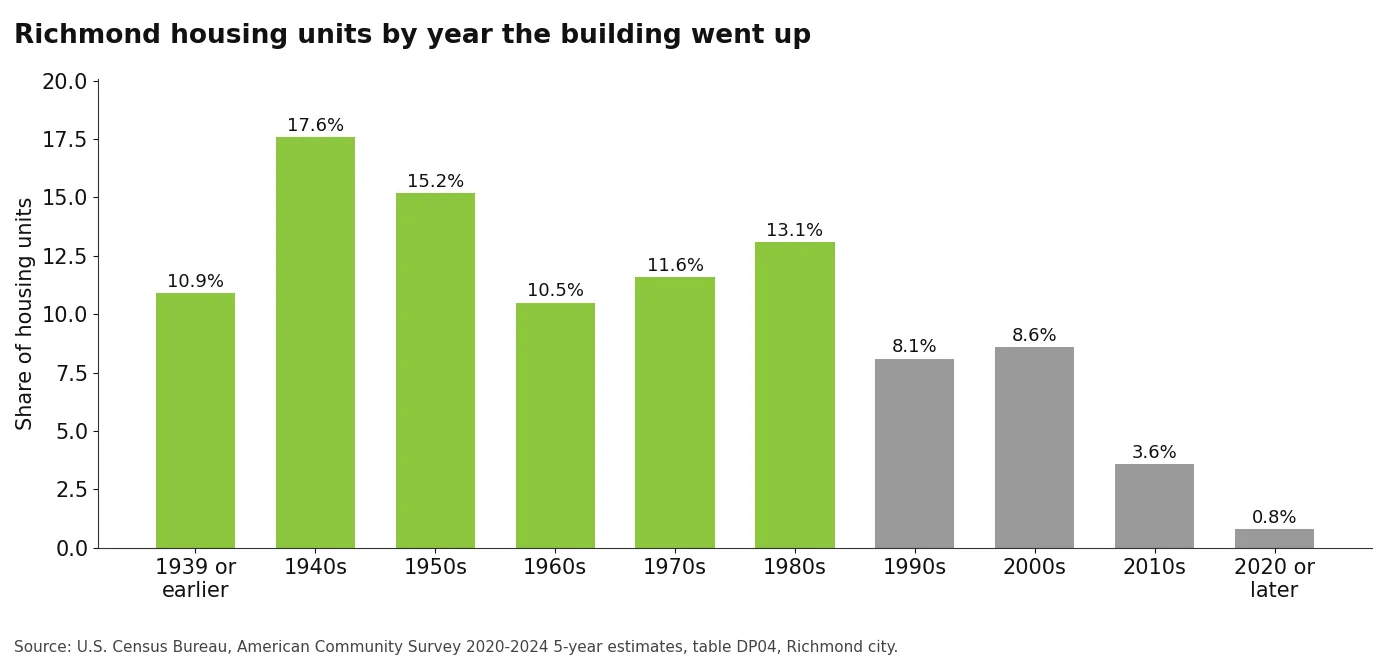
The city’s landlord page separates fully covered units, which have rent control and just cause protection, from partially covered units, which have just cause protection only. Rent control reaches properties with more than one dwelling unit on a parcel built before February 1, 1995. In the Census Bureau’s 2020-2024 estimates (table DP04), only 13.0% of Richmond’s housing units were built in 2000 or later, so most of the city’s housing predates that cutoff.
Richmond housing by year built. Rent control covers multi-unit buildings put up before February 1, 1995, and most of the city’s housing stock is older than that. Source: Census Bureau, ACS 2020-2024, table DP04.
Rent increase notices are filed too
For rent-controlled units, the annual general adjustment may be applied on or after September 1, after notice under Civil Code section 827, and a copy of the Notice of Rent Increase goes to the Rent Program within ten business days after it is served. Landlords also have to give the tenant the Rent Program brochure at the start of the tenancy and with each rent increase notice (RMC 11.100.060(g)). When we serve a rent increase notice, the proof records the date that starts that ten-day window.
A Richmond mailing address is not always a Richmond rental
The ordinance is a city law, so it reaches only units inside Richmond city limits. Several of the communities that use the Richmond courthouse, listed in the figures above, sit outside those limits, and a notice for a unit there has no Rent Program filing step. Checking the parcel before the notice goes out avoids a filing that was never required, or a missed one that was.
A Richmond notice with a two-day clock
Upload the notice, any warning notice already served, and the relocation papers if the ground needs them. The proof comes back with the service date and method stated so it can go straight into the Rent Program filing.
El Sobrante and North Richmond read like Richmond on an envelope, but they are county land
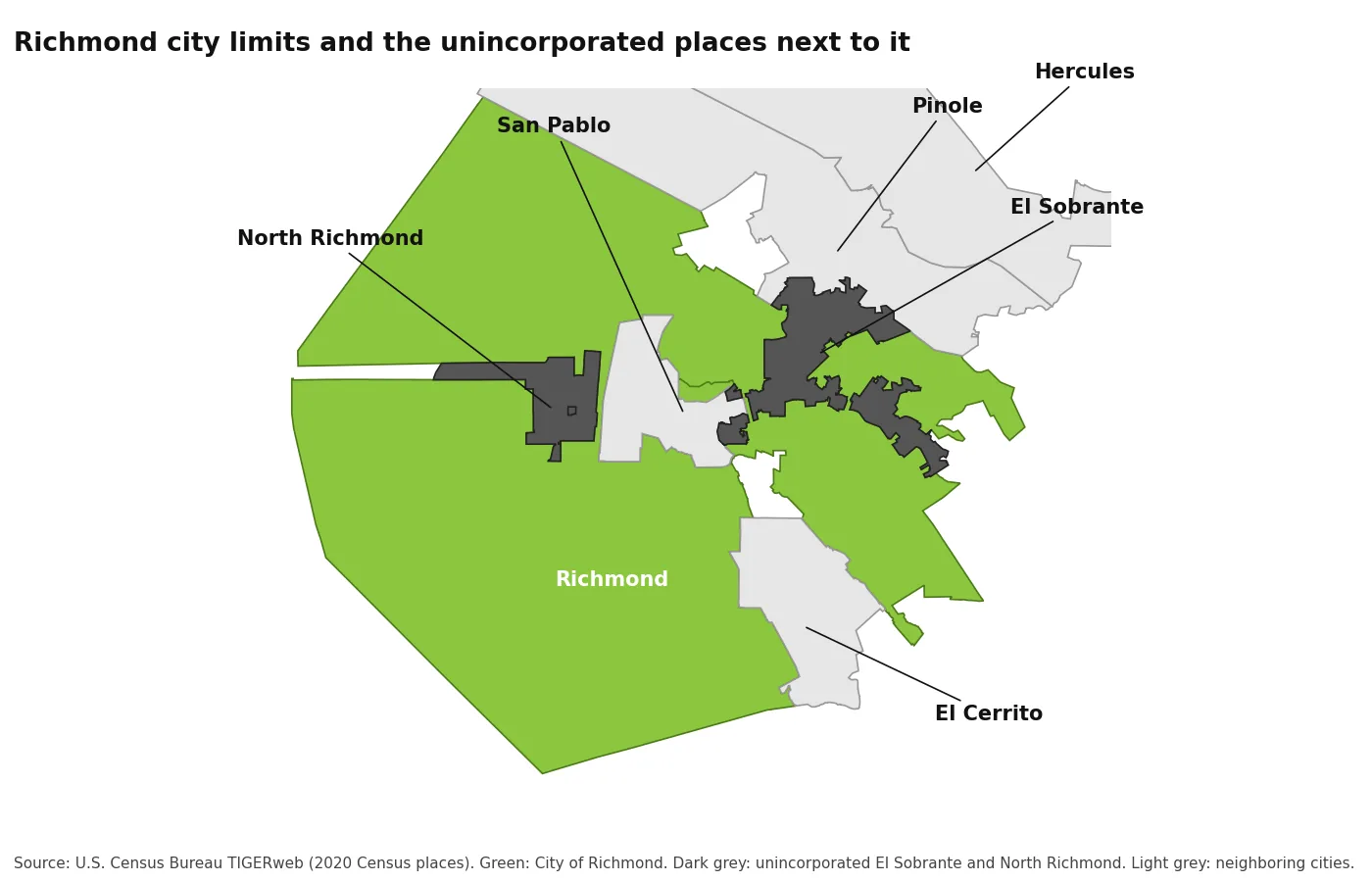
Two of the communities that send their small claims and evictions to the Richmond courthouse are not part of the city at all. El Sobrante and North Richmond are census-designated places in unincorporated Contra Costa County, and the households a server finds there differ from the city’s in ways the 2020-2024 Census estimates make plain.
Richmond city limits (green, including the bay waters inside the city boundary) and the unincorporated places of El Sobrante and North Richmond (dark grey). Rent Program rules stop at the green line. Source: Census Bureau TIGERweb.
Owner-occupied houses up the hill in El Sobrante
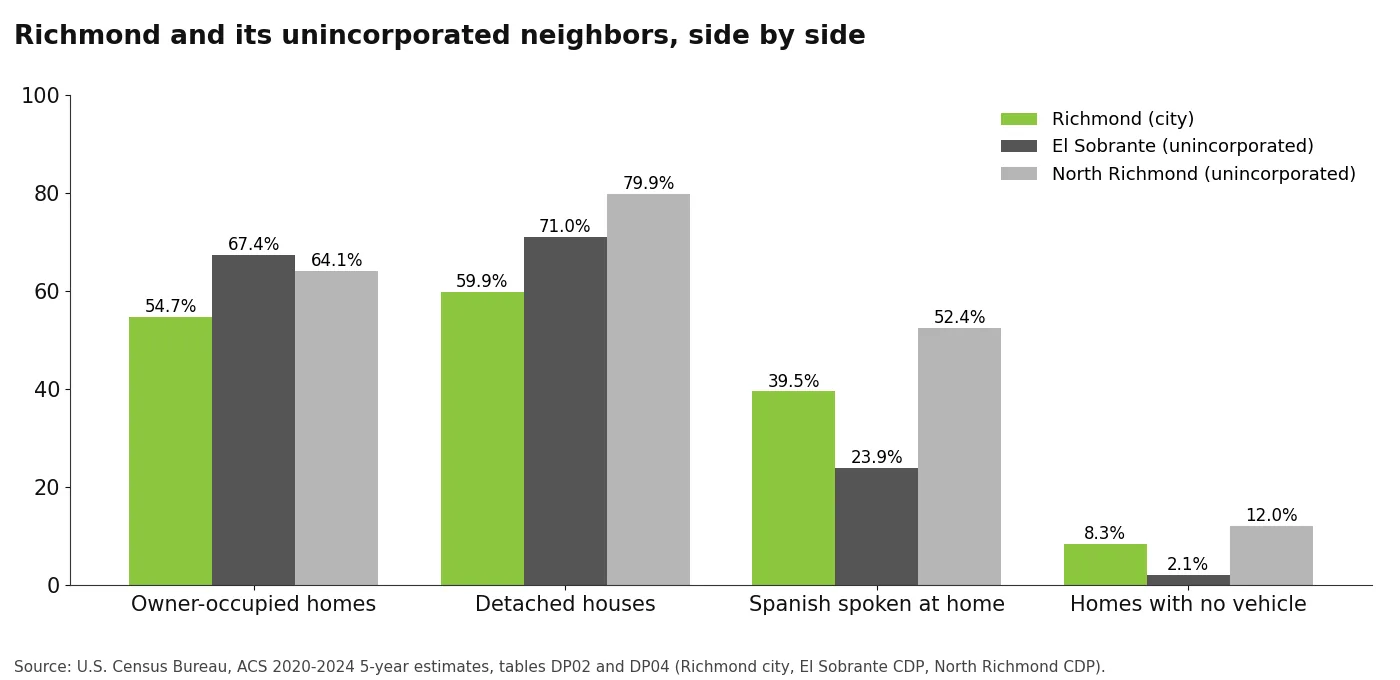
El Sobrante has 6,042 housing units (ACS DP04). Two thirds are owner-occupied (67.4%, against 54.7% in Richmond), 71.0% are detached houses, and only 2.1% of households have no vehicle. Three quarters of its homes (75.4%) were built before 1980. Spanish is spoken at home by 23.9% of residents, well under Richmond’s 39.5%. For a server, that profile looks more like a suburb than the flatland neighborhoods of the city: fewer apartment buzzers, more driveways, and a recipient who is often the owner of the house.
North Richmond, a small Spanish-speaking pocket between two cities
North Richmond is far smaller, with 1,157 housing units (ACS DP04), almost all of them (79.9%) detached houses. It has the highest share of Spanish spoken at home of the three places (52.4%), and 12.0% of its households have no vehicle, more than in Richmond itself. Its boundary is drawn around blocks that sit between Richmond and San Pablo, so an address that reads “Richmond, CA 94801” can be outside the city.
Three places behind one courthouse. El Sobrante is more owner-occupied and car-owning; North Richmond is the most Spanish-speaking. Source: Census Bureau, ACS 2020-2024, DP02 and DP04.
Why the boundary changes the file
Beyond the Rent Program filing step, the boundary decides which agencies hold the records a case may need. A case still goes to the same courthouse, but city departments such as the Richmond Police Department keep records only for city addresses, and a lockout after judgment is the county Sheriff’s job everywhere in the county. We confirm the place for each West County address before the first attempt and write it into the order notes.
Court data · Contra Costa County
Richmond is in Contra Costa County. These are the Contra Costa County Superior Court’s civil filing figures for fiscal year 2024-25.
24,546
Civil filings
Total new civil cases filed in the year
20.99
Per 1,000 residents
Statewide: 26.35
3,818
Evictions
Unlawful detainer cases, which start with service of the summons and complaint
1,612
Small claims
Each claim has to be served on the defendant before the hearing
How a Richmond assignment moves from intake to the door
After intake review, a registered process server takes the assignment with the address details — slip number for marina or port-tenant addresses, suite or floor number for office tenants, unit number for residences. Each visit is added to the account with what was observed at the door, gate, or reception.
“Hands down ? the best attorney service out there!”
– Vernon C. Tucker, Esq.
“Highly recommended! By far the best company we have used. Very fast service of process. Website is easy to use and the people there know what they are doing.”
– Ashley B
“They are very reliable and prompt. I like the ease of using the service.”
– Jay Rahimi
Owner move-in and Ellis Act files in Richmond take a series of serves
The two no-fault grounds that carry the largest relocation payments in Richmond also carry the longest paper trail. Each step leaves a document someone has to deliver and a filing the Rent Program expects, and several of them ask for a proof of service.
Withdrawing a building under the Ellis Act
The city’s Ellis Act guide, built on Rent Board Regulation 503, sets the order. The landlord first files a Notice of Intent to Withdraw with the Rent Program, then gives the tenants written notice that this has been done and files a copy with a proof of service on each tenant. A Summary Memorandum is recorded with the Contra Costa County Recorder and filed with the Withdrawal Certificate, and the withdrawal date falls 120 days after the Rent Program receives them.
The serve itself comes at step 6, and it is four documents on each tenant, delivered by personal service or by certified mail, return receipt requested:
the Notice of Intent to Withdraw Accommodations, which has to state that every unit on the parcel is being withdrawn;
a Notice of Termination of Tenancy with an effective date no earlier than 120 days after service;
the Notice of Entitlement to Permanent Relocation Payment, with the Assertion of “Qualified Tenant Household” status;
the notice of the right to one year’s notice, in two copies.
A notice of intent is not valid unless every unit on the property is served and the city’s fees are paid. A tenant who is disabled, 62 or older, has a child under 18 at home or lives in a lower-income household, and has been there a year, can extend the withdrawal date to one year by notifying the owner within 60 days.
The language duty in an Ellis notice
The guide also says the owner must find out whether a member of each household can speak English and seek help explaining the notice to any household that cannot. With Spanish spoken in close to four in ten Richmond homes, that question is worth answering before the papers are handed over, and the order notes are the place to record it.
Language spoken at home in Richmond. The Ellis Act guide asks owners to check whether each household speaks English and get help explaining the notice when it does not. Source: Census Bureau, ACS 2020-2024, table DP02.
Owner move-in filings continue after the tenant leaves
An owner move-in can be for the landlord or the landlord’s spouse, children, parents or grandparents, and the city’s sample notice includes the tenant’s first right of refusal under Regulation 1010(C)(1). The landlord then files an Initial Certification of Occupancy within 30 days after the tenant moves out, a Statement of Occupancy within 30 days after the owner or relative moves in, and a Continued Statement of Occupancy every twelve months for 36 months. The Rent Program posts Spanish versions of these forms for reference only; the English version is the one submitted.
Relocation amounts the notice has to announce
The Relocation Ordinance (RMC chapter 11.102) sets maximum permanent relocation payments per unit. The city’s published figures are for calendar year 2025; the 2026 adjustment was delayed because the October 2025 Consumer Price Index release was postponed.
$4,355.81 base; $4,923.76 for a qualified tenant household
Owner move-in, 1 bedroom
$6,725.81 base; $7,749.89 qualified
Owner move-in, 2+ bedrooms
$9,159.42 base; $10,504.08 qualified
Ellis Act or government order, studio
$8,775.23 base; $10,056.28 qualified
Ellis Act or government order, 1 bedroom
$13,451.61 base; $15,501.04 qualified
Ellis Act or government order, 2+ bedrooms
$18,255.22 base; $21,009.41 qualified
For an owner move-in or Ellis Act notice, half the payment is due within three business days after the tenant tells the landlord in writing that they will leave on the notice date, and the rest within three business days after the tenant has moved out, no more than two days after that date, and removed their belongings.
A Contra Costa eviction from a Richmond address, paper by paper
The Contra Costa Superior Court gathers the papers for an unlawful detainer into one packet, CV-660, revised January 1, 2026. Several of its pieces depend directly on what the server does and writes down.
Posting the summons needs a record of real attempts
When a tenant cannot be found, the court’s local form CV-667 asks for an order under Code of Civil Procedure section 415.45 to serve by posting the summons and complaint on the property and mailing a copy by certified mail. The application lists each attempt by date and time with the reason service failed, and it asks whether service was tried during business hours at the defendant’s workplace and at the residence, with an explanation if not. A declaration from the process server describing the attempts can be attached. Our attempt log for a Richmond eviction is kept in that shape so it can go straight into the application.
Asking for a default
If no answer is filed, the packet’s instructions list what the clerk needs for a default: a separate proof of service for each defendant, the request for entry of default, the judgment, a writ of execution in an original and four copies, the fee by check or money order, and a stamped envelope if documents are to be mailed back. A money judgment can be requested with a declaration under section 585(d) or set for a hearing.
The writ goes to the Sheriff with its own instruction sheet
The packet ends with the Sheriff’s instruction form for a writ of possession. It goes to the Civil Unit at 1026 Escobar Street, 2nd Floor, Suite 2A, Martinez, phone 925-655-4555, email [email protected]. The form asks for details a landlord’s office may not have collected:
whether the eviction follows a foreclosure sale of a rental unit;
any known illegal activity or prior police contact at the address;
risks such as weapons, threats, surveillance cameras, alarms or vicious animals;
for each defendant, the full name, date of birth, driver’s license number and phone numbers.
Some of that is visible at the door during service, so our servers note dogs, cameras and alarms in the attempt record, which the landlord’s office can carry forward to the Sheriff’s form.
Subpoenas for Richmond police records go to the City Clerk, not the station
The Richmond Police Department’s Records Section page answers a question servers get often: where to serve a subpoena for police records or for an officer’s appearance. The City Clerk is the agent for service of process for every city department, so summonses and subpoenas for Richmond Police records or employees are served in person, with the required fees, at the City Clerk’s Office, 450 Civic Center Plaza. The Clerk’s Office takes questions at (510) 620-6513.
What the Records Section does
The Records Section is the department’s central store of documents and electronic records. It forwards traffic citations and misdemeanor reports to the court, routes felony reports to Investigative Services, enters data into state and national criminal justice databases and assists staff, other agencies and the public. The unit itself never closes; staff are at the public counter on weekdays until 7:00 p.m., starting at 8:00 a.m., and the public line is (510) 620-6675.
Getting a report copy for a case file
Call first to confirm the report is ready and can be released.
Reports are usually available 7 to 10 business days after the incident.
A police report copy costs $10 per report, and a traffic report copy $10, both subject to release.
A report may be withheld while the case is under active investigation, when release could endanger someone involved, or when it contains juvenile information.
Those limits matter when a records subpoena is being drafted: a report that the department will not release over the counter may still be the subject of a subpoena, and the subpoena goes to the City Clerk.
Live Scan at the station
The Records Section also takes Live Scan fingerprinting by appointment on Tuesdays, Wednesdays and Thursdays, for $50 plus the Department of Justice and FBI fees, with a photo ID and the request form from the employer or agency.
Port of Richmond addresses, and who is actually at the terminal
The Port of Richmond sits about nine miles from the Golden Gate on the east shore of San Francisco Bay, along a city shoreline of 32 miles, according to the city’s port overview. It takes in five city-owned terminals and ten privately owned ones handling liquid and dry bulk, metals, vehicles and break-bulk cargo. For a server, the useful fact is in the overview’s wording: the city-owned terminals are tenant-operated.
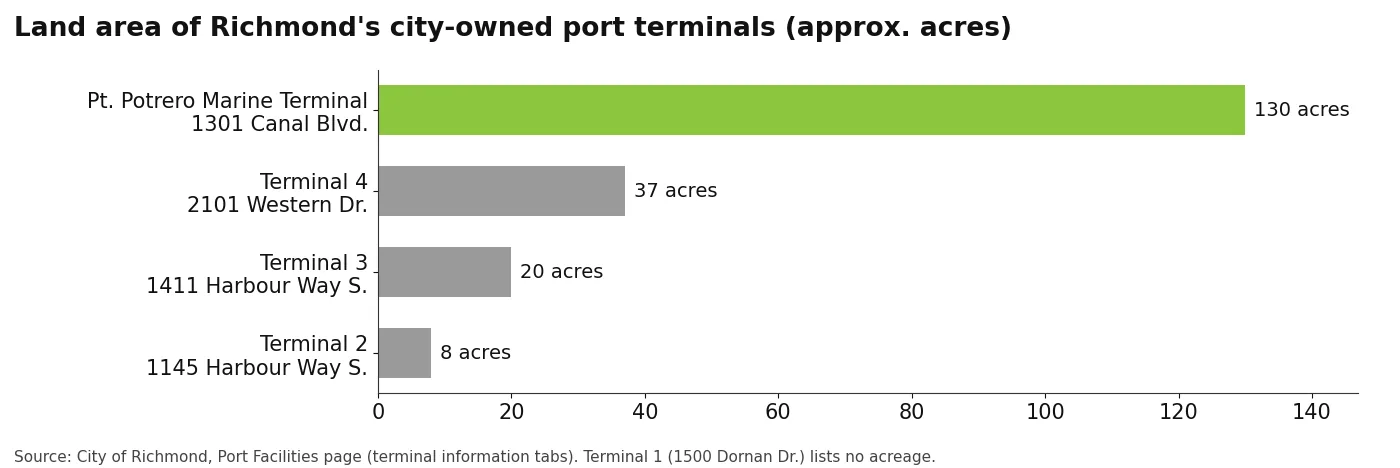
1145 Harbour Way South. Storage and distribution of liquid bulk on about 8 acres, with 140,000 square feet of warehouse.
Terminal 3
1411 Harbour Way South. Import, storage and distribution of break bulk, project cargo and containers on about 20 acres, with two 37-short-ton wharf cranes.
Terminal 4
2101 Western Drive. About 37 acres; the city lists its use as pending.
Point Potrero Marine Terminal
1301 Canal Boulevard. Autos, break bulk and dry and liquid bulk on about 130 acres, with five graving basins and eleven rail car spots.
Land area of the city-owned terminals. Each is run by a tenant company, which is the business a server usually needs to reach in a port dispute. Source: City of Richmond, Port Facilities page.
Serve the company running the terminal, not the port
Because the terminals are run by tenants, the defendant in a dispute over cargo, a contract or an injury at a terminal is usually the operating company, not the City of Richmond. That company is served like any other business, through the agent for service of process it lists with the California Secretary of State or through an officer. The port office at 1411 Harbour Way South (510-215-4600) shares an address with Terminal 3, but it is the city’s port administration, not an agent for the tenants.
Getting to a person at a working terminal
Terminals with rail connections, wharves and secured yards are not places where a server walks up to a front desk. When the recipient works at the port, the order notes should name the employer and, if known, the gate or office the person reports to. Point Potrero, home of the largest city terminal, was the site of Richmond Shipyard No. 3 during the Second World War.
Richmond Harbor from the air. The terminals along the inner harbor are tenant-operated, so papers go to the company at the terminal. Image courtesy of the U.S. Army Corps of Engineers, public domain, via Wikimedia Commons.
Richmond Shipyard No. 3 on Point Potrero, where the city’s 130-acre Point Potrero Marine Terminal at 1301 Canal Boulevard now handles autos and bulk cargo. Photo: Jet Lowe, HABS/HAER, public domain, via Wikimedia Commons.
Place a Richmond process serving order
Details that speed up a Richmond order
Open a new order through your account and enter the recipient and document details.
The recipient’s full name and the address, with the unit as written on the lease.
Whether the unit is inside Richmond city limits, so the Rent Program filing step is planned.
For someone who works at the port or another secured site, the employer and the gate or office.
Same-day handling can be requested when scheduling allows.
Pricing is a flat rate, with add-ons listed at intake.
A stakeout block can be reserved for set hours when the recipient is rarely home.
A pre-dispatch address check is available on request.
Filing of the proof can be added at intake or after service is complete.
Visit-by-visit updates appear on the order as the server works the address.
The signed proof of service is available in the account once the order is finalized.
Richmond order request form
Please fill in the form below. A member of our team will contact you to finalize the order.
Civil cases from Richmond typically route through the Contra Costa County Superior Court. Specific courthouse routing depends on the case type and is confirmed at filing.
Can a server reach the Port of Richmond?
The Port of Richmond is a working commercial port with multiple tenants. Serving a recipient at a port-tenant workplace typically requires the recipient’s department, hours, and any access information at intake.
Can a server work near the Rosie the Riveter Memorial?
The Rosie the Riveter / WWII Home Front National Historical Park preserves portions of the former Kaiser Shipyards as a federal park. Public-facing visitor areas are accessible during posted hours; service to a specific recipient typically requires a residential or business address.
Can a server work along the MacDonald Avenue corridor?
Yes. MacDonald Avenue is a primary commercial corridor through Richmond with public sidewalks, shopping centers, and storefronts reachable during business hours.
Does language get in the way of service in Richmond?
Language can affect communication during an attempt, but the server’s role is to identify the recipient and deliver the documents according to California service rules. Add any language or recipient-identification notes at order intake.
Can a Richmond address be verified before the server goes out?
Yes. Address verification can be added before the assignment goes out when the address is uncertain. The check covers public records, and the result is logged to the order.
What happens to a Richmond landlord who is out of compliance with enrollment or fees?
The city says landlords who have not enrolled the property, registered rent-controlled tenancies or paid the Residential Rental Housing Fee may not qualify to raise the rent and may be unable to lawfully evict. Fully covered units pay the full fee and partially covered units a lower one, and fees are due within 30 days of the invoice date before late fees apply.
Who receives the relocation payment when several tenants share a Richmond unit?
The payment is figured per rental unit, up to the maximum for that unit type, and split among the eligible tenants. A unit with a single tenant pays the whole amount to that tenant; with more than one, each eligible tenant receives a pro-rata share.
What makes a Richmond household a “Qualified Tenant Household”?
Under the Relocation Ordinance, it is a household displaced for a reason other than non-payment, breach, nuisance or refusing access that includes a senior, a person with a disability, a child under 18, or a lower-income household as defined in Health and Safety Code section 50079.5. An owner move-in also qualifies when the tenant has a terminal illness. These households receive the higher relocation amount.
What does Richmond require when a tenant must leave temporarily for repairs?
Temporary relocation is paid on a per diem basis, at least weekly. The 2025 figures are $185.86 a day per household for a hotel or motel, $37.42 a day per person for meals, $1.25 a day per household for laundry, and $36.17 a day for a cat or $64.86 for a dog. The landlord can instead provide comparable housing in Richmond.
How does a Richmond tenant displaced by an owner move-in keep the right to return?
Under Rent Board Regulation 1010(C)(1), the tenant tells the landlord in writing that they want to return if the unit is offered for rent again and sends a copy to the Rent Program. Regulation 1010(C)(2) asks the tenant to keep the landlord informed of a current address so the unit can be re-offered.
Where is the Richmond Rent Program office, and how do I reach it?
The Rent Program is on the second floor of 440 Civic Center Plaza, Richmond, CA 94804, next to City Hall. Its housing counselors take calls at (510) 234-RENT (7368), and questions can also go by email to [email protected]. The city asks landlords to speak with a counselor before filing a rent adjustment petition.
Where can a Richmond tenant or a small landlord get free legal help?
The court’s eviction packet points people who cannot afford a lawyer to Bay Area Legal Aid at 1017 Macdonald Avenue in Richmond, (510) 233-9954, and to the Lawyer Referral Service at (925) 825-5700. The court’s Self-Help Center works by email and telephone only and does not help people who already have an attorney.
Who answers Contra Costa small claims questions?
The court’s Small Claims Advisor answers by email and says to expect a reply within two weeks. For a lawyer’s view, the Contra Costa County Bar Association schedules a half-hour consultation for a $45 administrative fee.
Does the Richmond Police Records Section also handle El Cerrito?
It provides records support for the El Cerrito Police Department as well as for Richmond. Subpoenas for Richmond records still go to the Richmond City Clerk; a subpoena aimed at El Cerrito’s own records is a matter for that city.
4.7★★★★☆
Based on 24 Google reviews
S Strauss
★★★★★
a year ago
I had an exceptional experience with On-Call Legal Process Servers. They were incredibly reliable and efficient, especially when I needed rush service over the weekend. Their website was very user-friendly, providing clear fee information, and their outstanding customer service further boosted my confidence in their services, which made them an easy choice out of the many process server companies I looked into. Thanks to their prompt delivery, the served party contacted me shortly afterward to settle the case. Given their extensive coverage beyond Los Angeles, I plan to use them again soon for a small claims case in Riverside County.
THOMAS DAVID
★★★★★
2 years ago
I had to file a Writ of Review with the California Court of Appeal. I contact several services for assistances most were not interested and others didn't provide the services I needed. I called On-Call Legal Process Servers and spoke to one of their staff. The staff member gave me a list of services they provide everything from a small claims court, to Court of Appeal to the Supreme Court. They will assist you in the filing all court documents and proof of service. To get start with On-Call Legal Process Servers and more an account has to be opened online. Before charges can be posted to the account an Email is sent out listing the proposed charges. The staff returns Email questions and orders during their normal business hours during the same day. On-Call Legal Process Servers file the writ for me and obtain the filing court's case number.
DR. Guita Balakhane
★★★★★
3 years ago
I was fortunate enough to be introduced to On-Call Legal through a family friend for services of process. Not only were the owners Brandon & David incredibly kind, but their process servers were professional, fast and affordable. I would use them again and would recommend them to anyone.
Denise altobelli
★★★★★
3 years ago
On-Call was absolutely AMAZING! Our trial team at Brown Goldstein & Levy flew into LA for a USDC trial from Baltimore. From first contact, On-Call was professional, prompt & handled everything we threw at them from exhibit binders for the Court and parties, to delivery to Court to meet our 8:30 am filing deadline! David A & his team handled everything! Looking forward to working with them again!
Richmond’s land neighbors are San Pablo and El Cerrito. San Rafael is at the far end of the Richmond-San Rafael Bridge, and Hercules is a short drive up Interstate 80.
We use cookies to run this site, measure traffic, and serve relevant ads. Choose which categories you allow. You can change this any time. See our Privacy Policy.
Cookie preferences
Choose which cookies you allow. You can change these at any time from the "Cookie preferences" link in the footer.
Strictly Necessary
Required for the site to function (session, security, form submissions). Cannot be disabled.
Always on
Analytics
Help us understand how the site is used (e.g., Google Analytics). Aggregated, no individual identification.
Marketing
Used to measure ad effectiveness and show you relevant ads on other sites (e.g., Google Ads, Meta Pixel).
Functional
Enable enhanced features like live chat and remembering preferences.