
How Do You Serve a Minor With Legal Papers in California?
A minor named as a defendant in California is served under Code of Civil Procedure section 416.60. The papers go to the child’s parent, guardian, conservator, or similar fiduciary, and also to the minor at 12 years of age or older. The statute joins those deliveries with the word and, so doing one without the other leaves the job unfinished.
On Call Legal has served legal documents since 1999 from three offices, two in Los Angeles and one in Irvine, covering all 58 California counties and nationwide. Our process servers handle the two recipient problems a minor defendant creates, because an adult answers for the child and a child aged at least 12 receives a copy as well. Schedule a consultation with us today to have both recipients identified before the first attempt.
This article covers who receives the papers, the diligence that substituted service takes, the guardian ad litem step, and what the SPARE Act changes in 2027.

Who Actually Receives the Papers When a Minor Is the Defendant
Service of process gives a defendant notice and a real chance to respond. Because a minor generally participates in civil litigation through a guardian, conservator, or court-appointed guardian ad litem, California law provides separate rules for serving a minor defendant. Section 416.60 is a who statute, while the how of serving court papers is found in sections 415.10 through 415.95.
The section came from a joint State Bar and Judicial Council proposal, enacted as Chapter 1610 of the Statutes of 1969, and it has not been amended since 1972. It still carries the pronouns of its era.
“A summons may be served on a minor by delivering a copy of the summons and of the complaint to his parent, guardian, conservator, or similar fiduciary, or, if no such person can be found with reasonable diligence, to any person having the care or control of such minor or with whom he resides or by whom he is employed, and to the minor if he is at least 12 years of age.”
The Parent, Guardian, or Similar Fiduciary
California routes a minor’s summons to the parent, guardian, or person responsible for the child’s care. Three of the four are statuses a court confers, so a person described loosely as a legal guardian may not qualify.
A summons aimed at a minor follows a different delivery rule from one aimed at an adult. The section does not specify where delivery must occur, nor does it require an adult to be present when a child receives a set.
What Happens When No Parent Can Be Found
The papers may go to a person having care or control of the minor, or one the minor lives with or works for, only if a parent, guardian, conservator, or similar fiduciary cannot be found with reasonable diligence. That diligence requirement is internal to section 416.60.
Additionally, skip tracing turns a stale address on an old custody order into a current one, because parents separate and guardianships change.
The Second Delivery to a Minor Aged 12 or Older
The statute ends with the phrase “and to the minor if he is at least 12 years of age,” and that conjunction is “and,” rather than “or.” A minor of 12 or older is personally served in addition to the adult, and both deliveries make one service. A defendant under 12 is covered only by the adult delivery.
Legal capacity to accept service is a separate question from who the statute names. Section 416.70 covers a person other than a minor for whom a guardian has been appointed, and it lets a court dispense with that delivery for sufficient cause. Section 416.60 offers no such relief, and a minor who has a guardian is served under it.

Why Serving a Minor Takes More Work Than Serving a Business
A business or a government agency is reached through subdivision (a) of section 415.20, which covers sections 416.10 through 416.50. That branch opens with the words in place of personal delivery, so no attempt is required first.
Section 415.20(b) allows substitution only if the papers cannot, with reasonable diligence, be personally delivered to the person to be served as specified in Section 416.60. A minor sits in subdivision (b), so attempts come first and get written down.
The table sets a minor against the two defendant types whose rules run the other way.
|
Defendant type |
Who the papers go to |
Substituted service subdivision |
Reasonable diligence required first |
Three attempts on three days from January 1, 2027 |
|---|---|---|---|---|
|
Partnership, section 416.40 |
A general partner, the general manager, or the agent designated for service of process in a Secretary of State filing, not an agent authorized informally |
415.20(a) |
No |
No |
|
Public entity, section 416.50 |
The clerk, secretary, president, presiding officer or other head of its governing body, such as a city clerk, the front office of a California department, or the Attorney General’s Office in a suit against the State |
415.20(a) |
No |
No |
|
Minor, section 416.60 |
The parent, guardian, conservator or similar fiduciary, and the minor personally at 12 or older |
415.20(b) |
Yes |
Yes |
A sole proprietorship, a limited partnership, and a corporation each carry recipient rules of their own, so a business name on the caption gets checked early.
The Guardian Ad Litem and When It Has to Be in Place
A minor party does not litigate alone; that step is separate from service. Under section 372, a minor who is a party shall appear by a guardian or conservator of the estate or by a guardian ad litem appointed by the court. That rule governs how the minor appears in the court case rather than how the papers arrive.
Section 373 settles the sequence on its face. For a minor plaintiff, the appointment must be made before the summons is issued. For a minor defendant, service comes first, and a minor of 14 or older may apply personally within 10 days after service of the summons. A relative or friend of the minor, any other party, or the court on its own motion may apply where the minor is younger or does not apply. That 10-day window binds only the minor’s own application.
The application runs on form CIV-010/FL-935, adopted for mandatory use under Code of Civil Procedure section 372 et seq. and Family Code sections 6229 and 7635. The appointment issues on CIV-011/FL-936, a separate mandatory form carrying the judicial officer’s signature. Before a court appoints a guardian ad litem under this chapter of the Code of Civil Procedure (sections 372 through 376), section 372(d) requires the proposed guardian ad litem to disclose to the court and all parties any known actual or potential conflicts of interest that would or might arise from the appointment and any familial or affiliate relationship with any of the parties. Form CIV-010 collects that disclosure, and its relationship item includes a “No relationship” option. Probate guardianships run their own track, where GC-210 is the petition to appoint a guardian of a minor and GC-240 is the appointing order. Probate Code section 1511 requires notice 15 days before a hearing for a ward who is 12 years of age or older.
Chui v. Chui (2022) 75 Cal.App.5th 873 turned on a guardian ad litem’s capacity to contract on behalf of a minor. Presiding Justice Frances Rothschild wrote in part C.1 of the published Discussion that minors with no guardian ad litem appointed were not self-represented. Quoting earlier authority, she called the court itself “the guardian of the minor,” with the guardian ad litem appointed “merely to aid and to enable the court to perform that duty of protection.”
The Delivery Methods Available
Section 416.60 names the people, and the manner of delivery comes from the article that follows. Three methods do the work on a residential case, and completion drives the calendar, since section 412.20 gives 30 days to respond.
Personal Service
Section 415.10 allows personal delivery of the summons and complaint to the person being served, complete at the time of such delivery. Where the minor is 12 or older, it happens twice, and not necessarily on the same day. A defendant outside California can be served under section 415.40 by first-class mail requiring a return receipt, complete on the 10th day after mailing. Section 415.30 adds a consent route on a notice and acknowledgment of receipt, and who may sign that for a minor is a question for the plaintiff’s attorney.
Substituted Service at the Home
The eighteen-year minimum for a substituted-service recipient makes a minor’s own household useless as a backstop, because the sixteen-year-old who answers the door cannot qualify. Section 415.20(b) allows a copy to be left at the person’s home, usual place of abode, usual place of business, or usual mailing address, but never at a post office box. It goes to a competent member of the household, or a person apparently in charge, at least 18 years of age, who shall be informed of the contents thereof.
Substituted service where the defendant lives still requires a second copy mailed to that address, and nothing is complete until the tenth day after mailing. No hours limit appears in the summons chapter, and the 8 a.m. to 8 p.m. rule in section 1011(b)(1) covers papers served at a residence after a party has appeared.
Service by Publication as a Last Resort
Reasonable diligence at personal service has to come first, substituted service follows with no court involvement, and only a judge can authorize publication. Section 415.50 makes publication a last resort, on an affidavit that no other manner specified in the article will reach the party with reasonable diligence. That showing stacks up for a minor, because the manner it rules out includes substituted service, which carries its own diligence requirement.
How to Serve a Minor With Legal Papers in California
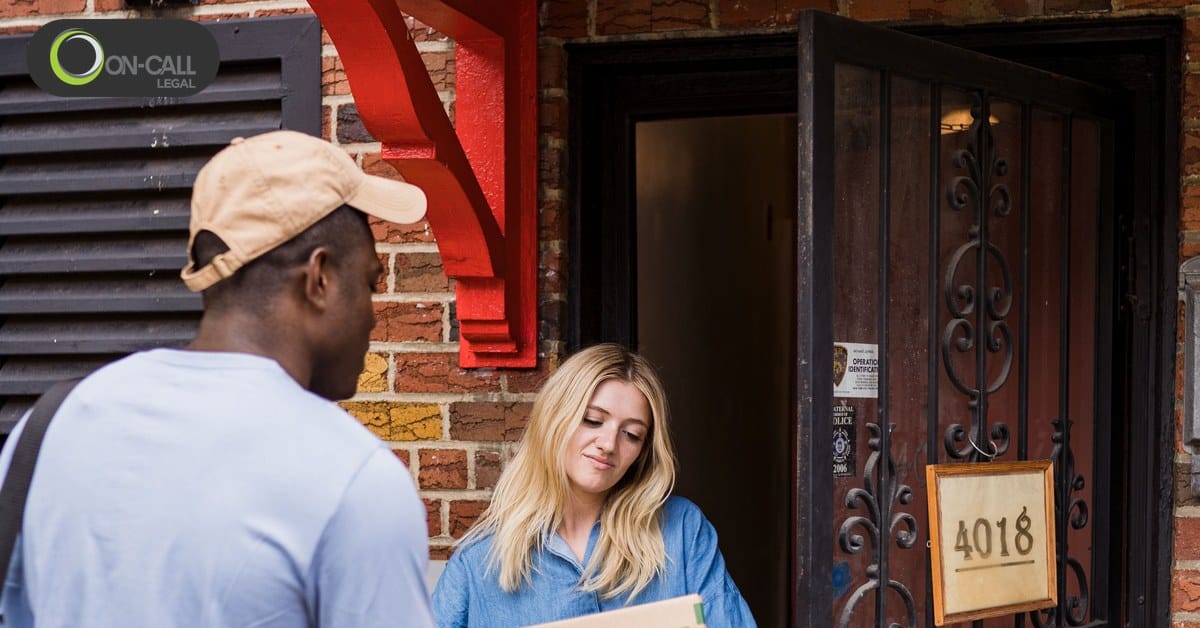
The person serving them must be at least 18 and not a party. Attempts at personal delivery follow at the address where the person lives, each logged by date and time. When the person refuses to take the papers after being identified and told what they are, the server may leave them in that person’s presence and record the refusal. Serving summons and complaint on two people at one house is ordinary, and the proof goes to the court clerk.
Proof of Service and the Problem of Recording Two Deliveries
An invalid proof of service can name the correct address and the adult who took the papers and still omit the capacity that adult held. California law requires the affidavit to show the time, place, and manner of service, the name of the person served, and that person’s capacity under section 417.10(a). For instance, writing “Maria Reyes, mother of the minor defendant,” satisfies this requirement.
POS-010 holds the places to record it, starting at item 3a, which is for the party as shown on the documents served. Item 3b takes a person served on behalf of an entity or as an authorized agent, with the relationship to the party at item 3a stated. Its wording excludes anyone on whom substituted service was made under item 5b, which matters before a parent goes there. Item 6d carries a checkbox labeled 416.60 (minor), among 416.10 (corporation) and 416.70 (ward or conservatee). Item 5b(5) is where a declaration of diligence goes, the form’s own name for a due diligence record, and it is optional. SUM-100 has a CCP 416.60 (minor) box of its own.
The form leaves a real gap, since POS-010 states that a separate proof of service is required for each party served, while section 416.60 produces two deliveries for one party. It offers one party line and one person-served line against a single method block and no repeating field for a second delivery. A checkbox under item 5d allows an additional page describing the service. Because section 416.60 may require delivery to both an adult and the minor while POS-010 is structured around service on a single party, confirm with the filing attorney or court how both deliveries should be documented. An affidavit of service for either delivery still has to show its time, place, manner, person served, and capacity.
Rule 3.110(b) gives a civil plaintiff 60 days from filing to serve every named defendant and to file the proofs, and Rule 3.110(a) leaves Family Code proceedings outside that clock. California’s service of process rules put a minor defendant on the same service clock as an adult. 65% of unlimited civil cases were disposed of within 12 months in fiscal year 2024-25, against the Judicial Council’s own target of 75%.
Mistakes That Get Service on a Minor Set Aside
Serving only the parent when the minor is 12 or older is the error the conjunction creates, and serving only the teenager reverses it. Either one is improper service, and proper service means a minor party must be served correctly on both tracks.
Papers left with a minor are the standard example of an improper recipient when the defendant is an adult, the reverse of the rule here. An adult family member at the same address can take papers for someone else only if they live there and know what the papers are.
Brandon Yadegar, Director and Client Manager at On Call Legal, describes how the firm plans a minor’s case. “When the named party is under 18, one visit often has to cover two people. The parent or guardian receives a copy, and if the child is 12 or older, the child receives one as well. We plan around both.”
A stepparent or an adult sibling is not a parent, and neither one becomes a guardian or a conservator without a court order. Either may qualify at the fallback tier as a person having care or control, which opens only after the search for a tier-one adult is documented. Serving the stepparent with nothing in the file about that search is the gap a later motion uses to invalidate service.
Section 416.60 sets no location restriction, and no statute reviewed here bars service at a school. Penal Code section 626.8 does make it a misdemeanor to be on school grounds without lawful business where your presence disrupts the school, and you refuse to leave.
What the SPARE Act Changes for Serving a Minor in 2027
Assembly Bill 747, the SPARE Act, was signed on October 10, 2025, and its duties become operative on January 1, 2027. Its headline rule defines reasonable diligence as attempting personal delivery in good faith on at least three occasions, on three different days and at three different times. That definition is written for purposes of this subdivision, which is section 415.20(b), whose list names section 416.60. A minor therefore falls inside the three-attempt standard, while a partnership and a public entity sit in subdivision (a) and stay outside it.
New section 417.10(a)(1) requires photographs of the site of each effected or attempted service, each carrying a readable stamp that automatically records the date, time, and GPS or equivalent coordinates. Subparagraph (a)(2)(A) governs a minor’s case because it covers a dwelling place or abode and asks for the door, or the entrance where the door is not reasonably accessible.
Subparagraph (a)(2)(C) then requires the server to explain with specificity why the door could not be reached. Exceptions cover the server’s reasonable safety judgment at (a)(4) and a missing signal at (a)(1)(B), each on a written statement. Paragraph (a)(5) requires the photograph to be taken as closely as practicable to the time of service. The duty is triggered by the method rather than the type of defendant, and a photograph serves a purpose that a written physical description never did.
The proof of service must document the attempts and completed service as required by the applicable 2027 rules. The follow-up mailing gains options too, since the 2027 text allows Priority Mail with tracking or certified mail with return receipt requested alongside first-class mail. New section 473.2(b)(2) keeps a return filed before the operative date from failing for want of a photograph.
Ready to Serve a Minor Without Guessing at the Second Delivery?
Getting a summons to a child’s household is an identification problem before it is a driving problem, since age and the adult’s identity decide how many sets go out. On Call Legal confirms both before the first attempt and returns court-acceptable proof of service with the capacity line completed. Same-day rush options and 24-hour service cover the weeks when a deadline and an unconfirmed address collide.
Our experienced process servers work all 58 California counties and nationwide from three offices, and every server is registered and bonded under Business and Professions Code section 22350. We are affiliated with NAPPS and ServeNow, and we cover 88 incorporated cities and more than 30 courthouse locations in Los Angeles County. Contact Us Today to get the legal papers delivered.
Frequently Asked Questions
On Call Legal has served legal papers across California since 1999 and records timestamped attempts for every case. The answers below track the statutes and Judicial Council forms that govern the work.
Can a Minor Be Served Directly in California?
A minor who is at least 12 years of age is served directly, and that delivery is required rather than optional. The copy to the parent, guardian, conservator, or similar fiduciary still has to happen, because section 416.60 joins them with and.
Does an Emancipated Minor Get Served as an Adult?
Family Code section 7050 provides an emancipated minor the capacity to sue or be sued in the minor’s own name, and section 7122(c) makes a declaration of emancipation conclusive evidence. Section 416.60 still refers simply to a minor, and Family Code section 7002 confirms that an emancipated minor remains a person under 18. Ask for the declaration and take instructions from the plaintiff’s attorney, because which section applies is a legal question.
How Many Days Before a Court Date Must a Minor Be Served?
No rule sets several days before a court date for a civil summons, which instead directs a response within 30 days after service. The 15-day figure belongs to small claims, where service is completed 15 days before the hearing if the defendant resides in the county or 20 days if outside it.
Can a Friend or Family Member Serve the Papers?
Section 414.10 allows any person at least 18 years of age and not a party to serve court papers, so a friend or family member may serve documents in the case. Being related to a party disqualifies no one, while a plaintiff cannot serve papers in their own case, so the person at the door is not you. Anyone making more than 10 paid services of process yearly registers with the county clerk under Business and Professions Code section 22350, and a registered process server puts that number on the proof.
Is There a Fee Waiver for Serving a Minor?
A court fee waiver covers court fees, so a professional process server’s charge sits outside it. Sheriffs and marshals also serve process, and Rule 3.55 includes their fees in an initial fee waiver.
Do Family Law and Juvenile Cases Follow the Same Rules?
Family law cases and juvenile matters run on different rules, and rule 3.110(a) excludes Family Code proceedings from the civil timeline. The family law summons on Form FL-110 travels with FL-115, a proof of service form approved for optional use, while the civil POS-010 is adopted for mandatory use. In dependency and delinquency, Welfare and Institutions Code section 212.5 bars electronic service on anyone under 10 and conditions it on consent above that age, a juvenile rule rather than the civil one.
Legal Disclaimer
On Call Legal is a process-serving and legal support services company and is not a law firm. This article describes California statutes, rules of court, and Judicial Council forms as of the publication date as general procedural information. Nothing here is legal advice, and reading it creates no attorney-client relationship, so consult a licensed California attorney about your case.



On-demand legal services with arranging services from eFiling to organizing and preparing your subpoena for records and/or personal appearance and much more.