
How Do You Serve a Government Agency in California?
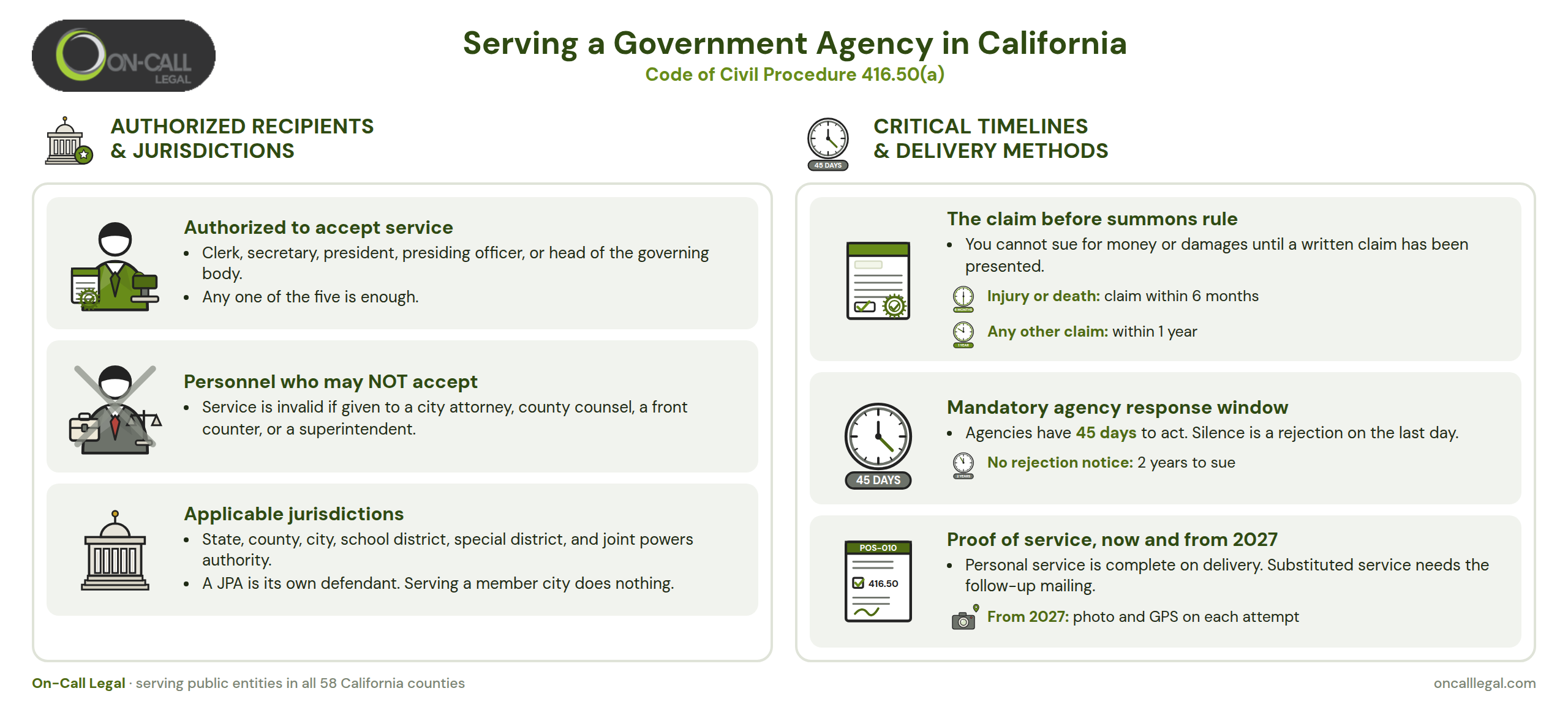
A California public entity is served by delivering the summons and complaint to the clerk, secretary, president, presiding officer, or other head of its governing body under Code of Civil Procedure section 416.50. Before that delivery, a suit for money or damages requires a written claim presented to the entity first, subject to the statutory exceptions. That step is called service of process, and the written claim before it is a statutory precondition to suing.
On Call Legal has been serving legal documents since 1999 from three offices, two in Los Angeles and one in Irvine, covering all 58 California counties and nationwide. Suing a city, a county, or a state department turns the process serving into a counter-errand, because the officer who takes the summons keeps posted hours. Schedule a consultation with us today.
This article explains who may accept service for a public entity, the claim that comes first, how the tier of government changes the recipient, and what the SPARE Act changes.
Who Can Legally Accept Service for a California Public Entity
Service of process on a public entity is governed by its own statute, which names offices instead of people. Section 416.50 has two subdivisions, and only one tells you where the papers go.
The Clerk, Secretary, or Presiding Officer of the Governing Body
Subdivision (a) allows delivery of the summons and complaint to the clerk, secretary, president, presiding officer, or other head of its governing body.
Subdivision (b) does a different job. It defines what counts as a public entity and authorizes service on no one. Its list reaches the state, any state board or agency, the Regents of the University of California, a county, a city, a district, and a public authority. Reading it as a roster of servable officers leads to a motion to quash.
Why the Front Counter Cannot Take the Papers
The officer or agent authorized by law to receive service holds one of the five offices in section 416.50(a). The clerk of the agency's board is the one who staffs a public counter. Government entities do not register an agent the way corporations do, so no business search answers the question. A front-desk employee at city hall is not the city clerk, and court papers left with the wrong counter staff document a delivery without completing service.
A city attorney or county counsel sits outside the list, holding none of the five offices. The same limit catches a school district superintendent, whom Education Code section 35035(a) calls the governing board's chief executive officer. On Call Legal routes subpoena service to a city department through that same clerk's office, though a deposition subpoena has its own statute. Deposing a peace officer also requires a $275-per-day deposit under Government Code section 68097.2, so a deposition subpoena for a personal appearance goes out with a check.
The Claim You Usually Have to File Before You Can Sue
A suit against a public entity does not begin with the summons. Government Code section 945.4 bars any suit for money or damages until you present a written claim and the entity acts on it or deems it rejected. The 60-day and three-year service deadlines begin only once a complaint exists, so waiting on a city does not consume any of the service window.
Which Claims Have to Be Presented First
The Government Claims Act, which older material still calls the Tort Claims Act, governs liability and immunity for public entities. Section 905 requires presentation of all claims for money or damages against local public entities. Workers' compensation claims are excluded, along with public employees' wage claims, pension applications, and tax refunds, and section 905.1 covers inverse condemnation. An exception does not always mean no claim step, because section 935 lets a local entity impose its own procedure by ordinance.

Six Months, One Year, and What the Clock Runs From
A claim for death, injury to a person, injury to personal property, or growing crops must be presented within six months of accrual. Every other cause of action gets one year, and that year is the residual default in Government Code section 911.2 rather than a carve-out. Both periods run from accrual, which section 901 ties to the limitations statute that would otherwise apply.
Section 910 sets out what the claim form must show. A claim under $10,000 states the amount and the basis of computation, while a claim over $10,000 states no dollar amount. Same-day messenger delivery is how a claim form gets onto a city clerk's counter before a deadline.
What the Agency Does With It, and the 45-Day Silence
Government Code section 915 routes the claim by the tier of government, not by one universal rule. To file a claim against a local public entity, hand-deliver it to the clerk, secretary, or auditor. Mailing it to those officers or the governing body at its principal office also works. A claim against the State goes instead to the Department of General Services. A claim against a superior court or one of its judges goes to the court executive officer. A claim against the California State University goes to the Office of Risk Management at the Chancellor's Office.
A mailed claim is presented on the date of deposit, so one mailed on the last day is timely even if it arrives late. The board then has 45 days to act, and silence is a deemed rejection on the last day of that period under section 912.4. An entity that fails to return a late six-month claim with the section 911.3 notice within 45 days waives the untimeliness defense.
The California Victim Compensation and Government Claims Board recorded 7,165 government claims against the state in fiscal year 2015-16. That was the last volume figure it reported before the program moved to the Department of General Services. In fiscal year 2014-15, the last year it could calculate allowances, the Board allowed 618 of 6,485 claims received, so rejection is the ordinary outcome.
The Separate Clock to Actually File Suit
Rejection starts a second clock, separate from the claim deadline. Where the entity gives written notice of rejection under section 913, suit must be commenced within six months after that notice is delivered or mailed. Where it never gives notice, Government Code section 945.6 instead allows two years from accrual. The five-day mail extension in section 915.2(b) is withheld here, so there is no six months plus five days.
The sequence below tracks a claim from accrual to the deadline to sue, with the authority for each period. Every date assumes the claim reached the recipient section 915 names for that entity.
|
Stage |
Deadline |
Authority |
|---|---|---|
|
Cause of action accrues |
Day 0 |
Gov. Code 901 |
|
Present a written claim for death, injury to a person, personal property, or growing crops |
6 months after accrual |
Gov. Code 911.2(a) |
|
Present a written claim for any other cause of action |
1 year after accrual |
Gov. Code 911.2(a) |
|
Deliver or mail the claim to the recipient section 915 names for that entity |
On or before the deadline above |
Gov. Code 915(a) to 915(d) |
|
Mailed claim is presented |
Date of deposit in the mail |
Gov. Code 915.2(a) |
|
Board acts on the claim |
Within 45 days of presentation |
Gov. Code 912.4(a) |
|
Board does nothing |
Deemed rejected on the last day of the 45 days |
Gov. Code 912.4(c) |
|
Commence suit after a written rejection notice |
6 months from personal delivery or mail deposit |
Gov. Code 945.6(a)(1) |
|
Commence suit where no rejection notice was given |
2 years from accrual |
Gov. Code 945.6(a)(2) |
|
Apply to the entity for leave to present a late six-month claim |
Reasonable time, not over 1 year from accrual |
Gov. Code 911.4(b) |
|
Petition the superior court after denial |
6 months from denial or deemed denial |
Gov. Code 946.6(b) |
|
File suit after the court grants relief |
30 days |
Gov. Code 946.6(f) |
How the Type of Agency Changes Who You Serve
The United States Census Bureau's 2025 government organization tables list California as having 4,520 local government units for the fiscal year ending June 30, 2025, including 2,976 special districts. The recipient changes with the tier of government, and so does the address.
The State of California and Its Agencies
A suit against the State of California itself goes to the Attorney General's office. A suit against a county agency goes to the county clerk, and a suit against a city agency goes to the city clerk. Government Code section 955.4 says that service in all actions on claims against the state shall be made on the Attorney General, and section 416.50 reaches the state separately. Whether one displaces the other is a question for the plaintiff's lawyer, and serving both routes covers the file either way.
Section 955.4 carries four express exceptions, and three of them name a different officer to serve. Caltrans and Department of Water Resources inverse condemnation claims may go to the Attorney General or that department's director. Claims against a superior court go to the court executive officer instead. Section 811.9 covers trial court employees and names no one to serve.
Counties, Cities, and School Districts
A county's governing body is the board of supervisors, and Government Code section 25100 makes the county clerk its ex officio clerk unless law provides otherwise. Counties that have provided otherwise run a separate Clerk of the Board office, so the County Clerk-Recorder counter is the wrong one there. A city's legislative body is the city council, and Government Code section 36501 vests general law city government in that council together with a city clerk. Section 416.50(a) puts that clerk on the service list, and a charter city may title the office differently. High school districts elect both a president and a clerk each year under Education Code section 35143. Every other type of school district elects a clerk under the same section, which expressly excludes community college districts.
Special Districts and Joint Powers Authorities
A special district is served through the clerk, secretary, president, or presiding officer of its own board, and a general manager is not on that list by title. A joint powers authority is its own defendant under Government Code section 6507, so serving a member city does nothing.
The table below pairs each common defendant with the officer who accepts service and the source of the address. Titles vary by charter, so confirm the officeholder before dispatch, and remember the claim in front of the summons routes separately under section 915.
|
Entity type |
Who takes the papers? |
Where the mailing address comes from |
|---|---|---|
|
State of California |
Attorney General under Gov. Code 955.4, with the clerk, secretary, president, or presiding officer of the agency’s governing body under CCP 416.50(a) |
The Attorney General’s published service offices |
|
State agency, board or commission |
Clerk, secretary, president or presiding officer of the board, or the other head of the body |
The agency’s own published address |
|
Superior court or a judge |
The court executive officer under Gov. Code 955.9(a) |
That court’s published address |
|
County |
Clerk of the board of supervisors, or the board chair |
The county’s own Clerk of the Board office, not the Registry |
|
City or city and county |
City clerk, or the mayor as presiding officer |
The city’s own City Clerk office, not the Registry |
|
School district |
Clerk or president of the governing board, or a board secretary, under Educ. Code 35143 |
Registry of Public Agencies, plus the district’s own site |
|
Community college district |
Clerk, secretary, or president of the board of trustees, set by the board’s own bylaws |
Registry of Public Agencies, plus the district’s own site |
|
Special district |
Clerk, secretary, president, or presiding officer of the district board |
Registry of Public Agencies |
|
Joint powers authority |
The authority’s own board clerk, secretary, or president |
Registry of Public Agencies |
|
University of California |
Secretary, chair, or president of the Board of Regents |
The Regents’ published office |
|
California State University |
Secretary, chair, or president of the Trustees |
The Chancellor’s Office published address |
|
Public employees sued individually |
The individual, under CCP 416.90 |
Ordinary individual-defendant investigation |
Finding the Right Officer Through the Registry of Public Agencies
Government Code section 53051 requires each public agency to file a statement with the Secretary of State and the county clerk of each county where it keeps an office. Paragraph (a)(4) calls for the name, title and address of the presiding officer and of the clerk or secretary of the governing body. The Legislature has effectively published a directory of the people, and agencies file that statement on Form SF-405 with no fee.
Section 960.8 turns that filing into a service tool. Process served in conformity with the statement on file, if otherwise made in compliance with law, constitutes personal service on the public agency. Where no statement is on file, or the listed officers cannot be personally served with due diligence, sections 960.2 and 960.3 open a court-ordered route on valid reasons shown by affidavit.
Section 53050 excludes the state, counties, and cities, so a reader looking there for a city finds nothing. Section 946.4 removes the failure-to-present defense where the statement was missing or non-conforming during the 70 days after accrual. This removes only a defense, so an unregistered agency is never a reason to skip the claim.
The 2026 California Roster, a separate Secretary of State publication, lists 483 incorporated cities and towns and names a clerk for 481 of them. The jurisdictions report that data themselves, so verify it before dispatch.
The Delivery Methods Available for a Public Entity
Section 416.50 identifies the person, and Code of Civil Procedure sections 415.10 through 415.50 govern how you serve legal documents on that person.

Personal Service
Personal service on the clerk of the governing body finishes the job in a single visit. Section 415.10 completes service at the moment of delivery, so a server who can serve person-to-person leaves nothing to follow. Any person who is at least 18 years old and not a party to the action may serve papers.
Substituted Service at the Agency's Office
Substituted service applies when the designated officer is unavailable during usual office hours, and the follow-up mailing is as mandatory at a government counter as at a private office. Section 415.20(a) includes section 416.50 in its list and begins with the words "in lieu of personal delivery," so no prior attempts are required. A process server leaves a copy with the person apparently in charge of the office and mails a copy by first-class mail to the same address.
At a closed office, neither step is available because nobody is apparently in charge and no office hours are running. Service is then complete on the 10th day after that mailing. The subdivision (b) branch, which allows service at a person's home, covers individual defendants.
Mail With Acknowledgment of Receipt
Section 415.30 allows the summons and complaint to be mailed with two copies of a notice and acknowledgment and a prepaid envelope. Service is complete only when that acknowledgment is executed and returned, so counsel who declines to sign leaves the case unserved. Electronic service does not reach a public entity that has never appeared, because consent is what makes email service valid.
How to Serve a Government Agency in California
Serving local government agencies starts with naming the defendant correctly, because a joint powers authority, an independent special district, and a county department are separate entities. Once the entity is identified, pull the registry statement for a district or the California Roster entry for a city.
With the name in hand, attempt personal service during posted hours, and service is complete the moment the papers change hands. If the officer is unavailable, substituted service requires serving the person apparently in charge, plus a follow-up mailing. Complete POS-010 at items 3b and 6d, then file it within the 60-day period allowed by rule 3.110(b).
Proof of Service and the Deadlines That Run Alongside It
POS-010 has a field for the capacity in which the recipient was served, and that line decides whether the return survives a motion. California law requires the affidavit to show the time, place, and manner of service, plus the title or capacity of the person who took the papers. On the Judicial Council form, that means completing item 3b with a description such as Clerk of the Board of Supervisors, County of Kern. Item 6d then takes the box labeled 416.50 (public entity). A return naming the person and the office shows the entity was served correctly.
SUM-100 itself has no 416.50 box at all, because its Notice to the Person Served stops at 416.90 and then offers other (specify). Writing CCP 416.50 (public entity) on that line keeps the return consistent with the papers served.
Court filing of the proof starts the agency's response clock, and an unfiled proof leaves a later default request without support. Once you file papers with the court, Rule 3.110(b) runs a 60-day clock from the filing of the complaint, covering service and the proofs. Section 583.210 sets the outer boundary at three years, and section 583.250 makes dismissal mandatory once that passes. The court clerk issues the summons under section 412.20, giving the defendant 30 days to file a response and other court documents.
Mistakes That Get Service on a Public Entity Set Aside
An invalid proof of service against a public entity can name a real person at a real address and still fail, because capacity matters more than delivery details. Serving the city attorney, the County Clerk-Recorder, or a member of a joint powers authority fails for the same reason. None of those people holds a section 416.50(a) office.
Documentation errors do comparable damage, starting with logging a counter drop-off as personal service, which misstates when the 30 days start. Attaching a declaration of diligence to a section 416.50 return falsely advertises a requirement that does not exist. An entity that has not been properly served can move to quash under section 418.10 without appearing generally, and that motion voids the service while the case survives.
What the SPARE Act Changes for Agency Service in 2027
The SPARE Act, Assembly Bill 747, was signed on October 10, 2025, and its duties become operative on January 1, 2027. Its headline rule defines reasonable diligence as at least three attempts at personal delivery on three different days at three different times. That definition sits inside section 415.20(b), scoped for purposes of that subdivision, whose list reaches sections 416.60 through 416.90. Section 416.50 is absent, so the three-attempt rule does not reach a public entity.
A public employee sued individually is a separate defendant with different rules. That person is served under section 416.90, which does appear on the subdivision (b) list, so the three-attempt standard applies. One lawsuit naming both the county and a deputy therefore carries both standards.
The photograph duty is different because new section 417.10(a)(1) is based on the method rather than the type of defendant. Service under sections 415.10, 415.20, or 415.45 will require a photograph with a readable stamp recording the date, time, and GPS coordinates of each attempt. Subparagraph (a)(2)(B) calls for a shot of the door of the specific office served, which on its face covers a clerk of the board.
Ready to Serve a California Public Entity Without Guessing at the Recipient?
Getting a summons to the right officer of the right governing body is a records problem before it is a driving problem. On Call Legal identifies the recipient from public filings and serves during posted hours, returning court-acceptable proof of service with the capacity line completed. Same-day rush options and 24-hour service cover the weeks when two deadlines collide.
Our experienced legal couriers work all 58 California counties and nationwide from three offices, fully bonded and affiliated with NAPPS and ServeNow. If you cannot tell whether the defendant is a district, an authority, or a county department, tell us the agency's name and its county. Contact us today to serve legal documents to the government agency you want to serve.
Frequently Asked Questions
On Call Legal has served legal papers on California public entities since 1999 and records timestamped attempts in a client portal. The questions below are the ones clients raise once a claim has been rejected.
How Do You Serve a Government Agency in California After a Claim Is Rejected?
You file the complaint, then deliver the summons and complaint to the clerk, secretary, president, presiding officer, or other head of the governing body under section 416.50(a). The rejection does not change the method, though a written rejection notice starts a six-month window and silence leaves two years from accrual.
Can You Serve a Government Agency by Certified Mail With a Return Receipt?
Certified mail with a return receipt is not a stand-alone way to serve a California summons on a public entity. Section 415.30 works only when someone signs and returns the acknowledgment, though from January 1, 2027, certified mail with return receipt requested becomes a permitted follow-up.
Is There a Fee Waiver for the State Claim Filing Fee?
Government Code section 905.2 sets a $25 filing fee for state claims presented to the Department of General Services. The same section waives it for people on certain public benefits and for anyone at or below 125% of the monthly federal poverty line. A person in custody with $100 or less in a trust account is also covered.
Do Family Law Cases Against a Public Agency Follow These Rules?
Family law cases sit outside the 60-day clock because rule 3.110(a) excludes Family Code proceedings and unlawful detainer cases. Where a public agency is a party, section 416.50 still identifies who may accept the papers.
How Do You Serve a Federal Agency Located in California?
You do not serve a federal agency in California under California rules. Service on a United States agency follows Federal Rule of Civil Procedure 4(i), with its own recipients and timing.
Does a Public Entity Receive Extra Time to Respond to a Summons?
A California public entity responds on the same 30-day schedule as any other defendant, because Government Code section 945.2 applies the ordinary rules of practice.
Legal Disclaimer
On Call Legal is a process-serving and legal support services company and is not a law firm. This article describes California statutes, rules of court, and Judicial Council forms as of the publication date and is for general information. Nothing here is legal advice, and reading it creates no attorney-client relationship, so consult a licensed California attorney about your matter.



On-demand legal services with arranging services from eFiling to organizing and preparing your subpoena for records and/or personal appearance and much more.