
How Many Days Do You Have to Serve a Summons in California? Both Deadlines Explained
Quick answer
On-Call Legal has served legal documents throughout California since 1999, and our registered process servers work across all 58 counties with timestamped attempt records and court-acceptable proofs of service. Our process servers handle cases where a deadline is already close, and the defendant is difficult to find, which is when the difference between the two deadlines stops being academic. Contact us if you have a summons that has to be served by a specific date.
This article explains both deadlines, what happens when each one is missed, when service counts as complete under each method, and the situations where the timeline works differently.
The Two Deadlines for Serving a Summons in California
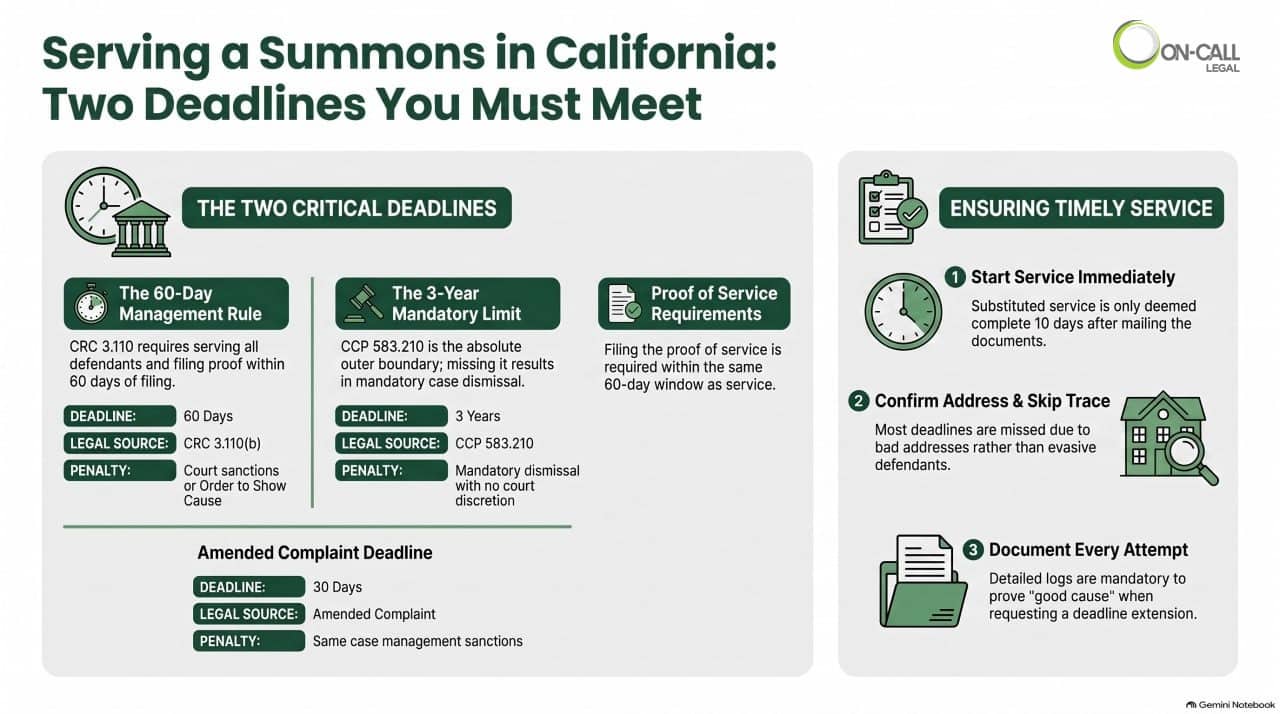
Most articles on this subject give one number and stop. That is why so many people end up with the wrong answer, because the two deadlines come from different sources, serve different purposes, and carry very different consequences.
The 60-Day Rule Under the California Rules of Court
California Rules of Court Rule 3.110 states that the complaint must be served on all named defendants, and proof of service on those defendants must be filed with the court within 60 days after the filing of the complaint. This is the time limit that governs your case in practice. It is a case management rule, which means the court is using it to keep the matter moving toward a trial date rather than to end it, and it conserves court resources by stopping cases from sitting unserved.
The Three-Year Limit Under the Code of Civil Procedure
Code of Civil Procedure section 583.210 states that the summons and complaint shall be served on a defendant within three years after the action is commenced against that defendant, and that an action is commenced at the time the complaint is filed. This is the outer boundary. It is not a target and no competent plaintiff should ever approach it.
Why the Two Deadlines Do Different Jobs
The 60-day rule is enforced with sanctions and pressure. The three-year rule is enforced with dismissal. Miss the first, and you will be explaining yourself to a judge who has the power to make life difficult. Miss the second, and there is no explanation available, because the statute removes the court’s discretion entirely.
That is the distinction to keep in mind for the rest of this article. One deadline is about how the court manages your lawsuit. The other is about whether your lawsuit continues to exist.
What the 60-Day Rule Actually Requires
The rule asks for two things rather than one, and the second is where plaintiffs most often slip.
Serving All Named Defendants Within 60 Days of Filing
Every named defendant has to be served inside the window, not just the main one. A case involving four defendants is not compliant if three were served promptly but the fourth was left until later. The unserved defendant delays the entire matter at the first case management conference.
Filing Proof of Service and the Deadline People Get Wrong
Rule 3.110(b) requires the proofs of service to be filed within that same 60 days, not merely for service to have happened. Serving on day 55 and filing the proof with the court clerk on day 80 misses the rule, even though the service of the summons itself was timely.
There is a second and separate provision that causes real confusion here. Code of Civil Procedure 583.210(b) says proof of service of the summons shall be filed within 60 days after the time the summons and complaint must be served on a defendant, which means 60 days measured from the three-year mark rather than from anything else. Two different 60-day periods, running from two different starting points. Because neither of them runs from the date of service, any source telling you that proof must be filed within 60 days after service is describing a nonexistent rule.
The 30-Day Rule When an Amended Complaint Adds a Defendant
When a complaint is amended to add a defendant, the added defendant must be served, and proof of service must be filed within 30 days of the filing of the amended complaint. The window is half the original, and it is easy to overlook, because by the time an amended complaint is filed, the case usually feels like it is already moving.
Cross-Complaints and When They Must Be Served
A cross-complaint against a party who has already appeared in the action must be accompanied by proof of service at the time it is filed. Where a cross-complaint adds new parties, those parties must be served and proofs of service filed under the timeline set out by the rule. The practical point is that a cross-complaint is not an afterthought with a generous deadline attached.
What Happens If You Miss the 60-Day Deadline
Missing this deadline is a problem rather than a catastrophe, provided you deal with it rather than hope nobody notices.
Requesting an Extension for Good Cause
Rule 3.110(e) allows the court to extend the time for service on a written application showing sufficient cause. The application must describe the efforts made to complete service and specify the date by which service is proposed to be completed. That first requirement is the one that matters, because an application that cannot describe genuine efforts is asking the court to excuse inactivity rather than delay.
This stage is where documented attempts earn their value. A professional process server who has logged every attempt with a date and a time gives you the evidence the application needs.
Orders to Show Cause and Sanctions
Under Rule 3.110(f), if a plaintiff fails to serve and file pleadings as required and has not obtained an order extending time, the court may issue an order to show cause why sanctions should not be imposed. Separately, Rule 3.110(g) requires a plaintiff to file a request for entry of default within 10 days after the time for service of a responsive pleading has elapsed where no responsive pleading has been served.
Why Courts Expect Service Much Sooner Than Three Years
California courts expect plaintiffs to serve defendants far sooner than the statutory outer limit, and the 60-day rule is the expression of that expectation. Treating three years as your working deadline is how cases end up dismissed, because the three-year clock keeps running while you are dealing with everything else.

The Three-Year Limit and Mandatory Dismissal
This period is the deadline with no give in it, and the statutory language is unusually blunt about that.
How the Three Years Is Calculated From the Date the Complaint Is Filed
The three-year period runs from the date the complaint is filed, since that is when the action is commenced for this purpose. It does not run from the date of the underlying incident, from the date you discovered the claim, or from the date you located the defendant.
Periods That Are Excluded From the Three-Year Count
Code of Civil Procedure 583.240 excludes certain periods from the three-year computation. These periods include times when the defendant was not amenable to the court’s process, when the prosecution of the action was stayed and the stay affected service, and when the validity of service was itself the subject of litigation between the parties. Additionally, it covers times when service was impossible, impracticable, or futile due to causes beyond the plaintiff’s control.
The statute then closes the obvious loophole. Failure to discover relevant facts or evidence is expressly a cause within the plaintiff’s control. Not knowing where the defendant lives does not delay the time limit.
Why Dismissal Under This Rule Is Mandatory Rather Than Discretionary
Section 583.250 states that if service is not made within the prescribed time, the action shall be dismissed by the court, either on its own motion or on the motion of any interested person, and no further proceedings shall be held. It then states that the requirements are mandatory and are not subject to extension, excuse, or exception except as expressly provided by statute.
That is about as absolute as California civil procedure can be. The court is not weighing your reasons. It does not need the other party to ask.
How Long the Defendant Has to Respond After Being Served
Once the defendant has been served, a different clock starts. Code of Civil Procedure section 412.20 requires the summons to direct the defendant to file a written pleading in response to the complaint within 30 days after the summons is served on them and to warn that a default may otherwise be entered.
Those are calendar days, not court days, and the period is extended if the documents were served by a method that carries an extension. If no response arrives and no extension has been granted, the plaintiff is expected to request entry of default rather than let the matter drift, and a default judgment can follow from there.
How Many Days Before a Hearing You Must Serve Documents
This is a different question from the summons deadline, and it gets confused with it constantly, so it is worth separating clearly.
Code of Civil Procedure 1005(b) requires that, unless otherwise ordered or specifically provided by law, all moving and supporting papers be served and filed at least 16 court days before the hearing. Court days exclude weekends and court holidays, so 16 court days is meaningfully longer than 16 calendar days.
Where the notice is served by mail, that 16-day period increases by five calendar days if the place of mailing and the place of address are both within California, by 10 calendar days if either is outside California but within the United States, and by 20 calendar days if either is outside the United States. This rule governs motions and hearings. It has nothing to do with how many days you have to serve a summons, and applying it to a summons will give you the wrong answer.
How the Service Method Changes When Service Is Complete
A deadline only means something once you know when service actually counts as done, and that varies by method. Getting this wrong is how a service that looked timely turns out not to be.
Personal Delivery, Complete on Delivery
Personal service is complete at the moment the documents are handed to the person served. There is no waiting period and nothing to add, which is why it is the safest method when a date is close.
Substituted Service, Complete on the 10th Day After Mailing
Where personal delivery fails, and the server leaves the documents with a qualifying adult and mails a copy, service is deemed complete on the 10th day after that mailing. Ten days of your window disappear at the end of the process, which is exactly why substituted service should never be the plan you start with when a deadline is close.
Service by Mail, Certified Mail and the Extension That Is Not a Delay
This one is widely misstated. Under Code of Civil Procedure 1013, service by mail is complete at the time of deposit in the mail. The five-day extension adds five calendar days to any notice period or response obligation when both the mailing and address locations are within California, and it adds ten calendar days if either location is outside California but still within the United States.
So service by mail is not complete five days after mailing. Service is complete on deposit, and the other party gets five extra days to respond. The distinction matters when you are counting backward from a deadline. Where a statute requires certified mail, the return receipt is part of the proof rather than an optional extra, so build the extra handling time into your schedule.
Service by Publication and Reasonable Diligence
Service by publication requires a court order and proof of reasonable diligence in trying to locate the defendant. It is slow, it needs the court’s permission, and it is a last resort rather than a timing solution.

Deadlines That Work Differently in Certain Cases
Rule 3.110 does not apply uniformly across every case type, and some proceedings run on their own timetable.
Unlawful Detainer Actions and Their Faster Timeline
Unlawful detainer actions move far faster than ordinary civil cases and carry their own service and response deadlines, with a response window measured in days rather than the standard 30 and a court date that arrives quickly. Anyone treating an eviction matter as though the general civil timeline applies will miss a deadline.
Claims Against a Public Entity
Claims against a public entity involve a separate claim presentation process before a lawsuit can proceed, with its own deadlines that sit ahead of anything discussed here. Service on a public entity is also made through the clerk or the designated agent of the body rather than on an individual, and the same is true when you are serving a business through its agent for service of process.
Serving a Defendant Outside California
A defendant does not have to be located in California. California courts permit service on defendants outside the state under subdivision (a) of Code of Civil Procedure 413.10, and the three-year rule still applies to them. What changes is the practical time required and, where documents are mailed, the size of the extension the other party receives.
Comparing the California Service Deadlines
The table below puts the main deadlines side by side. Read it as a summary rather than a substitute for the sections above, since the consequence column is the part that varies most.
| Deadline | Source | What it requires | What happens if missed? |
|---|---|---|---|
| 60 days from filing | California Rules of Court 3.110(b) | Serve all named defendants and file proofs of service. | Order to show cause, possible sanctions |
| 30 days from amended complaint | California Rules of Court 3.110(b) | Serve any newly added defendant and file proof. | Same case management consequences |
| Three years from commencement | Code of Civil Procedure 583.210 | Serve the summons and complaint. | Mandatory dismissal under section 583.250 |
| 30 days after service | Code of Civil Procedure 412.20 | Defendant files a written response. | Plaintiff may request entry of default. |
| 16 court days before hearing | Code of Civil Procedure 1005(b) | Serve and file moving papers. | Hearing may not proceed. |
How to Avoid Missing a Service Deadline
None of these deadlines are difficult to meet. They get missed because service is treated as an administrative task to be started once everything else is settled.
Start Service Immediately Rather Than at Day 50
The 60-day window is generous only if you use all of it. A defendant who is avoiding service, who has moved, or who is only home at unpredictable hours can absorb weeks. Start on day 50 and there is no room for escalation to substituted service, which adds ten days at the end.
The legal deadline and the practical timeline are two different things, and how long it takes to serve someone in the real world depends on the address, the method, and how cooperative the defendant is. Plan for the second one, not the first.
Confirm the Address Before the Clock Runs
More deadlines are missed because of a bad address than because of an evasive defendant. Confirming where the person actually lives or works, before attempts begin, is the single most useful thing a plaintiff can do. Where the address is unknown, skip tracing at the start of the window costs far less than an extension application at the end of it.
Document Every Attempt in Case You Need an Extension
If you do need more time, the court will want to see what you have done. Attempts logged with dates, times, and outcomes turn an extension application into a formality. No record makes it a problem, and it is easier to understand what happens if you cannot serve someone court papers before you are in that position than after.
Why Service Deadlines Get Missed
“Almost everybody meets these deadlines because they knew the number,” says Brandon Yadegar, Director and Client Manager at On-Call Legal. “They miss them because they started late. A firm files the complaint, gets busy, and sends us the papers on day forty-five with a defendant who turns out to have moved twice. Now you will need to conduct skip tracing, make three attempts at the new address, and complete substituted service, which is not considered complete until ten days after the mailing. That is the whole window gone. Send it out in week one, and none of that matters.”

So How Many Days Do You Really Have to Serve a Summons in California?
You have 60 days from the complaint’s filing to serve every named defendant and file the proofs of service, and that is the deadline you should be working to. Behind it sits an absolute three-year limit from the date the action commenced, after which dismissal is mandatory and the court has no discretion to forgive it. If a defendant is added by an amended complaint, the window shrinks to 30 days, and the practical deadline is always earlier than the number suggests, because substituted service is incomplete until ten days after the mailing and a bad address can consume weeks before that.
Ready to Get Your Summons Served on Time?
Meeting a service deadline is far easier than explaining a missed one, and the difference is almost always how early the papers went out. On-Call Legal serves summonses and complaints across California with documented attempts, fast escalation when an address turns out to be wrong, and proofs of service filed in time to satisfy the rule. If your 60-day window has already started running, the sooner the papers are with a server, the more options remain.
Our professional process servers have served legal documents throughout California since 1999, covering all 58 counties with registered process servers, timestamped attempt records, and court-acceptable proofs of service. The same team handles skip tracing when an address needs confirming and court filing when the proof has to be on file by a date. Contact us today to get your summons served against the deadline that applies to your case.
Frequently Asked Questions
The questions below cover the deadlines that are most often confused with each other and what each one actually requires. The answers are based on On-Call Legal’s experience serving clients across California, the practical knowledge gained from handling service of process throughout the state, and the current text of California statutes and rules of court.
How Many Days Do You Have to Serve a Summons in California?
Sixty days from the date the complaint is filed under California Rules of Court 3.110(b), including filing the proofs of service. The outer statutory limit is three years from when the action commenced.
What Happens If a Summons Is Not Served in Time?
Missing the 60-day rule can bring an order to show cause and possible sanctions. Missing the three-year limit results in mandatory dismissal under Code of Civil Procedure 583.250, which is not subject to extension or excuse.
Can the Time to Serve a Summons Be Extended?
Yes, a party can extend the 60-day rule by submitting a written application that demonstrates good cause, outlines the efforts already made, and includes a proposed completion date. The three-year limit cannot be extended except as expressly provided by statute.
When Does the Three-Year Period Start?
The three-year period starts on the date the complaint is filed, since that is when the action is commenced for this purpose. Certain periods are excluded, but failure to discover relevant facts is included.
How Long Does a Defendant Have to Respond After Being Served?
Thirty calendar days after the summons is served, under Code of Civil Procedure 412.20, is extended where the method of service carries an extension.
How Many Days Before a Hearing Must Documents Be Served?
At least 16 court days before the hearing for moving papers under Code of Civil Procedure 1005(b), increased by five calendar days when served by mail within California. This is a hearing rule that does not apply to serving a summons.
Does Substituted Service Meet the Deadline?
Only if it is complete in time. Substituted service is deemed complete on the 10th day after the copy is mailed, so those ten days have to fall inside your window.
Legal Disclaimer
This article provides general procedural information about service of process in California and is not legal advice. Deadlines vary by case type, by court, and by local rules, and some proceedings carry their own timelines. Consult an attorney about your specific matter.



On-demand legal services with arranging services from eFiling to organizing and preparing your subpoena for records and/or personal appearance and much more.