
How to Serve a Partnership in California?
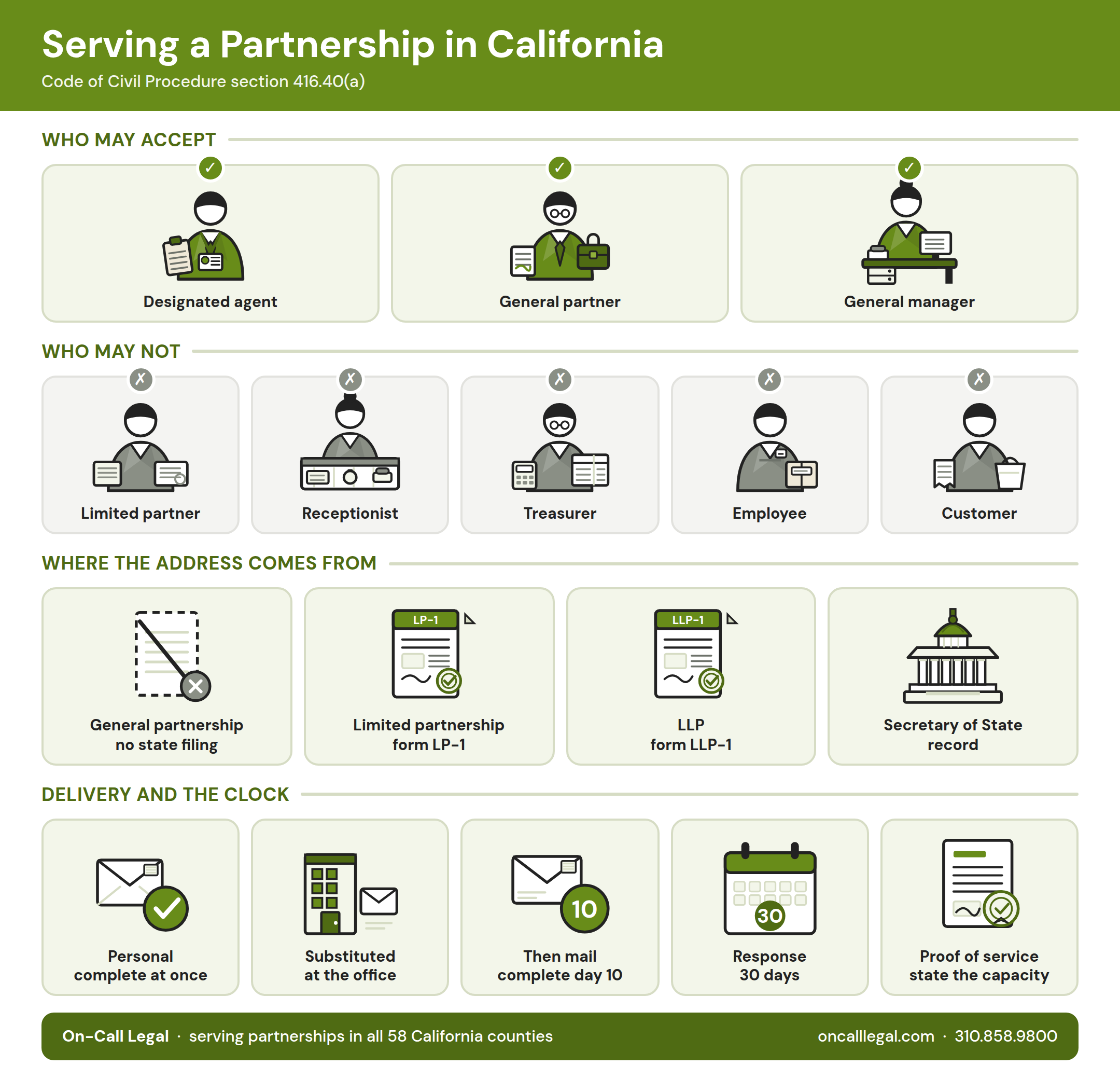
Code of Civil Procedure section 416.40(a) lets you serve a general or limited partnership by delivering the summons and complaint to the agent named in a Secretary of State filing, to a general partner, or to the general manager. Those three categories are the entire list in subdivision (a), since the longer officer roster in subdivision (b) applies only when the association is not a partnership, and subdivision (c) adds only a court-ordered delivery to designated members under Corporations Code section 18220. Delivery itself runs through sections 415.10 to 415.95, usually as personal service or substituted service at the partnership’s office.
On-Call Legal has served legal documents since 1999, covers all 58 California counties, works nationwide, and holds NAPPS and ServeNow memberships. Our process servers log timestamped attempts in a client portal and return court-acceptable proof of service, with same-day rush from our two Los Angeles offices and our Irvine office. Schedule a consultation with our team today to ensure the partnership is served correctly.
This article covers who may accept service for a California partnership, how the entity type and the partnership agreement change the answer, and what the SPARE Act changes in 2027.
Who Can Legally Accept Service for a California Partnership
Service of process on a partnership works differently from service on an individual, because the entity cannot take a document, and a person has to accept it on the partnership’s behalf. Section 416.40 covers unincorporated associations, and its first subdivision is the one written for partnerships.
The Agent Named in the Secretary of State Filing
The agent for service of process on file with the California Secretary of State is the address to try first on a registered limited partnership or LLP, and it is also the address that quietly goes stale. California Corporations Code section 15901.16(d)(1) says a limited partnership’s certificate “shall designate” an agent, while section 16309(a) says the Statement of Partnership Authority a general partnership may file “may designate an agent for service of process.”
Plenty of entities appoint a commercial agent company such as CT Corporation instead of a partner, which turns the attempt into a walk-in delivery at an intake counter. Sections 15901.16(d)(5) and 16309(d) require an amended designation when an agent resigns, and entities routinely skip it.
A General Partner or the General Manager
A general partner can take the papers for the whole partnership, so identifying the general partners correctly matters more than finding the office. Corporations Code section 15901.16(b) adds the same route for limited partnerships, including officers of a corporate general partner.
Serving a general partner completes service on the partnership without making that individual a defendant in their own name. Section 16307(c) states that a judgment against a partnership alone does not constitute a judgment against a partner, and it cannot reach a partner’s assets unless a judgment also runs against that partner. A caption naming the partnership and a partner individually requires two capacities and two proofs.
The People Who Cannot Accept Service for a Partnership
Limited partners appear nowhere in section 416.40(a), so handing a summons to one is not authorized service. The vice president, secretary, and treasurer roster that fills so many articles comes from section 416.40(b), which applies only if the association is not a partnership. A receptionist or office manager is not authorized either, though papers left with them can be valid as substituted service, and the partnership’s counsel needs express authority from the client. Employees and customers deal with the business constantly without holding that authority, so neither can accept a summons for the partnership.
The California Court of Appeal, Fourth District, Division Two, put the principle plainly in Dill v. Berquist Construction Co. (1994) 24 Cal.App.4th 1426, 1438.
“Agents are not fungible. A person who is authorized to perform one function on behalf of a principal may have no authority at all regarding a different function. In particular, the fact that a person is authorized to receive mail on behalf of a corporation and to sign receipts acknowledging the delivery of that mail does not mean that the same person is authorized by the corporation to accept service of process.”
Dill was a corporation case, and the same opinion treats substantial compliance as sufficient, which matters because it gets miscited for a strict-compliance rule. The court still found compliance absent on the facts before it and affirmed the dismissal, since liberal construction cannot cure a complete failure to comply with the service statutes. The reasoning travels anyway, since a partnership is reached through individual people and 416.40(a) names which ones.
How Your Partnership’s Structure Decides Who Gets Served
A partnership is an unincorporated business structure, and California law recognizes several entities under that heading. Their filing requirements decide whether a public record exists and where the first attempt goes.
A General Partnership Leaves No State Filing to Search
Corporations Code section 16202(a) provides that the association of two or more persons to carry on as co-owners for profit forms a partnership, whether or not they intend to form one. Because no state formation filing is required, most California general partnerships have no record with the Secretary of State and no registered agent. Each partner in a general partnership carries unlimited personal liability for its debts because section 16306(a) makes all partners jointly and severally liable for the partnership’s obligations. A general partnership using a fictitious business name must still file a fictitious business name statement with the county clerk within 40 days under Business and Professions Code section 17910.

A Limited Partnership Names Its Agent and Its General Partners on Form LP-1
A limited partnership exists only once the partners submit Form LP-1 to the Secretary of State. Corporations Code section 15902.01 requires that the certificate of limited partnership name the entity, its principal office, the initial agent for service of process, and each general partner. Section 15903.03(a) generally protects limited partners from being liable for the entity’s obligations, unless a limited partner is named as a general partner in the certificate or takes part in controlling the business. Section 15904.04(a) imposes joint and several liability for those obligations on the general partners. That division of liability is why a general partner can accept the summons for the entity and a limited partner cannot.
An LLP Registers With the State and Stays a Partnership for Service
An LLP registers with form LLP-1 under Corporations Code section 16953, which requires the registration to name a California agent for service of process. An LLP remains a partnership, so section 416.40(a) still governs who may accept the summons, with the additional route in Corporations Code section 16962 layered on top. That section adds hand delivery to the designated agent and, on a court order, substitute service through the Secretary of State.
Five arrangements account for nearly every partnership file, and each produces an address from a different record.
|
Entity type |
State filing required |
Who you can serve |
Where the address comes from |
|---|---|---|---|
|
General partnership |
Optional GP-1 Statement of Partnership Authority |
A designated agent if one was named, a general partner, or the general manager |
County fictitious business name records, the partnership agreement, field investigation |
|
Limited partnership |
Required, form LP-1 certificate of limited partnership |
The same three categories under section 416.40(a); a limited partner is not among them |
Secretary of State record, which names the agent and each general partner |
|
Limited liability partnership |
Required, form LLP-1 |
The same three categories, plus the hand-delivery and court-ordered routes in Corporations Code section 16962 |
Secretary of State record, obtained by request to the Sacramento office |
|
Foreign partnership registered in California |
Yes |
The California-registered agent, a general partner, or the general manager |
California Secretary of State record |
|
Foreign partnership not registered |
No |
A general partner or the general manager wherever that person is found, and the Secretary of State as statutory agent under Corporations Code section 15909.07 for claims arising from business done here |
Out-of-state investigation, home-jurisdiction filings, and the California Secretary of State |
The Partnership Agreement Sets the Roster a Server Works From
Relations among the partners are governed by the partnership agreement under Corporations Code section 16103(a), and the statutory default rules apply only where that agreement is silent. No statute requires an agreement at all, and none requires a writing, though a written agreement is what a court and a server can actually read.
A well-drafted agreement records who the general partners are, how new partners are admitted, what happens when a partner exits, and how profits and management decisions are divided. Section 16103(b) still fences off terms they cannot rewrite, including the duty of loyalty each partner owes the other partners as a fiduciary duty.
The general partners of a limited partnership run the business day-to-day under section 15904.06(a). A California partnership agreement can allocate a partner’s authority over particular decisions or name the partner responsible for a given function. None of that changes who may be served, since section 416.40(a) is not a rule the partners agree around. What a written partnership agreement does control is the roster of individual partners from whom a server works. Whoever holds general partner status on the day of the attempt can take a summons on the partnership’s behalf.
Admitting a partner or losing one changes that set, and a filing from two years ago may name a partner who is no longer involved. Section 16403(a) requires a general partnership to maintain its books and records, if any, at its principal office, and section 15901.11 requires a limited partnership to keep a current partner list with mailing addresses there. That list is the record that identifies a servable person, which matters because partner disputes are frequently the lawsuits being served. An accounting between partners is one common example, where the difference between a general partner and a limited partner decides whether the proof survives a motion to quash.
Checking the Secretary of State Record Before the First Attempt
The Internal Revenue Service counted 501,509 partnership returns filed from California addresses in fiscal year 2025. The agency assigns a state by the principal office on the return, so that counts filing addresses rather than partnerships operating here. The Franchise Tax Board reported 4,272 first-year limited partnerships and 387 first-year LLPs in taxable year 2022, counting first-year registrations rather than active entities.
The business search the Secretary of State’s office runs at bizfileonline returns the registered agent and address of record. General partnerships and LLPs generally are not searchable there, so an empty result is not evidence the business does not exist. Their records come instead from an in-person or mailed request to the Secretary of State’s Sacramento office. When the filed address turns out to be an empty suite, skip tracing converts it into a current one by running each named general partner.
The Delivery Methods California Recognizes for a Partnership
Section 416.40 answers who may accept the papers, while a separate article answers how they get there. California recognizes personal service, substituted service, mail with notice and acknowledgment, out-of-state mail with a return receipt, court-ordered publication, and delivery to a business organization whose form is unknown, across sections 415.10 to 415.95. Whoever makes the delivery has to be at least 18 and not a party to the action under section 414.10, which holds across every method in the chapter.
Personal Delivery Completes Service the Moment It Happens
Personal service on the designated agent, a general partner, or the general manager ends the analysis cleanly, because section 415.10 deems service complete at the moment of delivery with no waiting period.
Substituted Service at the Partnership’s Office
Section 415.20(a) opens with the words “in lieu of personal delivery” and lists the entity sections, including 416.40, which means substituted service on a partnership carries no reasonable-diligence prerequisite. The diligence language everyone quotes lives in section 415.20(b), which lists sections 416.60, 416.70, 416.80, and 416.90, covering individuals. A server may therefore go straight to substituted service without logging failed attempts first.
No diligence requirement is not the same as no care. The copy still has to be left during usual office hours with the individual apparently in charge, followed by a first-class mailing to that same address. Service is deemed complete on the 10th day after the mailing. A server who skips the mailing has no completion date and no completed service.
When the Entity’s Form Is Unknown, Section 415.95 Fills the Gap
Section 415.95 covers service on a business organization, form unknown. It works like substituted service at an office, with a copy left during usual office hours with the person apparently in charge and a copy mailed to that address. Service is complete on the 10th day after the mailing. Subdivision (b) withholds the section from a corporation with a registered agent on file, which leaves it available for the partnership-sounding name whose form the public record does not settle. Form POS-010 prints it as a checkbox at item 6d alongside 416.40.
Mail With Acknowledgment of Receipt
Section 415.30 lets you mail the summons and complaint first-class with a notice and acknowledgment form whose statutory wording expressly addresses a person signing for an unincorporated association including a partnership. Service completes only when the recipient executes and returns that acknowledgment.

Serving a Partnership Outside California
Section 415.40 allows service outside this state by first-class mail requiring a return receipt, complete on the 10th day after the mailing. A foreign limited partnership transacting business here without a certificate of registration appoints the Secretary of State as its agent by operation of law under Corporations Code section 15909.07.
What to Do When the Agent Cannot Be Found
A partner who cannot be located after documented attempts pushes the case toward a court order for an alternate method, and the judge will want the attempt log first. For a registered limited partnership, Corporations Code section 15901.16(c)(1) requires an affidavit showing the agent cannot with reasonable diligence be found. A court may then order hand delivery to the Secretary of State of one copy per defendant plus the order. Government Code section 12197 puts the fee at $50, and service completes on the 10th day.
Serving a Partnership, Step by Step
The opening move is confirming what business entity the defendant actually is, since a name ending in “Partners” may be a general partnership, a limited partnership, an LLP, or an LLC that took a partnership-sounding name. Once that is settled, pull the Secretary of State record and, for a general partnership, the county fictitious business name filing, so you have the agent and the general partners with their addresses. Choosing which of the three categories in section 416.40(a) you are aiming at comes next, because that choice governs what the proof will say.
The attempt starts with personal delivery to that individual at the address on file, and when the person is not there, substituted service follows immediately under section 415.20(a) with whoever is apparently in charge. The follow-up mailing goes out the same day where possible, with completion calendared for the 10th day. Only once it is documented does the server prepare form POS-010 naming the individual, the relationship to the entity and the 416.40 capacity, and the file closes when the proof reaches the clerk.
Proof of Service and the Deadlines That Run Alongside It
Section 417.10(a) requires the affidavit to show the time, place, and manner of service and to state, where appropriate, the person’s title or the capacity in which the person is served. On form POS-010, this involves filling out item 3b with the individual’s name and their relationship to the entity, followed by marking 416.40, which is labeled “association or partnership,” in item 6d. An invalid proof of service is the usual reason a partnership default is vacated, and the defect is almost always a missing capacity statement.
California Rules of Court, rule 3.110(b) requires the complaint to be served and the proofs filed within 60 days of filing, while section 583.210 sets the outer limit at three years from commencement. Section 412.20(a)(3) gives the partnership 30 days after service is complete to respond, so one served by substitution gets 40 days from the mailing rather than from the drop-off, and the court filing closes the loop.

Mistakes That Get Service on a Partnership Set Aside
California superior courts took in 299,534 unlimited civil filings in fiscal year 2024 to 2025. That figure measures volume across every civil case type, and the report makes no finding about service of process, so nothing in it explains why an individual partnership default gets vacated.
Logging a handoff to a receptionist as personal service misstates the method and the completion date, and serving a limited partner, or a partnership’s treasurer, puts the papers in hands that section 416.40(a) never authorizes. Brandon Yadegar, Director and Client Manager at On-Call Legal, ties the pattern back to the paperwork.
“The proof of service has to say who accepted and in what capacity. When a server writes ‘a person who answered the door,’ the other side has something to work with. When it names the general partner, they do not.”
What the SPARE Act Changes for Service in 2027
Assembly Bill 747, the Service of Process Accountability, Reform, and Equity Act, was signed on October 10, 2025, as chapter 563 of the 2025 statutes, and its substantive requirements are operative January 1, 2027, rather than 2026.
The widely reported rule requiring personal delivery to be attempted in good faith on at least three occasions, on three different days at three different times, sits in new section 415.20(b)(2). That subdivision lists sections 416.60, 416.70, 416.80, and 416.90 and omits 416.40, so the three-attempt definition never reaches a partnership served under subdivision (a). New section 417.10(a)(1) works the other way, because it is triggered by the method rather than the type of defendant, applying whenever service is made under section 415.10, 415.20, or 415.45.
A server making substituted service at a partnership’s office in 2027 will therefore need photographs of the site. Each must carry a readable stamp recording the date, time, and GPS coordinates, and 417.10(a)(2)(B) requires one showing the door or entrance of the specific office. The successor version of 415.20(a) also widens the follow-up mailing to allow Priority Mail with tracking or Certified Mail with a return receipt requested.
Ready to Get Your Partnership Documents Served Correctly?
Serving a partnership takes more research than driving, and that research is what keeps a default from being vacated later. On-Call Legal confirms the entity type, pulls the Secretary of State and county records, identifies the authorized recipient, and timestamps every attempt for the court. Fully bonded and serving legal documents since 1999, we handle partnership files statewide, with same-day rush service when a deadline is within two weeks.
Our experienced legal couriers and registered process servers know which counties move quickly, which intake counters close early, and which filings carry dead addresses. Contact us today with the partnership’s filing details, and we will scope the service strategy.
Frequently Asked Questions
Our servers work partnership files across all 58 California counties, including 88 incorporated cities and 36 courthouse locations in Los Angeles County. These questions are recurring, and the answers describe general procedure rather than advice on a particular case.
What Taxes and Returns Does a California Partnership File?
General partnerships, limited partnerships, and limited liability partnerships all file a Partnership Return of Income, Form 565, and each partner reports their share of profits on a Schedule K-1 (565). Limited partnerships and LLPs each owe the $800 annual tax under Revenue and Taxation Code sections 17935 and 17948, while general partnerships do not.
Can a Limited Partner Accept Service for the Partnership?
No, because neither section 416.40(a) nor Corporations Code section 15901.16(b) names a limited partner, so papers handed to one are not authorized service.
Is There a Time of Day When a Partnership Cannot Be Served in California?
No statute fixes clock hours for serving a summons, and the 8 a.m. to 8 p.m. window that gets quoted comes from section 1011(b)(1), which governs papers served after a party has appeared and applies only at a residence. Substituted service is the one place the clock matters, because section 415.20(a) requires that the copy be left at the office during usual office hours. That is an element of the method rather than a curfew on service generally.
Does Serving a General Partner Reach That Partner’s Personal Assets?
No, because Corporations Code section 16307(c) provides that a judgment against a partnership is not by itself a judgment against a partner and cannot be satisfied from a partner’s assets without a separate judgment.
Does a General Partnership Have to Register With the Secretary of State?
No state formation filing is required, because two or more people carrying on a business as co-owners for profit form a general partnership by conduct. County filing requirements still apply when the business operates under a fictitious name.
Does the Same Capacity Rule Apply to a Subpoena?
The same capacity question governs subpoena service, so a records subpoena aimed at a partnership goes to a general partner or the designated agent rather than whoever answers the phone.
Legal Disclaimer
This article describes the California service-of-process procedure in general terms for informational purposes only; it is not legal advice, and reading it creates no attorney-client relationship. Statutes, rules of court, and Judicial Council forms change over time, and the correct approach depends on the facts of a specific matter, so anyone with a pending or contemplated lawsuit should consult a licensed California attorney or business law attorney about their own situation.



On-demand legal services with arranging services from eFiling to organizing and preparing your subpoena for records and/or personal appearance and much more.