How Do You Serve a Subpoena on a Non-Party in California?
You serve a non-party to a California lawsuit or other legal proceeding with a subpoena. Service (also called “serving”) means personally delivering the issued subpoena to the witness or to an authorized agent of a business. For records-only deposition subpoenas, the date to produce the records must be set no less than 20 days after the subpoena is issued or 15 days after the subpoena is served, whichever is later. Witnesses who are required to appear are entitled to receive $35 a day and 20 cents a mile. The server then signs the proof of service.
Since 2008, On-Call Legal has prepared and served subpoenas in all 58 California counties and nationwide from five offices around the state. Our subpoena service team personally serves witnesses and records custodians, handles the consumer notice, and arranges deposition officers to receive the records. If you have a deposition or production date approaching, contact our team for a free consultation.
This article explains how to serve a non-party, covering the different subpoena forms, witness fees, notice to consumers, and the proof of service.
Key Takeaways
- A non-party is compelled by personal service of a subpoena (it may not be served by mail).
- Records subpoenas must allow for production at least 20 days after being issued or 15 days after being served, whichever is later.
- Written notice to the consumer or employee is required before disclosure of personal or employment records, unless they sign an authorization to release them.
What Makes Someone a Non-Party Under California Law
Non-parties in a lawsuit are individuals and organizations that are not listed as parties in the case, including eyewitnesses, hospitals, banks, and previous employers. However, CCP 1987 applies differently to parties. Parties may be compelled to appear by serving their attorney with written notice at least 10 days in advance of the hearing. There’s no shortcut for getting evidence from non-parties, as a subpoena is necessary.
The Judicial Council of California counted 299,534 unlimited civil filings in fiscal year 2024 to 2025.
Deposition Subpoenas Under the Civil Discovery Act
Subpoenas are governed by the California Code of Civil Procedure and are a method of obtaining discovery from persons or entities that are outside the litigation. Under CCP 2020.010, the process that requires a non-party to provide discovery is a deposition subpoena. It can be used for an oral deposition, a deposition on written questions, or a deposition for business records only.

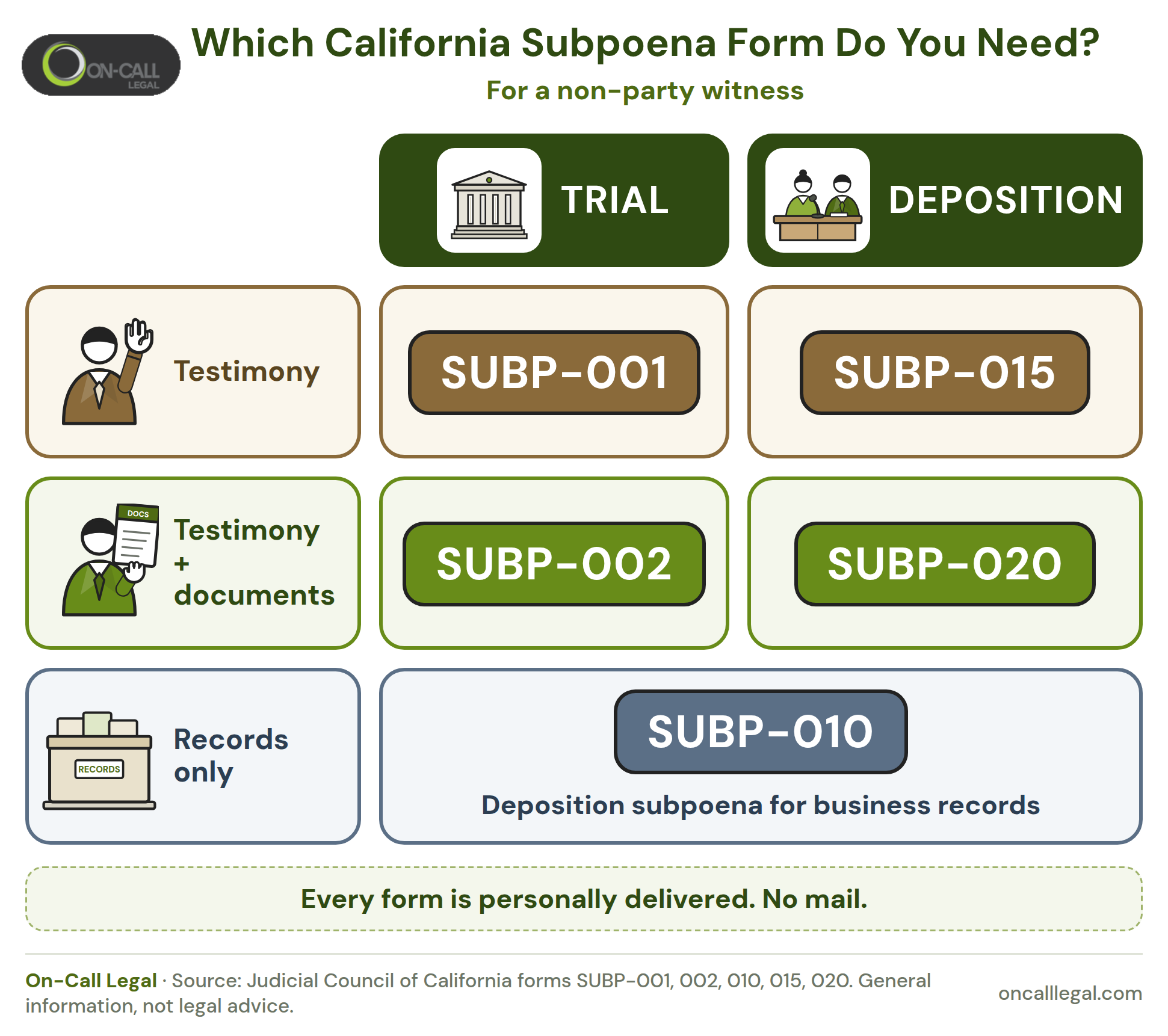
CCP 2020.020 addresses three scenarios: only testimony, only records, and both records and testimony. The choice of which type of subpoena to use depends on the type of discovery being sought, whether it is documents or testimony.
Trial Subpoenas and Subpoenas Duces Tecum
A trial subpoena orders a witness to appear and testify at a trial or hearing. The summons vs. subpoena difference matters here: a summons reaches defendants, but subpoenas can be directed at anyone (not just defendants) and can therefore compel people to show up in situations other than as defendants in a legal proceeding. A subpoena duces tecum orders a witness to appear and testify at a trial or hearing and to bring along any documents requested.
Under CCP 1985, that version needs an affidavit that shows good cause, states the exact matters or things desired, explains why they matter to the case, and says the witness has them. CCP 1987.5 makes service invalid unless a copy of that affidavit is served with the subpoena.
Which California Subpoena Form Fits Your Witness
Civil cases involving non-party witnesses most commonly use the forms listed below. Each of these Judicial Council subpoena forms is mandatory, and each has its own fee and timing rules.
|
Form |
What It Compels |
Who Receives It |
Fees at Service |
Timing Rule |
|---|---|---|---|---|
|
Personal appearance at trial or hearing |
Trial witness |
Only if demanded |
Reasonable time to prepare and travel |
|
|
Trial testimony plus documents, with an affidavit or declaration |
Trial witness who must bring documents |
Only if demanded |
Reasonable time, plus consumer notice for personal records |
|
|
Deposition testimony |
Deposition witness |
Owed whether or not demanded |
Reasonable time, within distance limits |
|
|
Deposition testimony plus documents |
Witness who must testify and produce |
Owed whether or not demanded |
Reasonable time, plus consumer notice for personal records |
|
|
Business records only |
Custodian of records |
The records fee goes with the service |
20 days after issuance or 15 after service, whichever is later, plus consumer notice for personal records |
If the documents that are being asked for are personal records, a subpoena duces tecum in California will accompany SUBP-025 (Notice to Consumer or Employee and Objection).
Who Can Serve a Subpoena on a Non-Party in California?
According to the subpoena rules in CCP 1987, anyone is allowed to serve a subpoena, and under CCP 2020.220, any individual can personally deliver the subpoena. The California Courts Self-Help Guide adds that the server must be 18 or older and that even a party can do it. The same guide states plainly that a subpoena “can’t be served by mail.”

Service of consumer notices has even more stringent requirements than the service of a subpoena. The person effecting service on SUBP-025 must be someone who is not a party to the action and who is at least 18 years of age. Knowing who can serve court papers helps avoid confusion, since there are two different standards for who may serve.
Under Business and Professions Code 22350, anyone who serves papers for pay more than 10 times a year must register. Proof of service provides a place for the server to check off the applicable server category.
- Not a registered California process server
- California sheriff or marshal
- Registered California process server, or an employee or contractor of one
- Exempt from registration under Business and Professions Code 22350(b)
- Registered professional photocopier
- Exempt from registration under Business and Professions Code 22451
The Judicial Council reports that California’s court self-help centers serve over 1.2 million people a year, and many of them may deal with service issues themselves. For self-represented litigants, a registered server prevents a potentially charged in-person confrontation.
How to Serve a Subpoena on a Non-Party Step by Step
Subpoenas for personal or employment records must be served in a certain order, first to the consumer or employee, then to the records custodian. The steps below assume this order and walk through the process from determining residency through obtaining a proof of service.
Confirm the Witness Lives in California
First, where does the witness live? CCP 1989 obliges only a California resident to attend. CCP 2020.220 likewise says personal service on a witness who resides in California when served is sufficient to bind such deponent. Under CCP 2025.250, a natural person will testify in a deposition within 75 miles of the deponent’s home or within the county where the case is pending and within 150 miles of the deponent’s home.
Get the Subpoena Issued by the Clerk or an Attorney
The subpoena shall be signed by the clerk or an attorney of record pursuant to CCP 2020.210. Blank subpoena forms may be obtained online from the court’s website. The clerk can sign and seal a subpoena but leave it otherwise blank, and the party fills it in. An attorney of record can also sign and issue the subpoena, and it doesn’t need the court seal.
Describe the Records and Set the Production Date
Then describe what you want, since CCP 2020.410 requires each item or category to be reasonably particularized. Be as specific as possible, identifying the account, dates, and document types.

The production date can be no earlier than 20 days after issuance of the subpoena or 15 days after service of the subpoena, whichever is later. Service must also leave reasonable time to locate and produce the records, and how much notice is required depends on the subpoena type. Give reasonable time to comply to avoid arguments over short notice.
Serve the Consumer or Employee Notice First
Personal records add a step before the custodian sees anything at all. CCP 1985.3 requires written notice to the consumer at least 10 days before production and 5 days before serving the custodian. Mailing the notice adds extra days.
Employment records follow the same pattern under CCP 1985.6, with the notice going to the employee. Anyone who plans to subpoena bank records should expect this step, though a signed authorization from the consumer can replace it.
Assemble the Papers and the Witness Fee
The party issuing the subpoena must ensure that all necessary documents are prepared in advance, as the absence of any single item could necessitate a return trip. This includes having the subpoena completed on the appropriate Judicial Council form, an affidavit if it is a trial subpoena duces tecum (deposition subpoenas for records don’t need one), the required witness or records fee as stipulated by the code, and proof of service of the consumer notice or a signed authorization.
Personally Deliver the Subpoena
The server is required to personally deliver the subpoena to the witness, as CCP 1987 and CCP 2020.220 mandate that only personal service is permitted for non-party subpoenas. For an organization, the server delivers to an officer, a director, the custodian of records, or an agent authorized to accept service. Serving a company works much like the way you serve an LLC, and the registered agent is often the safest target.
For a minor, the subpoena is personally delivered to a parent or guardian and to the minor too if 12 or older. Listed peace officers and state employees can be served through their immediate superior under Government Code 68097.1.
Complete and Keep the Proof of Service
The server of the subpoena must complete the proof of service attached to the last page of the subpoena indicating how, when, and where the subpoena was served upon the individual and whether or not any witness fees were demanded or paid. A form for proof of service of the consumer notice is also attached to the consumer notice in SUBP-025.

For subpoenas for production of records, proof that the consumer was sent the notice must be provided to the custodian of the records with the subpoena. Keep a signed proof of service in your file, since it becomes your evidence if the witness never appears.
Witness Fees and Costs for a Non-Party
Government Code 68093 sets ordinary civil witness fees at $35 a day plus 20 cents a mile, counted both ways. At trial, CCP 1987 requires those fees only if the witness demands them at service. For a deposition, CCP 2020.230 says the fee is owed whether or not it is demanded, and it is paid at service or at the deposition. A records-only subpoena must include the records witness fee set by the Evidence Code at the time of service.
Copying runs 10 cents a page plus clerical time of up to $24 an hour under Evidence Code 1563. Subpoenaed peace officers, firefighters, and state, court, or county employees cost more, since Government Code 68097.2 requires $275 a day tendered with the subpoena, adjusted later to the agency’s full cost. Under CCP 2034.430, retained experts receive their reasonable and customary hourly or daily fee for deposition time. Adding these up early shows the real cost to subpoena someone before the budget takes a hit.
What a Records Custodian Does After Being Served
Under Evidence Code 1560, in a civil case, the custodian will deliver copies (accompanied by a signed affidavit) within 15 days after receipt. Under CCP 2020.430, the release of records before the date and time noted on the subpoena is prohibited. Records generally are delivered to the deposition officer, who must be a registered professional photocopier or a person exempt from registration under Business and Professions Code 22451. Firms that pull records on a weekly basis commonly use records retrieval for law firms so one team tracks the copies, the officer, and the custodian.
How a Non-Party Can Object or Limit a Subpoena
CCP 1985.3 (and CCP 1985.6 for employees) lets a consumer or employee who isn’t a party to the case serve a written objection, and the custodian then waits for an agreement or court order. The requesting party may move to enforce the subpoena within 20 days of that objection. If you’ve been subpoenaed and you’d like to object to a subpoena, you may also seek relief directly from the court.
CCP 1987.1 lets the court quash or modify the subpoena or issue a protective order, and besides the witness, any party to the case, or the consumer or employee whose records are sought, can file that motion too. For electronic records, CCP 1985.8 directs the court to ensure that non-parties are not unduly burdened or incur unreasonable expense as a result of the discovery process. A motion to quash brought or opposed in bad faith can lead to an award of fees under CCP 1987.2.
When a deponent declines to answer or produce, CCP 2025.480 provides the party seeking discovery 60 days after the deposition record is completed to move to compel, along with a meet and confer declaration.
What Happens if a Non-Party Ignores a Subpoena
Ignoring a subpoena is a poor gamble, because CCP 1991 allows contempt, and CCP 2020.240 needs no prior court order for depositions. CCP 1992 also makes a witness who fails to appear forfeit $500 plus all damages, a warning printed on the form.
Serving a California Non-Party in an Out-of-State Case
Subpoenas issued out of state may not be served in California by mailing a copy to the witness. Under CCP 2029.300, you must file it with the superior court clerk in the county where you seek discovery. Once you have completed the required form SUBP-030 and paid the applicable fee, the clerk will issue a California subpoena.
A retained California attorney may issue the subpoena instead, and it must then be personally served in accordance with California law. California law (CCP 2029.300 and 2029.350, expanded in 2025 by SB 497) also bars these subpoenas when the out-of-state case is based on another state’s law that interferes with the right to seek or obtain gender-affirming care, or when it is a penal civil action that would require disclosing information about sensitive services. California has 58 superior courts, one per county, so picking the right one is relevant for any out-of-state subpoena.
Ready to Serve a Subpoena on a Non-Party Witness?
Anyone asking how to serve a subpoena on a non-party in California needs the right form to use, personal delivery (hint: it must be personally served), and the correct fee. If you want to obtain employment or personal records, you must also send the consumer notice before serving the subpoena on the records custodian. Missing a step could result in an objection by opposing counsel and possibly a postponement of the deposition.
On-Call Legal belongs to NAPPS, CALSPro, and ServeNow, and our experienced subpoena process servers cover all 58 California counties. We can serve nationwide within 24 hours and also arrange deposition officers, court reporters, and records retrieval on one timeline. Contact us today to get your non-party subpoena served on schedule and documented correctly.
Frequently Asked Questions
On-Call Legal has served subpoenas on witnesses, banks, hospitals, and employers since 2008. Before serving a non-party, pro se litigants and attorneys most often ask about the following issues:
Can a Subpoena to a Non-Party Be Served by Mail in California?
No. A subpoena must be personally delivered to the witness or, if the witness is a business entity, to its authorized agent. Only the notice to the consumer or employee whose records are sought (and any objection to it) can be served by mail.
Do You Have to Pay a Non-Party Witness Before a Deposition?
A witness’s deposition fee is due whether or not the witness demands it. The fee may be paid by the party taking the deposition either at the time of service or at the witness’s appearance for the deposition.
Can You Serve a Company’s Registered Agent With a Records Subpoena?
Usually, yes. For a business, a deposition subpoena may be served on an officer or director, the custodian of records, or any agent or employee the business has authorized to accept service of a subpoena.
How Long Does a Business Have to Produce Subpoenaed Records?
The production date must be at least 20 days after its issuance or 15 days after service thereof, whichever is later. In civil cases, the custodian then delivers within 15 days after receipt, unless the subpoenaing party and the custodian agree on another time.
Can a Non-Party Refuse a Subpoena That Asks for Too Much?
Non-parties may object, file motions to quash, or ask for a protective order when a discovery request would result in an undue burden. Simply ignoring the subpoena risks contempt and a $500 penalty.
How Far Can a Non-Party Witness Be Required to Travel for a Deposition?
Depositions must be taken within 75 miles from the witness’s place of abode, or within the county in which the action is pending and within 150 miles.
Legal Disclaimer: On-Call Legal is a litigation support company; we are not a law firm. Nothing in this article constitutes legal advice, nor should it be treated as such. This article is general information on California legal procedure, and for legal advice you should always consult with a California attorney. Contacting us will not create an attorney-client relationship between you and On-Call Legal.



On-demand legal services with arranging services from eFiling to organizing and preparing your subpoena for records and/or personal appearance and much more.