
Out-of-State Subpoena in California
Quick answer
To use an out-of-state subpoena in California, you present it to the superior court clerk in the county where the witness or records are, and the clerk reissues it as a California subpoena with identical scope. You won’t need to hire a local lawyer or open a new lawsuit, and afterward California law controls compliance and any fight over it.
Enforcing a subpoena across state lines can be challenging when you need to obtain testimony or get documents from people in different states. Each state has its subpoena service rules, and understanding how to handle these jurisdictional differences helps make sure the subpoena is valid and enforceable. If you’re trying to serve a subpoena in California for an out-of-state case, you must follow strict procedures under California’s version of the Uniform Interstate Depositions and Discovery Act (UIDDA). This ensures the subpoena is properly recognized and enforceable under California law without delays or rejection.
At On-Call Legal Process Servers, we’ve spent over 15 years handling complex subpoena services across state lines, ensuring legal documents are served correctly the first time. Our team understands California court procedures, including the UIDDA, and how to navigate every step of the process efficiently. If you need reliable support with subpoena service or out-of-state subpoena California compliance, contact us today to get started.
In this article, we’ll cover what an out-of-state subpoena is, the key legal requirements, the process for enforcing an out-of-state subpoena, and other important things you need to know.
What Is a Subpoena?
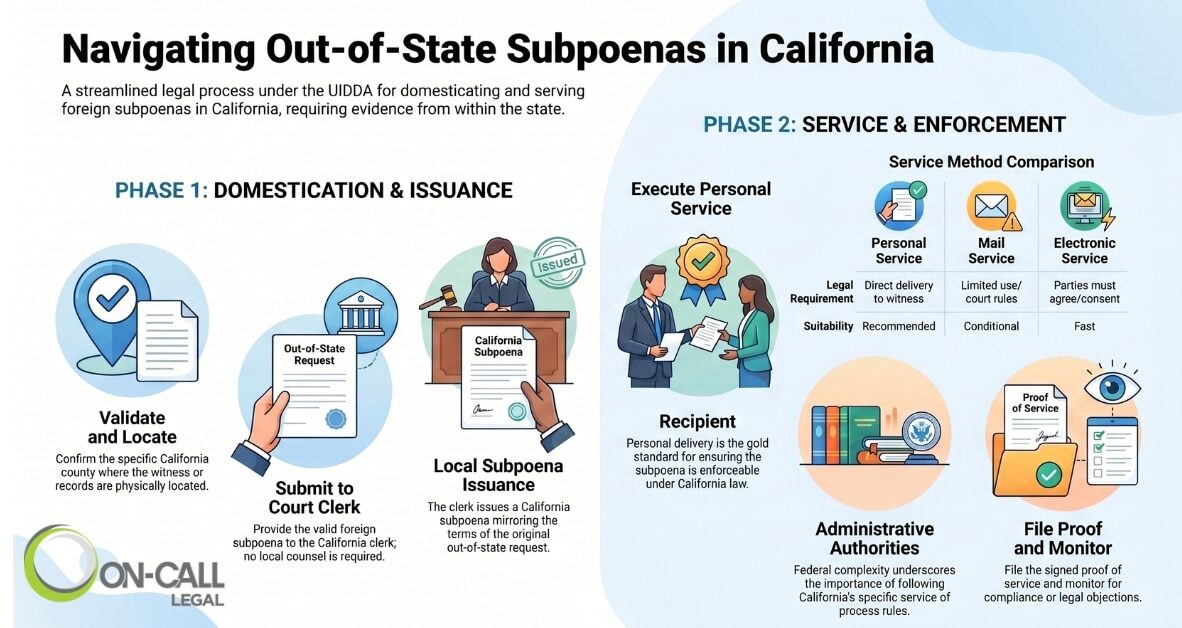
A subpoena is a legal document that requires the recipient (an individual or entity) to testify as a witness in a court case or produce certain specified documents. It is usually issued by a court or a government agency. The process of delivering a subpoena to the intended recipient is known as service of process, and your service of process must fulfill all the jurisdictional legal requirements to be considered valid. Failure to comply with the requirements can result in legal penalties, including fines or imprisonment for contempt of court.
There are two main types of subpoenas: subpoena ad testificandum and subpoena duces tecum. A subpoena ad testificandum compels a person to provide testimony, either in court or during a deposition. If you’re served this kind of subpoena, you must appear in person to give verbal evidence in the specified legal proceeding. On the other hand, a subpoena duces tecum requires you to produce specific documents, records, or evidence that pertain to a legal case. It may be used to request tangible items, such as contracts, emails, or medical records.
What Is an Out-of-State Subpoena?
An out-of-state subpoena, also known as a foreign subpoena, is a subpoena issued when a party to a lawsuit or legal proceeding in one state needs to obtain testimony or documents from a person or entity located in a different state. Since different states operate under their own legal jurisdictions, a court in one state does not have the authority to enforce a subpoena in another state. As such, you must follow a formal legal process to make the discovery subpoena recognized and enforced in the state where the witness or documents are located.
This process of issuing and enforcing out-of-state subpoenas is simplified by the Uniform Interstate Depositions and Discovery Act (UIDDA), which has been adopted by many states in the U.S. Under the UIDDA, you don’t need to open a new case or appear in court in the other state where the recipient is. Instead, the subpoena can be “domesticated,” which means it will be issued by a court in the receiving state and enforced according to that state’s laws. That way, the legal system makes sure that evidence can be gathered from different jurisdictions while maintaining the fairness and transparency of legal proceedings across different states.
When Is an Out-of-State Subpoena Needed?
You need to issue a subpoena for out-of-state service when you need to serve a recipient who is not located in the state where the court case is held. Examples of such situations include cross-border disputes, subpoenaing a witness from another state, or document requests. For example, say you need to obtain testimony from a witness who lives in Texas for a civil lawsuit in California. A court in California cannot directly enforce its subpoenas in Texas, so you must request an out-of-state subpoena to compel the Texas witness to testify or provide evidence.
Often, a person or company in another state may have custody of important documents, records, or other physical evidence. For instance, a party to a lawsuit in Florida may need to obtain business records from a company headquartered in California. An out-of-state subpoena compels the person or entity to produce these documents for use in the legal proceedings.
Especially in personal injury cases, such as car accidents or medical malpractice claims, you often use medical records to estimate the damages. However, the healthcare provider or hospital that holds these records may be located in a different state from the one where the lawsuit is filed. An out-of-state subpoena is necessary to compel the healthcare provider to release the records for review in the legal case.
Legal Framework for Out-of-State Subpoena in California
California adopted the Uniform Interstate Deposition and Discovery Act (UIDDA) in 2010. The UIDDA was developed by the National Conference of Commissioners on Uniform State Laws (NCCUSL) to simplify and standardize the process of issuing and enforcing subpoenas across state lines. Before its adoption, the process for enforcing out-of-state subpoenas was often complex, time-consuming, and differed widely between states. Each state had different procedures, usually involving filing motions, attending hearings, and potentially opening a new case just to enforce a subpoena in a different jurisdiction.
However, under the UIDDA, a party seeking discovery in another state no longer needs to open a separate legal action or attend court hearings in the state where the discovery is sought. Instead, you can present a valid subpoena from your home state to a court clerk in the other state, who will then issue a local subpoena that can be enforced in that state.
Hence, with California’s adoption of the UIDDA, the process has become more efficient and consistent. The adoption has reduced the burden on litigants and made the discovery process smoother, even in cases that involve parties, witnesses, or documents located in multiple states.
Key Provisions of the UIDDA as Implemented in California
California’s version of the Uniform Interstate Depositions and Discovery Act (UIDDA) is codified under the California Code of Civil Procedure, Sections 2029.100 to 2029.900. The act provides guidelines on how to submit, issue, serve, enforce, and object to an out-of-state subpoena. To serve someone in California a subpoena from another state, you must first obtain a valid subpoena from the court where the legal action is taking place (known as the “home state”). Then, you submit the foreign subpoena to the clerk of the superior court in the California county where you seek discovery. The submission does not require a motion or court appearance.
As soon as the clerk of the court receives the out-of-state subpoena, the clerk will issue a California subpoena for service. The California subpoena must incorporate the same terms used in the foreign subpoena, such as the scope of the documents requested and the details of the deposition, but must also align with California’s procedural rules regarding discovery and service of process. Additionally, it must contain or be accompanied by the names, addresses, and telephone numbers of all counsel of record in the proceeding to which the subpoena relates, as well as of any party not represented by counsel.
One of the key benefits of incorporating the UIDDA is that it eliminates the need for out-of-state attorneys to hire local counsel or to be admitted to practice in California to request the subpoena. The court clerk handles the issuance of the subpoena administratively, so the requesting party’s attorney does not need to appear in California court.
After California issues the subpoena, California’s rules govern its enforcement, discovery disputes, and compliance. If the intended recipient refuses to comply, you can file a motion to compel them to do so in the appropriate California court. The California court has the authority to enforce the subpoena through its usual legal mechanisms, such as imposing sanctions or holding the non-compliant party in contempt of court.
According to a U.S. Department of Justice report, federal agencies currently operate under approximately 335 separate administrative subpoena authorities, demonstrating how expansive and complex subpoena enforcement has become across jurisdictions. This complexity is one reason why complying with California’s interstate discovery rules and UIDDA procedures is so important.
You must serve the California subpoena according to California’s subpoena service rules. Generally, this means that the service must follow the same rules that would apply if the subpoena were originally issued in California. If the recipient of the California subpoena wishes to object to the scope or terms of the subpoena, they may do so by filing a motion for insufficient service of process or for a protective order in the California court that issued the subpoena. Similarly, California’s discovery laws will resolve any disputes over the subpoena, such as whether the request is overly broad or burdensome, ensuring fairness for the party subject to the subpoena.
Essential Requirements and Documentation For an Out-of-State Subpoena
There are various important requirements and documentation you must fulfill when serving an out-of-state subpoena to guarantee that the process complies with both California’s rules and the UIDDA. Let’s look into these considerations in more detail.
1. Specific Documents Needed for Out-of-State Subpoena
The most important document you need to start the process of enforcing an out-of-state subpoena in California is the original subpoena issued by the court in the state where the legal proceeding is taking place (the “home state”). You must draft this subpoena properly, and it must be legally binding in the home state. It must clearly state the specific request, whether it involves compelling a witness to testify or producing documents.
When you obtain the original subpoena from the home state, you must submit a formal request for the issuance of a California subpoena to the clerk of the appropriate superior court in California. Be sure to attach the original subpoena and specify that California’s adoption of the UIDDA is the basis for this action.
In some cases, you may need to provide a supporting affidavit or declaration. The affidavit provides details about the legal case involved and confirms that the subpoena issued by the home state is valid and enforceable. The affidavit aims to ascertain that the California court understands the context of the request and also to verify that the subpoena complies with applicable laws. It may also provide further reasons why the subpoenaed party’s testimony or documents are necessary for the legal proceeding.
The party requesting the out-of-state subpoena should prepare a California subpoena that reflects the terms of the original out-of-state subpoena. This document will be submitted to the California court and issued by the clerk once the request is approved. The California subpoena should include the same instructions and details as the out-of-state subpoena but must be formatted according to California’s rules.
2. Jurisdictional Requirements and Applicable Court Rules
To properly issue and enforce an out-of-state subpoena in California, there are certain jurisdictional requirements and court rules you must follow. Recall that California courts only have jurisdiction over individuals or entities physically located within the state. Therefore, the subpoena can only compel individuals residing or companies operating within California to comply with the subpoena requests.
Note that the out-of-state subpoena must first be domesticated in the California county where the discovery is sought. The domestication process is initiated by submitting the original out-of-state subpoena to the clerk of the superior court in the county where the witness or evidence is located.
Although the case is being litigated out of state, California’s local court rules and subpoena procedures still determine how the subpoena is enforced. This includes requirements that have to do with timelines, rules on objections, limits on the scope of testimony or documents, and provisions for protective orders if the scope of the subpoena is disputed.
One of the advantages of the UIDDA is that there is no need for a formal court appearance or for the out-of-state party’s attorney to hire local counsel in California. The process is largely administrative, handled by the court clerk, provided the original subpoena is valid, and the discovery request conforms to California’s laws. This streamlines the process and saves the requesting party the time and cost of engaging in additional legal proceedings in California.
Differences Between Summons and Subpoena in Out-of-State Cases
A summons initiates a civil case, while a subpoena compels testimony or documents during discovery. In an out-of-state case, a summons must be served to establish jurisdiction, but a subpoena is used later for evidence gathering.
A summons notifies a defendant of legal action, while a subpoena is issued during the discovery phase. Both may involve California courts, but they serve entirely different legal purposes.
Legal Process for Serving an Out-of-State Subpoena in California
At OnCall Legal, we’ve refined a practical, court-compliant framework based on years of handling out-of-state subpoenas in California matters for attorneys, foreign parties, and litigation teams. This approach aims to reduce delays, avoid rejected filings, and ensure that every subpoena aligns with California’s civil procedure and UIDDA requirements. Below is the structured step-by-step framework we recommend for handling any foreign subpoena that needs enforcement in California.
Step 1: Confirm Jurisdiction and Discovery Location
Before anything is filed, identify exactly where the discovery is sought within California. This means confirming the correct California county where the witness, business, or records are located.
This step is critical because only the appropriate clerk of the superior court in that county can issue the corresponding California subpoena. Getting this wrong often results in delays or rejection.
Step 2: Validate the Foreign Subpoena from the Home State
The subpoena must first be properly issued in the originating state, also known as the foreign jurisdiction. It should be a true and correct copy of a legally valid subpoena, including the correct caption and case number, and clearly state whether it involves testimony or business records. If the subpoena is incomplete or defective, California courts will not reissue it.
Step 3: Submit the Request for Issuance in California
Once validated, the subpoena must be submitted to the appropriate California superior court using the request issuance process under the Uniform Interstate Depositions and Discovery Act.
This submission typically includes:
- The foreign subpoena
- Any supporting documents or notice of deposition
- Contact information for all counsel of record
- Required telephone numbers and party details
No separate civil case needs to be opened, and no local counsel is required solely for issuance purposes.
Step 4: Clerk Issues the California Subpoena
The clerk of the superior court will issue a California subpoena that mirrors the “same terms” of the foreign subpoena. This ensures continuity between jurisdictions while aligning the document with California Code of Civil Procedure requirements.
Once issued, the subpoena becomes enforceable under California law and carries the full authority of a California court.
According to a process server at OnCall Legal, “This issuance step is what transforms a foreign request into enforceable California discovery.”
Step 5: Arrange Proper Service of Process
After issuance, the subpoena must be served according to California’s strict service of process rules. This is where many cases fail due to improper delivery or unqualified servers.
Service must comply with process server laws in California and, in most cases, requires personal service on the witness or custodian of records.
As one experienced process server at OnCall Legal explains, “Even a valid subpoena can collapse if service isn’t done exactly right under California rules.”
Step 6: File Proof of Service with the Court
Once the service is completed, a proof of service must be filed with the issuing court. This document confirms that the subpoena was properly delivered in accordance with California law.
Any errors in this filing, such as incorrect dates, wrong recipient details, or missing signatures, can result in challenges or invalidation.
Step 7: Monitor Compliance or Enforce the Subpoena
After service, the responding party must comply by producing documents or appearing for a deposition. If they fail to comply, the requesting party may file a motion to compel in the California superior court.
This step often requires judicial review, especially if someone raises objections regarding scope, privilege, or burden.
Step 8: Address Objections or Discovery Disputes
If the subpoena is challenged, California courts may evaluate objections under the civil procedure section rules. Common disputes include overbroad requests, confidentiality issues, or claims of undue burden. At this stage, parties may negotiate, narrow the scope, or seek court intervention.
Methods of Serving Subpoenas
Service of an out-of-state subpoena in California must follow strict legal rules depending on the method:
- Personal service – Direct delivery to the witness or custodian
- Mail service – Limited and only valid under certain conditions
- Publication service – Rare and court-approved only
- Electronic service – Allowed only if parties agree or the court permits
As one California process expert explains, “Personal service remains the gold standard for enforceability in interstate subpoenas.”
Comparison of Service Methods for Out-of-State Subpoenas in California
| Service Method | Legal Requirements | Timeframe | Proof of Service Needed | Common Issues |
|---|---|---|---|---|
| Personal Service | Must comply with California civil procedure | Fast | Yes (signed proof) | Incorrect delivery |
| Mail Service | Limited use under court rules | Moderate | Certificate of mailing | Disputes over receipt |
| Publication | Court order required | Slow | Proof of publication | Rarely approved |
| Electronic Service | Consent required | Fast | Electronic confirmation | Challenge to validity |
Foreign Subpoena: Common Issues and Tips For a Smooth Service of Process

There are many challenges you may encounter while serving a foreign subpoena. To start with, each jurisdiction has its own rules, which can complicate the process of getting testimony or documents from someone located in a different region. To avoid these complications, you need to domesticate a subpoena in the state or country where the person or business is located. For example, if you need to enforce a subpoena in California, you must file it with a California court under the UIDDA or applicable international laws if it’s a foreign country. Once domesticated, the local court will have the power to enforce it.
Note that each jurisdiction has different rules regarding how legal documents like subpoenas must be served. If you don’t serve the subpoena according to the applicable jurisdictional rules, the recipient may have legal ground to challenge its validity. Make sure you follow the local rules for service of process in the jurisdiction where the subpoena is being enforced.
Furthermore, the person or business receiving the subpoena may try to avoid complying by raising objections, such as claiming the request is too broad, too burdensome, or irrelevant. To avoid such objections, make sure the subpoena specifically requests only the necessary information or testimony. If they raise objections, you can file a motion to compel in the local court, requesting the judge to enforce the subpoena. Nonetheless, be prepared to negotiate reasonable accommodations, such as limiting the scope of the request or extending deadlines.
Moreover, subpoenas may request information that is considered confidential or privileged, such as attorney-client communications, trade secrets, or medical records. In such cases, the recipient may cite confidentiality as the grounds for refusing to respond accordingly. The best way to tackle this is to understand the local laws governing confidentiality and privilege. In many cases, you can agree to a protective order to keep sensitive information confidential. Meanwhile, the court can also decide whether certain materials are privileged.
Another common challenge is an unreasonable timeframe for responding to the subpoena. It’s best to give the recipient enough time to gather the requested documents or prepare for testimony. Additionally, find out the local rules for reasonable response times, and be flexible with deadlines if necessary.
In addition, serving an out-of-state subpoena can be expensive, especially if it involves international service, travel for depositions, or collecting large amounts of documents. The recipient of the subpoena may also request compensation for their time and expenses. For example, in the U.S., you may be required to pay witness fees or cover travel expenses for depositions. To manage this, plan ahead for these costs and be ready to cover reasonable expenses for the person or business being subpoenaed.
Need Help With a Foreign/Out-of-State Subpoena?
Serving an out-of-state subpoena requires a good understanding of the jurisdictional differences between the home state and the state where the intended recipient is. If you need a subpoena for a legal action pending outside California, you’ll need to get a subpoena from the home state and domesticate it by requesting that a superior court issue a subpoena having the same terms as the original subpoena. As long as you serve the domesticated subpoena according to California subpoena service rules, you should be able to obtain the evidence you need if the subpoena is valid.
Since serving a subpoena for an out-of-state case can be complex, it’s always recommended to hire a professional process server in California to be sure your subpoena is served appropriately. With our experience and expertise at On-Call Legal Process Servers, you can be sure your legal document is in the right hands. Schedule a free consultation with us to ensure a seamless and compliant service of process.
FAQ
Enforcing subpoenas across state lines can be confusing, especially when different states have their own legal process on out-of-state subpoenas. Here are quick answers to some common questions:
Can You Subpoena Someone Out of State?
Yes, but not directly. If you’re involved in a case in one state and need someone from another state to testify or provide records, you’ll have to follow that state’s rules. Most states, including California, require you to “domesticate” the subpoena first, making it legally enforceable in that state.
How to Domesticate a Subpoena in California?
To domesticate an out-of-state subpoena in California, you’ll need to submit the original subpoena to the appropriate superior court along with a completed Request for Issuance of Subpoena, following the Uniform Interstate Depositions and Discovery Act (UIDDA). The Judicial Council of California provides the required forms. In some counties, you may also need to file a civil case cover sheet to officially open a discovery matter. Once the subpoena is reissued by the California court, it has the same legal weight as a locally issued subpoena. Always check local court rules, because they can vary more than you’d expect.
Can I Ignore a Subpoena From Another State?
If you live in California and receive a subpoena from another state that hasn’t been domesticated here, you’re not legally obligated to respond. However, once the subpoena is properly domesticated in California, ignoring it could lead to legal penalties. Always check the details and talk to a legal professional if you’re unsure.
How Can I Serve an Out-Of-State Subpoena in California?
You must submit the subpoena to a clerk of the superior court in the appropriate county. The clerk will issue a California subpoena, which must then be served according to California civil procedure rules. Proper service ensures enforceability in court.
Can Subpoenas Be Served by Mail in California?
Yes, but only in limited cases and under strict conditions. Mail service must comply with California civil procedure section rules and may require consent. Improper mail service can result in invalidation of the subpoena.
What Should I Do if I Receive an Out-Of-State Subpoena?
First, confirm whether it has been properly domesticated in California. If it has not, you may not be legally required to comply. If it has been issued by a California superior court, you must respond or risk penalties.
How to Challenge an Out-of-State Subpoena in California?
You can file a motion to quash or request a protective order in California court. Grounds include overreach, improper service, or privilege violations. Courts will review whether the subpoena complies with California law and UIDDA standards.


Disclaimer: This article provides general procedural information about legal support services in California and is not legal advice. On-Call Legal is a legal support services company and not a law firm. Requirements vary by court, by county, and by case type, and rules change over time, so anyone with a pending or contemplated matter should consult a licensed California attorney. For how our content is written and reviewed, see our Editorial Policy.

On-demand legal services with arranging services from eFiling to organizing and preparing your subpoena for records and/or personal appearance and much more.