Can You Subpoena Bank Records in California?
Yes, records from banks can be subpoenaed in California, but it all depends on who is requesting them. A private civil litigant operates under Code of Civil Procedure section 1985.3. In contrast, a California government agency follows the California Right to Financial Privacy Act at Government Code section 7460 and subsequent sections, while a federal authority adheres to the federal Right to Financial Privacy Act at 12 U.S.C. section 3401 and following, each with its own notice, timing, and objection rules. California law provides customers of banks with more notice ahead of time than is required by federal constitutional standards by itself.
Since 1999, On-Call Legal has served attorneys and paralegals, as well as litigants who represent themselves, and has coverage that spans all 58 counties in California and also reaches all 50 states nationwide. Our subpoena service team prepares the subpoena form, serves every required party on behalf of a client, and tracks the production date so a case does not stall. Contact us before a deadline if a bank records subpoena needs to go out on a tight schedule.
This article explains the notice a civil litigant must give before subpoenaing bank records, how a bank actually responds once properly served, when a subpoena can be quashed or met with a written objection, how a civil subpoena differs from a government or grand jury subpoena, and what happens with a joint bank account.
What Notice Does California Law Require Before Subpoenaing Bank Records?
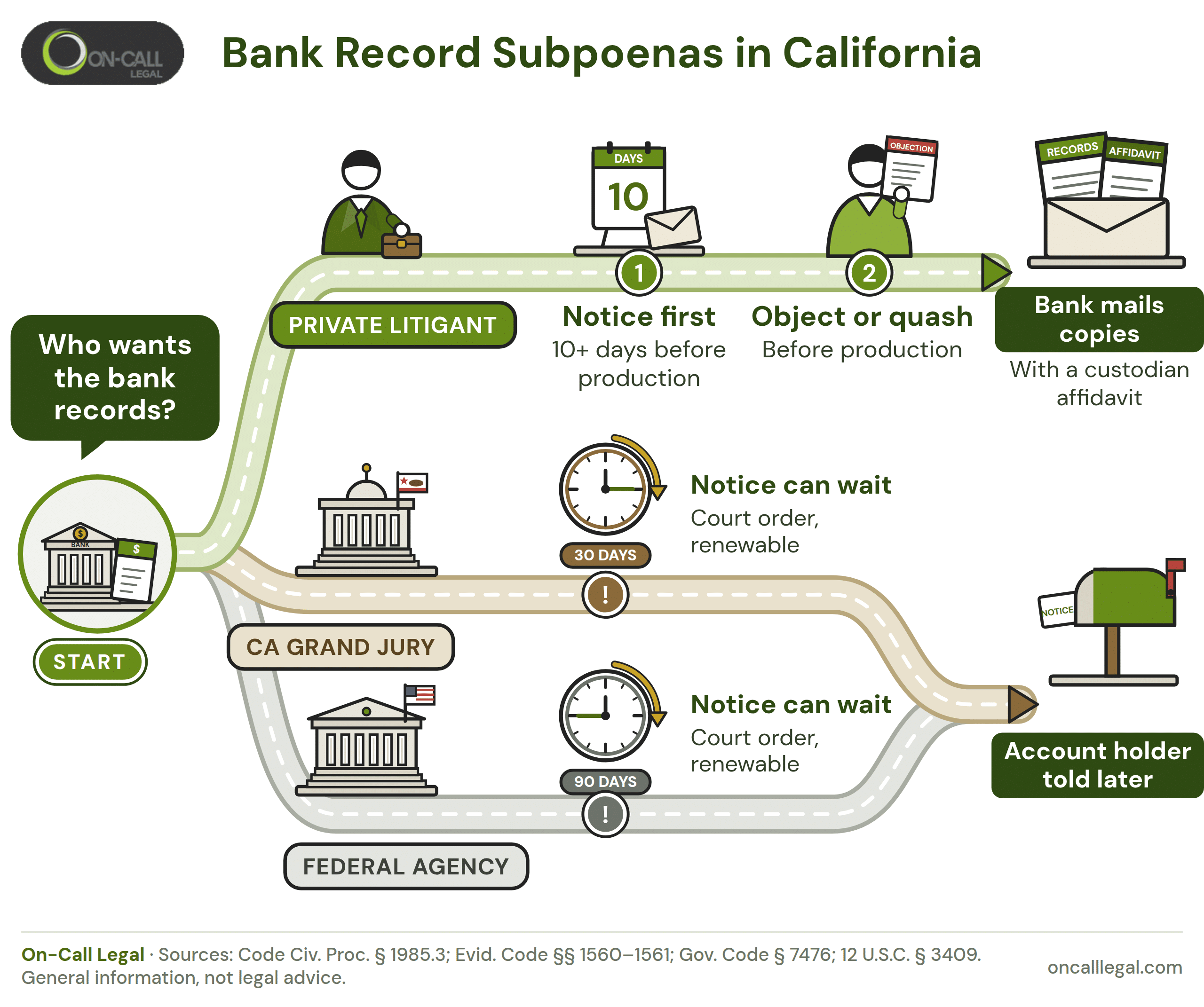
California treats banking records as private. When a private party to civil litigation wants records from a bank, credit union, or similar institution, Code of Civil Procedure section 1985.3 is the controlling statute, and it applies only to private litigants, expressly excluding state and local government agencies, covered separately under the Government Code below. This notice and objection process runs alongside that used by attorneys when they subpoena medical records in California; however, there are different statutory definitions for these two kinds of records. The statute treats the bank as the witness and the person with the account as the consumer. And the party seeking information needs to provide the consumer with a copy of the subpoena along with any supporting affidavit and also a notice explaining what is going on.
The requesting party must serve the consumer at least 10 days before the production date, plus added time if service is by mail under section 1013, and must also do so at least 5 days before serving the bank itself. The notice has to tell the consumer that records are being sought, that the consumer may object before the production date, and that the consumer should consult an attorney if the requesting party will not limit the request voluntarily.

Financial records pertain to a consumer rather than belonging to one under the statute’s own language, since it describes documents the witness holds relating to a person’s dealings with that institution, not property the account holder owns outright.
A civil litigator must clearly specify the exact records being requested, avoiding vague requests for an entire account history, as overly broad requests can lead to objections. Many requesting parties begin their process with an online search or by visiting a law library. Understanding the requirements for the Judicial Council form for a deposition subpoena for business records early on is less time-consuming than dealing with a court clerk’s office that rejects the wrong state court form.
On-Call Legal’s subpoena team verifies methods for serving papers and specifies deadlines as well; they serve personally, through regular mail, or by substituted means. Serving incorrectly or too late can render otherwise valid requests invalid.
How Does a Bank Actually Respond to a Subpoena?
A bank hardly ever sends someone into court carrying a big pile of paper documents. Under Evidence Code section 1560, a bank that is not a party can comply by mailing a true, legible copy of the records to the clerk of court, the deposition officer, or the hearing body, with a custodian’s affidavit under Evidence Code section 1561 confirming authenticity. The custodian gets 15 days after receipt in civil cases, or 5 days after receipt in a criminal case, unless the parties agree otherwise.

A bank can also allow the requesting attorney or a deposition officer to inspect and copy records in person. This requires at least 5 business days’ notice and a six-hour window designated by the custodian, which is more suitable for voluminous document production than copying documents page by page.
The costs outlined in Evidence Code section 1563 are defined by statute, specifying rates for copying rather than relying on the prices set by a photocopy shop. Standard reproduction runs $0.10 per page, microfilm copying runs $0.20 per page, and actual cost, not a flat rate, applies to oversize documents or other documents requiring special processing. Clerical costs for locating records run up to $24 per hour per person, billed in quarter-hour increments of $6, plus actual postage and third-party retrieval costs. The on-site inspection option caps the custodian’s fee at $15 plus off-site retrieval costs, and the requesting party has to pay all of it, not the account holder.
Can You Quash a Subpoena for Bank Records?
A consumer who disagrees with a subpoena has options, though the right tool depends on whether that consumer is a party to the case. A party-consumer can bring a motion to quash or modify under Code of Civil Procedure section 1987.1, filed before the production date with 5 days’ notice to the witness or deposition officer. A consumer who is not a party instead serves a written objection stating specific grounds, which has the same practical effect and allows them to remain outside a lawsuit.
Once a motion or written objection is served, the bank cannot produce records without a court order or agreement of the parties, the bank, and the consumers affected, pausing production until the dispute is resolved. The requesting party then has 20 days from service of the written objection to bring a motion to enforce the subpoena, supported by a declaration showing a genuine attempt at informal resolution with the other party first.

This structure traces back to Valley Bank of Nevada v. Superior Court, 15 Cal.3d 652 (1975), a California Supreme Court decision holding that before a bank discloses confidential customer information in civil discovery, it must take reasonable steps to notify the customer and give a fair chance to object. That decision is the direct ancestor of the notice scheme in section 1985.3, and it leaves California more protective of an account holder than what many states require by default.
Whether to object or move to quash usually comes down to relevance, since a request tailored to a real dispute is harder to challenge than one written broadly just to see what turns up.
Does the Right to Financial Privacy Act Protect Your Bank Records?
Two statutes share a similar name, and mixing them up is common. The federal Right to Financial Privacy Act, 12 U.S.C. section 3401 and following, is federal law governing access by federal government authorities, not by private litigants or state agencies. California’s own Right to Financial Privacy Act, Government Code section 7460 and following, governs access by California state and local agencies instead, and neither statute touches an ordinary civil litigant’s subpoena, which stays governed by section 1985.3.
Both versions have a mechanism that gives a delay before issuing notices for criminal matters. Under 12 U.S.C. section 3409, a court may delay customer notice up to 90 days where notice would endanger safety, risk flight, or jeopardize an investigation, renewable in additional 90-day increments. California’s parallel mechanism for a grand jury subpoena lives at Government Code section 7476, subdivision (b)(1)(C), letting a court withhold customer notice for 30 days from receipt of the subpoena, renewable through the end of the grand jury’s term or the filing of criminal charges. Subdivision (b)(3) then requires written notice once the investigation ends without an indictment or criminal complaint, so the delay stays temporary.
The burden for a criminal or grand jury subpoena is much lighter compared to that of a civil subpoena. A California grand jury subpoena for bank records must be signed by a superior court judge on a written showing of a reasonable inference that a crime was committed and that the records are reasonably necessary to the investigation. That is still less than probable cause, since probable cause governs a warrant, not a subpoena, and grand jury proceedings stay sealed, limiting how an account holder even learns a subpoena exists. This lower standard, not any published statistic about challenges, explains why a criminal subpoena plays by different rules.
All of this traces to United States v. Miller, 425 U.S. 435 (1976), where the Supreme Court held a bank depositor has no Fourth Amendment interest in records the bank keeps as its own business records since the depositor voluntarily revealed that information to a third party, the bank itself. That ruling remains good law federally and anchors the third-party doctrine. California layers more protection through section 1985.3, its own Right to Financial Privacy Act, and the state constitutional right to privacy voters added in 1972.
The processes for civil litigants and government investigations vary significantly in terms of notice, timing, and delays, justifying a comparative analysis.
|
Feature |
Private Civil Litigant Subpoena |
Government or Grand Jury Subpoena |
|---|---|---|
|
Governing law |
Code of Civil Procedure section 1985.3 |
Gov’t Code section 7476 (state) / 12 U.S.C. section 3409 (federal) |
|
Notice to account holder |
Required at least 10 days before production. |
Can be withheld during an active investigation |
|
Delay mechanism |
None, notice is mandatory absent a narrow exception. |
30 days (state, renewable) or 90 days (federal, renewable) |
|
Who can object before production? |
The named consumer, by motion or by written objection |
Notice delay removes that option until the investigation is completed. |
What Happens With Joint Bank Accounts?
A joint account complicates matters because its transaction history is one shared record, not two separate ledgers. A subpoena naming one account holder as the consumer sweeps in deposits, withdrawals, and transfers made by every other signer, since the records do not separate one person’s activity from another’s. That creates a real gap, since section 1985.3’s notice requirement is typically directed at the named target, so a co-holder whose financial activity is fully exposed may never receive independent notice or a separate chance to object.
After learning there is pending legal action against an account, splitting the joint account doesn’t undo exposure for transactions that had already taken place while the account was shared among people. Those transaction records already exist. Closing or splitting the account only limits a future subpoena, not what a past production already captured.

Most people never consider this until records of a jointly held account reveal a judgment neither party involved anticipated. Identifying issues related to family law and shared accounts is crucial for records retrieval services used by law firms. Addressing these concerns early on provides more options for resolution if they arise later.
Ready to Get Your Bank Records Subpoena Served Correctly?
Whether a bank records subpoena comes from a private civil litigant, a California agency, or a federal authority changes who gets notified and how much time they get. Getting the service sequence right, and knowing which statute governs, is most of what keeps a subpoena from being challenged on a technicality. What stays constant under the surface are the records requested, but how they are obtained changes according to who is requesting them.
On-Call Legal has served subpoenas and tracked deadlines for lawyers as well as those representing themselves in litigation throughout all 58 counties of California since 1999 and also has operations reaching nationwide in all 50 states. Our subpoena service specialists confirm which statute applies and serve all required parties within the proper time frames. Reach out to our team before your next deadline if a bank records subpoena needs to go out correctly the first time.
Frequently Asked Questions
On-Call Legal has served subpoenas for financial records across California since 1999, and these questions come from attorneys and account holders trying to sort out notice, timing, and who actually has to respond before a dispute over bank records escalates.
Can You Subpoena Bank Records in California Without the Account Holder Knowing?
Not via normal civil procedure. Section 1985.3 requires the requesting party to notify the consumer before the production date, though a government investigation can have notice delayed for a renewable period.
How Much Notice Does California Law Require Before a Bank Must Produce Records?
A civil litigant must notify the consumer at least 10 days before the production date and at least 5 days before serving the bank, extended if service happens by mail.
Can Someone Object to or Quash a Subpoena for Their Bank Records?
Yes. A party-consumer can move to quash or modify the subpoena before the production date, and a non-party consumer can instead serve a written objection stating specific grounds, both of which stop production until the dispute is resolved.
What Happens if No One Responds to an Objection in Time?
The requesting party has 20 days from the service of a written objection to bring a motion to enforce the subpoena, supported by a declaration showing a genuine attempt at informal resolution, and the bank cannot produce records without a court order or an agreement.
Does a Joint Account Holder Get Notified if Their Co-Owner’s Records Are Subpoenaed?
Not necessarily. Notice is typically directed only at the person named as the consumer, so a co-holder whose transactions appear in the same joint account records may not receive separate notice even though their financial activity is part of what gets produced.
Is There a Difference Between a Civil Subpoena and a Criminal or Grand Jury Subpoena for Bank Records?
Yes. A civil subpoena requires advance notice to the consumer, while a criminal or grand jury subpoena can proceed under a delayed notice order. In California, a grand jury subpoena also needs a judge’s signature based on a reasonable inference that a crime was committed and that the records are reasonably necessary, which is still less than probable cause.
Does a Bank Have to Send Someone to Court or Can It Just Mail Copies of Records?
In most cases, a bank can send copies either by mail or directly to a clerk, deposition officer, or hearing body using an affidavit from a custodian rather than personally attending.
Who Pays for Copying Costs When a Bank Responds to a Subpoena?
The requesting party pays, under a fee schedule for standard copying, microfilm, oversized or specially processed documents, clerical time, postage, and third-party retrieval costs, not the account holder.
What Is the California Right to Financial Privacy Act?
It is Government Code section 7460 and following, governing how California state and local agencies, as opposed to private litigants or federal agencies, obtain financial records from a bank.
Does the Constitution Protect Bank Records from a Subpoena?
The Supreme Court held in United States v. Miller that a bank depositor has no Fourth Amendment interest in records the bank keeps as its own business records, which is why California’s statutes go further than that federal baseline.
This article provides general information about the procedure for subpoenaing bank records in California and is not legal advice. Procedures, deadlines, and statutes can vary by case and change over time, so confirm current requirements with a licensed attorney before relying on anything here for an active matter.



On-demand legal services with arranging services from eFiling to organizing and preparing your subpoena for records and/or personal appearance and much more.