
How to Subpoena Medical Records in California
To subpoena medical records in California, you need a valid subpoena duces tecum, written notice to the patient under Code of Civil Procedure § 1985.3, compliance with the HIPAA Privacy Rule and the Confidentiality of Medical Information Act, and proper service on the provider’s custodian of records. The subpoena must identify the records with enough specificity to avoid an objection, provide the patient time to respond, and meet every procedural step before any file can be released. Get the process wrong, and the records stay locked, the case slips, or the requesting party ends up answering a motion to quash and possibly a HIPAA complaint.
On-Call Legal Process Servers has handled subpoena services for attorneys, businesses, investigators, and individuals across California and out of state for more than 15 years. Our team serves the documents, tracks the deadlines, and follows the procedure end to end. Schedule a free consultation to discuss your case.
This article covers what a medical records subpoena is, the legal requirements, the step-by-step process, and what to do if a subpoena is contested or ignored.
Overview of Subpoenaing Medical Records in California

A subpoena is a court-backed order requiring a person or entity to hand over documents, give testimony, or appear at a proceeding. For medical records, the tool is a California subpoena duces tecum; it tells the healthcare provider to produce the records themselves, without requiring the doctor to show up in person.
California puts heavy guardrails on these subpoenas because medical files contain protected health information. State and federal law overlap here, and depending on the situation, the party seeking records may need a signed patient authorization, a qualified protective order, a court order, or some combination of the three.
At the federal level, the Health Insurance Portability and Accountability Act (HIPAA) controls how protected health information moves. Under the HIPAA Privacy Rule, a provider can release records in response to a subpoena only when one of two conditions is met (45 CFR § 164.512(e)):
– The patient has authorized the disclosure in writing, or
– The party seeking the records provides satisfactory assurances, generally either documented notice to the patient or a qualified protective order.
California layers on more. The Confidentiality of Medical Information Act (CMIA), Civil Code § 56 et seq., requires the party issuing the subpoena to give the patient advance written notice, often through the patient’s attorney. The notice is the formal “Notice to Consumer,” and it includes a form the patient can use to object.
A subpoena duces tecum also has to come with a declaration of the custodian under California Evidence Code § 1561, which authenticates the records that get produced. If the request reaches into psychotherapy notes or sensitive conditions like HIV status or substance use treatment, expect a judge to look at it before anything is released.
What Medical Records Can Be Subpoenaed?
Whether a given record can be subpoenaed depends on what it contains and how tightly it ties to the case. Courts will generally allow access to records that bear directly on the issues in dispute. Privacy law still applies on top of that, and some categories carry extra procedural locks.
Records that can be reached by subpoena include:
- General medical records treatment notes, diagnoses, prescriptions, lab results, hospital admissions and discharges, surgical reports, and physical therapy logs.
- Billing and insurance records include invoices, payment histories, and insurance claims.
- Mental health records from psychologists, therapists, or psychiatrists. Psychotherapy notes get heightened protection under HIPAA (45 CFR § 164.508(a)(2)) and usually need a court order plus a chance for the patient to object.
- Substance use treatment records. These are governed by federal rules at 42 CFR Part 2, which generally require patient consent or a court order with specific findings that the records are essential to the case.
- HIV and AIDS testing records. These typically need a court order showing a compelling need, often with identifiers redacted.
- Reproductive health records, abortion, contraception, fertility treatments, related services. Disclosure is limited, and these are often heavily redacted.
- Records of minors, which may require parental or guardian consent.
Step-by-Step Process to Subpoena Medical Records in California

Sending a subpoena is the easy part. California enforces the procedural rules, the privacy statutes, and the notice rules strictly, and any one of them can stop a request cold. Here is the sequence we use at On-Call Legal.
Step 1: Identify the Records You Need
Decide what records you actually need before you draft anything. The description has to be specific. Overbroad requests draw objections, court intervention, and weeks of delay. Treatment notes, billing records, diagnostic reports, and anything else you request should map directly to the issues in the case.
Step 2: Obtain the Appropriate Subpoena Form
California recognizes several subpoena types: witness subpoena, deposition subpoena, and subpoena duces tecum. For a patient’s medical records, the deposition subpoena for the production of business records is the usual choice because it lets the provider produce documents without sending a person to court.
Step 3: Complete the Required Documentation
The subpoena has to name the patient, the provider, and the custodian of records who will produce the file. Depending on what is being requested, you may also need a signed HIPAA authorization, a Reproductive Health Attestation, a written statement, or a court order authorizing disclosure.
Step 4: Serve Notice to the Patient
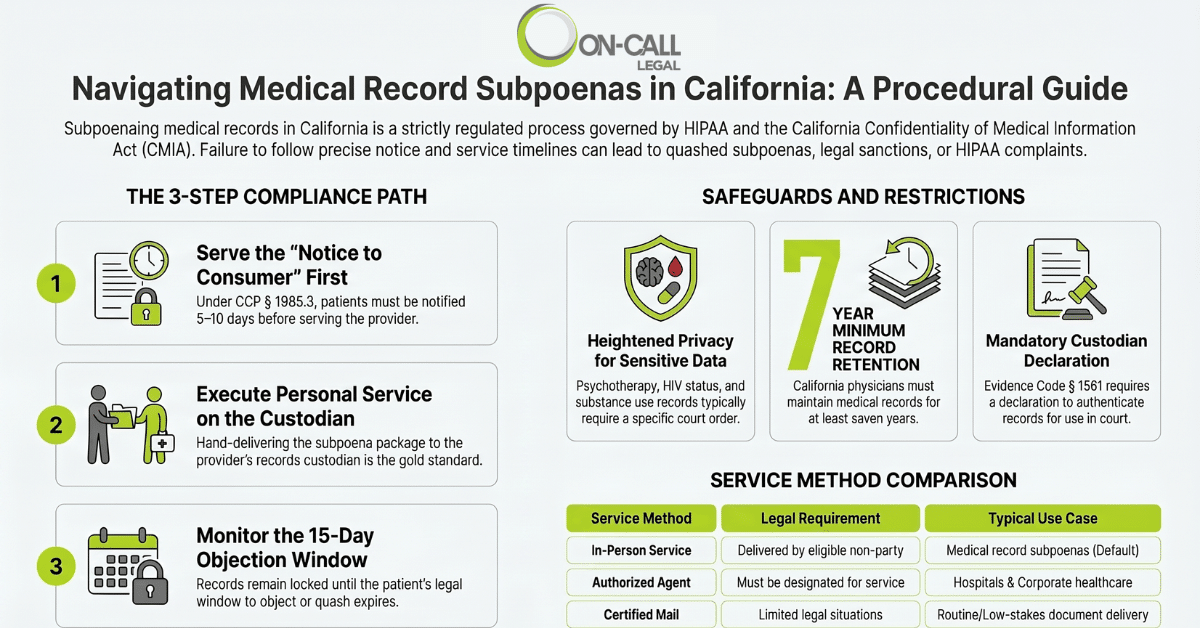
California requires that the patient be notified before records can be moved. Under California Code of Civil Procedure § 1985.3, the party issuing the subpoena has to provide the patient (or the patient’s attorney) with written notice before serving the records custodian. The notice must be served at least 5 days before the subpoena is served in person.
If the notice goes by mail within California, it has to be served at least 10 days ahead. The notice and the subpoena together must be served at least 10 days before the deposition or hearing date. That window is what allows the patient time to object.
Step 5: Serve the Healthcare Provider
Personal service is the preferred method. Service by mail or another approved method is available if reasonable in-person efforts fail. Under Evidence Code § 1561, the subpoena package is generally hand-delivered to the custodian of records and includes the subpoena, the notice documents, any required authorization forms, and instructions about deadlines. The custodian’s declaration that comes back is what allows the records to be used in court without the provider having to testify.
Service has to follow California’s rules to the letter. A wrongly served subpoena is one that gets quashed; this is the practical reason cases use professional process servers for medical record work.
Step 6: Wait for Objections or Compliance
If the patient files a written objection, the records stay where they are until the objection is resolved or a court orders production. If no objection comes in within the allowed window, the provider can produce.
Step 7: Receive and Review the Records
Once the waiting period has run and service is good, the provider releases the records. Review them against what you asked for and against any limits the court imposed before relying on them.
Legal Requirements and Restrictions for Serving Subpoenas in California
Service is more than handing over paper. California requires strict adherence to the service rules so that everyone gets proper notice and the case is not vulnerable to a later challenge.
A subpoena generally has to be served by someone who is not a party to the action. The server has to complete the proof of service accurately and document when, where, and how service happened. A defective proof of service is one of the most common reasons subpoenas get knocked out, and an inaccurate affidavit can hold up the entire case.
Personal service is still the default for medical record subpoenas. Alternatives exist in limited situations, but knowing when service has to happen in person matters. This is because if you guess wrong, the subpoena is invalid.
When records sit outside California, or the provider is in another state, interstate discovery rules come in. Those cases have to satisfy both California law and the law of the other jurisdiction.
Serving Subpoenas: In-Person vs. Alternative Methods in California
| Method | Legal Requirements | Advantages | Disadvantages | Typical Use Cases |
|---|---|---|---|---|
| In-Person Service | Personally delivered by an eligible server | Strongest proof of service, widely accepted | Higher cost and coordination required | Medical record subpoenas, court matters |
| Certified Mail | Permitted in limited situations | Lower cost | Delivery disputes possible | Routine document delivery |
| Service on Authorized Agent | Must be designated to accept service | Efficient for large institutions | The wrong agent can invalidate service | Hospitals and corporate healthcare providers |
| Electronic Service | Only when legally authorized | Fast and convenient | Not universally accepted | Certain court-approved matters |
| Substitute Service | Requires due diligence and legal compliance | Useful when direct service fails | More vulnerable to challenge | Difficult-to-locate recipients |
Common Reasons to Contest a Medical Records Subpoena

California gives patients the right to push back when someone tries to access their medical records without proper justification. Whether you are the patient, the attorney, or the provider, knowing the legitimate grounds for objection and how to raise them is what keeps the process honest.
- Lack of relevance – the requested medical records have nothing to do with the legal dispute.
- Privacy violations – the request reaches into sensitive information beyond what the case needs.
- Overbreadth – the description is too broad or vague.
- Failure to serve a Notice to Consumer – the patient never got the required notice.
- Lack of authorization or court order – for psychotherapy notes, HIV status, substance use treatment, or other locked categories.
How to Object to a Subpoena for Medical Records
If you get a subpoena and you are not comfortable with it, here is the path to object:
- Move fast. You generally have 15 days from the service of the Notice to Consumer to file an objection. Miss that window and the provider may release the records.
- Put the objection in writing. A simple letter to the party issuing the subpoena and to the provider works state that you object, why, and ask that the records be withheld.
- Send the objection to everyone involved: the issuing party, the provider with custody of the records, and the court if you are filing a motion to quash.
- File a motion to quash if needed. If the issuing party does not back down, the objecting party can ask the court to cancel or narrow the subpoena. That is a formal motion that the judge decides.
What Happens After an Objection Is Made?
Once an objection or motion to quash is on file, the provider cannot release the records unless the court overrules the objection or the patient withdraws it in writing.
From there the court can do a few different things. The judge may quash the subpoena if the records should not be disclosed at all. The judge may narrow it, letting some records through, limiting the timeframe, or ordering sensitive content redacted. Or the judge may uphold the subpoena if it is valid and the records are relevant, in which case the provider has to produce, often under a protective order. In the most sensitive cases the judge will review the records in chambers before deciding what gets released.
How Long Can Medical Records Be Subpoenaed in California?

Records can usually be reached for a window of two to ten years back, depending on the retention rules that apply to the provider, the statute of limitations on the underlying claim, the type of case, and the patient’s health plan.
A few of the relevant rules:
- Physicians are expected to maintain medical records for at least seven years from the date of last service; a standard tied to the Medical Practice Act and Medical Board guidance (Business and Professions Code § 2266).
- Records of care provided under the Medi-Cal program must be kept for 10 years from the date of service (Welfare and Institutions Code § 14124.1).
- The statute of limitations on most California personal injury claims is two years (Code of Civil Procedure § 335.1).
- Medical malpractice claims run one year from the date of discovery or three years from the date of injury, whichever is earlier (Code of Civil Procedure § 340.5).
Subpoenas also have to fit inside the civil discovery cutoff for the case. Even if the records exist and would be relevant, discovery has to be completed by the court’s deadline, which limits how far the timing can stretch.
Consequences for Failing to Comply with a Subpoena
Ignoring a valid California medical records subpoena carries real penalties, and those penalties can reach providers, custodians, patients, and third parties.
For Medical Providers or Custodians of Records
A provider who is properly served and does not respond or produce can be held in contempt of court, which can mean fines or, in extreme cases, jail. The court can also award monetary sanctions, including attorney’s fees, if it finds there was no good cause for the failure to respond. The court can issue an enforcement order setting a hard date to produce, and refusing that order moves things into more serious territory. A provider who ignores subpoenas repeatedly also picks up a reputation problem with the court that follows them into later cases.
For Patients Who Issue Improper Objections
You can object to a subpoena, but the objection has to have a legal basis. The court can overrule one that does not, which lets the provider release the records, and in some cases the court can order the patient to pay fines tied to the delay. Be sure the ground is real before you file, and follow the procedure correctly.
Ready to Serve Your Medical Records Subpoena With Confidence?
A California medical records subpoena lives or dies on the procedural details: the privacy rules, the notice requirements, the service rules, and the deadlines. Get them right and the records come through. Miss one and you spend weeks dealing with a motion to quash instead.
On-Call Legal Process Servers brings more than 15 years of experience to California subpoena work, with a network of process servers and subpoena specialists who know the state’s service requirements. We prepare the documents, serve them according to the rules, and back the service with proper proof so the subpoena holds up. Contact us to talk through your case.
FAQ
We have spent more than 15 years helping attorneys, investigators, businesses, and individuals work through California subpoena rules. Below are the questions we hear most often about medical records subpoenas.
Can Medical Records Be Subpoenaed Without Patient Consent?
Yes, in some situations. The subpoena has to be valid, HIPAA and California privacy rules have to be satisfied, and the patient has to receive the required notice. For sensitive categories, psychotherapy notes, HIV status, substance use treatment, a court order authorizing disclosure is often required on top of that.
How Many Times Will a Process Server Attempt to Serve a Subpoena?
It depends on the situation and the client’s instructions. A professional server will make several reasonable attempts before moving to an alternative method. Availability, location, and how urgent the case is all affect the number of attempts.
What Happens if a Subpoena for Medical Records Is Ignored?
Ignoring a valid subpoena can lead to enforcement orders, sanctions, or contempt of court. Providers and custodians should review the subpoena and respond, either by producing or by objecting, rather than letting the deadline pass.
How Do HIPAA Laws Affect Subpoenaing Medical Records in California?
HIPAA sets the federal floor for releasing protected health information. Providers have to confirm the subpoena meets HIPAA’s disclosure conditions before releasing anything. The Privacy Rule and California’s CMIA run together, so the patient still has to get notice and a chance to object where state law requires it.
What Do I Do if I Receive a Subpoena for Medical Records?
Check that service was proper and that the package includes everything it should, Notice to Consumer, custodian declaration, and any required authorizations. If everything is in order and no objection is filed, produce the records by the stated deadline.
Can I Subpoena Medical Records Without the Patient’s Consent?
Yes, but only under specific legal conditions, such as obtaining a court order.
How Long Does It Take to Receive Medical Records After Issuing a Subpoena?
Records are typically due 15 to 20 days after service, depending on the case type and whether a Notice to Consumer applies. An objection or a court-imposed limit can push that out.
Should You Respond to a Legal Subpoena for Medical Records?
Yes. Not responding can lead to contempt or fines. If you believe the subpoena is improper, file a timely objection rather than ignoring it.
Legal Disclaimer
This article is general information about California subpoena procedure and is not legal advice. Subpoena rules can change and the right step in any given case depends on the facts. For advice on a specific subpoena, talk to a licensed California attorney.



On-demand legal services with arranging services from eFiling to organizing and preparing your subpoena for records and/or personal appearance and much more.