
How to Object to a Subpoena in California?
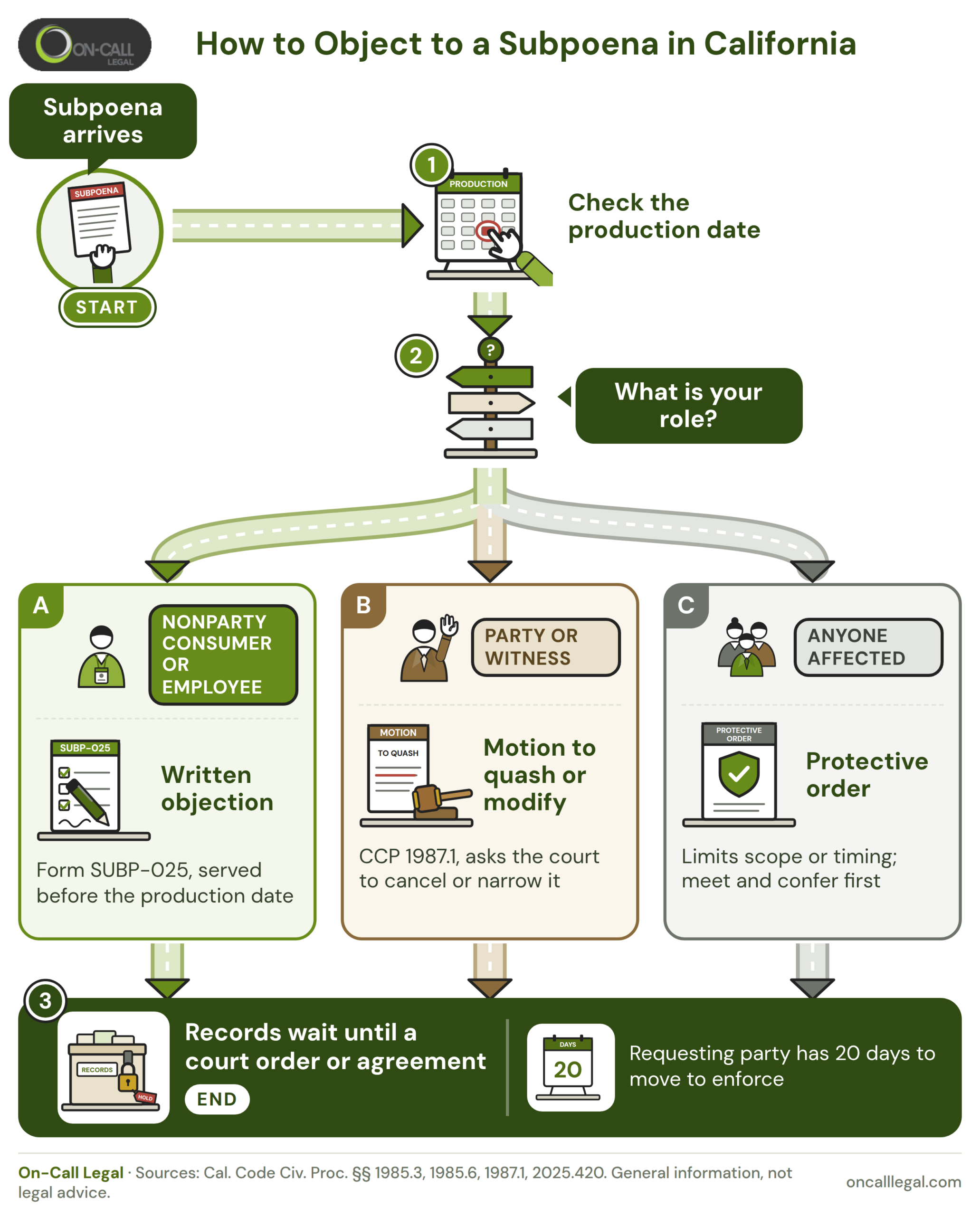
You object to a California subpoena by serving written objections or by asking the court to quash or modify it. Parties and witnesses can move to quash, and a nonparty whose consumer or employment records are sought can serve written objections. Timing is important, so serve the challenge before the production or appearance date noted on the subpoena.
On-Call Legal has been serving attorneys and paralegals as well as those who act as their own litigators since 2008. We provide service across all 58 counties in California and also serve all 50 states. Our subpoena service team prepares the subpoena form, serves every required party on behalf of a client, and tracks the production date so a case does not stall. Contact us before the production date if objections or a motion need to be served on a tight schedule.
This article explains who can object, which challenge to use (a written objection, a motion to quash, or a protective order), the usual grounds, the deadlines, and what happens next.
Who Can Object to a Subpoena in California?
Your options depend on your role in the case, so start by working out where you fit. Under Code of Civil Procedure section 1987.1, a party, witness, consumer, or employee can ask the court for relief. The judge can completely nullify a subpoena, modify it as well, or impose conditions such as protective orders.
Parties to the Lawsuit
A party who is either a plaintiff or defendant can contest a subpoena that has been issued by the opposing side even if it involves someone else. Usually, parties file motions to quash the subpoena or motions for protective orders rather than making informal objections. For a party’s own consumer records, the statute provides a motion, and written objections are reserved for nonparties.
Nonparty Witnesses and Subpoena Recipients
Under California law, the tool for getting discovery from someone outside the lawsuit is a deposition subpoena, as section 2020.010 explains. A recipient of a subpoena from a third party, either an individual or an organization, can request the court to quash or modify that subpoena. If the recipient simply refuses to produce, the party seeking discovery can move to compel production under section 2025.480.
Consumers and Employees Whose Records Are Sought
California has rules protecting people whose personal information is stored somewhere else, such as with their doctor, bank, insurance provider, or employer. Section 1985.3 covers consumer records, and section 1985.6 covers employment records under nearly parallel rules. The requesting party must serve the consumer or employee with the subpoena and a notice at least 10 days before production. That service must also come at least five days before the custodian is served, with extra time added if mailed.

Judicial Council form SUBP-025, the Notice to Consumer or Employee and Objection, is served on the consumer or employee with the subpoena. Its bottom half provides a nonparty a place to write an objection. The objection is served directly on the party that requested something and on the witness, not filed with the court itself. The same notice rules apply when a litigant wants to subpoena bank records, since banks are listed record holders under section 1985.3.
What Types of Subpoenas Can You Challenge?
A subpoena issued in California can request either testimony, documents, or both, and each type of request follows specific rules. The three forms below show up most during the discovery phase and at trial.
Deposition Subpoena for Business Records
This records-only subpoena uses Judicial Council form SUBP-010 and asks a custodian to produce documents without testifying. Section 2020.410 requires that each item be described individually or that each category of requested documents be reasonably particularized. The custodian then delivers copies to the deposition officer named in the subpoena, as section 2020.430 directs. Litigants frequently use a deposition subpoena for business documents to get evidence from banks, hospitals, and employers.

Deposition Subpoena for Testimony
A deposition subpoena can also compel someone who is a witness to show up and answer questions while taking an oath. Under Section 2020.220, personal service on a California resident can require attendance, testimony, and any listed production. When a subpoena asks for both testimony and items, Section 2020.510 sets the rules for describing what to bring.
Trial Subpoena and Notice to Attend
For a trial or hearing, a subpoena duces tecum on form SUBP-002 requires a witness to show up and bring along some evidence. When a subpoena is issued before trial, Section 1985 requires the issuing party to submit an affidavit showing good reason for it and specifying exactly what information they want. For a party or its officer, director, or managing agent, section 1987 allows the attorney to receive a notice to attend instead. The notice must be given out at least 10 days before the appearance unless the court specifies a shorter period. A notice also asking the party to bring documents must be served at least 20 days before the appearance. The court can shorten that, and the party may serve written objections within five days or a court-set period.
Should You Serve Written Objections, File a Motion to Quash, or Seek a Protective Order?
California has three main ways to challenge a subpoena, and each one works for different people and different situations. Here’s a comparison table that will help you match the right tool to your role and timeline.
|
Option |
Who Usually Uses It |
Code Section |
What It Asks For |
When to Act |
|---|---|---|---|---|
|
Written objection |
A nonparty consumer or employee whose records are sought, or a party served with a notice to produce |
CCP §§ 1985.3(g), 1985.6, 1987(c) |
The witness and deposition officer are not required to produce the disputed records without a court order or an agreement. |
Before the production date, or within five days after receiving a notice to produce |
|
Motion to quash or modify |
A party, witness, consumer, or employee |
CCP § 1987.1 |
A court order cancelling the subpoena, narrowing it, or setting conditions |
Before the production date, with at least five days’ notice to the witness and deposition officer for personal records |
|
Protective order |
Any party, deponent, or affected person or organization |
CCP §§ 2025.420, 2017.020 |
Limits on scope, timing, place, or output. |
Promptly, with a meet-and-confer declaration |
A protective order under section 2025.420 can limit how a deposition runs, what gets produced, and who may attend. That motion must include a meet-and-confer declaration showing a genuine effort to settle the dispute directly with the other side first. Our motion to quash guide explains how that motion works and what happens at the hearing.
What Grounds Can You Use to Object to a Subpoena?
An objection is stronger when it names a concrete legal reason instead of a general complaint. For nonparty consumers and employees, the statute requires a written objection citing the specific grounds for blocking production.
Undue Burden and Expense
Orders using Section 1987.1 protect people from unreasonable or excessive demands. Section 2017.020 requires the court to limit discovery when its burden, expense, or intrusiveness clearly outweighs its likely payoff. The test asks how probable it is that information sought will result in admissible evidence. An unreasonable burden claim needs support, such as the actual cost, staff hours, or disruption involved.
Privileged Communications
A subpoena generally cannot force disclosure of material protected by a legal privilege. Discovery in section 2017.010 only relates to things that aren’t privileged. Under Evidence Code section 954, privileged communications between clients and lawyers are kept confidential.
Privacy, Tax Returns, and Confidential Information
Section 1987.1 also lets the court guard a person against unreasonable violations of the right of privacy. Requests for tax returns, medical history, and other confidential information often draw privacy objections for exactly that reason. Trade secrets have their own privilege under Evidence Code section 1060, unless keeping the secret would conceal fraud or otherwise work injustice. A court may respond with limits, such as narrower dates or restrictions on who sees the records, rather than blocking everything.
Overbroad Requests and Fishing Expeditions
A subpoena that requests all documents on a broad topic looks like a fishing expedition. Section 2020.410 requires a subpoena for records to describe each item or reasonably particularize each category of documents requested as specifically as possible. Discovery must be pertinent to the subject matter of the current lawsuit under section 2017.010. Trimming a request for unrelated accounts, years, or other materials down to the necessary information often settles the dispute.
Defective Service or Missing Notice
Under section 2020.220, service of a deposition subpoena happens through direct service by personal delivery, and any person can do the serving. Whether you can serve a subpoena by mail depends on its type, so check the rules before assuming mail is enough. For consumer records, section 1985.3 says a failure to follow its notice rules is enough for the witness to refuse production, one of several things that make a subpoena invalid.
What Are the Deadlines to Object to a California Subpoena?
No single deadline covers every subpoena, because the dates vary based on the subpoena type and the records involved. The production date printed on the subpoena controls most of the timing rules under California Code of Civil Procedure.

For a records-only deposition subpoena, production comes no earlier than 20 days after issuance or 15 days after service, whichever is later. A nonparty consumer or employee must serve a written objection before that production date. A party-consumer moving to quash must provide the witness and deposition officer at least five days’ notice before production.
Once a consumer serves a written objection, the person requesting something has 20 days from service to file a motion to enforce that request after receiving the objection. Most noticed motions also require papers to be served and filed at least 16 court days before the hearing under section 1005. Extra calendar days are added if the notice is delivered by mail or overnight delivery. That period can change by court order or a more specific rule, so confirm hearing dates with the clerk early.
How Do You Object to a Subpoena in California Step by Step?
These steps walk through a typical objection from the moment the papers arrive until the issue is decided. Follow them in order because missing an early step makes later steps much harder.
1. Note the Production Date and Case Details
Please write down the production date or appearance date, the issuing body, the case number, and the superior court handling the case. Every later deadline depends on these details; please keep both the subpoena and envelope together.
2. Identify Your Role in the Case
Decide whether you are a party, a nonparty witness, or a consumer or employee whose records someone else holds. Your role controls which objection tools and deadlines apply to you.
3. Ask the Issuing Party to Narrow the Request
Ask the party that issued the subpoena to narrow or withdraw it before you spend money to file an objection. Confirm any agreement in writing before the production date so nobody disputes it later.
4. Choose the Right Challenge
Using that table, decide which of these you want: written objections, a motion to quash, or a request for protection. The right choice depends very much on your role, the records sought, and how much time is left to act.
5. Put Each Objection in Writing
State the specific reasons behind each objection, like privilege, privacy concerns, or unfair burden. Nonparty consumers or employees can use the objection section of form SUBP-025 for this step.
6. Serve Your Objections on Every Required Party
Serve objections to the party that requested them, to the witness, and to the deposition officer before the production deadline. Keep a copy of the signed proof of service showing who received the papers and when they got them.
7. Track the Next Deadlines
Keep track of any hearing date and the 20-day window for filing motions to enforce the subpoena. Speak with an attorney before those important dates pass if you have complicated or high-stakes subpoenas.
What Happens After You Object?
The next stage depends on how the requesting party responds to your objection or your motion.
Motion to Compel and Court Orders
After a consumer or an employee raises an objection or files a motion, the person taking testimony and handling depositions does not have to produce the records. Unless the court orders otherwise or the parties agree, the current status remains in effect for witnesses, consumers, and employees involved. The requesting party’s enforcement motion must include a declaration showing a reasonable, good-faith attempt to resolve the dispute informally. For other deposition subpoenas, a motion to compel must come no later than 60 days after the deposition record is complete.
What Happens If You Ignore a Subpoena
Under section 1991, the court that issued the subpoena may punish disobedience as contempt. Section 1992 adds that a person who fails to appear forfeits $500 to the aggrieved party, plus resulting damages. The statutes provide formal means for recipients to object where there is no risk of contempt compared to ignoring the subpoena.
Who Pays the Costs and Expenses of a Subpoena?
A nonparty does not have to absorb the full cost of answering a records subpoena. Under Evidence Code section 1563, a nonparty’s reasonable costs of producing business records are charged to the party serving the subpoena. There are some costs involved: $0.10 per page for regular copies and $0.20 per page for copying from microfilm, as well as charges for clerical work time. Clerical time is limited to $24 per hour for each person; the fee is calculated as $6 per quarter hour or any fraction of one. Actual postage and any third-party charges for retrieving offsite records are covered too. When a deposition subpoena requires personal attendance, section 2020.230 requires the noticing party to pay witness fees and mileage.
Under section 1987.2, the court may award reasonable expenses on a motion to quash that is brought or opposed in bad faith. The court may also award sanctions if a motion lacked substantial justification or some portion of the subpoena was unduly burdensome. Issuers have their own bills too, and the cost to subpoena someone depends on fees for service, copying, and witnesses as well.
Ready to Get Your Subpoena Paperwork Handled Correctly?
Objecting to a subpoena means knowing your role, choosing the right tool, and acting before the production date. Objections that are written along with motions to quash and protective orders each fit different people and handle different situations in different ways. Handling paperwork correctly and on time helps avoid losing an objection due to procedural issues.
On-Call Legal has served subpoenas and tracked deadlines for lawyers as well as those representing themselves in litigation throughout all 58 counties of California since 2008, and its operations reach all 50 states nationwide. Our process servers confirm which statute applies and serve all necessary parties within the proper time. Contact us today before your next deadline if written objections or a motion to quash must reach every party correctly the first time.
Frequently Asked Questions
Since 2008, On-Call Legal has been supporting legal teams for California, and we prepare and serve subpoenas every day; this is where such questions arise regularly. Below are general descriptions of the process and should not be considered legal advice.
Can You Object to a Subpoena Without Hiring a Lawyer?
Yes, an individual can serve written objections or file a motion without a lawyer, and form SUBP-025 covers nonparty objections. Generally speaking, a business needs a lawyer to file motions and when dealing with complicated or high stakes subpoenas you should talk to an attorney licensed in California.
Do You Have to Produce Records After Serving an Objection?
For consumer and employment records, the witness does not have to produce after a proper objection. Production waits until there is an order from the court or everyone directly involved has agreed. The party that filed the request gets 20 days from when they receive objections to file a motion to enforce.
Can a Subpoena Be Quashed for Improper Service?
It can be, and improper service is also a ground for an objection, because deposition subpoenas generally require personal delivery to the witness or an authorized agent. Skipping the required consumer notice also gives the witness a legal reason to refuse production.
What Is the Difference Between a Subpoena and a Notice to Attend?
A subpoena goes directly to the witness while a notice to attend is sent to the opposing party’s lawyer. The notice works only for parties and their officers, directors, or managing agents, and it has the same effect as a subpoena.
Can the Court Change a Subpoena Instead of Cancelling It?
Yes, section 1987.1 lets the court modify a subpoena or set the terms a witness must meet to comply. That allows judges to narrow down specific dates, topics, or types of documents without killing the whole request.
Disclaimer: This article provides general information only and is not intended as legal advice. On-Call Legal is a litigation support company, not a law firm, and contacting us does not create an attorney-client relationship. Consult with a California lawyer for specific rules regarding the kind of case and subpoena you have because those rules can vary depending on the nature of both.



On-demand legal services with arranging services from eFiling to organizing and preparing your subpoena for records and/or personal appearance and much more.