
How Much Notice Is Required to Serve a Subpoena in California?
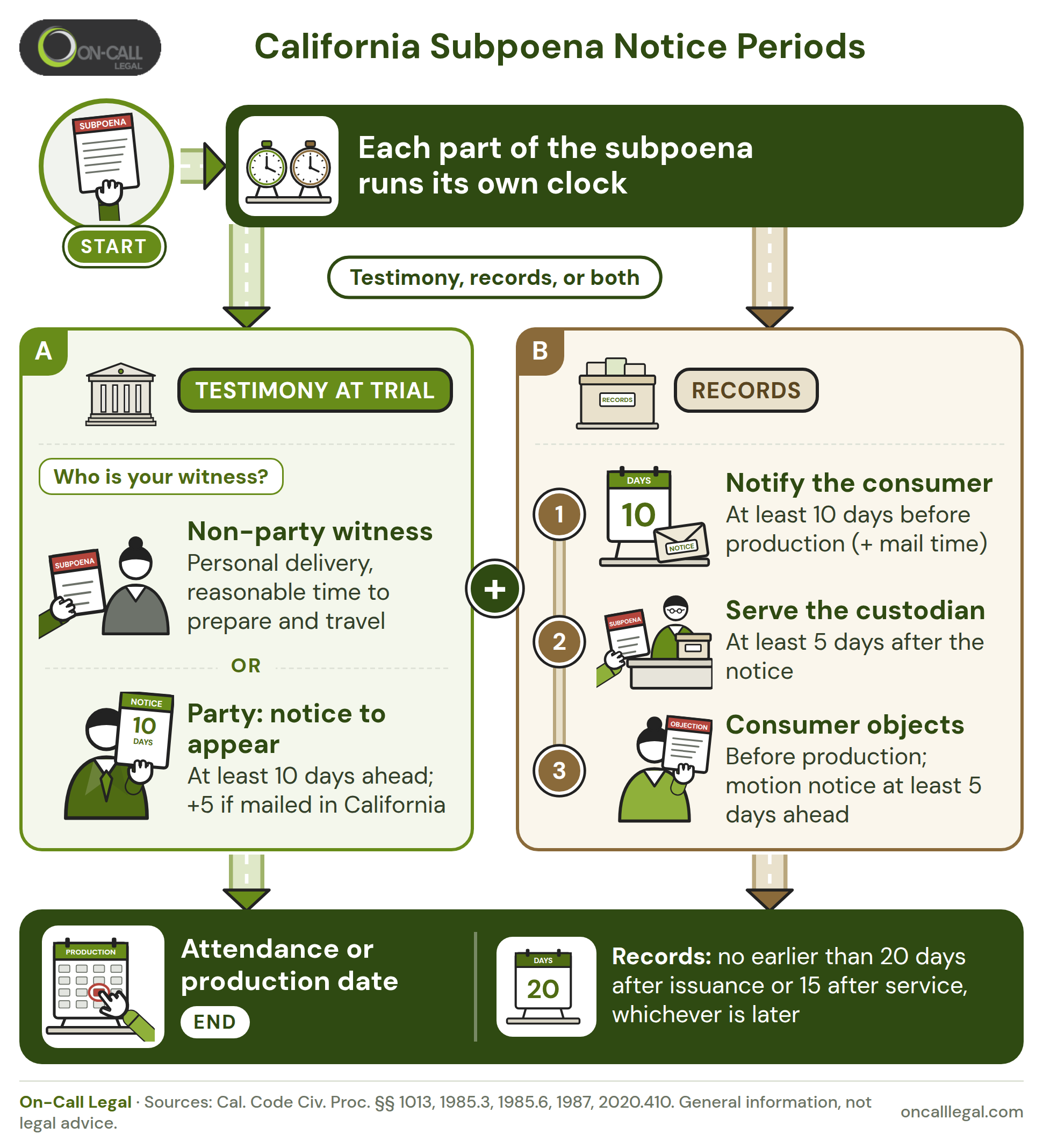
In California there is no single notice period for subpoenas because the deadline depends on the type of subpoena. A trial witness is owed only a reasonable time, while a party’s attorney must get written notice at least 10 days ahead. Records subpoenas run longer, with production set at least 20 days after issuance and the consumer notified at least 10 days before production.
On-Call Legal has served legal papers since 2008 and covers all 50 states, all 58 counties in California, and Los Angeles County’s 88 incorporated cities, along with 38 courthouses. Our team manages the serving of subpoenas, logs the timestamps of each attempt in a client portal, and supplies court-acceptable proof of service. Service runs 24 hours a day with same-day rush options, so contact us for a free consultation when your date is close.
This article covers how much notice is required to serve a subpoena in California for each case type, plus the extra days mail adds.
Notice Depends on the Type of Subpoena
A subpoena is a court order that tells a person to show up at a set time and place to give testimony. Under the California Code of Civil Procedure, the same document can also demand books, papers, or electronically stored information. That version is called a subpoena duces tecum, and the summons vs. subpoena difference matters here because only a subpoena can reach a non-party.
Timing can be confusing because each kind of subpoena has its own timeline running separately. Different periods can count backward from the start of the trial, some count forward from when they are issued, and some count from service on the custodian of records. A deposition subpoena can order testimony only, business records only, or both, and each option has its own set of rules according to CCP 2020.020.
Who must receive notice also differs. In a civil case, the witness receives a subpoena, and other parties receive notice. A consumer whose records are being sought receives a separate privacy notice. Mixing up these three groups is how a subpoena that looks good on paper winds up being challenged.
Trial Subpoenas and the Reasonable Time Standard
Trial subpoenas follow a looser clock than records subpoenas, because California sets no fixed day count for most trial witnesses. The code asks instead whether the witness had a reasonable time to prepare and travel to court. Parties are different, since a notice to appear or a request to bring documents carries its own minimum deadline. Knowing which rule applies to your witness tells you how early service has to happen.
Personal Service on a Non-Party Witness
According to CCP 1987(a), a subpoena issued for a civil trial is served by delivering a copy directly to the witness. Personal delivery is the default method, and the law allows only limited exceptions: notices to parties, peace officers served through their superiors, and minors served through their parents or guardians.
The statute sets no fixed day count for a non-party. It says that service must allow the witness “a reasonable time for preparation and travel to the place of attendance.” If a witness challenges the timing, the court determines what was reasonable. Distance, the witness’s schedule, and what the person subpoenaed must bring are all important factors.

Some guides quote a 10-day rule for non-party witnesses, but that figure is a planning habit, not a statute. A week or two of lead time is common practice, and it gives the witness room to arrange work and travel. Delivery must follow the rules for how a subpoena is legally served in California. Serving the wrong person does not start the time limit.
There are some other limits as well. If a witness is a minor, you deliver service to their parent or guardian and also serve the child if they are 12 years old or older. According to CCP 1989, there is no duty for someone to show up as a witness unless they lived in California when they were served.
Notice to Appear for a Party Under CCP 1987(b)
When the witness is a party, or an officer, director, or managing agent of a party, a subpoena is often unnecessary. CCP 1987(b) allows the party that issues the notice to serve written notice on that party’s lawyer instead. The notice must be given out at least ten days before attendance is needed unless the court specifies a shorter amount of time.
If that notice is sent via mail within California, then CCP 1013 adds five calendar days to the period. The notice carries the same weight as a subpoena, including sanctions. A witness who is entitled to both fees and mileage should be able to collect payment before they testify.
Requests to Bring Documents to Trial
The same notice can ask a party to bring records to trial, but only with more lead time. CCP 1987(c) requires service at least 20 days before attendance, or a shorter period if the court orders it. There are five days for objections, and then the court can order production if good cause is shown.
A subpoena duces tecum aimed at a non-party before trial needs a supporting affidavit. CCP 1985(b) requires justification showing good reasons for requesting specific things and specifying exactly what is being requested. Under CCP 1987.5, service is invalid unless a copy of that affidavit is served along with the subpoena.
Deposition Subpoena Notice Periods
A deposition subpoena compels testimony or records outside the courtroom, and California sets its notice periods by what the subpoena asks for. A subpoena for live testimony runs on a different clock than one for business records alone. Eviction cases follow a shorter schedule, so the case type matters as much as the subpoena itself.
Deposition Subpoenas for Personal Appearance
Two separate clocks run for a deposition, and mixing them up is a common error. CCP 2020.220(a) says that service must be made “a sufficient time in advance of the deposition” to give the person being questioned a reasonable time to get there. That standard is there to protect witnesses.
The second clock protects the parties. CCP 2025.270(a) requires that an oral deposition be scheduled at least 10 days after service of the deposition notice. That 10-day rule applies to the notice served on parties, not to the subpoena handed to a non-party deponent. The deposition subpoena for personal appearance has its own fee and distance rules on top of these deadlines.
For an organization, any person may serve the subpoena by personal delivery to an officer, director, or someone who has custody of records. An agent or employee authorized to accept service of a subpoena also counts under CCP 2020.220(b). Once personally served, a subpoenaed person who lives in California must appear and produce whatever the subpoena specifies.
Deposition Subpoenas for Business Records
A records-only deposition subpoena has a hard floor. CCP 2020.410(c) requires compliance on a date no earlier than 20 days after issuance, or 15 days after service, whichever date is later. The same rule is printed right onto the face of the Judicial Council Form SUBP-010.

This type of subpoena duces tecum needs no good-cause affidavit. The custodian forwards copies of the records to the deposition officer who is named in the subpoena. The records come with an affidavit that follows Evidence Code 1561. It verifies that copies are genuine and have been kept as part of the normal business process.
Early release is not permitted. CCP 2020.430(d) bars the custodian from delivering the subpoenaed records before the date and time in the subpoena, unless the parties and any consumer agree. For non-party business records served under Evidence Code 1560(b), the custodian may comply within 15 days after receipt in a civil action.
Unlawful Detainer Depositions
Eviction cases move faster, so deposition deadlines are shorter. CCP 2025.270(b) requires that an oral deposition take place at least five days after service of the deposition notice in an unlawful detainer case. It also has to happen no later than five days before trial.
CCP 2025.270(d) allows courts to shorten or lengthen deadlines when there is good reason. This can be done on motion or ex parte application. The same option applies to regular depositions, and the court can also stay a deposition while a motion for a protective order is pending.
Consumer and Employee Records Notice
When a subpoena seeks someone’s personal files, that person gets a separate notice that goes out on its own schedule. The rules are found in CCP 1985.3 for consumer data and CCP 1985.6 for employment data. The subpoenaing party is responsible for both.
Who Counts as a Consumer?
According to CCP 1985.3(a)(2), a consumer is defined as any individual, partnership of five or fewer persons, association, or trust. To qualify, that consumer must have transacted business with the witness, used its services, or had the witness act as its agent or fiduciary. A small business partnership of five or fewer persons gets the same protection as an individual.
Consumers don’t have to be part of the case. The statute has one procedure for party consumers and another for “any other consumer or nonparty.” A bank customer or a patient who is outside the lawsuit still gets notice. The party that issues or serves the subpoena duces tecum is the one responsible for this notice.
Personal Records and Employment Records
Personal records covered under CCP 1985.3(a)(1) are records that a listed record keeper maintains about a consumer. That list contains doctors, dentists, hospitals, pharmacies, clinical labs, and psychotherapists, so most medical records fit into this list. It also covers banks, credit unions, insurers, title and escrow companies, attorneys, accountants, brokerage firms, phone utilities, and schools.

These records are sensitive, which is why the notice rule exists. A subpoena for one account holder’s bank records follows the same process.
Records of employment receive equal treatment under CCP 1985.6. These are records related to the employment of any employee, kept by an employer or former employer or by a labor union. The employee whose file is requested receives the same type of notice a consumer does.
Serving the Consumer Notice First
The consumer notice comes first, and both deadlines in CCP 1985.3(b) have to be met. The subpoenaing party serves the consumer with the subpoena, any affidavit, the notice, and proof of service. Service must occur at least 10 days before the production date and at least five days before service of the custodian.
Each of those periods grows by the CCP 1013 extension if the notice goes by mail. Personal service on the consumer, service at the last known address, or service on the consumer’s attorney of record are the accepted routes. CCP 1985.6(b) sets the same two deadlines for employees.
The Judicial Council form SUBP-025, titled Notice to Consumer or Employee and Objection, is the standard document for this step. It explains how to object and includes an objection form for nonparties. Under CCP 2020.410(d), the custodian’s copy must come with the proof of service of that notice or the consumer’s written authorization.
Two more timing rules apply. A deposition that seeks consumer or employment records must be set at least 20 days after the subpoena issues, under CCP 2025.270(c). The subpoena must also be served in sufficient time to give the witness a reasonable time to locate and produce the records.
Not every records subpoena needs consumer notice. If the consumer is the subpoenaing party and the only subject of the records, notice is not required. Requests that identify no particular consumer and ask the custodian to remove personally identifiable information are also outside the rule.
Objections and Motions to Quash
Consumers can object to the release of their records, and the route depends on whether they are a party. A consumer who is a party files a motion to quash under CCP 1987.1 before the production date. Notice of that motion must reach the witness and deposition officer at least five days before production.
A nonparty consumer serves a written objection on the subpoenaing party, the witness, and the deposition officer before production. Once a motion or objection arrives, the witness does not have to produce anything without a court order or an agreement. The subpoenaing party has 20 days from service of the objection to file a motion to enforce.
Failing to follow the notice rules has a direct cost. CCP 1985.3(k) states that failure “shall be sufficient basis for the witness to refuse to produce the personal records.” In practice, a custodian who has not received a proof of service of the consumer notice can simply hold the file.
How Mail and Electronic Service Add Time
CCP 1013(a) stretches notice periods when a document is mailed instead of handed over. The extension is five calendar days within California and 10 calendar days if either address is outside the state but inside the United States. It rises to 12 days for the Secretary of State’s address confidentiality program and 20 days for an address outside the country.
Express Mail and overnight delivery add two court days under CCP 1013(c). Under CCP 1010.6, electronic service also adds two court days. Please note that these are court days; weekends and court holidays are not counted here.
The extensions apply to notices such as consumer notices, a CCP 1987(b) notice to appear, and deposition notices. They do not let a party mail a witness subpoena to a non-party, which still requires personal delivery under CCP 1987(a) and 2020.220(b). Whether a subpoena can be served by mail depends on the type of document and who it is going to.
California Subpoena Notice Periods Compared
The minimum notice changes with the subpoena type and its trigger date. Counting from the wrong date is a common way to lose a production date. The table below puts the statutory floors side by side. Mail extensions apply only when a notice can legally be mailed.
|
Subpoena or Notice Type |
Minimum Notice |
Counted From |
Mail Extension |
Statute |
|---|---|---|---|---|
|
Subpoena for a non-party witness to appear in trial |
Reasonable time for preparation and travel |
Attendance date |
None, personal delivery required. |
CCP 1987(a) |
|
Notice to appear for a party |
At least 10 days, unless the court prescribes a shorter time |
Attendance date |
Plus 5 days within California |
CCP 1987(b), 1013 |
|
Notice to a party to bring documents |
At least 20 days, or shorter by court order |
Attendance date |
Plus 5 days within California |
CCP 1987(c), 1013 |
|
Deposition subpoena for personal appearance |
Sufficient time to travel reasonably |
Deposition date |
None, personal delivery required. |
CCP 2020.220(a) |
|
Deposition notice to parties |
At least 10 days |
Service of the notice |
Plus 5 days within California |
CCP 2025.270(a), 1013 |
|
Unlawful detainer deposition notice |
At least 5 days after service and no later than 5 days before trial |
Service of the notice and trial date |
Plus 5 days within California |
CCP 2025.270(b), 1013 |
|
Deposition subpoena for business records |
No earlier than 20 days after issuance or 15 days after service, whichever is later |
Issuance and service |
None for the subpoena |
CCP 2020.410(c) |
|
Notice to consumer or employee |
At least 10 days before production and 5 days before serving the custodian. |
Production date and custodian service |
Plus CCP 1013 time if mailed. |
CCP 1985.3(b), 1985.6(b) |
|
Deposition requesting consumer or employee records |
At least 20 days |
Issuance of the subpoena |
Not addressed |
CCP 2025.270(c) |
|
Criminal subpoena for a peace officer served through a superior |
Superior may refuse if tendered less than 5 working days before the hearing. |
Hearing date |
Not applicable |
Witness Fees and Production Costs
Fees affect timing, because a witness who asks for fees and does not get them may not have to appear. Under Government Code 68093, civil witness fees are $35 a day plus 20 cents a mile, both ways. The California Courts Self-Help Guide reports the same numbers for small claims and tells people to be prepared to pay at the time of service.
Deposition subpoenas are stricter. Under CCP 2020.230(a), the party noticing a personal appearance deposition must pay the witness fee and mileage whether or not the witness asks. Payment can be made either at the time of service or when the witness shows up. A records-only subpoena must come with the witness fee set by Evidence Code 1563(b)(6).
It costs more to subpoena public employees. Government Code 68097.2 covers peace officers, firefighters, and state, trial court, or county employees called about their duties. The party must deposit $275 for each day of required attendance. The party at whose request the subpoena is issued pays that amount along with the subpoena.

Production costs are separate from witness fees. Evidence Code 1563(b) charges the party serving the subpoena for a non-party’s reasonable costs. That includes 10 cents per page for standard copies and an hourly charge for clerical work up to $24 per hour. The witness can demand payment when the records are delivered, which is why the full cost to subpoena someone usually runs past the service fee.
Criminal, Small Claims, and Out-of-State Subpoenas
Not every subpoena comes out of a California civil action. Criminal cases, small claims hearings, and subpoenas issued by other states each follow their own rules on service and timing. Most still require personal delivery, while the deadlines come from different codes and forms.
Criminal Subpoenas
Criminal subpoenas follow the Penal Code, not the civil rules. According to Penal Code 1328(a), anyone except the defendant may serve one, and service means handing a copy personally to the witness. There is no fixed minimum number of working days in sections 1326 through 1328.
Peace officers are unusual exceptions. An officer’s immediate superior may accept service. According to Penal Code 1328(e), the superior is entitled to refuse service if it comes less than five working days before the scheduled hearing time. If the superior later cannot deliver the copy, the server must be told at least 48 hours before the hearing. Business records in a criminal case are due five days after the custodian’s receipt of the subpoena under Evidence Code 1560(b).
Small Claims Subpoenas
Small claims subpoenas use the Judicial Council form SC-107, which refers to CCP 1985 and the sections that come after that one. The Self-Help Guide says the subpoena must be served in person by someone 18 or older and never by mail. No statute sets a specific day count; instead, the reasonable time standard applies. It’s still safest to serve well before the hearing, and requests for personal records will trigger a consumer notice as well.
Out-of-State Subpoenas
A subpoena issued from another state doesn’t work in California until it’s reissued here. According to CCP 2029.300, a party with a subpoena from another state submits it to the clerk of the superior court in the county where discovery is sought. Then the clerk promptly issues a subpoena in California. A California attorney retained by a party may also issue it under CCP 2029.350.
The reissued subpoena must be served personally according to California law, and California deposition and production rules apply in full under CCP 2029.500. An out-of-state subpoena for records still has to meet the 20-day and 15-day floor and the consumer notice deadlines. For records, the California subpoena is issued on Form SUBP-035.
How to Time and Serve a California Subpoena
Most timing problems come from counting forward from the day the paperwork is ready. Counting backward from the date in the subpoena avoids that. The following is the sequence that a process server follows when serving a subpoena for records, and most of these steps also work for subpoenas to witnesses.
Identify the Subpoena Type and Trigger Date
First decide what the subpoena is ordering. Testimony only, records only, and testimony plus records each fall under a different rule. Then find the date from which that rule counts, whether it is issuance, service, production, or the trial or hearing itself.
Count Back From the Production Date
Then do the math, including the time for sending mail. Take a records-only subpoena where the consumer notice is mailed within California. The notice has to go out at least 15 days before production, which is 10 days plus five for mail. It also has to go out at least 10 days before the custodian is served, which is five days plus five. The production date must be at least 20 days after issuance and 15 days after service.
Serve the Consumer or Employee Notice
Serve the consumer or employee with the SUBP-025 Notice, the subpoena, and any affidavit. Personal service adds no extra days. Mail adds the CCP 1013 days, so a mailed notice needs more lead time on the calendar.
Personally Serve the Witness or Custodian
Serve the custodian or witness via personal delivery after the consumer notice passes its five-day window. A professional subpoena service can attach the consumer proof of service for customers and also record the precise timing of each attempt. Even when deadlines are very close, same-day rush service helps keep the original release date.
Tender Witness Fees With the Subpoena
Give the witness fee and mileage to the server, or the records fee for a records-only subpoena. For a peace officer or public employee, the $275 daily deposit goes with the subpoena. Paying at service removes one easy reason for a witness to skip the date.
Keep the Proof of Service Ready
Finally, file or deliver the proof of service where it is needed. Under CCP 1985.3(c), the custodian must receive the consumer proof of service, or a signed authorization, before releasing anything. Keep a copy in the case file in case the timing is ever questioned.
What Happens When the Notice Period Is Too Short?
Short notice gives witnesses and other parties grounds to push back. A custodian can refuse to release personal information if the consumer rights notices have been overlooked. A party, witness, or consumer can also file a motion to quash or modify a subpoena under CCP 1987.1. Courts can impose conditions or protective orders.
Courts can also fix timing issues in the other direction. Under CCP 1985.3(h), a subpoenaing party that shows good cause and due diligence can obtain an order shortening time. CCP 2025.270(d) and the “unless the court prescribes a shorter time” language in CCP 1987(b) provide courts similar flexibility.
Once a witness has been properly served with enough time, ignoring the subpoena carries real liability. CCP 1991 allows the court that issued the subpoena to treat disobedience as contempt. CCP 1992 adds a $500 forfeiture plus damages for anyone who fails to appear under a subpoena or court order. In criminal proceedings, Penal Code 1331 allows for contempt, and a witness who ignores a defense subpoena is liable to the defendant for $100.
These deadlines impact a lot of litigation. The Judicial Council of California reports 299,534 unlimited civil cases filed statewide in fiscal year 2024 to 2025, with 110,774 in Los Angeles County alone. The caseload is uneven, and civil court filings by county range from 8 unlimited cases in Alpine County to more than 110,000 in Los Angeles. At that volume, short notice comes up often, and it is one of the defects that can make a subpoena invalid.
Ready to Serve Your Subpoena on Time?
The notice period for a California subpoena depends on what it commands, who must be notified, and how the paperwork travels. Records subpoenas have the most moving pieces because consumer notices proceed independently ahead of service on the custodian. Getting the dates right beforehand is much easier than having to fix them later if someone refuses to produce them.
Since 2008, On-Call Legal has served subpoenas throughout all 58 counties of California. Our experienced process servers belong to NAPPS and CALSPro, and we provide same-day rush and 24-hour service at (310) 858-9800. Contact us today to schedule your subpoena by the deadline that applies.
Frequently Asked Questions
Our team has served subpoenas across California since 2008, so we hear the same timing questions from attorneys and self-represented litigants every week. The answers below reflect the statutes we work under on every serve. Each answer is kept to a few sentences so the number you need is easy to find.
How Many Days Before Trial Must a Subpoena Be Served in California?
A non-party witness must get a reasonable time to prepare and travel, and the statute sets no fixed number. A written notice to appear served on a party’s attorney must arrive at least 10 days before attendance.
How Much Notice Does a Consumer Get Before Records Are Produced?
The consumer must be served at least 10 days before the production date and at least five days before the custodian is served. Mail adds five more days to each period within California.
When Is a Deposition Subpoena for Business Records Due?
The production date can be no earlier than 20 days after issuance or 15 days after service, whichever is later.
Does Mailing a Notice Add Time?
Yes. CCP 1013 adds five calendar days within California and 10 calendar days for mail sent out of state, and electronic service adds two court days.
Can a Court Shorten the Notice Period?
Yes. A court can shorten time for good cause, and the consumer notice rules allow an order shortening time when due diligence is shown.
Who Can Accept Service of a Subpoena for a Business?
An officer, director, custodian of records, or an agent or employee authorized to accept service of a subpoena can take it for the organization.
Disclaimer. This article provides general information only and should not be considered as legal advice. On-Call Legal is a company that provides process service and legal support; it is not a law firm. Deadlines can vary based on the details of a case, local rules, and court orders; you should talk to a licensed attorney in California for specifics on your case.



On-demand legal services with arranging services from eFiling to organizing and preparing your subpoena for records and/or personal appearance and much more.