
On-Call Legal

Soledad service of process, prisons and Monterey County courts

Process Server Soledad, CA

Arrange service of process anywhere in Soledad online

For firms with papers bound for Soledad: two state prisons sit just outside town, each with its own rules for staff and the people held there, and a Soledad civil case is filed and tried at the Monterey courthouse, 44 road miles away.

Process Server

Serving papers in Soledad in brief

Quick answer

The filing for a Soledad matter goes to the Monterey County Superior Court. A first attempt usually goes out within a few business days of the order. What the server sees at each address is written down and posted to the order. Address verification can be added before the assignment goes out when the address is uncertain.

Soledad orders split between town addresses, farm and packing businesses around the city, and the two state prisons on its edge. Process serving orders are placed through your On-Call Legal account; the order is reviewed at intake and routed to a registered process server.

Soledad service facts that change how an order is planned

Most Soledad orders fall into one of two groups: papers for someone at or connected with Correctional Training Facility or Salinas Valley State Prison, and ordinary civil, family or eviction papers for a Soledad address. These are the figures behind both, with sources.

Key figures for a Soledad order
FigureWhat it means for a serve or filingSource
2 prisonsWhat it means for a serve or filingCTF and Salinas Valley State Prison are separate CDCR institutions, each with its own mail boxes and litigation coordinator.SourceCDCR, CTF, CDCR, SVSP
Visiting areaWhat it means for a serve or filingWhere a non-sworn process server may personally serve an incarcerated person, and only by prior arrangement with the institution.SourceCDCR Operations Manual 14010.7.4
$275 a dayWhat it means for a serve or filingTendered with a subpoena for a state employee, such as prison staff, for each day the witness must attend a civil proceeding.SourceGov. Code 68097.2
43.9 milesWhat it means for a serve or filingRoad distance from downtown Soledad to the Monterey Courthouse at 1200 Aguajito Road, where Monterey County civil cases are filed and tried.SourceLocal Rule 6.2; OSRM route
21.2 milesWhat it means for a serve or filingTo the King City Courthouse, the closest counter, which takes family, restraining order and small claims filings.SourceKing City Courthouse; OSRM route
45 daysWhat it means for a serve or filingLatest point before the first case management conference by which the plaintiff must serve notice of it.SourceLocal Rule 6.8
Papers to serve in Soledad
An inmate, a prison employee and a resident of the town are three different jobs here. Say which one your papers are for, and the route is set before anyone travels.
Start a Soledad order

CTF and Salinas Valley State Prison, two institutions with separate addresses

The California Department of Corrections and Rehabilitation runs two separate prisons on the Highway 101 side of Soledad. They share a town name and a ZIP code, 93960, and almost nothing else that matters to a server: they have different main lines, different mailing boxes and their own litigation coordinators. An order that says only “Soledad prison” cannot be routed.

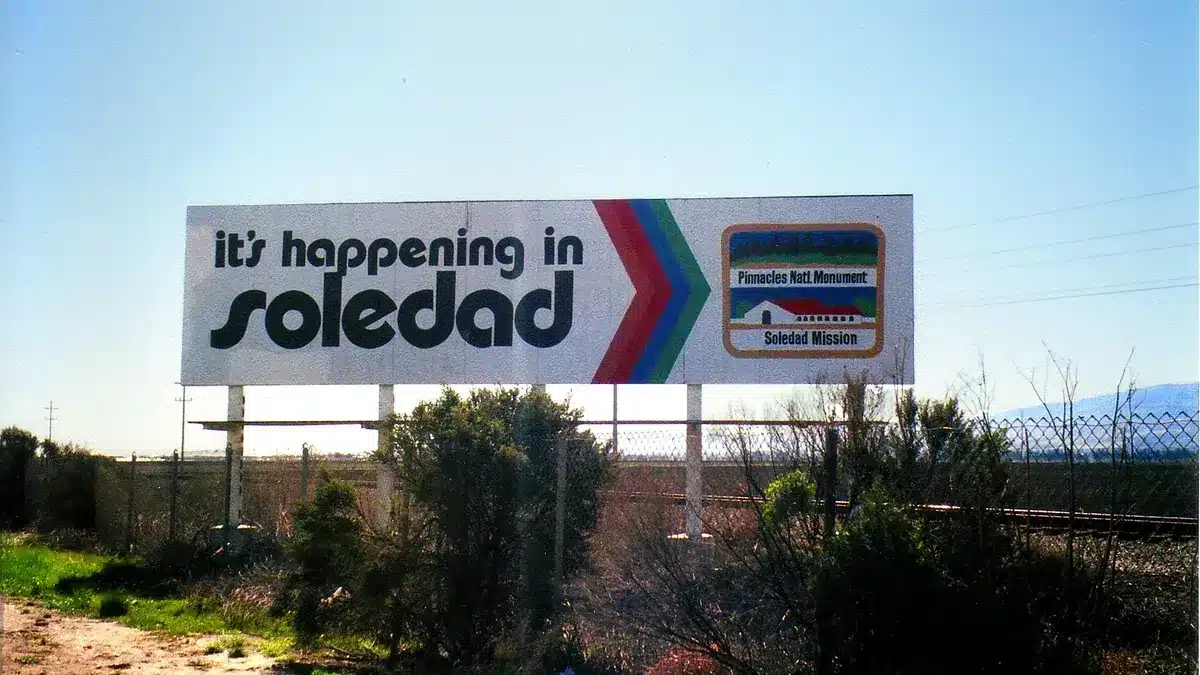
U.S. Route 101 northwest of Soledad, with the "It's Happening in Soledad" sign
U.S. Route 101 about 2.4 miles northwest of Soledad. SVSP’s address is on this highway, 31625 Highway 101, and CTF is reached by Soledad Prison Road; a server headed to either one comes this way. Photo: Mona Eshaiker, Wikimedia Commons, CC BY-SA 3.0.

Correctional Training Facility

CTF is on Soledad Prison Road, and its switchboard is (831) 678-3951, according to the Department’s listing. Mail is split by facility:

  • all staff: P.O. Box 686, Soledad, CA 93960-0686;
  • incarcerated people in Facilities A and B: P.O. Box 705;
  • Facility C: P.O. Box 689;
  • Facility D: P.O. Box 690.

Salinas Valley State Prison

SVSP’s CDCR page lists 31625 Highway 101, Soledad, CA 93960, main phone (831) 678-5500. Institution mail goes to P.O. Box 1020, Soledad, CA 93960-1020. Letters for someone held there use P.O. Box 1050, and SVSP wants the envelope to identify the person by name and CDCR number and to give the housing on record.

Why the facility letter matters

At CTF, the right box depends on which facility the person is housed in. When a firm knows the facility from earlier correspondence or a case record, it belongs in the order notes, along with the CDCR number. Staff at the institution use those to find the person before deciding how the papers will reach them.

Kinds of Soledad prison orders

  • a summons, petition or notice for an incarcerated person;
  • papers naming an officer, nurse, counselor or other employee;
  • papers aimed at the Department itself, or at prison records.

The sections below take them in that order. Each one runs through a different office and a different rule.

Serving a person incarcerated at CTF or SVSP

CDCR’s own manual sets the method. Section 14010.7.4 of the Department Operations Manual says its rules on serving incarcerated persons “preclude process servers from direct access to security areas of the institutions.” A process server does not walk into a housing unit with a summons. The manual then lists the ways service can be completed.

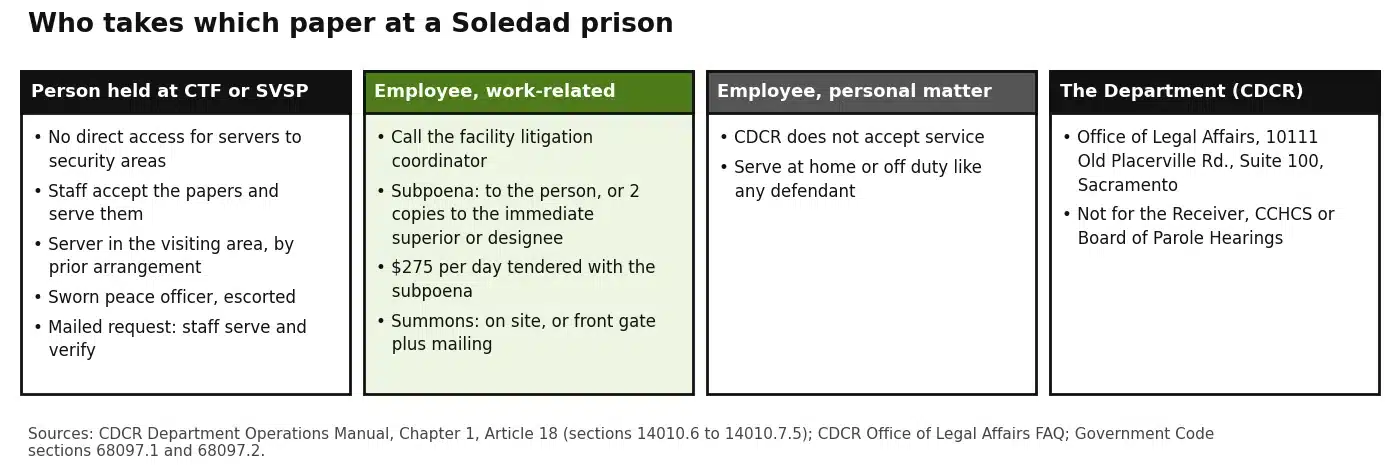
Diagram of who receives each kind of paper at a Soledad prison
Who takes which paper at CTF or SVSP: incarcerated persons are served through staff, the visiting area or a sworn officer; work-related papers for staff go through the litigation coordinator; papers for the Department go to its Office of Legal Affairs in Sacramento. Sources: CDCR Department Operations Manual 14010.6-14010.7; CDCR Office of Legal Affairs.

Staff complete the service

The first option is that institution staff accept the papers from the process server and then serve the incarcerated person themselves. The institution’s staff, not our server, then completes the verification of service.

A server in the visiting area

A non-sworn process server may be allowed to make personal service, but only when three conditions are all met:

  1. the server wants to make personal service and has made arrangements in advance;
  2. the incarcerated person can reasonably be brought to the visiting area;
  3. allowing it does not compromise the security of the institution.

When a firm needs our own proof of personal service, for example because the other side has already disputed service once, this is the route we ask the institution for, and we tell you in advance that the prison decides whether it happens.

A sworn officer, or a request by mail

A sworn peace officer may be escorted into the security area to serve. And when a request for service arrives by mail, the manual tells institution staff to serve the papers and complete the verification of service themselves.

What the proof looks like

If staff serve the papers, the record of service comes from the institution. The firm then files that verification, or relies on it in its own proof, rather than a declaration from our server. We keep the delivery to the institution, the name of the staff member who accepted the papers and the date in the order log, which is what you need if the timing is questioned. The forms that go with each method are in our article on serving someone in jail or prison.

Papers that should not wait

People are moved between institutions. A person who was at SVSP when the case was filed may be elsewhere by the time the papers are ready, and the papers then have to follow them. Placement is confirmed before delivery so that the Soledad trip is not wasted.

Subpoenas for correctional officers and other prison staff

A subpoena aimed at Soledad can name someone who works at the prisons: an officer, nurse, counselor or records clerk who saw something or keeps a record of it. State law gives these witnesses a separate set of service and fee rules, and CDCR’s manual adds its own.

Copies to the immediate superior

Government Code section 68097.1(b) covers state employees who are needed as witnesses in a civil action on a matter where they have expertise from their duties. The subpoena may be served by delivering a copy to the employee personally, or by delivering two copies to the employee’s immediate superior, or to an agent the superior has designated to receive service. Subdivision (a) has the same two-copy rule for sheriffs, deputies, CHP officers, city police officers and the other listed officers, when the case concerns an event they perceived or investigated on duty. A city police officer subpoenaed about an incident they investigated falls under that subdivision.

The $275 deposit

Under Government Code section 68097.2(b), the party who requests the subpoena must tender $275, together with the subpoena, to the person accepting it, for each day the employee is required to attend. If the employer’s actual cost turns out lower, the difference is refunded; if higher, the party pays the rest. When a court continues the hearing on its own motion, no further fee is needed for the new date. The check belongs in the package we deliver, and the proof records that it was tendered.

What CDCR tells its staff

The manual’s subpoena sections say every employee may be subpoenaed for actions arising from their employment. Any employee may designate another employee in writing to accept subpoenas for work-related matters, and service on that designated agent counts as personal service. An employee who receives a subpoena must notify their supervisor of the time, date, place and case, and must contact the litigation coordinator (DOM 14010.6.9). The employee is excused from appearing only if told so by the party who issued the subpoena, the Attorney General’s office, CDCR’s Office of Legal Affairs or the litigation coordinator on the case.

Start with the litigation coordinator

CDCR’s Office of Legal Affairs advises anyone serving a person who works at an institution, on a work-related matter, to “contact the Litigation Coordinator at that particular facility and be prepared to serve the person on site.” For that reason a Soledad staff subpoena is routed through the coordinator at CTF or SVSP first, to learn who is authorized to accept and when the employee is on site, before a server makes the drive.

Where the witness lives

Section 68097.1(c) ties these subpoenas to Code of Civil Procedure section 1989, which only obliges a witness to attend if they live in California at the time of service. Staff who live in Monterey County, or anywhere in the state, are within reach.

Suing a prison employee, or the Department itself

A summons is not a subpoena, and CDCR treats it differently. The manual calls service of any civil document other than a subpoena “legal process,” and it routes that by whether the case is about the employee’s job.

The Department and its headquarters staff

CDCR’s Office of Legal Affairs accepts service of process “only for CDCR (the Department) and certain executive staff at Headquarters,” at 10111 Old Placerville Road, Suite 100, Sacramento, CA 95827. It does not accept service for the federal Receiver, California Correctional Health Care Services or the Board of Parole Hearings, and gives (279) 223-2100 for instructions on those. A summons naming the Department is not served at the Soledad gate.

An employee sued over their work

For a work-related case against a person employed at CTF or SVSP, the same office says to contact that facility’s litigation coordinator and serve the person on site. The manual describes substituted service at the workplace as leaving the papers with “a person in charge,” which “may be the officer on duty at the front gate or public entrance,” and then mailing a copy to the employee at the place of employment. Under section 14010.7.5, the institution then forwards the papers to the employee, either by office mail or in person.

A personal matter

CDCR “does not accept service of process for non-work-related matters involving CDCR employees.” A divorce, a car accident or a debt case against someone who happens to work at CTF is served at home or wherever the person can be found off duty, like any other defendant. The prison gate is the wrong place for it.

What the employee reports

An employee served with legal process forwards it to the person the warden designates, normally the litigation coordinator or case records staff, and reports the date, place, server’s name and method of service (DOM 14010.7.5). A clear proof from our side, matching what the employee reports, avoids a later dispute about when service happened.

Small claims against staff

Section 14010.8 notes that an employee may be served with a small claims case arising from their employment, and that neither the Attorney General nor any other attorney can appear for the employee in small claims court. The employee is told to contact the person who handles legal documents at the institution.

Subpoenas for records held by the prisons

Firms subpoena prison files for things such as housing and movement history, medical records and incident reports. CDCR’s manual sorts these subpoenas into groups, and the group decides who answers.

Records about an incarcerated person

Under section 14010.6.10.3 of the manual, subpoenas for an incarcerated or supervised person’s records are always referred to the Attorney General’s office, with two exceptions:

  • the subpoena was issued by the person’s own attorney, in which case the attorney is told that the person’s written consent is needed to review the record;
  • the person’s medical records are sought in a civil case that does not involve the Department and in which the person is a party, in which case the person is notified before disclosure.

Plan the production date around the referral

A referral to the Attorney General adds a step between our delivery and the response. When a firm’s subpoena falls into the referred group, we tell you at intake so the production date leaves room for it, rather than finding out after the date passes.

Delivering a records subpoena

  • name the institution and the custodian or unit that holds the records;
  • include the person’s CDCR number and date of birth;
  • attach any consent the person signed;
  • for a consumer’s records, include proof the notice to the consumer was served.

When the witness is someone held at CTF or SVSP

A person serving a sentence can still be the witness a civil case turns on. California law does not let a subpoena simply bring them to court. It routes the testimony through a court order.

Deposition inside the prison

Penal Code section 2623 provides that if a witness in a civil action or special proceeding is a prisoner in a state prison, an order may be made for the prisoner’s examination in the prison by deposition. The order is made by the court where the case is pending, or, if the case is in small claims court, by a judge of the superior court of that county. It is made on motion, with an affidavit showing the nature of the case, the testimony expected and why it is material.

Who takes it

Under section 2622, which section 2623 adopts, the deposition may be taken before any magistrate or notary public of the county where the prison is located. Both Soledad prisons are in Monterey County. A firm in Los Angeles deposing a Soledad prisoner is therefore booking a Monterey County notary or officer, and a court reporter, for a session inside the institution.

Bringing the witness to court

Code of Civil Procedure section 1997 allows a court to require the witness to be produced only if the witness is in a jail in the same county where the case is pending. In every other case the examination, if allowed, is taken by deposition. A Soledad prisoner is in a state prison, not a county jail, so for a case in another county the deposition is the usual route.

What we prepare

  • service of the motion and the signed order on the parties;
  • delivery of the order and notice to the institution through the litigation coordinator;
  • a deposition officer or court reporter for the session, when that is part of the order.

A parent or spouse held at a Soledad prison

Family cases reach Soledad because one parent or spouse is in prison there. Penal Code section 2625 sets out what the court must do, and it puts duties on the warden as well as on the parties.

Cases that require notice to the prisoner

Section 2625(b) requires the court to order notice to the prisoner in a proceeding to free a child from parental custody under Family Code section 7800 and following, a Welfare and Institutions Code section 366.26 hearing, a dependency petition about the prisoner’s child, certain review hearings, and any hearing that will decide the parentage of the prisoner’s child.

How the notice is served

Service follows Family Code section 7881 or 7882, or the listed Welfare and Institutions Code sections. Under section 7881, the citation is served “in the manner provided by law for the service of a summons in a civil action, other than by publication,” at least 10 days before the appearance date. That puts the citation into the institution’s service methods described above.

The prisoner’s right to be there

If the prisoner or their attorney tells the court the prisoner wants to be present, the court must order the prisoner temporarily removed from the institution and brought to court. A termination proceeding cannot go forward without the prisoner or their attorney present unless the court has a signed waiver from the prisoner or an affidavit from the warden, or a designated representative, stating that the prisoner has indicated an intent not to appear.

Divorce and other marital cases

For any other case in which a prisoner’s parental or marital rights are being decided, section 2625(e) lets the court order the prisoner’s production. A copy of the order must be sent to the warden at least 15 days before it is to be carried out, and the sheriff of the county that made the order brings the prisoner to court and back.

In Monterey County, a petition to terminate parental rights also triggers a Family Court Services investigation. The court charges $550 per parent whose rights are at issue, and the hearing is usually set no more than 45 days after filing, with the investigator’s report due at least five days before. When the parent is at CTF or SVSP, those 45 days include the time the institution needs to complete service.

Which Monterey County courthouse takes a Soledad case

Monterey County has five court locations, according to the court’s location list, and none of them is in Soledad. The nearest counter is in King City; the courthouse that hears Soledad civil cases is on the Monterey Peninsula.

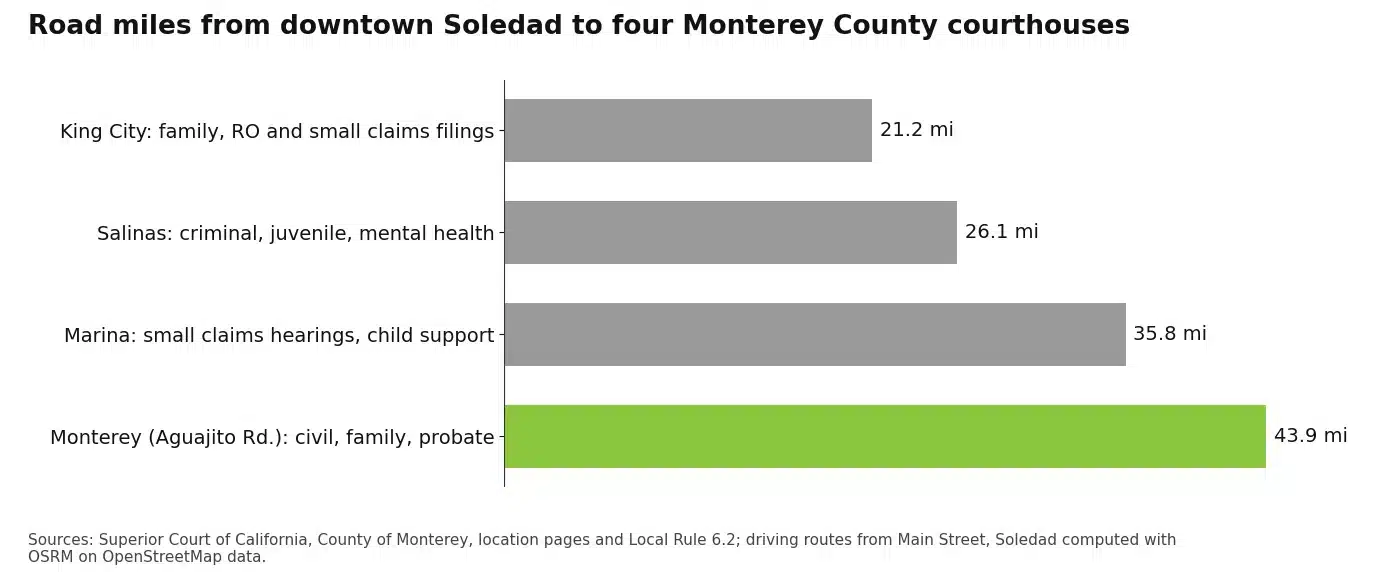
Bar chart of road miles from Soledad to four Monterey County courthouses
Road miles from downtown Soledad to four Monterey County courthouses, with the case types each one takes; the juvenile court on Natividad Road is left out. Civil cases are tried at the Monterey Courthouse, the farthest of the four. Sources: Monterey County Superior Court location pages and Local Rules; OSRM routes on OpenStreetMap.

Civil cases go to Aguajito Road in Monterey

Local Rule 6.2 places the civil division “in the Monterey Division Courthouse at 1200 Aguajito Road, Monterey,” and says all civil cases are processed and tried there unless the rules or the presiding judge provide otherwise. Rule 2.2 lists the proceedings that must start in the Monterey Division, including all civil, family law, domestic violence, harassment, child support, parentage, adoption and small claims proceedings. From downtown Soledad that is 43.9 road miles, about 57 minutes.

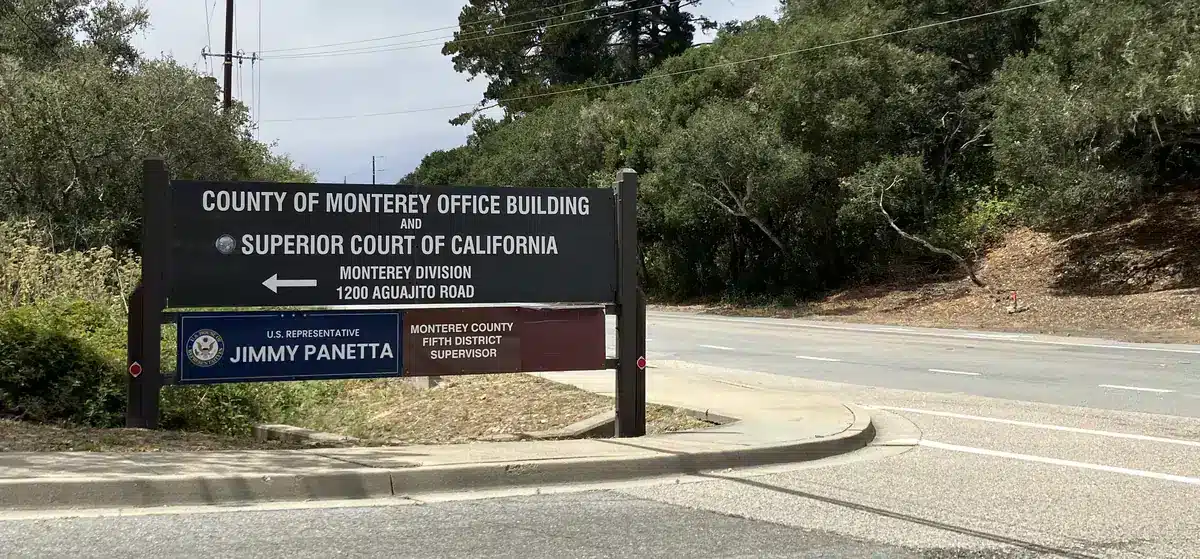
Entrance sign for the Superior Court, Monterey Division, 1200 Aguajito Road
The entrance sign on Aguajito Road for the Superior Court’s Monterey Division at 1200 Aguajito Road, where Local Rule 6.2 places the county’s civil division and where Soledad civil cases are tried. Photo: Guylaen, Wikimedia Commons, CC0.

Departments for an unlimited civil case

Unlimited civil cases are assigned in rotation to Departments 13-A, 14 and 15. Complex cases go to Department 14 if the case number is even and 15 if odd, and collection cases under rule 3.740(a) go to Department 13-A for all purposes. Civil harassment restraining orders are heard by the commissioner in Department 16-A.

Family law in Departments 16 and 17

The family law page says family matters are heard at the Monterey Courthouse in Departments 16 and 17, assigned by case number: odd-numbered cases to Department 16, even-numbered to Department 17. Tuesday mornings at 8:30 belong to domestic violence restraining orders in Department 16, while child support cases brought by the Department of Child Support Services go to Department 21 in Marina on the same weekday.

King City, the nearest counter

The King City Courthouse, Courtroom 18 at 250 Franciscan Way, lists family filings, restraining order filings, small claims filings, self-help services and child support calendars among its services, along with traffic. It is 21.2 road miles from downtown Soledad. When a Soledad family case needs a paper filing in person, King City is the shortest drive.

Salinas handles criminal and juvenile work

The Salinas Courthouse at 240 Church Street is described by the court as its main hub, and its location page lists criminal, juvenile and mental health. Felony, misdemeanor and juvenile appeals are filed with the appeals unit on its first floor. It is the wrong building for a summons in a Soledad lawsuit.

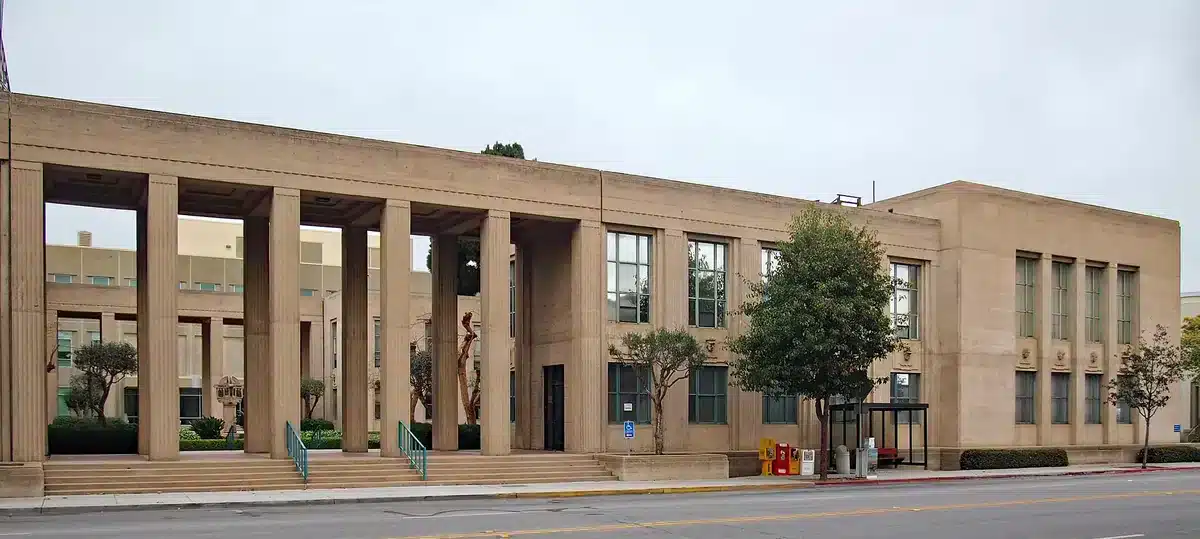
Monterey County Courthouse at 240 Church Street in Salinas
The Salinas Courthouse at 240 Church Street is the court’s criminal and juvenile hub, and the closer of the two large courthouses to Soledad, but it is not where a Soledad civil complaint is filed. Photo: McGhiever, Wikimedia Commons, CC BY-SA 4.0.

Monterey County filing rules that reach the serve

A few of Monterey County’s local rules decide what has to go out with a summons and how fast a proof has to come back.

E-filing in every case type

Local Rule 1.7 requires electronic filing “in all case types,” except appellate department cases, through the court’s e-filing providers. Self-represented parties are encouraged but not required to e-file, and a party may ask for an exemption. The court’s civil page puts it more briefly: “Attorneys are mandated electronic filers.”

Papers served in the courtroom still get e-filed

Rule 1.7(F) says documents served by hand, in court or otherwise permissively must then be e-filed before the close of business on the next court day, and the proof of service must reference the date the document was originally served in open court. A document handed across the counsel table at a Monterey hearing is not finished until that filing is made.

What travels with a Monterey summons

Under Rule 6.1(B), the court files and sends the initiating party a Notice of All Purpose Case Assignment and Setting of Case Management Conference. That notice and the court’s Alternative Dispute Resolution information packet “must be served together with the Summons and Complaint,” under rule 3.722 and the local rules. We check that both are in the set before the first attempt.

The conference clock

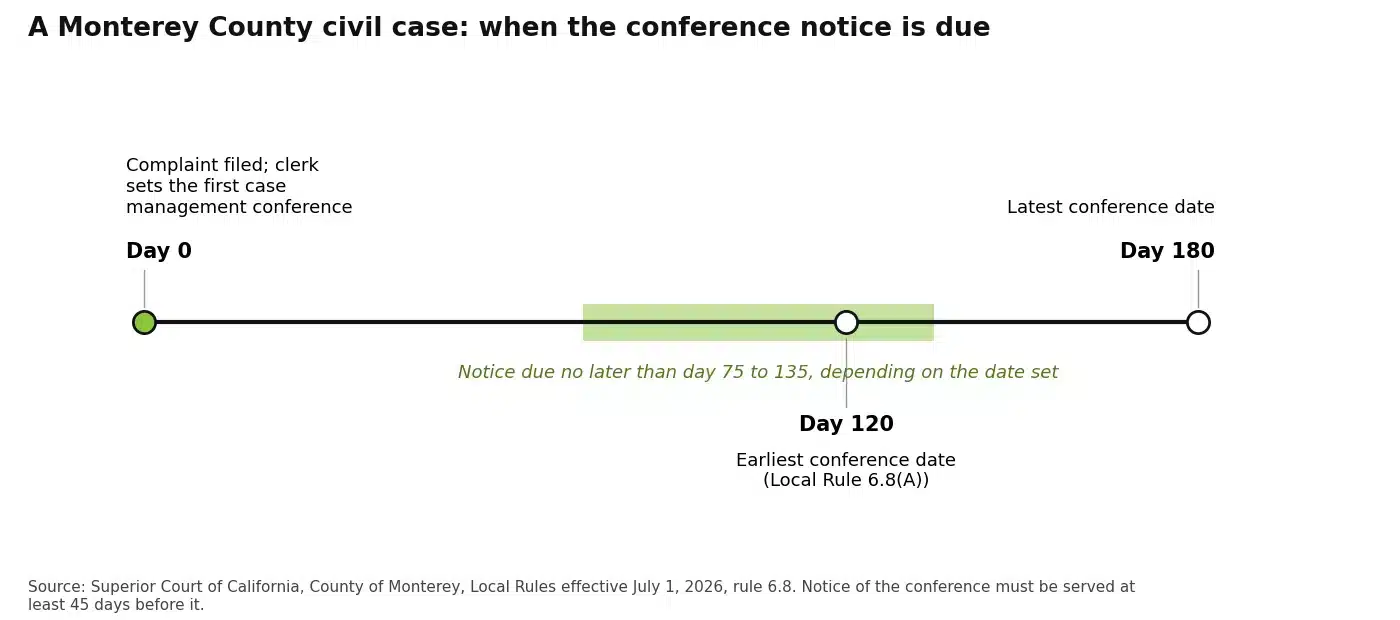
Rule 6.8 has the clerk set the first case management conference at least 120 and no more than 180 days after the complaint is filed, and requires the plaintiff to serve all parties with notice of it no later than 45 days before the conference. A defendant served late in that window has to receive the conference notice with, or soon after, the summons.

Monterey County timeline: conference between day 120 and 180, notice due 45 days before
Monterey County civil timeline: the clerk sets the first case management conference between day 120 and day 180 after the complaint is filed, and the plaintiff must serve notice of it at least 45 days before the conference date (Local Rule 6.8). Source: Monterey County Local Rules, July 1, 2026.

Newspapers for publication

When a court orders service by publication, the civil division publishes its list of adjudicated newspapers of general circulation for Monterey County. The order for publication names the paper, and it has to be one on that list.

From a Soledad request to a signed proof

A Soledad order goes one of two ways after intake. A town address goes to a registered server with your notes, while papers for CTF or SVSP start with the litigation coordinator or a visiting-area arrangement. Calls to the prison and trips to a street address both go into the order log, and the signed proof lands in your account when the job closes.

5 out of 5 stars

“Hands down 👊 the best attorney service out there!”

– Vernon C. Tucker, Esq.

5 out of 5 stars

“Highly recommended! By far the best company we have used. Very fast service of process. Website is easy to use and the people there know what they are doing.”

– Ashley B

5 out of 5 stars

“They are very reliable and prompt. I like the ease of using the service.”

– Jay Rahimi

Send papers for service in Soledad

Details that belong in a Soledad request

When the order is opened, upload the papers along with what you know about the person. For a Soledad job these points decide which office hears from us first:

  • whether the person is held at CTF or SVSP, works there, or lives in town;
  • for someone held there: the CDCR number, the facility letter at CTF and the last known housing;
  • for staff: the employee’s title, unit and shift, and the $275 check for each day of a witness subpoena;
  • for a Monterey County civil case: the case assignment notice and ADR packet;
  • the hearing or production date, so time for the institution’s own steps is built in.

The price of a standard serve appears before you submit, and anything extra, such as a rush or a stakeout, is its own line. A stakeout suits a town address where the person is rarely home during the day. If a street address in town looks out of date, we can look it up in public records before the trip and note what we found. Each trip to a Soledad address or gate is logged with what the server found, and the proof can be filed with the Monterey County court as part of the same order.

Contact Us

Please fill in the form below. A member of our team will contact you to finalize the order.

Court and form links for Soledad filers

California Secretary of State

Superior Court Holidays

Federal Rules and Practice Procedures

Questions firms ask about serving papers in Soledad

Where are civil cases from Soledad filed?

A Soledad civil complaint is filed 44 road miles away in Monterey, at the Aguajito Road courthouse, since the town has no court of its own. The courthouses section above explains why the closer buildings in King City and Salinas are the wrong stop for it.

Can a server reach an in-custody recipient at a state correctional facility?

Yes, through the prison rather than past it. CDCR keeps servers out of security areas, so the papers are handed to institution staff to serve, or served in the visiting area when the prison agrees in advance. The inmate’s CDCR number is the one detail we cannot start without.

Can a server work at a Soledad-area ag operation?

Packing sheds and ranch offices around Soledad work in shifts, and field crews move during the season, so a serve on a worker is planned around where and when the person reports. Give us the employer, the crew or department and the usual hours.

Serving a Soledad business, a produce packer or an operation along US-101, sometimes means the documents go to the company registered agent rather than a person at the gate. The agent on file with the state accepts service for the entity. Here is how to find a registered agent for service of process before the order goes out.

Can language access affect service in Soledad?

A language difference at the door does not change the rules for a valid serve. If the person mainly speaks a language other than English, say so in the order and the server plans for it. Papers for someone inside CTF or SVSP are served by prison staff, so the question only comes up at town addresses.

Can a server work along US-101 in Soledad?

Yes. Businesses along Highway 101 can be served in their opening hours. One 101 address is different: number 31625 is Salinas Valley State Prison, where papers follow the prison’s own process.

Can address verification be added to a Soledad order?

Yes. Before anyone drives to a Soledad street address that may be stale, it is run against public records and the result is noted on the order. If the person may have been sent to CTF or SVSP since, we confirm the institution with CDCR first.

How do I find out which prison a person is in before ordering service?

CDCR’s Office of Legal Affairs tells attorneys looking for an incarcerated person who is a party to a lawsuit to call CDCR’s ID Warrants unit at (916) 445-6713, with the person’s full name and date of birth if the CDCR number is not known.

Does the prison charge to serve papers on someone held there?

No. CDCR’s Department Operations Manual, section 14010.7.4, says no charge is made for serving legal papers on incarcerated persons by departmental staff. If a fee is sent with a request for service by mail, it is returned with the verification of service.

Can a subpoena reach a correctional officer’s personnel file?

Only through the procedure for peace officer records. CDCR’s manual treats those files as confidential under Penal Code sections 832.7 and 832.8. They are disclosed with the officer’s written consent, on a district attorney subpoena for child support enforcement, or after a motion under Evidence Code sections 1043 and 1046 with notice served on the Department more than ten days before the hearing; the court decides what is released.

Does a CDCR employee served at work get a state lawyer?

They can ask for one. Under CDCR’s manual, an employee served with job-related legal process may request representation at state expense or hire private counsel (DOM 14010.7.5 and 14010.14), and an employee subpoenaed over their work completes a Request for Representation unless one is already on file for that case (DOM 14010.6.9).

Where is a small claims case from Soledad filed and heard?

Monterey County’s small claims page says all small claims documents are filed at the Monterey Courthouse, 1200 Aguajito Road, and all hearings are held at the Marina Courthouse, 3180 Del Monte Boulevard, in Department 20 on Thursdays at 8:30 a.m. and 1:30 p.m. The King City Courthouse also lists small claims filings among its services.

What are the small claims limits in Monterey County?

Individuals and sole proprietors can claim up to $12,500, and corporations, partnerships, public entities and other businesses up to $6,250. No one may file more than two claims over $2,500 anywhere in California in a calendar year, unless the filer is a public entity.

Is free eviction mediation available for a Soledad tenancy?

Yes, if both sides represent themselves. The court partners with the Monterey College of Law and the Mandell-Gisnet Center for mediation of unlawful detainer and small claims cases before filing, after filing or on the trial date, at no cost; requests go to the ADR coordinator at 831-582-4095.

How much does a Monterey County court record search cost?

The clerk charges $15 for each record search without a case number, and $15 for any search that takes more than ten minutes. Files kept off-site take seven to ten days and a $10 retrieval fee for up to three files. Viewing hours are 8:00 a.m. to 3:30 p.m.

How does a Soledad tenant ask to stop an eviction after the Sheriff posts the notice?

Monterey County takes a request for a stay electronically, at the Monterey Courthouse, 1200 Aguajito Road, or through the drop box at any courthouse. The court calls it an extraordinary remedy that should be submitted as soon as possible after the Sheriff’s posting, and asks for at least 48 hours to process it.

Can papers for a Monterey County case be left in a courthouse drop box?

Yes. Each courthouse has a drop box outside. The court says drop box and mailed filings are processed the next day, not the same day, and that using the boxes at the Salinas or Marina courthouses can add another day before review.

Which court hears an appeal from a Soledad case?

It depends on the case type. A Superior Court judge hears a small claims appeal; limited civil cases go to the Appellate Division of the Monterey County Superior Court; unlimited civil cases go to the Sixth District Court of Appeal.

4.7 ★★★★☆
Based on 24 Google reviews
Showing five-star Google reviews, newest first.

Other Monterey County cities we cover

Soledad is one of six Monterey County communities with a page of its own. Salinas and Prunedale are up Highway 101 to the north; Seaside, Marina and Monterey are on the bay, near the courthouse that hears Soledad civil cases.

Filing, records and deposition help on Soledad cases

Litigation support beyond service of process:

Soledad is in Monterey County. For cases outside Monterey County, we handle process serving across California and nationwide.