
How Much Does a Court Reporter Cost in California?
In California, what court reporters cost depends on whether they’re provided by the court or your firm has to book their services. For example, official court reporting comes with set (statutory) fees, such as $1.13 per 100 words for an original transcript or a $30 court fee for a short civil hearing. Generally speaking, private court reporters charge a fee to show up as well as a per-page fee, and if you need their transcription quickly (or you need video court reporting services), you could pay in the low thousands for a day of court reporting.
Since 2008, On-Call Legal has worked with California attorneys and legal teams, and it belongs to CALSPro, NAPPS, CAALA, and ServeNow. Law firms use our court reporting services, including certified court reporters, court videographers, and interpreters at depositions, hearings, and examinations under oath. If you already have a deposition scheduled, get a quote today.
This article explains what California court reporters charge, why the rates sit where they do, and how to get an accurate quote.
What Does a Court Reporter Charge in California?
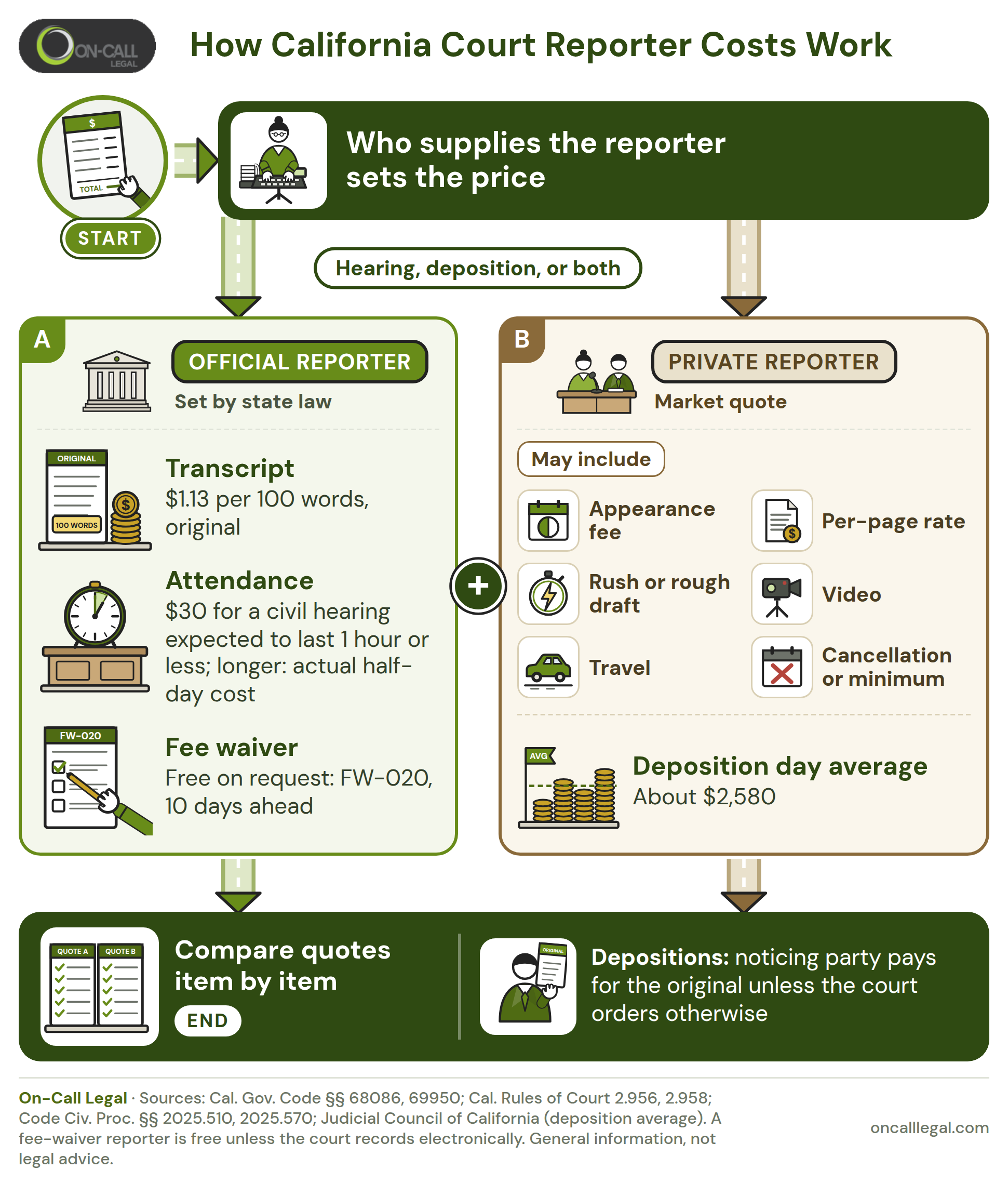
Court reporting in California runs on two price systems, one written by the Legislature and one set by the open market. The Judicial Council of California puts the private average at $2,580 a day for a deposition and $3,300 a day for trial. Outside the courtroom, firms pay a freelance reporter or the agency that books one, and those providers set their own prices. The reporter is also one line among several, since a full deposition fee can include video, a deposition officer, and a room.
Official Court Reporter Fees Set by Statute
If an official court reporter prepared the transcript, that person works for the court, and state law sets the price of the transcript. Under Government Code 69950, an original costs $1.13 per 100 words, and each copy bought with it costs $0.20. The first copy, for those who forgo the original option, costs $0.26 per 100 words, and any extra copies bought at the same time cost $0.20. For depositions, cost recovery has its own limit: under Code of Civil Procedure 1033.5, a prevailing party’s allowable costs cover an original and one copy of the depositions it took.

Attendance carries its own charge, and Government Code 68086 sets $30 for a civil proceeding expected to last an hour or less. Longer proceedings are billed at actual cost per half day, under a formula in Rule of Court 2.958. Call the clerk or the court department handling your case to find out the cost in your jurisdiction. If you have a fee waiver, you can ask to have the hearing or trial reported for free. See Rule of Court 2.956.
Private Deposition Reporter Rates
No statutory fee schedule applies to private deposition reporters, so providers set their own prices. Under Code of Civil Procedure 2025.570, the deposition officer may set a reasonable charge when releasing a copy of the transcript to any person who requests one.
Expect a quote with an appearance fee that is calculated on a per-day basis (this could be a half-day fee or a full-day fee), plus a per-page fee for the deposition transcript. Some charge by the hour. Other items you may see in a court reporter’s deposition quote include a separate charge for rush service or a rough draft. There may be a minimum fee. If the deposition is canceled on short notice, there may be a cancellation fee. Depending on where the deposition is to take place (for example, in a rural county), the court reporter may add travel expenses to the quote.
Official vs. Private Court Reporter Costs Compared
Depending on who’s supplying the reporter, different people are in a position to set the price, and each arrangement leaves a different party footing the bill. A statewide contract from the Office of Administrative Hearings adds a published benchmark, though it covers administrative hearings, not depositions.
|
Reporter Type |
When You Use One |
Who Sets the Rate |
Attendance Cost |
Transcript Cost |
Who Pays |
|---|---|---|---|---|---|
|
Official court reporter (civil) |
Civil hearings and trials when the court provides a reporter |
State law and each court |
$30 for one hour or less, then the court’s actual half-day cost |
$1.13 per 100 words for the original |
The parties, unless a fee waiver applies |
|
Official reporter pro tempore |
The court has no reporter, so a party arranges a certified court reporter |
The reporter and the arranging party |
Paid by the arranging party |
Confirm with the reporter before the hearing |
The arranging party, who may recover it as court costs |
|
OAH contract reporter |
State administrative hearings |
OAH statewide contract, with rates for April 2026 to March 2027 |
$1,400 to $1,600 in person or $875 virtual for a full day |
$6.50 to $13.00 per page, depending on turnaround |
Confirm with the local OAH office |
|
Private deposition reporter |
Depositions and examinations under oath |
The provider, at market rates |
About $2,580 a day all-in on average (Judicial Council attorney survey) |
Per-page rate set by the provider |
The noticing party for the original |
What Drives the Price of a Court Reporter
Longer cases cost more. Period. The more hours you require and the more pages of transcript you expect, the more it’s going to cost. Beyond that, turnaround time, service type, location, and timing will heavily impact pricing.
Adding video brings in another person (a legal videographer), because the reporter’s role at a deposition is swearing in the witness and capturing all the words spoken. Specialty services will also increase the price. These services include real-time reporting, which delivers testimony to lawyers’ laptops while the witness is speaking, video synchronization, and certified interpretation, where a third professional is hired to interpret for a witness.

Demand and location show up in the state contract as well: an in-person day will cost $1,400 in four regions and $1,600 in all others. A half-day fee also applies when an OAH hearing is canceled or continued and the reporter is not canceled by 5 p.m. on the previous business day. Cancellation and minimum policies vary from one reporting agency to the next, so make sure you understand what they are and obtain them in writing before booking.
Turnaround and Delivery Speed
Speed is under your control, since you’re the one ordering the service. On the official side, Government Code 69951 lets a reporter charge 50% more for special daily copy.
Similarly, in the OAH contract, $13.00 buys a page of the daily transcript, but rates decline to $6.50 for 21 to 25 days out. In between, the rates are $11.25 for two to seven days, $10.00 for eight to 14 days, and $8.00 for 15 to 20 days. Rush charges can accumulate, so review past invoices for expedited orders. Don’t schedule transcription based on old patterns; match the deadline.
Remote and In-Person Depositions
Remote depositions eliminate travel time and hassle (like finding parking) but have their own technological challenges (learning how to use the deposition platform and figuring out how to best share exhibits electronically). In the OAH contract, the rates for a virtual full day and a virtual half day are the same for all areas and are $875 and $435.50, respectively.

For an in-person half day, you will pay $700 or $800 depending on the region, so the difference exists even before you include any mileage costs. Depositions that are conducted in person require advance consideration of logistics (finding a space that will accommodate the court reporter’s equipment and deciding how to best introduce paper exhibits). Shorter days cost less (in either format), one more reason to prepare for a deposition with a tight witness outline.
Why Court Reporters Cost What They Do in California
The short answer is supply. Fewer court reporters are licensed in California than law firms and courts would like to employ. The Judicial Council counted 1,101 court-employed reporters in 2026 and said courts need 458 more full-time reporters. Across 4.2 million family, probate, and unlimited civil hearings from April 2023 through March 2026, 71.3% had no verbatim record at all.
Without a verbatim record, an appeal can be nearly impossible, so the justice system feels that gap first. In fact, Government Code 69957 restricts the use of electronic recording to infraction, misdemeanor, and limited civil cases, and only when no reporter is available, meaning court reporters will continue to be in demand. Another trend is an aging workforce. Of active licenses, 48.1% were issued 30 or more years ago. Only 176 new licenses went out in fiscal year 2024-25, so new entrants are not replacing retirees quickly.
Scarcity is reflected in salary, with the Bureau of Labor Statistics reporting median pay of $116,020 for court reporters in California as of May 2025. The state’s average annual salary for the profession was $108,890, the highest mean wage of any state. San Jose had the top metro mean at $128,960, and other California metros included Stockton-Lodi at $123,680, Riverside-San Bernardino at $122,540, San Francisco at $120,200, and San Diego at $104,720. Those kinds of salaries affect what agencies charge to provide a court reporter for the day. For people weighing careers in the field, BLS projects little or no change in employment through 2035, with most openings coming from reporters who retire or leave the field.
How California Licenses Certified Shorthand Reporters
Certified shorthand reporters must be licensed by the California Court Reporters Board, a board within the Department of Consumer Affairs. Under Business and Professions Code 8020, applicants qualify for the licensure exam in one of four ways. A certificate from an approved reporting school, NCRA or NVRA certification, verbatim reporting experience for a year, or an equivalent license in another state is acceptable.

Under the board’s regulations, recognized programs must include at least 660 academic hours, with at least 150 hours of legal instruction such as legal terminology and court procedure, on top of 2,300 hours of machine shorthand or voice writing practice. The same rules include 120 medical hours and a keyboarding standard of 45 words per minute. There are three sections of the exam, and the skills section involves dictation of four voices at 200 words per minute. Since January 1, 2025, candidates pass that part at 95% accuracy, while English and Professional Practice are written tests. According to the Court Reporters Board’s exam statistics, only 158 of 294 candidates (53.7%) passed the skills test across the November 2025, March 2026, and July 2026 sittings.
Recent legislation allows holders of a CVR, CVR-S, or RPR to skip the skills portion of the exam. License renewal is $225 annually. There are no CE requirements set by the board. West Valley College in Saratoga offers a board-recognized program at no registration cost to help students prepare for the CSR exam. Steno students must provide their own machine. Classes are noncredit and open only to California residents. With the 17 recognized schools of 2010 dwindling to just eight, programs such as these are becoming increasingly important.
National Certifications and CART Captioning
The National Court Reporters Association awards the RPR, RMR, RDR, and CRR, plus the Certified Realtime Captioner credential. The National Verbatim Reporters Association awards the CVR, CM, RVR, and RCP-M to voice writers. CART (communication access realtime translation) is speech-to-text translation displayed on a screen almost instantly. CART is used at live events, in classrooms, and at community meetings so that deaf and hard-of-hearing individuals have access to the conversation. Professionals with real-time credentials may also send testimony to the attorney in real time during depositions, a specialty service that can add to the cost of a deposition.
How to Hire a Court Reporter in California
Done in order, these four steps will help the hiring process move along quickly and keep costs transparent and transcripts on track.
Check Whether the Court Will Provide a Reporter
First, find out whether the court has a reporter. Absent a court reporter, Rule 2.956 authorizes a party to make arrangements for a certified shorthand reporter to act as reporter pro tempore. That party pays the reporter, but you may be able to get that amount back later as court costs. A litigant with a fee waiver can instead request an official reporter at no cost by submitting form FW-020. The rule asks you to file it 10 calendar days before the proceeding, so note the date when the hearing is set.
Gather Quotes With the Same Cost Components
Next, obtain comparable estimates by specifying the same number of hours and pages for each service provider. Price the job item by item, including the appearance fee, hourly or half-day rate, page rate, rush service, video service, cancellation policy, minimum charges, rough draft, and copies. Ensure that any blank areas on the estimates are clarified before making a comparison.
If the deposition needs a legal videographer or a certified interpreter, ask for each as its own line item, since each is a separate professional with a separate rate. Our breakdown of deposition costs shows how those pieces add up.
Confirm the Reporter Holds a Current CSR License
Then make sure the reporter’s license covers stenographic depositions, since those must be reported by a reporter certified in California. Before the reporter arrives, verify the license status (active or expired) in the Court Reporters Board license search, which also shows whether the reporter is licensed as a steno or voice writer.
Book Early and Set Your Transcript Deadline
Finally, reporters on short notice may be difficult to come by, so it’s a good idea to reserve as soon as possible given the limited supply. When scheduling, make sure the provider knows when you need the transcript, and ask whether you also need a deposition officer for records. If the witness is a nonparty, the deposition subpoena has to be served well before the date. By completing these steps before you serve notice, you can avoid changes in rate and availability.
Who Pays for the Court Reporter
The party who notices the deposition is responsible for the cost of having it transcribed. This is the default rule under Code of Civil Procedure 2025.510. The court, however, can order on motion and for good cause that another party bear or share that cost. Copies for the deponent and other parties are charged to those individuals, which is why each side’s attorney receives its own bill from the court reporter. A prevailing party can generally recover the costs of transcribing and videotaping necessary depositions, as Code of Civil Procedure 1033.5 lists them as allowable costs.
Clients who want to monitor litigation costs can compare these rules with the statutory court reporter fees covered earlier in this article. Once the transcript is complete, the officer seals the original and sends it to the noticing attorney under Code of Civil Procedure 2025.550, one of the duties of a deposition officer.
Ready to Book a Court Reporter for Your Next Deposition?
Court reporter costs in California come from two places: statutory fees for official court reporters and market rates for private court reporting services. Court reporter pricing will vary depending on whether you use an official or private reporter and the rates charged by individual court reporting services. The Judicial Council’s survey-based $2,580 deposition average and the state’s OAH contract rates give you real figures to compare any quote against. Because only a limited number of new court reporters are licensed in California each year, it’s important to reserve your court reporter well in advance to secure your preferred date and lock in pricing.
From our office locations, we cover all 58 California counties and arrange reporters nationwide. Our experienced professionals book reporters, videographers, interpreters, and deposition officers through one account. For an itemized quote built on your date, hours, and transcript deadline, contact us today.
Frequently Asked Questions
When we book court reporters for our clients throughout California, we receive many questions about legal depositions and the costs associated with them. Here are some brief answers based on our experiences and knowledge of the published rates.
How Much Does a Court Reporter Charge per Page in California?
Official reporters don’t charge by the page. Their rates are based on the number of words in an original transcript and cost $1.13 per 100 words. Private reporters set their page rates, and the state’s contract with OAH pays between $6.50 and $13.00 per page, depending on the required turnaround time.
Is a Court Reporter Required for a Deposition in California?
Absent an agreement of the parties or a court order, deposition testimony is taken stenographically in California. Stenographic reporters must be certified shorthand reporters who are licensed by the state.
Can I Get a Free Court Reporter With a Fee Waiver?
Yes, if the court is not otherwise providing a reporter for your hearing or trial, as long as you file form FW-020 about 10 calendar days prior to the hearing (or as soon as you can if the hearing is set on shorter notice). The court must then provide an official reporter free of charge unless it will electronically record the proceedings.
Can You Recover Court Reporter Costs?
Often, yes, if you win. Under Code of Civil Procedure 1033.5, a prevailing party can claim the costs of taking, video recording, and transcribing necessary depositions, along with court reporter fees set by statute. The court can disallow costs that were not reasonably necessary to the case or that are unreasonable in amount.
Why Is There a Court Reporter Shortage in California?
New licenses are not keeping pace with retirements, and a dwindling number of recognized schools are training the reporters who would replace them. Of the currently active licenses, almost half were issued 30 or more years ago. Only 176 new licenses were issued in fiscal year 2024-25.
How Long Does It Take to Get a Deposition Transcript?
The price per page will increase with faster delivery times. Delivery time will vary depending on which option you choose. The state’s OAH contract prices standard delivery windows as long as 25 days. Daily copy is ready by the following morning.
How Much Do Court Reporters Make in California?
The Bureau of Labor Statistics reports a California median of $116,020 for court reporters as of May 2025. The state’s average was $108,890, the highest mean wage of any state.
Legal Disclaimer: The information in this blog post is for general informational purposes only and does not constitute legal advice. On-Call Legal is a litigation support company, not a law firm. Contacting On-Call Legal does not create an attorney-client relationship. Fees as stated are in accordance with statutes and other published sources as of November 2026. Fees may change, so please check with an attorney about your specific situation.



On-demand legal services with arranging services from eFiling to organizing and preparing your subpoena for records and/or personal appearance and much more.