
What Does a Court Reporter Do at a Deposition?
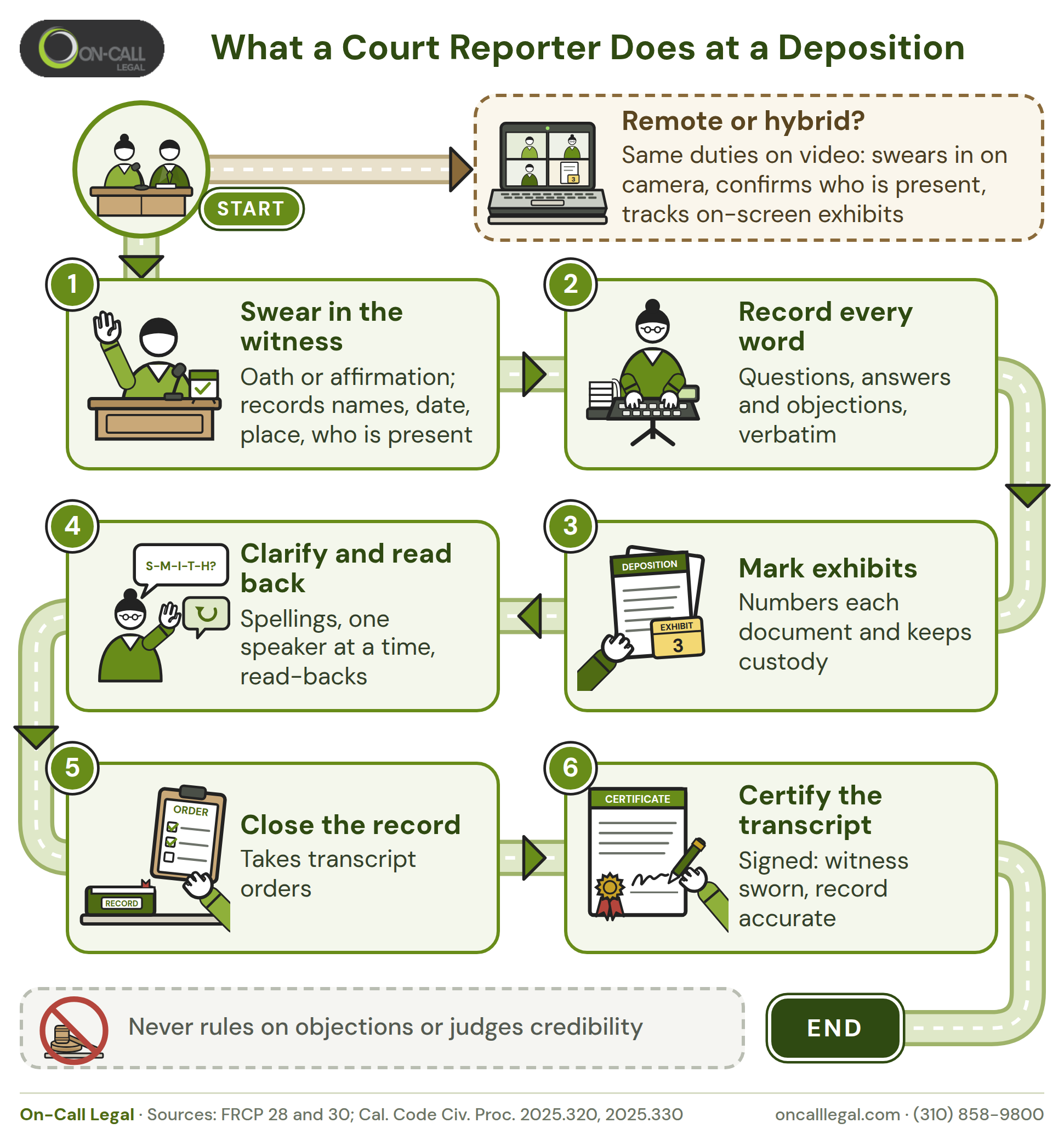
At a deposition, the court reporter swears the witness in and records every spoken word exactly as spoken. Then the reporter converts that record into an officially certified transcript, which the parties can use in motions, hearings, and trial. The reporter also marks exhibits but never rules on objections or decides if the testimony of witnesses is true.
Since 2008, On-Call Legal has worked closely with lawyers and legal teams in all 58 counties of California and all 50 states. Our court reporting services team arranges for certified court reporters, videographers for video depositions, interpreters, and deposition officers to attend depositions either face-to-face or virtually. Book a court reporter before your notice goes out if you want the reporter, room, and any videographer confirmed together.
This article explains the reporter’s work before, during, and after a deposition, the recording methods used, and how reporters get licensed.
What Is the Role of a Court Reporter in a Deposition?
A deposition takes place outside the courtroom, but the sworn answers can have significant consequences in later court proceedings. That only works if a neutral person keeps the record, and in most depositions, that person is the court reporter. Rule 28 of the Federal Rules of Civil Procedure requires that a deposition be conducted in the presence of an officer who is authorized to administer oaths. Court reporters play that part in most court depositions, and in California the role is often called the deposition officer.
The whole process of taking depositions depends heavily on having a complete legal record. The legal process simply assumes the reporter got it right, which is why the rules around the official record are strict.
Why the Court Reporter Must Stay Neutral
Rule 28(c) bars any officer who is a party’s relative, employee, or attorney, or who has a financial stake in the case. No California statute directly qualifies or disqualifies attorneys, but a court may authorize a neutral attorney with no tie to the case to act as a deposition officer in California. The lawyer for either side is barred under Rule 28(c). California’s Code of Civil Procedure section 2025.320 sets a similar rule and requires the officer to offer every party attending the deposition the same services. The adverse party has to trust the same transcript as the side that noticed the deposition, so fairness is built in. The officer also cannot give any party notes about a witness’s demeanor or collect the witness’s personal information for one side.
What a Court Reporter Does Not Decide
The reporter is not a judge and has no power to rule on any objection an attorney raises. Under Federal Rule 30, objections go into the transcript, and questioning proceeds. A judge may rule on the objection later, usually when a party tries to use the testimony at a hearing or trial. Reporters also avoid deciding if someone testifying told the truth, and that decision belongs to the judge or jury.

How a Court Reporter Handles a Deposition From Start to Finish
A reporter’s job begins long before a witness takes the stand and ends only when a certified transcript reaches the attorneys. Lawyers preparing for a deposition mostly see the reporter on the day itself, but much of the work happens on either side.
Reviewing the Assignment Details
First, the reporter reviews the notice and booking details sent by the court reporting firm. That covers the case caption, the deponent, the noticing attorney, the location or video link, and whether an interpreter will attend. The reporter then builds a word list of names, places, and specialized terminology so spellings are right from page one.
Setting Up the Equipment and the Room
Next, the reporter arrives early to set up, often in a law office conference room with a clear view of every speaker. A stenographer comes with a shorthand machine and also carries a laptop loaded with computer-aided transcription software. Meanwhile, a voice writer carries a microphone that is covered with a mask. Many reporters have audio backups that prove useful for double-checking answers before they get edited. For remote depositions, setup means testing the video platform, each participant’s audio, and the digital tools used to share exhibits. Good preparation allows a deposition to get underway on schedule.

Opening the Record and Swearing In the Witness
Then the reporter opens the record with a short statement that the rules spell out. Rule 30(b)(5)(A) lists the officer’s name and business address, the date, time, and place, and the deponent’s name. The statement identifies every person present before the reporter takes the oath or affirmation. Under AB 3252, California licensees must also state their name and license number at the start of a proceeding.
Capturing Testimony Word for Word
After the witness is sworn, the reporter records the questions being asked, the responses given, and the dialogue that goes back and forth among the lawyers. Every spoken word goes in, including objections, false starts, and answers the witness later corrects. This is live testimony recorded as it occurs, and its accuracy depends on writing exactly what was said. A reporter never cleans up spoken testimony to reflect what someone probably intended.
Marking and Tracking Exhibits
When an attorney hands over a document to be introduced, the reporter numbers that document and writes down that number in the transcript. Good handling of exhibits means each piece retains its number throughout the whole case. Rule 30(f)(2)(A) says that documents produced during a deposition must, on a party’s request, be marked for identification and attached to the deposition. Managing exhibits also includes keeping custody of those items. Unless the lawyers stipulate otherwise, the reporter keeps the marked exhibits together. Exhibit binders labeled with Bates numbers ensure that if multiple people look at the same documents, they all number them consistently.
Asking for Clarification and Reading Back Testimony
The reporter may interrupt when two people talk at once, when an answer is inaudible, or when a name needs spelling. An attorney may also ask for a question or answer to be read back, which the reporter does from the notes. The reporter only goes off the record if both sides agree to this. They also note at what time the recording stops and starts again.
Closing the Record and Taking Transcript Orders
When questioning ends, the reporter states on the record that the deposition is complete, as Rule 30(b)(5)(C) requires. Each party then orders copies and picks a turnaround time, which sets the delivery date for the transcript. BLS observes that freelance reporters often sell extra copies for a fixed price per page. That page rate is one reason deposition fees vary so much from one case to the next.
Producing and Certifying the Final Transcript
After taking the deposition, reporters then edit their notes into a written transcript that follows the formatting attorneys expect, like page and line numbers. The reporter compares the text against audio backups, reviews the word list, and then fixes any mistakes before releasing it. Then Rule 30(f)(1) also asks the officer to certify that the witness was duly sworn and that the deposition correctly records what the witness said. That statement sits on the certificate page at the end of the final transcript, signed by the reporter. Because reporters personally certify the transcripts they produce, a certified transcript carries more weight than an uncertified typed copy of an audio recording.

How Do Court Reporters Record Testimony?
The party who notices the deposition chooses the recording method and states it in the notice. Rule 30(b)(3)(A) allows audio, audiovisual, or stenographic recording, and the noticing party bears the recording costs. California is stricter, since section 2025.330 calls for stenographic recording by a certified reporter unless the parties agree or the court orders otherwise. You can also add audio or video recording in California if the deposition notice says so or all parties agree, and any other party can make its own recording at its own expense by serving written notice at least three calendar days before the deposition.
Each method trades off speed, readability, and cost, so attorneys should pick one with the end use in mind. Here’s how the four methods that we see used most commonly compare in actual practice.
|
Method |
How It Works |
What the Attorneys Receive |
Common Use |
|---|---|---|---|
|
Stenography |
The reporter writes shorthand strokes on a steno machine connected to CAT software. |
A certified transcript, with real-time text available during the session |
California depositions and other cases that need a certified record |
|
Voice Writing |
The reporter repeats every word into a masked microphone, and speech software converts it to text. |
A certified transcript prepared by the voice writer |
Depositions covered by a licensed voice writer (California licenses voice writers as CSRs) |
|
Digital Audio Recording |
A monitor records the audio, and a transcriber prepares the text later. |
An audio file and a transcript produced after the session |
Federal depositions noticed for audio recording; in California, only by agreement or court order. |
|
Video Deposition |
A legal videographer records video alongside the court reporter. |
This video is synced to the written transcript by page and line. |
Witnesses who may be unavailable at trial or whose demeanor at trial is important. |
Stenography and the Steno Machine
Stenography is the method most court reporters picture when they describe the job to someone outside it. A steno machine lets the reporter press several keys at once, writing a whole syllable, word, or phrase in one stroke.
Voice Writing
The voice writer speaks every word directly into a mask that contains a built-in microphone; thus, no one in the room ever hears the reporter speaking directly. Speech recognition software translates what that reporter speaks into text, which is then used for editing purposes. The Court Reporters Board says that AB 3252 lets holders of the NVRA’s CVR or CVR-S voice writing certification skip the skills test and take only the two written CSR exams.
Realtime Reporting
In real-time reporting, translated text that reporters produce as the witness speaks goes directly to the laptops or tablets of lawyers. A same-day rough draft is uncertified and is not part of the finished transcript, so nobody should cite it in a motion.
Video Depositions and Legal Videography
While legal videography puts a camera person in the room, the court reporter still swears in the witness and keeps the record. After the session ends, synchronization lines up video footage with the transcript so that lawyers can play clips by page and line number. In California, the synced video does not replace the transcript: under section 2025.510(g), the stenographic transcript is the official record for trial and any later hearing or appeal.
What Happens to the Transcript After the Deposition?
The transcript leaves the reporter’s hands as evidence, not as a set of private notes. Lawyers depend on it at hearings, in pleadings, and at trial, and courts consider this testimony to be sworn.
How the Witness Reviews and Corrects the Transcript
If the witness or a party asks for review before the deposition ends, Rule 30(e) gives the witness 30 days to look at the transcript after the officer says it is ready. California’s section 2025.520 also allows for 30 days unless the parties and the deponent agree on a different period. A California witness who misses that window is treated as having approved the transcript, subject to timely changes.
How Transcripts Are Delivered
Transcripts can be delivered digitally or in printed form, depending on what each party ordered at the close. Typical electronic formats include PDFs that allow searching, short versions of transcripts, and electronic files for use with litigation software. The reporter formats every copy to the order’s specifications, and expedited or daily copy costs more than standard turnaround.
How Attorneys Use Deposition Transcripts
Lawyers use transcripts as they work on preparing for trial to support or oppose a summary judgment and to show a jury that a witness’s account has changed. Important excerpts tend to be pulled into exhibits for trial beside the documents first marked at the deposition. Because this is an official record of testimony, if there is any mistake in that record, it will carry over into the courtroom proceedings. Accurate transcripts matter for trial preparation and for every other stage of legal proceedings.
How Do Remote and Hybrid Depositions Change the Court Reporter’s Job?
Rules remain the same for remote depositions too. Reporting work is mostly done via a computer and a steady internet connection. Rule 30(b)(4) allows parties to stipulate or have the court order that depositions take place by telephone or other remote means. In hybrid proceedings, some people share a room while others join by video, and the reporter has to hear both groups. The reporter still swears in the witness over video, confirms who is present, and tracks exhibits shared on screen. Our deposition officer bookings cover in-person, remote, and hybrid sessions, so a late format change does not mean finding someone new.

What Training and Licensing Does a Court Reporter Need?
Court reporting takes formal training, a skills test, and, in many states, a license before a reporter can work depositions. The median annual wage for court reporters and simultaneous captioners, according to the Bureau of Labor Statistics, was $72,420 in May 2025. BLS also notes that many reporters work as freelancers, taking on pretrial testimony for law firms or corporations.
Court Reporting Programs and National Certification
Court reporters typically complete a court reporting program, which BLS says typically takes 2 or 3 years. CSR programs in California typically last for quite a long time, and the Court Reporters Board notes that such programs run for three to four years. BLS lists no prior work experience for entry-level reporters, who learn the equipment and terminology on the job.
State Licensing and the California CSR
Many states require a license or professional certification, and BLS notes that requirements vary by state and reporting method. California licenses Certified Shorthand Reporters through the Court Reporters Board, and you need that license to take a deposition stenographically, although notaries and registered photocopiers can serve as deposition officers in some situations. The board’s 2023-24 Sunset Review counted approximately 5,600 active licensed court reporters in California as of July 1, 2023. Under section 2025.330, depositions in California are taken stenographically by a certified reporter unless the parties agree or the court orders otherwise.
What Accuracy Standard Court Reporters Meet
Reporters strive for word-perfect accuracy, and certification tests measure very precisely how accurate they are. The National Court Reporters Association RPR test requires you to score 95% accuracy on each leg at a typing speed of up to 225 words per minute. California’s CSR skills test used to require 97.5%, but AB 3252 lowered the passing rate to 95%, effective January 1, 2025. The officer’s Rule 30(f)(1) certificate then states on the record that the transcript accurately records the testimony.
How to Help the Court Reporter Keep an Accurate Record
Lawyers and witnesses can help reporters out a lot, and transcripts usually highlight that difference. Ask most reporters what slows them down, and crosstalk comes up first, so one speaker at a time is the basic rule. Witnesses should answer out loud instead of nodding, because a nod never makes it into a transcript. If a key non-party witness has to appear, serving a deposition subpoena early keeps the date from slipping. Those habits should be part of any session preparing for a deposition, along with the actual testimony content.
Ready to Book a Court Reporter for Your Next Deposition?
A court reporter swears in the witness, keeps a verbatim record, tracks every exhibit, and certifies the final transcript. Each of those steps protects testimony your case may depend on months later at trial. Booking early gives reporters time to compile a vocabulary list, confirm participants, and bring appropriate equipment.
On-Call Legal has been providing litigation support to legal teams in California since 2008 and is part of NAPPS, CALSPro, and CAALA. Our experienced court reporting team books reporters, videographers, and interpreters who work out of offices in Los Angeles, Century City, Irvine, Glendale, and Sacramento. We handle deposition services from the notice to the certified transcript, so contact us today to schedule your next one.
Frequently Asked Questions
Since 2008, we have worked with California attorneys in all 58 counties, and the same deposition questions come up on most jobs. These are the ones we hear most often, answered from our day-to-day scheduling work.
What Is a Court Stenographer?
A court stenographer is a court reporter who writes testimony on a steno machine using shorthand strokes. People tend to use the two terms interchangeably even though some reporters use voice writing instead of using a stenotype machine.
Can a Stenographer Type Every Word?
A trained stenographer can keep up with fast speech because each stroke writes a whole syllable, word, or phrase. The NCRA’s RPR exam tests testimony at 225 words per minute with 95 percent accuracy. When a speaker is unclear, the reporter stops and asks for clarification.
Is a Court Reporter Required at Every Deposition?
According to federal rules, depositions can also be recorded by audio or video rather than being transcribed if that is specified in the notice. California is stricter and requires a certified reporter to take testimony stenographically unless the parties agree or the court orders otherwise.
Who Pays for the Court Reporter at a Deposition?
The noticing party bears the recording costs under Federal Rule 30(b)(3)(A), and California’s section 2025.510 puts transcription costs on that party too. Any other party who wants a copy of the transcript pays for its own copy.
What Happens if a Court Reporter Makes a Mistake?
The witness can catch errors during the review period, which runs 30 days under Federal Rule 30(e) when review is requested. The witness lists any changes on a signed statement, and the reporter attaches it to the transcript.
How Long Does It Take to Get a Deposition Transcript?
Standard delivery takes longer than expedited or daily copy, which costs more because the reporter edits on a tighter schedule. Exact timing depends on the length of the deposition and the turnaround each party orders when the record closes.
Are Court Reporters Still in Demand?
The Bureau of Labor Statistics projects little or no change in employment from 2025 to 2035. It still projects roughly 1,800 openings each year, and depositions, trials, and hearings still need certified documents.
Legal Disclaimer
This article is intended only as general information and is not legal advice. On-Call Legal isn’t a law firm. If you need advice for your specific situation, please consult a licensed lawyer.



On-demand legal services with arranging services from eFiling to organizing and preparing your subpoena for records and/or personal appearance and much more.