What Is a Proof of Service, and Why Is It Required for a Court Filing?
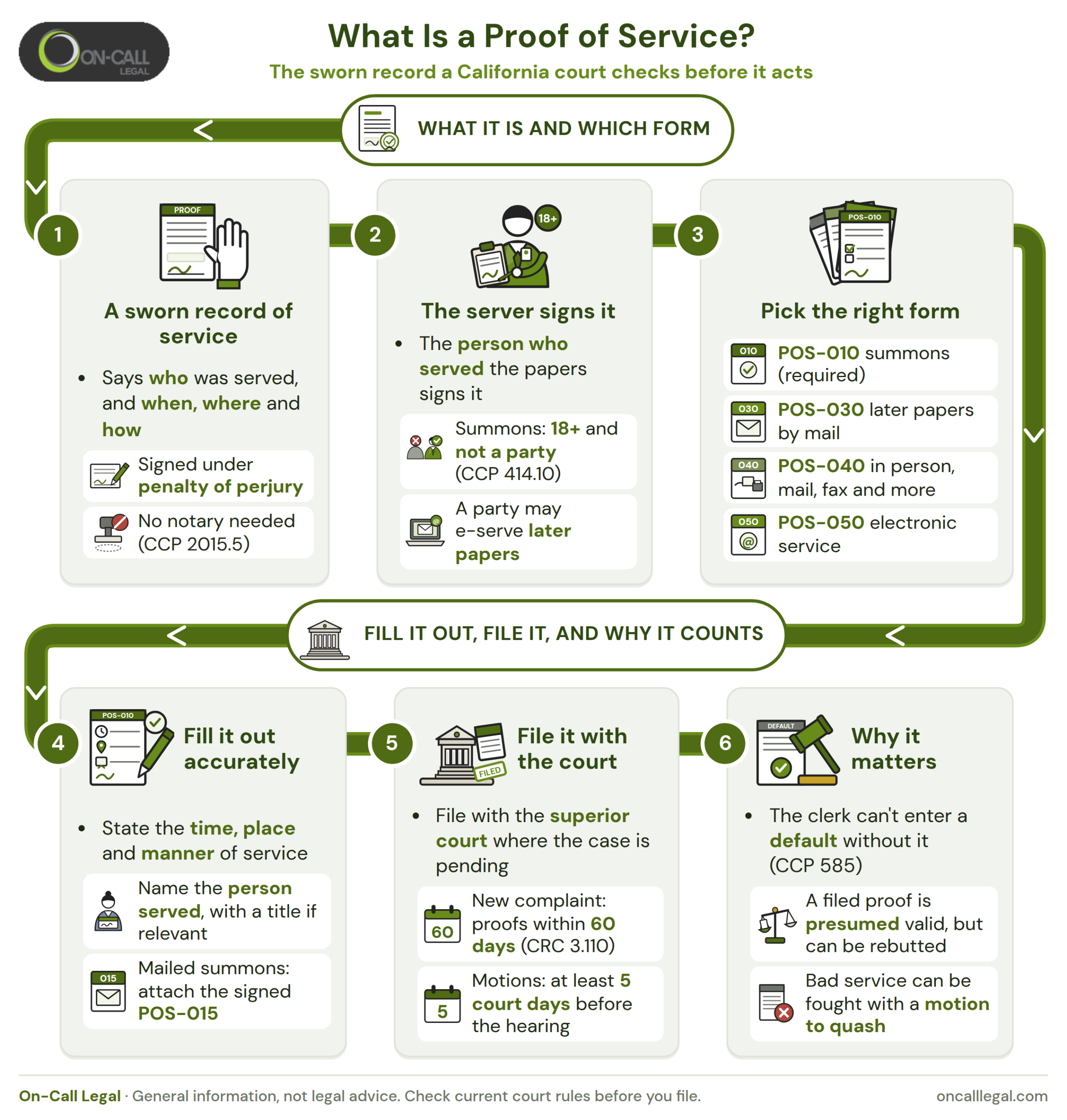
A proof of service is a declaration, signed under penalty of perjury by the person who delivered court papers, stating when, where, how, and on whom they were served. California courts require it because a judge cannot rely on a party’s word that the other side received notice. The filed proof is the evidence the court reviews before entering default or hearing a motion.
On-Call Legal has served legal documents since 1999 across all 58 California counties and nationwide, and we are members of NAPPS and ServeNow. Our process serving team signs a proof for every delivery, naming the person served and logging the time and place. Schedule a consultation so we can help with your proof of service.
This article explains what the proof tells a judge, why courts insist on it, which form to use, who signs it, how to file it, and what changes in 2027.
What a Proof of Service Tells the Court
People searching for what a proof of service is for a court filing want a definition and the reason behind it. Rule 1.21(c) of the California Rules of Court calls it “a declaration stating that service has been made,” and Rule 1.21(b) says that when a paper must be served and filed, its proof of service is filed with it. Service of process gives the other party notice and a chance to respond, which is central to due process. The proof is the server’s sworn statement about that delivery.
A summons proof follows CCP 417.10 and must be filed under CCP 417.30 unless the defendant has already made a general appearance. Later court documents use proofs governed by CCP 1013a for mail and CCP 1013b for electronic service. The dates on a proof also start the clock, since substituted service under CCP 415.20 is complete 10 days after mailing.
Why a California Court Will Not Act Without One
A judge acts on what the court file shows, and the file must show the defendant was brought into the case lawfully.
Jurisdiction Depends on Serving the Summons
In the case of Chinese Theater, LLC v. Starline Tours USA, Inc. (No. B333047, filed November 6, 2025), it is emphasized that adhering to the legal requirements for serving process is crucial for establishing personal jurisdiction. The California Supreme Court, in Johnson & Johnson v. Superior Court (1985) 38 Cal.3d 243, quoted with approval the rule that “the fact of service … confers jurisdiction, not the proof of service.”
This means that while a proof of service can often be corrected if it contains errors, issues with the service itself cannot be resolved through paperwork alone. Even so, SC-104B warns that “The judge cannot hear your case unless the court papers were served correctly.”
A Default Requires a Filed Proof
When a defendant fails to respond, the plaintiff asks the court clerk to enter a default. CCP 585(a) requires “proof of the service of summons,” and CCP 587 adds a declaration that the application was mailed to the defendant.
The Presumption a Filed Proof Creates
Courts hold that filing a proof “creates a rebuttable presumption that the service was proper,” as in Dill v. Berquist Construction Co. (1994), Floveyor Internat., Ltd. v. Superior Court (1997), and Hearn v. Howard (2009). A registered process server’s return also carries a presumption under Evidence Code section 647, which unregistered servers do not get. Both presumptions shift only the burden of producing evidence, so contrary evidence can still defeat a proof. In Chinese Theater, a registered server wrote only “Person in Charge,” and the court vacated a $232,670 default judgment as void under CCP 473(d). A defendant trying to prove improper service attacks exactly these facts in the return.

Matching Each Document to the Right Proof Form
The right form depends on what was served and how, and the Judicial Council publishes statewide court forms for each situation. The table pairs common documents with their proof forms.
|
Document served |
Proof form |
Status |
|---|---|---|
|
Civil summons and complaint, any method |
POS-010 |
Mandatory |
|
Summons mailed in California for signed acknowledgment |
POS-015, attached to POS-010 |
Mandatory |
|
Later papers in person or by mail |
POS-020 or POS-030 |
Optional |
|
Later papers by personal delivery, mail, overnight, messenger, or fax |
POS-040 |
Optional |
|
Later papers served electronically |
POS-050 |
Optional |
|
Family law summons and petition |
FL-115 |
Optional |
|
Family law papers after the summons |
FL-330 in person, FL-335 by mail |
Optional |
|
Small claims claim and order |
SC-104 |
Optional |
The warnings printed on these forms point in one direction. POS-040 says “Do not use this form to show service of a summons and complaint or for electronic service,” and POS-020 and POS-030 send summons proofs to POS-010, which says nothing about POS-040. Because CCP 417.10(f) requires proof of personal service to be made on a form “adopted by the Judicial Council,” a homemade or local service form for a summons invites a challenge.
The statutes also set what each proof must say. Under CCP 1013a, a proof of service by mail must list “the exact title of the document served,” and under CCP 1013b, a proof of electronic service such as a POS-050 needs the server’s electronic service address and a statement that the document was served electronically. Serving legal documents by email follows different rules than serving a summons.

What Every Proof of Service Must Include
Under CCP 417.10(a), a summons proof must state “the time, place, and manner of service and facts showing that the service was made in accordance with this chapter.” It names the person served, with a title where relevant, under the case caption. Registered servers add their county and registration number under B&P 22360, and under CCP 417.40 employees and independent contractors list the registrant’s county and number.
The choice between personal and substituted service changes what the server writes. Personal service is hand delivery, with the documents personally given to the defendant. Substituted service needs the recipient’s name and relationship, the location, the follow-up mailing, and usually a diligence declaration. Mail service of a summons inside California counts only if the defendant signs and returns POS-015, and mail outside the state needs proof of actual delivery, usually a signed return receipt, under CCP 417.20.
Brandon Yadegar, Director and Client Manager at On-Call Legal, says strong proofs read like a record of what the server saw. “We name the person served, never just a title, and if someone refuses a name we describe them and note where on the property the handoff happened,” he says. “Every attempt gets a date and a clock time, because the judge reading that proof months later needs facts.”
Who Can Sign a Proof of Service
Under CCP 414.10, a summons may be served by “any person who is at least 18 years of age and not a party to the action.” That rule determines who can serve court papers, so a relative or professional process server qualifies, while the plaintiff does not. The person who made the delivery signs, since CCP 417.10(a) calls for “the affidavit of the person making the service.”

Some websites say a proof must be notarized, and that is wrong for California. CCP 2015.5 lets a declaration signed under penalty of perjury replace an affidavit. A lawyer can sign a mail certificate under CCP 1013a(2), and CCP 1010.6 lets any person, “including a party,” perform electronic service. That is why attorneys and their staff routinely sign mail and e-service proofs. Anyone who makes more than 10 paid services of process in California in a calendar year must register under B&P 22350, although attorneys and their employees serving in their own cases are exempt.
Deadlines for Filing Proof of Service in California
No single deadline covers every proof, so timing depends on the type of court case involved. The table lists the main California filing deadlines.
|
Situation |
Deadline for the proof |
Source |
|---|---|---|
|
General civil complaint |
Serve and file proofs within 60 days after filing |
CRC 3.110(b) |
|
Defendant added by amendment |
Serve and file proof within 30 days |
CRC 3.110(b) |
|
Collections case up to $35,000 |
Serve and file proofs within 180 days |
CRC 3.740(d) |
|
Motion papers |
File proof at least five court days before the hearing |
CRC 3.1300(c) |
|
Small claims |
File proof at least five days before the hearing |
CCP 116.340(c) |
|
Any civil summons |
Serve within three years; file proof within 60 days after that three-year deadline |
CCP 583.210 |
Rule 3.110 excludes collection cases, unlawful detainer actions, and family law cases under the Family Code. For substituted service, SC-104B allows extra time for the mailing, roughly 25 days before trial (30 days outside the county), so confirm the count with your small claims advisor.
The deadlines for serving a summons run alongside these rules, and when a defendant has moved, serving a defendant you cannot locate means documenting due diligence the court can review.
How to File Your Proof With the Court
Filing comes right after serving documents, and the server should fill out and sign the proof first. Before filing, compare the completed proof with the served papers so the caption, names, and notice item match what was delivered. Then attach what the method requires, such as a signed POS-015 or a diligence declaration.

Once the packet is ready, file it with the superior court where the case is pending. The party must file, although SC-104B notes that a registered server can file the original directly. That is routine court filing work for us and a common request from self-represented litigants.
If your court requires e-filing by local rule, counsel must e-file, while CCP 1010.6(g)(4) exempts unrepresented persons. Electronic filing services handle the submission, and the filer keeps any wet-signed original until the case ends. After filing, keep a stamped copy with your records, and if you have a fee waiver, raise it at the clerk’s office before paying anything.
What Happens When a Proof of Service Is Missing or Defective
A late proof usually results in an order to show cause for sanctions under CRC 3.110(f), not automatic dismissal. Dismissal is mandatory when service is not completed within three years, under CCP 583.210 and CCP 583.250. A clerk cannot refuse a paper for lateness alone, since CRC 3.1300(d) says no paper “may be rejected for filing on the ground that it was untimely submitted for filing.”
An amended proof can correct how facts were recorded but cannot invent them. In Chinese Theater, the server’s later declaration describing his “standard procedure,” with no memory of the actual service, did not save the proof. Most invalid proof-of-service problems trace to the wrong form or a wrong conclusion about where the facts belong. You can also challenge improper service with a motion to quash under CCP 418.10.
How Proof of Service Differs Outside California State Court
The Judicial Council forms are captioned for the Superior Court of California, the state’s trial court. Federal cases in California are filed in U.S. District Court, which follows its own rules instead of these forms. Readers used to both circuit court and district court filings elsewhere will find California uses different rules, since some states call their trial court a circuit court. New York, for example, requires proof of substituted or affix-and-mail service within 20 days under CPLR 308, with service complete 10 days after filing.
What Changes for Proofs of Service on January 1, 2027
AB 747 (chapter 563 of the 2025 statutes) and AB 2042 (chapter 379 of the 2026 statutes) change the rules starting January 1, 2027, and AB 2042 applies the new default-motion rules to service attempted or completed on or after that date. The new CCP 417.10 requires time-stamped, GPS-tagged photos of the site of each effected or attempted personal, substituted, or posted service, including the door or entrance at a home or business unless taking one would be unsafe.
The follow-up mailing may go by first-class mail, Priority Mail with tracking, or certified mail with return receipt requested. Clerk defaults under CCP 585(b) will require proof of service of the summons, and new CCP 473(e) allows a motion to vacate a default judgment void for lack of proper service at any time after entry. Under new CCP 473.2, evidence of unlawful service rebuts the return’s presumption, and the plaintiff must then prove lawful service by a preponderance of the evidence.
Under the new B&P 22355, county clerks must keep a publicly available register of process servers. The revised CCP 417.40 drops the county, but B&P 22360 and 22356.5 still require it. Proposed forms were still pending as of late September 2026: SPR26-08 would add POS-010 item 8 and a new POS-012, and SPR26-21 would revise FL-115 and add FL-116. The Judicial Council’s next business meeting is set for October 15 and 16, 2026.
Ready to Get a Proof of Service That Holds Up in Court?
A proof of service is the record a California court checks before it enters a default, hears a motion, or moves a case forward. Getting it right means using the correct form, stating what the server saw, and filing on time. The 2027 photo rules will make those details even more important.
On-Call Legal has served legal documents since 1999, and we provide service in all 58 California counties, nationwide, and across 88 incorporated cities and 36 courthouse locations in Los Angeles County. We belong to NAPPS, ServeNow, and CAALA; our process servers are registered and bonded under California Business and Professions Code sections 22350 and 22353, and our experienced process servers handle courthouse filings statewide. Contact us today to get your papers served with a proof the court can act on.
Frequently Asked Questions
On-Call Legal has fielded these questions from attorneys and self-represented litigants since 1999, and the answers reflect that field work. Each answer stays short, with the detail in the sections above.
Does a Proof of Service Need to Be Notarized in California?
No notary is needed because CCP 2015.5 lets the server sign under penalty of perjury instead.
Can I Serve the Papers and Sign the Proof Myself?
A party cannot serve a summons or sign its proof under CCP 414.10. The one exception is electronic service of later papers, which CCP 1010.6 allows a party to do.
Can a Summons Be Served by Email in California?
E-service reaches papers that could otherwise be mailed, which excludes a summons unless you get the court’s permission through a CCP 413.30 order.
Do I Have to File a Proof If the Defendant Already Responded?
CCP 417.30 excuses the proof of service when the defendant has already made a general appearance.
Can a Mistake on a Filed Proof Be Corrected?
An amended proof can fix how facts were recorded, but it cannot add facts that did not happen.
Does a Filed Proof Stop the Defendant From Claiming They Were Never Served?
A filed proof creates only a rebuttable presumption, which contrary evidence can overcome.
Do I Serve a Copy of the Proof on the Other Side?
CCP 417.30 speaks only of filing a proof of service, but for mailed papers, CCP 1013(b) requires the served copy to show the mailing date and place or include an unsigned proof.
Legal Disclaimer
This article is informational only and is not legal advice. On-Call Legal is a process-serving and legal-support company, not a law firm, and reading this page does not create an attorney-client relationship. Consult a licensed California attorney about the facts of your specific legal matter.



On-demand legal services with arranging services from eFiling to organizing and preparing your subpoena for records and/or personal appearance and much more.