
How Do You Serve Someone in a California Jail or Prison?
You serve someone in a California jail or prison by delivering the papers through the facility, by hand in a visiting area, or through the warden, sheriff, or jailer who is holding them. Penal Code section 4013 lets any lawful server do the job and requires the official who receives the papers to deliver them forthwith. Each facility still controls its doors, so the right method depends on whether the person is in a county jail, state prison, or federal prison.
On-Call Legal has served legal documents since 1999 across all 58 California counties and nationwide, and the company is a member of NAPPS and ServeNow. Our process serving team handles visiting-room service, litigation coordinator packets, and follow-up work when someone moves between facilities. If you need to serve someone in custody, schedule a consultation so we can pick the right route before your service deadline gets close.
This article explains who can serve an inmate, how to locate the facility, the three delivery methods, family law papers, proof of service, and the 2027 photo rule.
Who Can Serve Papers on an Incarcerated Person in California
Service is the formal notification that a court case has begun, and a prison sentence does not pause it. Serving an incarcerated person still means following specific procedures. California’s service of process rules apply inside a facility, with Penal Code section 4013 layered over them for county jails and state prisons alike.

Penal Code section 4013, as amended by AB 1974 (Stats. 2022, ch. 255), has two subdivisions. Subdivision (a) reads “A warden, sheriff, or jailer upon whom a paper in a judicial proceeding, directed to an incarcerated person in the custody of the warden, sheriff, or jailer, is served, shall forthwith deliver the paper to the incarcerated person, with a note thereon of the time of its service.” Subdivision (b) reads “Service directed to a person who is incarcerated within any institution in this state may be served by any person who may lawfully serve process.”
Under Code of Civil Procedure section 414.10, the server must be at least 18 and not a party to the case. The test for who can serve court papers is the same inside a facility. A friend or family member who is not involved in the case qualifies, but you cannot serve papers yourself. Some online answers say an official must serve instead of a professional process server, but section 4013(b) says otherwise, and each facility controls its access.
The table compares who may serve and who controls access at each facility type, since procedures vary from one facility to the next.
|
Facility |
Who May Serve |
Access Limits |
Who Receives Papers |
|---|---|---|---|
|
County jail |
Sheriff’s civil unit, registered process server, or any non-party adult |
Visiting and security rules set by each jail |
Sheriff or jailer under Penal Code 4013(a) |
|
CDCR state prison |
Staff, an escorted sworn peace officer, or a server in the visiting area |
DOM 14010.7.4 bars servers from secure areas |
Warden, through the Litigation Coordinator |
|
Federal prison (BOP) |
A local process server |
Warden may require a law enforcement officer or a background check |
Nobody, because the BOP will not accept service for an inmate |
Finding the Right Facility Before You Serve
You must identify the specific correctional facility where the person is held, because papers sent to the wrong place can come back unserved. In Crane v. Dolihite (2021) 70 Cal.App.5th 772, service stalled partly because the plaintiff could not identify the defendant’s location after a transfer.
Searching the CDCR Inmate Locator for State Prisons
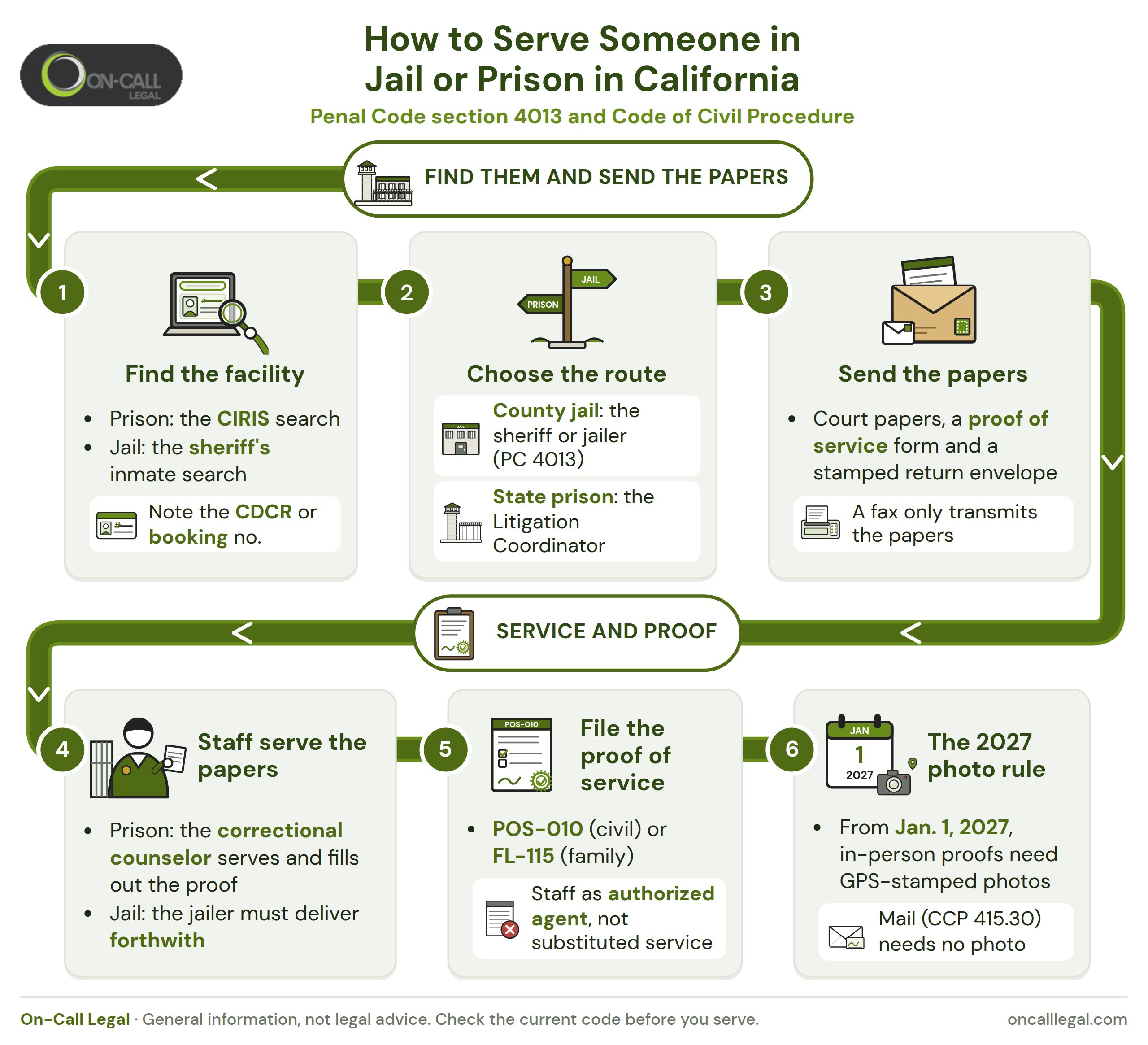
CDCR’s current search tool is CIRIS, the California Incarcerated Records and Information Search. A name search in the prison’s inmate locator returns the housing institution and the CDCR number. Have that number, or a county jail booking number, ready before you send anything. Facilities use it to route papers, even though the law does not require it for valid service.
Checking County Jail Records and Booking Numbers
County jails keep their own records through the county sheriff, such as the Orange County Sheriff’s inmate information system and the Santa Clara County inmate search. Checking jails is essential when a defendant goes quiet at their last known address.
Why a Felony Sentence Can Mean County Jail Instead of State Prison
California’s 2011 Public Safety Realignment (AB 109) took effect October 1, 2011. Under Penal Code section 1170(h), many lower-level felonies are served in county jail instead of state prison. A felony sentence goes to county jail if the offense is punishable under section 1170(h) and the person has no current or prior serious or violent felony. The person also must not be required to register as a sex offender or have received a section 186.11 white-collar enhancement. These sentencing changes apply to people sentenced on or after October 1, 2011, under section 1170(h)(7). Someone serving time for a felony may therefore be in a county jail.
Locating Someone in a Federal Prison
People in federal custody show up in the Federal Bureau of Prisons inmate locator, not in CIRIS or a county system. When the searches come back empty after a release, skip tracing can find a current address from records outside the corrections system.
Three Ways to Get Papers to Someone Inside
California law leaves you three workable routes to an incarcerated person, and many cases combine two of them. The choice turns on the facility, the document, and how much room is left before the deadline to serve a summons in California.
Personal Delivery in the Visiting Area
Personal service under CCP 415.10 is complete when you hand the summons and complaint to the person served. CDCR’s Department Operations Manual section 14010.7.4 keeps process servers out of security areas, but it lets a non-sworn server serve in the visiting area after prior arrangements. The person must be someone who can reasonably be brought there without compromising security, so a prison can still say no.
Serving the Warden, Sheriff, or Jailer Under Penal Code 4013
The second route is to hand the papers to the official with custody, who must then deliver them forthwith with a note of the time of service. Crane quotes Sakaguchi v. Sakaguchi (2009) 173 Cal.App.4th 852 on this point. That court read section 4013(a) to mean a jailer is authorized by law to receive service of process for a prisoner. That reading ties into CCP 416.90, which explains why those who can accept service at a prison include the Litigation Coordinator. Crane held that a coordinator’s refusal to accept service violated Penal Code section 4013, because “shall” in subdivision (a) denotes a mandatory obligation.
Mailing a Notice and Acknowledgment of Receipt
Under CCP 415.30, you mail the summons and complaint by first class with two copies of the notice and acknowledgment and a prepaid return envelope. Civil cases use form POS-015, and family law cases use form FL-117. In Sakaguchi, as Crane describes it, the court upheld service by mail to the litigation coordinator at Avenal State Prison after the coordinator signed the acknowledgment. An unsigned or unreturned form is not service, though, and a recipient who ignores it for 20 days owes only the added cost of serving another way.
The comparison lines up the three routes by who delivers, the legal basis, and the usual failure point.
|
Method |
Who Delivers |
Legal Basis |
Main Weak Point |
|---|---|---|---|
|
Personal delivery in the visiting area |
Process server by prior arrangement, or an escorted sworn peace officer |
CCP 415.10, Penal Code 4013(b), DOM 14010.7.4 |
Needs facility approval, and the person may be unavailable |
|
Delivery to the warden, sheriff, or jailer |
Staff, after any lawful server hands the papers to the official |
Penal Code 4013(a), CCP 416.90, Sakaguchi, Crane |
Staff proofs are sometimes filled in incorrectly |
|
Notice and acknowledgment by mail |
First-class mail, often routed through the Litigation Coordinator |
CCP 415.30, POS-015 or FL-117 |
Fails if nobody signs and returns it |
How Service Works at a California State Prison
At CDCR institutions, the work runs through the prison’s Litigation Coordinator, whom CDCR’s Ombudsman guidance describes as the person who processes and serves legal documents.
The first step is a CIRIS search that confirms the institution and CDCR number on the day the packet goes out. Once the institution is confirmed, find its coordinator in CDCR’s Litigation Coordinator directory, which lists an email address, phone number, and fax for each prison.
Address the packet to that coordinator and identify the person by name and CDCR prison number. CDCR’s instructions also ask, if possible, for a parole date and phone number so the institution can reach you with questions. Include the court documents, a proof of service form, and a self-addressed stamped envelope, which must still be mailed even if the documents were faxed.
After the coordinator logs the documents, the person’s correctional counselor serves them and completes the proof of service. The fax or overnight package is only a transmittal, and service happens when the counselor hands the papers to the inmate and fills out the proof of service. When the proof comes back in your envelope, you file it with the court.
If a coordinator returns the papers, a cover letter citing section 4013(a), Sakaguchi, and Crane puts the duty in writing. Crane also pointed to a judge’s order under CCP 413.30 as a fallback. Subpoenas follow different rules because DOM section 14010.7 carves them out of the legal process section.
How Service Works at a County Jail
One statute covers jails and prisons alike, but county jails set their own day-to-day procedures instead of using a litigation coordinator. The sheriff’s civil unit, a registered process server, or any other adult who is not a party can serve, subject to the jail’s visiting and security rules.
Many county jails restrict walk-in service for security reasons. In Los Angeles County, a unit order for the Century Regional Detention Facility lists a process server as a professional visitor and requires government photo ID. The facility books and logs visits through its video visitation system, but it routes professional visits through the visiting center. The same order asks for a process server’s state license, which California does not issue. Servers register by county under Business and Professions Code section 22350, so call ahead about credentials.
Why Federal Prisons Follow Different Rules
The Federal Bureau of Prisons sets its own policy. Its 2025 Legal Resource Guide says the BOP “will not accept service of process for or on behalf of an inmate.” The Penal Code 4013 route of serving the warden as agent does not apply there. The guide points servers to a local process server or local court procedures. Wardens may require a law enforcement officer for in-person service, and they may require other servers to pass a criminal background check. Process serving regulations vary significantly by state, so contact the institution before you send anyone.
Why Leaving Papers at the Jail or the Old Home Is Risky
Substituted service under CCP 415.20(b) lets a server leave papers at a usual place of abode with a competent adult and then mail a copy. We found no published California appellate decision holding that a jail or prison is an inmate’s usual place of abode. Treating a front-desk drop as substituted service rests on untested ground. The recognized route is delivery to the jailer or litigation coordinator as a person authorized by law to receive service.

A proof that says the person was served at a home address while they were actually locked up is riskier still. County of San Diego v. Gorham (2010) 186 Cal.App.4th 1215 is described in Yolo County DCSS v. Myers (2016) 248 Cal.App.4th 42. In Gorham, a default judgment was later held void because the defendant showed he was in custody on the day the proof said he had been personally served at a residential address, and the Court of Appeal ordered the case dismissed. A proof listing the same address where the person lives on paper, contradicted by a jail roster, is an invalid proof of service waiting to happen.
Lawmakers have tried to change the rules for serving people in custody, and AB 3131 (2020), AB 561 (2023), and SB 1040 (2024) all died. AB 561 and SB 1040 would have allowed substituted service at a jail or prison. When every lawful method fails, CCP 413.30 lets the court order service reasonably calculated to give actual notice, including email or other electronic service.
What Happens When an Inmate Refuses the Papers
Refusing papers handed over in person does not stop proper service in California. In re Ball (1934) 2 Cal.App.2d 578 arose from a habeas petition by a man held in county jail, though the service itself took place outside the jail. The court held that when the two are within easy speaking distance and the facts would convince a reasonable person that personal service is being attempted, service cannot be avoided by denying it and moving away. Khourie, Crew & Jaeger v. Sabek, Inc. (1990) 220 Cal.App.3d 1009 followed this rule. An inmate gets the same result as someone who refuses service at the door.
When a person refuses to sign a mailed Notice and Acknowledgment of Receipt, mail service fails, and they may also decline or miss a visit. In those cases, use staff service through the Litigation Coordinator or jailer, or ask the court for an order under section 413.30.
Serving Divorce, Custody, and Restraining Order Papers on an Inmate
Family Code section 2331 requires divorce papers in California to be served the same way as civil papers, so every route above works in a family law matter. The courts’ divorce service page says an official at the jail or prison will be your server, which overstates what section 4013(b) requires.
A divorce process server uses the same routes for custody, support, and property papers in family law cases. Under Penal Code section 2625(e), the court may order that the prisoner appear at a divorce or custody hearing, so production is discretionary. Production is mandatory in termination-of-parental-rights and dependency cases once the prisoner asks to attend.
Procedures for serving restraining orders differ from those for other civil documents in jails and prisons. Under Family Code section 6383, law enforcement must serve a domestic violence restraining order at the petitioner’s request, even if the respondent is in custody. No fee can be charged to the petitioner for that service.
Filing Proof of Service After Serving Someone Inside
Servers must document the service, and the party files the proof with the court. CCP 417.10 requires it to show the time, place, and manner of service and, where appropriate, the capacity in which the person was served. In civil cases, form POS-010 is mandatory, and item 5a covers personal delivery, with the facility’s street address in item 4.
When the papers went to a litigation coordinator or jailer, name that person in item 3b as an authorized agent under Penal Code section 4013(a) and CCP 416.90. Describe it as delivery to a person authorized to receive service, never as substituted service. Family cases use form FL-115, while small claims cases have their own proof form.

The Judicial Council has proposed new versions of POS-010 and FL-115 that add a site photo item for the 2027 rule, with a proposed effective date of January 1, 2027, so check the revision date at the bottom of the form before you file.
The table matches each proof form to the case type and the service method used.
|
Case Type |
Personal or Agent Delivery |
Mail With Acknowledgment |
|---|---|---|
|
Civil lawsuit |
POS-010, item 5a or item 3b |
POS-015, signed and returned |
|
Divorce or custody |
FL-115, personal service item |
FL-117, attached to FL-115 |
|
Restraining order through CDCR victim services |
The proof you enclose, completed by the counselor |
Not used for this route |
What the January 2027 Photo Rule Means for Jail and Prison Service
AB 747 (Stats. 2025, ch. 563) becomes operative January 1, 2027, and it adds GPS-stamped photographs to proofs of service under CCP 415.10, 415.20, and 415.45. The statute has no jail or prison exception. Its two exceptions cover a missing signal, which excuses the stamp but not the photo, and a server’s reasonable judgment that a photo would compromise safety.
That creates a practical conflict at the facility gate. Penal Code section 4575 makes unauthorized possession of a wireless device in a local correctional facility a misdemeanor, and section 4576 addresses phones at CDCR prisons. A section 415.30 mailing needs no photo, making the mail route more attractive after 2027. Whether a correctional counselor who serves papers must take photos remains unresolved, and the Judicial Council has not yet issued guidance on jails or prisons.
Ready to Serve Someone in a California Jail or Prison?
Serving an incarcerated person in California depends on reaching the right facility, choosing an allowed route, and filing proof that accurately describes the delivery. Penal Code section 4013 opens the door to any lawful server, but the litigation coordinator, the jail’s visiting rules, or the BOP decide how you get through it. A packet sent with the wrong CDCR number or the wrong form can cost you weeks you may not have before a court date.
On-Call Legal has served legal documents since 1999, and our experienced process servers cover all 58 California counties, work nationwide, and serve 88 incorporated cities and 36 courthouse locations in Los Angeles County. Our process servers are registered and bonded under California Business and Professions Code sections 22350 and 22353, and the company is a member of NAPPS, CAALA, and ServeNow. Contact us today to get your papers to the right litigation coordinator, jailer, or visiting room with proof that states exactly how delivery happened.
Frequently Asked Questions
On-Call Legal’s servers hear these questions from self-represented litigants and from the lawyer on the file whenever the person they need to serve is in custody. The answers draw on that fieldwork and on the statutes and cases cited above.
Can a Process Server Serve Someone in Jail?
A process server can serve someone in a California jail or prison because Penal Code section 4013(b) allows any person who may lawfully serve process. The facility still decides how the server gets access.
Do Prison Staff Have to Accept Papers for an Inmate?
Staff who receive papers for an inmate must deliver them forthwith under section 4013(a). In Crane v. Dolihite, a litigation coordinator’s refusal to accept service violated that statute.
Can I Serve Papers on an Inmate Myself?
A party to the case cannot serve the papers under CCP 414.10. A friend or family member who is at least 18 and not a party can serve them, as can a registered process server.
Does It Cost Anything to Have Prison Staff Serve an Inmate?
The CDCR DOM says no charge is made when departmental staff serves an incarcerated person, and any fee you send along is returned. You also won’t pay law enforcement to serve a domestic violence restraining order under Family Code section 6383.
Can I Leave Papers at the Inmate’s Old Home Instead?
Leaving papers at a home the person has not lived in since being jailed is risky, and a proof that places a jailed person at a home address can be rebutted by custody records. In Gorham, a default judgment was held void after the defendant showed he was in custody when the proof said he had been personally served at a residential address, and the Court of Appeal ordered the case dismissed.
What Happens if the Inmate Is Transferred Before Service?
Papers sent to the old facility can come back unserved, since section 4013 says nothing about forwarding them. Run a fresh CIRIS or jail search and send a new packet to the current facility.
Can I Serve Divorce Papers by Mail to Someone in Prison?
Under CCP 415.30, you can mail divorce papers with two copies of FL-117 and a prepaid return envelope. Service is complete only when the acknowledgment is signed and returned.
Is a Fax to the Litigation Coordinator Valid Service?
A fax only transmits the papers and is not a method of serving a summons. Service happens when the correctional counselor hands over the papers and fills out the proof of service.
Legal Disclaimer
This article is informational only and is not legal advice. On-Call Legal is a process-serving and legal-support company, not a law firm, and reading this page does not create an attorney-client relationship. Consult a licensed California attorney about the facts of a specific matter.



On-demand legal services with arranging services from eFiling to organizing and preparing your subpoena for records and/or personal appearance and much more.