
Can You Serve Legal Documents by Email in California? Steps Involved
Quick answer
On-Call Legal has been serving legal documents throughout California since 1999, and our team handles both traditional and electronic service across all 58 counties every working day. Our process servers track which method each document actually permits, because the difference between a valid service and a defective one usually comes down to choosing the wrong route for the wrong paper. Contact us if you need certainty about how a particular document has to be delivered.
This article explains which legal documents can be served electronically in California, which cannot, when consent is required, and how to prove that electronic service was properly completed.
When You Can and Cannot Serve Legal Documents by Email
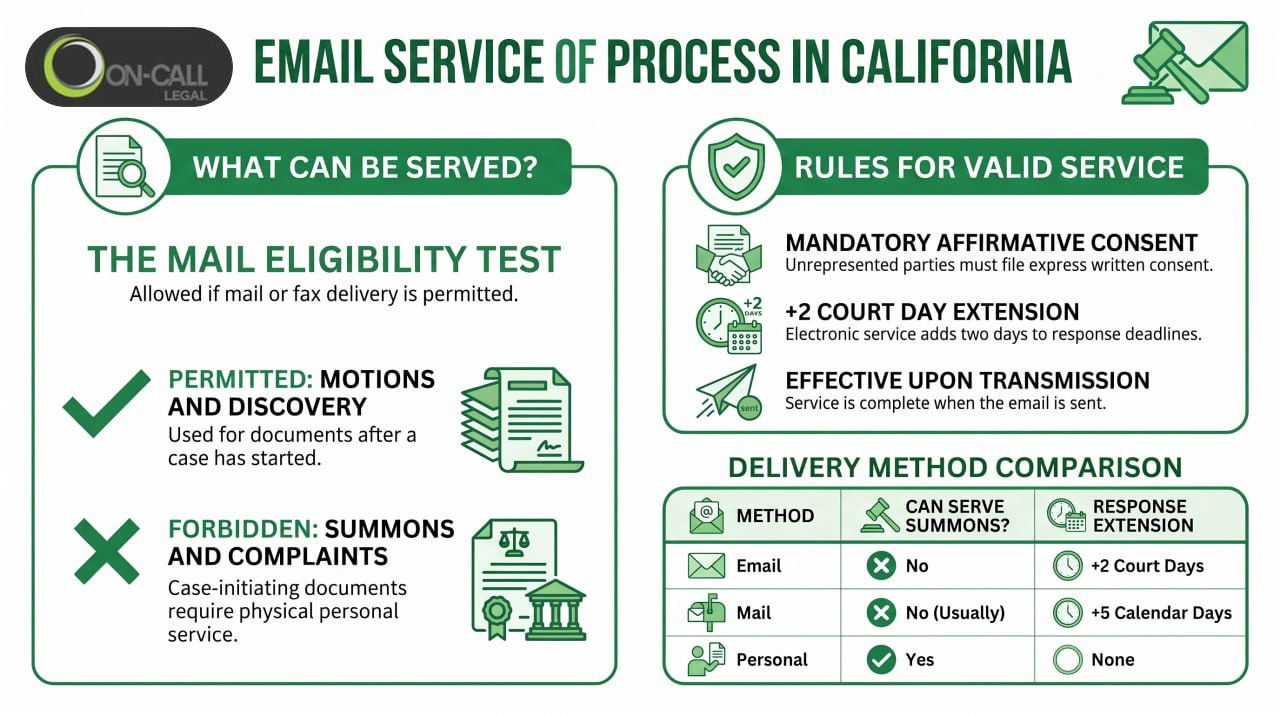
The rule that decides almost every question in California service of process is simple. If a document may be served by first-class mail, express mail, overnight delivery, or fax transmission, it may generally be served electronically instead. If a document requires personal service, or requires certified mail or registered mail, electronic service is not available for it.
That single test explains why you can email a motion to opposing counsel and cannot email a summons. One is a paper the law already lets you drop at the post office. The other is case-initiating paperwork that has to reach the defendant in a way the court can rely on, which is the part of the legal process the court will not compromise on.
What Electronic Service Means Under California Law
Electronic service is governed by Code of Civil Procedure section 1010.6, which defines it as service of a document on a person by either electronic transmission or electronic notification. It can be performed by a party directly, by an agent authorized to act on that person’s behalf, including an attorney, through an electronic filing service provider, or by the court itself.

Electronic Transmission and Electronic Notification
These are two different things, and the distinction matters when you calculate deadlines. Electronic transmission means sending the electronic documents themselves to the address at which the person receives electronic service. Electronic notification means sending a message that names the exact document served and provides a hyperlink where the recipient can retrieve it. Both count as valid service.
What an Electronic Service Address Is
An electronic service address is the specific address at or through which a person has agreed to receive electronic service. It is not simply any email address you happen to have for someone, and it is not the same thing as a mailing address. If a party has provided notice of one address and you send to a different one, you have not served them, however certain you are that the message arrived.
The Role of an Electronic Filing Service Provider
Many parties electronically file and electronically serve through a provider rather than sending anything themselves. Where a case is subject to mandatory electronic filing, the provider handles transmission to every party on the service list and generates the proof. Fees charged by a provider must be reasonable, and a provider must waive its fees where the court deems a waiver appropriate, including where a party has received a fee waiver.
Which Legal Documents Can Be Served by Email in California
Most documents that move between parties once a case is running can be served electronically. The category is defined by a single test rather than by a list, which makes it easier to apply than it first looks.
The Mail Eligibility Test for Electronic Service
Electronic service is available for any notice or document that may be served by mail, express mail, overnight delivery or fax transmission. That is the whole test, and working out whether the document could have gone in the post is the fastest way to answer whether it can go by email.
Documents You Can Serve Electronically
In practice this covers most of what moves between parties after a case is underway. Motions and supporting papers, responsive pleadings, discovery requests and responses, notices of hearing, case management statements, and other court papers that require formal service all fall inside the rule, and you can serve a notice electronically the same way. Once a party is properly before the court and the consent position is settled, email becomes the ordinary route for these documents rather than the exception.
Which Legal Documents Cannot Be Served by Email?
Four categories sit outside electronic service, and each one exists for a different reason. Getting any of them wrong tends to be expensive, because these are the documents where a defective service undermines the case rather than merely delaying it.

Case-Initiating Documents, the Summons and Complaint
A summons cannot be emailed. Section 1010.6 allows a court to issue a summons electronically and transmit a copy to the requesting party, but the statute then states that personal service of a printed form of the electronic summons has the same legal effect as personal service of an original summons. In other words, the summons may travel to you electronically, and it still has to reach the defendant by personal service or another authorized physical method.
This is where most confusion on the subject starts. Being able to receive a document electronically from the court is not the same as being able to serve it electronically on the other party.
Documents Requiring Certified or Registered Mail
Where a statute requires a document to be served by certified mail or registered mail, electronic service of that document is not authorised. The return receipt that certified mail produces is the point of the requirement, and an email cannot substitute for it.
Documents That Require Personal Service
Some papers must be personally served regardless of what any party consents to. Certain subpoenas fall into this group, and whether a subpoena has to be served in person in California depends on the type of subpoena and what it commands. Where personal service is required, no amount of agreement between the parties converts the document into something you can email.
Nonparties Who Have Not Consented
Under California Rules of Court rule 2.251, a document may not be electronically served on a nonparty unless the nonparty consents to electronic service, or electronic service is otherwise provided for by law or court order. This catches a lot of people serving subpoenas, since the recipient of a records subpoena is usually not a party to the case at all.
Who Can Accept Service for a Business or Public Entity
Who may accept service on an organization’s behalf is a separate question from which method you use, and getting the recipient wrong defeats an otherwise competent service.
A corporation is served through its designated agent for service of process, or through officers including a general manager. A public entity is served through the clerk of the body, so a claim against a city goes to the city clerk while a claim against a county goes to the county clerk. Identifying the correct recipient first is what makes the choice of method meaningful, because a document served correctly by the wrong route and a document served by the right route on the wrong person both fail.
When Consent Is Required for Electronic Service
Consent is where most email service actually fails. Whether you need it, and what counts as giving it, depends entirely on who the recipient is and whether they have appeared in the action.
Parties Represented by Counsel Who Have Appeared
A person represented by counsel who has appeared in an action shall accept service electronically for any notice or document that may be served by mail, express mail, overnight delivery, or fax transmission. This is the one situation where electronic service required of a party is mandatory rather than optional, which is why it is now the norm in California civil litigation between represented parties. A court may also order electronic service on a person represented by counsel who has appeared.
Unrepresented Parties and Affirmative Consent
An unrepresented party is in a different position. They may consent to receive electronic service, and until they do, you cannot serve them that way. Express consent may be given in one of two ways. The first is serving notice on all other parties stating that they accept service electronically, then filing consent with the court, and that notice must include the electronic service address. The second is manifesting affirmative consent through electronic means with the court or the court’s electronic filing service provider, providing the electronic service address at the same time.
Silence is not consent. Neither is having previously emailed you about the case.
Fee Waivers, Hardship and Local Rules
Mandatory electronic filing exists in many California courts, but the system has to accommodate people it would otherwise exclude. Courts must maintain a procedure for filing non-electronic documents so that the program does not cause undue hardship or significant prejudice to any party, including unrepresented parties. Parties who have obtained a fee waiver are among those the rules protect. Local rules vary between counties, so the practice in one superior court is not a safe guide to another.
When Electronic Service Is Complete and the Two-Court-Day Extension
Electronic service is deemed complete at the time of the electronic transmission of the document, or at the time the electronic notification of service is sent. It is complete when you send it, not when the recipient opens it, and not when they acknowledge it. A document transmitted after the close of business on a court day is deemed served on the next court day.
Because sending is instant and reading is not, the statute gives the recipient time back. Any period of notice, or any right or duty to act or respond within a period or by a date prescribed by statute or rule of court, is extended by two court days after service by electronic means.
The Three Deadlines the Extension Does Not Apply To
The two-court-day extension does not extend the time for filing a notice of intention to move for a new trial, a notice of intention to move to vacate a judgment under section 663a, or a notice of appeal. These three are the traps, because the extension applies almost everywhere else and it is easy to assume it applies here too.
How to Prove Electronic Service
Service that cannot be proved is service that can be challenged. The proof is a separate document from the thing you served, and it carries its own requirements about content, signature, and timing.

What the Proof of Electronic Service Must Contain
Every method of service needs a proof, and electronic service is no different. A proof of electronic service records the documents served, the identity and electronic service address of each person served, the date and time of transmission, and the identity of the person who effected service. Where there is not enough room on the printed form for every recipient, a separate attachment carries the rest. Where a hearing is involved, proof of electronic service of the moving papers must be filed at least five court days before that hearing.
Signed and Unsigned Proofs
A printed form of a proof of electronic service may be signed by the person who served the documents. An unsigned proof does not carry the same weight, and an original proof that is complete, signed, and promptly filed is what makes service presumed valid if anyone later questions whether a party was properly served. A proof of service by mail is a different printed mail form covering a different method, but the discipline behind completing it is identical.
Differences Between Email Service, Mail Service and Personal Service
The table below sets the three methods side by side. Read across the rows rather than down the columns, because the practical differences between them are about consent and timing rather than about the mechanics of delivery.
|
|
Email service |
Mail service |
Personal service |
|---|---|---|---|
|
Who can be served |
Parties who consent or are required to accept, and consenting nonparties |
Any party or person at a mailing address |
The named person directly |
|
Consent required |
Yes, unless mandatory for represented counsel or ordered by the court |
No |
No |
|
Can serve a summons |
No |
Only by notice and acknowledgment or another authorized method |
Yes |
|
When service is complete |
On transmission or when notification is sent |
On deposit with the United States Postal Service |
At the moment of delivery |
|
Response extension |
Two court days, with three exceptions |
Five calendar days within California |
None |
|
Proof required |
Proof of electronic service |
Proof of service by mail |
Proof of personal service |
|
Typical use |
Documents after appearance in the case |
Documents where no electronic consent exists |
Case initiating paperwork and personal service documents |
How to Serve Documents Electronically, Step by Step
The mechanics are straightforward once the consent position is settled. Working through these stages in order is what keeps a service defensible if anyone later questions it.
Confirm the Recipient’s Status and Consent
Before anything is sent, establish whether the person is represented and has appeared, whether they are unrepresented and have filed consent, or whether they are a nonparty. That answer determines whether you may serve documents electronically at all.
Collect the Electronic Service Address
Take the electronic service address from the filed consent or the court’s service list rather than from correspondence, and check it against the person’s home or business address on file where one is recorded. Where more than one party is involved, build the full service list first, since serving some parties and not others is the most common way a filing gets rejected.
Send the Document or the Electronic Notification
Serve either by sending the electronic documents themselves or by sending an electronic notification that names the exact document and links to it. Send to every person on the service list at the same time.
Calculate the Response Deadline
Count from the date of transmission, then add the two court days. Check first that the deadline is not one of the three the extension does not reach.
Complete and Promptly File the Proof of Service
Fill in the proof of service form with the documents served, the recipients, the addresses used, and the date and time, sign it, then file the documents with the court clerk promptly. A signed proof filed promptly is what protects the service later.
Who Can Serve Legal Documents in California
The method is one question, and the server is another. California sets a low bar for who may serve papers and a much higher bar for who may do it as a business.
Registered Process Servers and the County Clerk Rule
Anyone over 18 who is not a party to the case may serve papers, but people who do it for a living have a registration obligation. Under Business and Professions Code section 22350, a person who makes more than 10 services of process in California in one calendar year for compensation must file and maintain a verified certificate of registration as a process server with the county clerk of the county where they live or have their principal place of business. Corporations and partnerships that derive compensation from service of process carry the same duty in the county of their principal place of business.
A registered process server also gets an evidentiary advantage, because a proof completed by a registered server is treated as presumed valid in a way an unregistered server’s is not.
Sheriffs, Friends and Family Members
A sheriff or marshal can serve legal papers in California, and the registration requirement does not apply to them. A friend or a family member over 18 who is not a party to the case can also serve documents, though people who take that route often discover how much of the work is the paperwork rather than the delivery. What service of process is turns out to be a formal step with its own evidential requirements, and the volunteer who skips those requirements hands the other side an argument.
Why Email Service Fails, Consent Rather Than Delivery
“The failure we see is rarely the sending; it is the consent,” says Brandon Yadegar, Director and Client Manager at On-Call Legal. “Someone emails a self-represented party because they have been emailing them for months about the case, and they assume that history counts as consent. It does not. An unrepresented person has to affirmatively consent and give an electronic service address, and if they have not done that, the service is not good no matter how clearly the email arrived. Check the file for the consent before you send, not after somebody challenges it.”
So Can You Serve Legal Documents by Email in California?
Yes, for documents that could otherwise be served by mail, express mail, overnight delivery, or fax, and only where the recipient is required to accept electronic service, has affirmatively consented to it, or where a court has ordered it. No, for a summons and complaint, for anything a statute requires to go by certified or registered mail, for documents requiring personal service, and for nonparties who have not consented. The practical rule to carry away is that email service is a convenience available once a case is properly underway, and it is never the route by which a case begins.
Ready to Serve Your Legal Documents Correctly?
Choosing the wrong service method costs more than the service itself, because a document delivered the wrong way can unravel the work built on top of it months later. On-Call Legal handles personal service, substituted service, mail service, and electronic service, and our team knows which route each document actually permits under California law. Whether you are starting a case that needs a summons served properly or running one where electronic service has become the daily routine, the method should never be the thing that fails.
Our process serving professionals have served legal papers across California since 1999, covering all 58 counties with registered process servers, timestamped attempt records, and court-acceptable proofs of service. The same team handles subpoena service and court filing when documents need to be filed electronically as well as served. Contact us today to get your documents to the right person by the right method.
Frequently Asked Questions
On-Call Legal has handled service of process throughout California since 1999, covering all 58 counties with registered process servers and a court filing team that works with electronic service and electronic filing every day. The answers below reflect that practice and the current requirements of the California statutes and Rules of Court.
Can a Summons Be Served by Email in California?
No. A court can issue a summons electronically and send a copy to the filing party, but the summons still has to be personally served or served by another authorized physical method. Personal service of a printed form of an electronic summons has the same legal effect as personal service of the original.
Can a Subpoena Be Served by Email?
Usually not. Many subpoenas require personal service, and a subpoena recipient is often a nonparty who cannot be served electronically without consent or a court order. Whether a subpoena can be served by mail or electronically depends on the type of subpoena involved.
Does the Other Party Have to Agree to Email Service?
It depends who they are. A party represented by counsel who has appeared must accept electronic service. An unrepresented party has to affirmatively consent first and provide an electronic service address.
When Is Email Service Complete in California?
At the moment of transmission, or when the electronic notification is sent. It is not complete when the recipient reads the message, and a document sent after the close of business on a court day is deemed served the next court day.
Do You Get Extra Time to Respond After Email Service?
Yes, two court days are added to most response periods. The extension does not apply to a notice of intention to move for a new trial, a notice of intention to move to vacate a judgment under section 663a, or a notice of appeal.
Can You Serve a Self-Represented Party by Email?
Only if they have affirmatively consented, either by serving and filing a notice that includes their electronic service address or by manifesting consent electronically through the court or its filing service provider.
Legal Disclaimer
This article provides general procedural information about service of process in California and is not legal advice. Rules vary by jurisdiction, by court, and by case type, and local rules may apply. Consult an attorney about your specific matter.



On-demand legal services with arranging services from eFiling to organizing and preparing your subpoena for records and/or personal appearance and much more.