
How To Obtain a Certified Copy of a Court Record in California
You obtain a certified copy by requesting it from the clerk of the superior court in the county where the case was filed. Give the clerk the case number and names of the parties and pay certification fees ($40 per document according to Government Code section 70626(a)(4), plus extra fees for each page that needs copying). Then a court worker will certify that the copy is correct. Birth certificates, death certificates, and marriage certificates are different kinds of records that are issued by county offices and the California Department of Public Health.
On-Call Legal has served legal papers since 1999 in all 58 counties in California and nationwide, and we are members of both NAPPS and ServeNow. Our records retrieval team obtains court papers for law firms, including everything from pleadings and motions to judgments and case histories. If you need certified copies from one or more courts, schedule a consultation so we can confirm what each court requires before you send a request.
This article explains what a certified copy is, which office holds each record, what to gather, how to request it, what it costs, how sealed and confidential records work, how vital records differ, and how courts treat a certified copy as evidence.

What Is a Certified Copy of a Court Record?
A certified copy is a copy of a court document that a court employee has certified as correct. A plain copy shows what the document says. A certified copy carries the court’s attestation that it matches what is stored on file.

That attestation is important in court cases. Under Evidence Code section 1530, a copy of a public entity’s writing counts as prima facie evidence of its existence and content when the public employee who has legal custody of the original certifies the copy as correct. A copy that bears the court’s seal also gets help from Evidence Code section 1452, which presumes a seal is genuine if it purports to be the seal of a public entity or one of its departments or agencies.
Both rules create presumptions that affect the burden of producing evidence. The opposing side can challenge copies if they feel that is appropriate. Whether a certified copy fits a particular case is a question for the attorney handling it.
Court Records vs. Vital Records: Which Office Holds What
There is no statewide office that keeps all court records in California. Each county’s superior court keeps the records of cases filed there, sets its request procedures within the state’s fee rules, and maintains its own files. Separate systems house vital records.
|
What you need |
Where to ask |
|---|---|
|
Complaint, judgment, order, or other case document |
Clerk of the superior court where the case was filed |
|
Divorce records (the court file and judgment) |
Clerk of the superior court where the divorce was filed |
|
Birth certificates and death certificates |
County recorder or county health office, or CDPH Vital Records |
|
Marriage certificate (public record) |
County recorder in the county where the marriage license was issued, or CDPH Vital Records |
|
Confidential marriage records |
County clerk in the county where the license was issued |
When a court, an agency, or opposing counsel requests a “certified copy of the judgment,” they want the superior court file. A request for a marriage certificate indicates that someone is dealing with vital records.
Gather the Case Details First
When contacting the court clerks, collect this information beforehand, as they look up records using case numbers. You’ll need the case number and the names of the parties (plaintiff and defendant, or petitioner and respondent), along with the county and the court where the case was filed. Add the title of the document you need and its filing date, if you know it. When sending a mail request, please include your name, mailing address, and phone number.

Different courts use different words, but they end up saying the same thing. The Orange County court asks for the case number, the party name, the document name, and the filing date, and says to be “as specific as possible.” The Monterey County court says that if you don’t have a case number, the clerk can run a record search.
You can usually find your own case number. Many courts have an online index of cases now. Monterey’s divorce guidance, for example, points you to its online index to search by the parties’ names. A search by the clerk can carry its own fee, covered below.
The On-Call Legal court phone numbers page lists court contacts if you need to call a clerk’s office to confirm how a particular court handles requests, and the court forms page collects forms you may need.
How to Request a Certified Copy From a Superior Court
Most courts take requests both in person and by mail. Some also allow ordering online. The details vary by county, so please check the court’s records page before sending anything.
In Person
Go to the clerk’s office at the courthouse, where the court keeps the file. Please have your case information ready and bring along a valid ID because courts like Orange County need identification to review files that haven’t been imaged. Court locations vary; Orange County makes most unlimited civil files available for review at Central Justice Center and keeps limited civil and small claims files stored locally in Justice Centers. Older documents may be kept at an off-site location and can take several days to get to the courthouse, so you should call ahead first. Some courts also impose limits on the hours for requesting copies. Monterey, for example, accepts them from 8:00 a.m. to 3:30 p.m.
By Mail
Complete the court’s request form if it has one, or write a request that names the case number, the parties, and the document you need, then submit it with payment. Courts typically want a self-addressed, stamped envelope. Orange County asks for a 9″ x 12″ envelope with your mailed request, and Monterey asks for a stamped envelope and says it will add postage to your check if needed.

Use checks or money orders made out directly to the court; Monterey does not want cash sent in. Orange County’s mail instructions say the same. If you don’t know the exact amount, some courts accept an open-ended check. Monterey allows a check marked “Not to exceed $75.00” and fills in the actual fee.
Online
Some courts sell copies online now. The Orange County Superior Court says non-certified and electronically certified copies can be bought and downloaded through its Public Access System. Monterey’s webpage talks about looking up cases online but does not discuss how to order copies online. Don’t assume a court offers it until you see it on its site.
What a Certified Copy Costs
California sets court fees by statute, and each court posts its own schedule. The Kern County Superior Court’s published notice lists these state-set fees:
|
Item |
Fee |
Statute cited |
|---|---|---|
|
Copy of a document |
$0.50 per page |
Gov. Code § 70627(a) |
|
Certified copy |
$40 per document |
Gov. Code § 70626(a)(4) |
|
Search taking more than 10 minutes |
$15 per file |
Gov. Code § 70627(c) |
The notice doesn’t say whether the per-page fee also applies on top of the certification fee, and court pages differ on this point, so confirm the total with the clerk before you pay.
Orange County also mentions $0.50 per page for copying and a charge of $40 per document for certification on their mailing instructions, and they add an extra $50 charge for exemplification separately, as this is a service that has its own fee. Ask the clerk if you need this service.
Fee pages can lag the statute. When making your check out to the court, please verify that the current fee schedule applies for that day and save a copy of what you review. For vital records, the fees are different and are covered below.
Payment Options
At the counter, courts typically accept cash, checks, money orders, and credit cards. Monterey mentions all four. By mail, courts generally only accept checks or money orders, and Orange County’s page accepts checks or credit cards for mailed requests. A money order works for a mailed request if the court’s page doesn’t say otherwise.
How Long It Takes
Courts don’t promise one timeline. Monterey recommends allowing at least 10 days for copying and 7 to 10 days for files stored offsite. Orange County gives no fixed time and says older files may need “several days” to reach the courthouse. If you need something expedited quickly, ask the clerk if there is an expedite option offered at court and also find out how much this service costs.
Confidential and Sealed Court Records
Most court records are open. California Rule of Court 2.550 says that unless confidentiality is required by law, court records are presumed to be open.
Judges can seal records but only if they find specific reasons for doing so. The court must find an overriding interest that outweighs the public’s right of access, that the interest would likely be harmed if the record stays public, and that sealing is narrowly tailored and the least restrictive option available. The order must state the facts behind those findings and seal only the material that needs protection.
Some records are secret by law and other records are sealed by court order. If a clerk tells you a file is sealed or confidential, the request becomes a question for the court, not the clerk’s counter. When you look at the pages for Monterey and Orange County, they do not deal with sealed records, so you should ask the clerk exactly what the court requires. If you are a party to the case, your attorney of record is the person to raise it with the court.
Confidential marriage records follow a separate path, covered in the vital records section below.
Divorce Records
Divorce records are court documents. The divorce case file, including the judgment and orders, is stored at the superior court that handled the divorce. As with any court record, you need the case number or the parties’ names to find it. If you’re a party to the case and know the county, you should start with that court’s webpage for family law records.
For divorces from 1962 through June 1984, CDPH also issues a Certificate of Record, which is not the divorce decree. Make sure you know whether the agency or lender is requesting a court judgment or a record of dissolution from the state.
Birth Certificates, Death Certificates, and Marriage Records
Vital records aren’t the same as court records. Records show that events have happened, and they originate either from the county where they take place or from the California Department of Public Health (CDPH).

Authorized Copies vs. Informational Copies
Only authorized people should be able to get a full certified copy of vital records under Health and Safety Code section 103526. Stanislaus County lists them as the person named on the record or that person’s parent or legal guardian, a party entitled to the record by court order, certain government representatives, a spouse or domestic partner, a child, grandparent, grandchild, or sibling, and an attorney or appointed representative.
Others can ask for an informational copy instead. Informational copies are marked “INFORMATIONAL, NOT A VALID DOCUMENT TO ESTABLISH IDENTITY,” so they cannot be used as proof of identification. They can still be useful for things like genealogy research.
CDPH and each county have their own applications. If you want to order an authorized copy via mail, then you will need a notarized sworn statement. The CDPH assigns form VS 20 and incorporates that into the application.
Where Marriage Records Are Held
The marriage page of CDPH has some rules. CDPH holds public marriage certificates from 1905 to 1999, 2001, and 2008 to 2025. For marriages from 2000 and 2002 through 2007, contact the county recorder where the marriage license was issued, because CDPH says it can’t provide certified copies for those years. Confidential marriage records are not held by CDPH, so request them from the county clerk where the license was issued.
For in-person requests, you go to the county office that registered the marriage. The event must have occurred in that county.
Confidential Marriage Records
A confidential marriage record is released only to the two people listed on the certificate or to anyone who has received a certified court order that authorizes them to see it. Stanislaus County refers to Family Code section 511 and says that they cannot issue informational copies of confidential records. The CDPH page says the same thing about who is allowed to request them. Sealed records (an original birth or marriage certificate replaced by an amended one) require a separate application (Form CDPH 9126) from CDPH, usually with a court order, and they can only be requested by mail.
Vital Records Fees and Payment
CDPH’s marriage page lists $19 per certified copy by mail, payable by check or money order to “CDPH-VR.” CDPH’s fee page says that beginning January 1, 2026, Health and Safety Code section 103625(f) raised certified copy fees by $2 under AB 64, to $31 for a birth record, $26 for a death record, and $19 for a marriage record. Different counties also have their own processing rules. Stanislaus accepts payment in cash, checks, or money orders and does not accept debit or credit cards at its office.
Because fee tables on state and county sites haven’t all caught up, confirm the amount with the issuing office before you send a payment.
Common Mistakes That Delay a Request
Most of the delays result from the same few mistakes. A request has to be accurate to move forward, and one small error can send it back.
The first is asking the wrong court: the record sits in the county where the case was filed, so a request to the wrong county only costs you time. The second is omitting the case number or party names, which forces the clerk to run a search that can carry a fee. A third is sending cash by mail, which Monterey and Orange County both say not to do, and a fourth is skipping the self-addressed, stamped envelope that many courts require with mailed requests.
Vital records add their own traps. A mailed request for an authorized copy needs the notarized sworn statement, and a 2000 or 2002-2007 marriage record comes from the county recorder, not CDPH. Before you pay, double-check that the amount you’re paying matches what the court has posted on its schedule; this way your payment won’t be returned.
How Courts Treat a Certified Copy as Evidence
One way to bring a court document in front of a judge is to get an official certified copy. Under Evidence Code section 1530, a certified copy of a public document serves as prima facie evidence that it contains the same information as the original document.
The Evidence Code’s authentication rules, sections 1400 through 1421, cover other means of showing that a document is authentic, such as testimony from someone who saw the document being made. Those rules are not limited to certified copies.
One common assumption turns out to be incorrect. A document’s age does not automatically confer authenticity. According to Evidence Code section 643, a deed, will, or other writing affecting property interests is presumed authentic if it meets four conditions: it must be at least 30 years old, show no suspicious signs regarding its authenticity, be kept in a location where an authentic document would likely be found, and have been generally acted upon as authentic by interested parties. The rule doesn’t make every old document authentic. For any specific evidence question, ask the attorney who handled the matter.
When to Have a Records Team Handle the Request
Requests increase when something is spread out over different counties. One matter can need documents from several superior courts, each with its own forms, fees, and payment rules. A team that handles these requests as its daily work can keep each court’s rules straight.
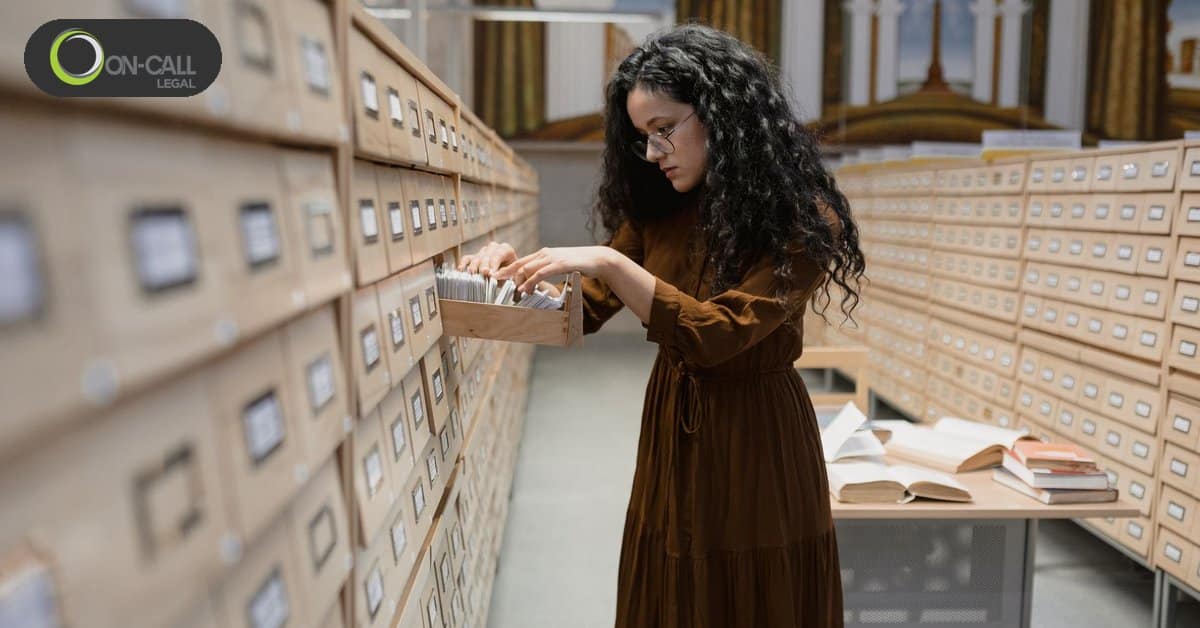
On-Call Legal’s records retrieval service retrieves court and legal documents for law firms, including pleadings, motions, judgments, and case histories. The page says retrieval starts after a request and any signed authorizations, and that the team verifies the requesting attorney first. Related services include court document retrieval, court filing and county recorder services. Tell the team, in your request, that you need certified copies so the order matches what the court issues.
Ready to Get Your Certified Court Records Without the Back-and-Forth?
A certified copy is issued by the clerk of the superior court in the county where your case was originally filed, and it comes quicker if you have the case number and the current fee, and you use a payment method the court accepts. Vital records come from county offices and CDPH; they have different rules for who can get copies and what each copy can be used for. Getting those details right the first time saves you returned payments, repeat trips, and delays before a filing deadline.
On-Call Legal has served legal documents since 1999, and we provide service in all 58 California counties and nationwide. We belong to NAPPS, ServeNow, and CAALA, and our team for handling court documents and filing is made up of experienced legal couriers. Contact us today to get the certified copies that you need quickly without the back-and-forth.
Frequently Asked Questions
How Much Does a Certified Copy of a Court Record Cost in California?
A certified copy costs $40 per document under Government Code section 70626(a)(4), plus $0.50 per page for copying under section 70627(a), according to the Kern County Superior Court’s notice. Make sure to double-check the total schedule with the clerk, as courts have their own schedules posted. Vital records, such as a marriage certificate, have separate fees.
How Long Does It Take to Get a Certified Copy?
It depends on the court and whether the file is stored off-site. Monterey County says to allow at least 10 days for copies and 7 to 10 days for off-site files. Orange County says older files may take a few days to arrive at the courthouse. You should ask the clerk what the current time frame is now.
Can Anyone Request a Certified Copy of a Court Record?
Most California court records are presumed open under Rule of Court 2.550, so a person can request copies without being a party. Records that are sealed or marked as confidential are the exception. A court order controls access to those, and a clerk can tell you what the court needs.
How Do I Get a Certified Copy if I Don’t Have the Case Number?
Search the court’s online case index by party name if it has one, or ask the clerk to run a record search. Monterey charges a $15 fee if you do not have a case number or when a search takes longer than 10 minutes. Kern County’s notice lists $15 per file for searches over 10 minutes.
How Do I Get a Certified Copy of a Divorce Record?
When it comes to getting divorce records, those are court documents, so you should go to the superior court where the divorce case started. Bring the case number or both parties’ names and the approximate filing date. Ask the clerk whether you need the judgment or the court’s full file.
Where Do I Get a Certified Copy of a Marriage Certificate?
The CDPH maintains records of marriage certificates for public access from 1905 through 1999, 2001, and 2008 to 2025. Contact the county recorder for records from 2000 and 2002 to 2007 about the license they issued. For confidential marriage records, you should contact the clerk of that county.
Do I Need a Notarized Statement to Get a Certified Copy of a Vital Record?
Yes, if you order an authorized copy via mail. The CDPH requires filling out a form called a notarized Sworn Statement (Form VS 20).
Can I Pay by Money Order or Cash?
It depends on what you ask for. By mail, courts and CDPH usually take only a check or money order, and Monterey and Orange County say not to send cash. At the counter, some offices also take cards, while others, such as Stanislaus County’s vital records office, take only cash, check, or money order and no cards.
Legal Disclaimer
On-Call Legal is not a law firm and does not give legal advice. This article provides general information about requesting certified copies of court records and vital records in California, and it is not a substitute for advice from a licensed attorney about your case. Court fees, forms, procedures, and statutes change, and each superior court and county office sets its own request process, so confirm current requirements with the court or agency before you send a request or payment. Whether a certified copy is admissible or sufficient in a particular proceeding is a question for the attorney handling your matter. Reading this article does not create an attorney-client relationship.



On-demand legal services with arranging services from eFiling to organizing and preparing your subpoena for records and/or personal appearance and much more.