What Is a Process Server?
Quick answer
A process server is an impartial adult who delivers legal documents and serves process so that a case can move forward with proper notice. They handle service of process for courts, law firms, and individuals, hand-delivering the papers that start or advance a lawsuit. Good process serving is the quiet step that lets the legal system work the way it should.
On-Call Legal has served legal documents since 1999, well over 15 years of process serving across all 58 California counties and all 50 states, and our team belongs to NAPPS and CALSPro. We log every attempt with a timestamp in a client portal and hand back a court-acceptable proof of service, with 24-hour rush and same-day options when a deadline is tight. To get your papers moving, contact us for a free consultation.
This article covers what a process server does, who can serve papers in California, the step-by-step serving process, the documents they deliver, what being served means for you, and the answers to the questions people ask most.

What Is a Process Server? Definition and Role Explained
A process server delivers legal documents to the parties named in a lawsuit. It's a simple job, but it carries real weight. When you file a case, the person on the other side has a constitutional right to know about it, and a court can't act against someone who was never told. Process servers close that gap.
They fill an essential role most people never notice until they need one. Law firms, legal teams, and other legal professionals lean on professional process servers to serve legal documents fast and correctly, which frees lawyers to work on the case itself. When a firm has to deliver legal documents to a defendant across the state or across the country, the process server is the one who gets them into the recipient's hands. Whether court documents are from an active legal proceeding or the first filing in a brand-new legal process, the task remains the same: deliver court documents to the right person and prove it happened.
The core function is straightforward to state and hard to do well. Locate the recipient. Hand over the court papers. Write down exactly how the delivery happened. That record tells a judge the defendant got proper notice. Process servers play a support role in nearly every civil case, and many jurisdictions treat proper service as the foundation for everything that comes after. They serve documents in person and deliver documents that formal notice depends on, so people actually learn about the legal actions that affect them.
All of this traces back to one Supreme Court case. In Mullane v. Central Hanover Bank & Trust Co., 339 U.S. 306 (1950), the Court held that due process requires "notice reasonably calculated, under all the circumstances, to apprise interested parties of the pendency of the action and allow them to present their objections." Every serve a professional completes is built to clear that bar. Proper service of process protects due process rights. Skip it, and a case stalls or collapses.
People mix up process servers with couriers, registered agents, or the local sheriff. The differences matter. A courier drops a package and leaves. A registered agent is a business's designated contact for accepting legal documents on the company's behalf. A sheriff or marshal can serve papers too, but they carry a heavy public caseload on a fixed schedule. A professional process server does one job, obeys the serving rules, and documents the result so it holds up in court. That's the line between valid service and a filing that the other side can pick apart.
So why not mail the papers yourself or send a friend? Because the whole value of a process server is impartiality. The server is a neutral third party with no stake in the outcome, which is exactly what a court wants behind a claim of proper notice. All kinds of people hire them: solo attorneys, corporate legal teams, landlords, and folks handling a case on their own. When someone contests a serve, a neutral professional's word carries weight; a plaintiff's own account never will.
Who Can Be a Process Server? (California Requirements)
Can anyone be a process server in California? Almost anyone can. State law sets two hard baseline rules. The server has to be at least 18 years old, and the server can't be a party to the action. Both come straight from California Code of Civil Procedure §414.10. A plaintiff can't serve their own papers.
Process Server Registration in California
Here's where people trip up. California doesn't issue a statewide process server license, and there's no state certification board. It uses county-level registration instead. Anyone who serves more than 10 papers a year for compensation has to register as a process server. So the accurate term is "registered process server," not "licensed process server."
To register in California, a server files a verified certificate with the county clerk in the county where they live or run their business under Business and Professions Code §22350. The requirements are specific:
- A $2,000 surety bond from an admitted surety, or a $2,000 cash deposit (B&P Code §22353)
- Live Scan fingerprinting and a DOJ and FBI background check, plus no disqualifying felony record
- A photograph for the county identification card, which also carries the registration number the county clerk assigns from its register of process servers (B&P Code §22355)
- At least one year of California residency
- The certificate stays valid for two years, then renews (B&P Code §22354)
The threshold is precise: more than 10 services of process within California in one calendar year, for pay. Corporations and partnerships that earn fees from serving process have no threshold at all. They register in the county of their principal place of business no matter how few papers they serve. Either way, a server registers once, in that home county, and the registration covers service anywhere in the state. There's no per-county registration, so a server registered in Los Angeles can serve papers in San Diego or Sacramento on the same card.
Some people don't have to register. Sheriffs, marshals, and government employees acting in their official roles are exempt. So are attorneys and their employees serving papers in their cases, court-appointed servers, licensed private investigators and their staff, and registered photocopiers. Everyone else who serves process for pay in California must register with the county clerk.
Skipping registration when the law requires it is a misdemeanor under B&P Code §22359. That penalty lands on the server. Nothing in the statute says the service itself is void because the server wasn't registered, and CCP §414.10 still lets any non-party adult serve a summons. The other side may still raise the server's registration status when it challenges the proof of service, so a current registration is worth checking before you hire.
The rules aren't uniform across the country. Most states want servers to be disinterested adults, but the legal requirements and service requirements past that point swing widely, and many jurisdictions pile on local laws and local regulations of their own. A server trained in state-specific legal requirements brings the jurisdictional knowledge to ensure compliance wherever the recipient lives. Each court keeps its own rules for how and when papers get delivered, so a pro checks the details before a serve instead of assuming one state's process works everywhere.
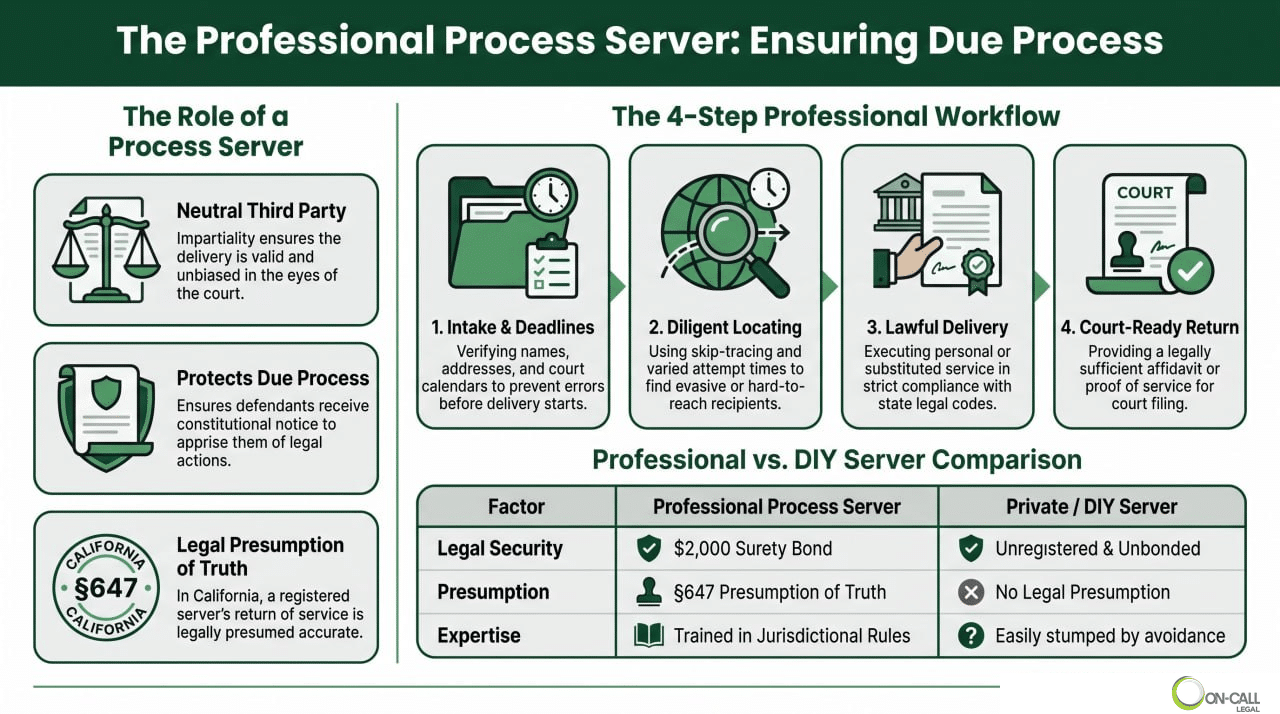
Registration isn't busywork. It buys a real legal advantage. Under California Evidence Code §647, the return of service filed by a registered process server carries a rebuttable presumption that the facts stated in it are true. That shifts the burden to the other side. If a defendant later claims they were never served, they must prove it. That presumption is one of the most compelling reasons to hire a registered professional instead of a friend or a party to the case. It also shapes who can accept service of process on the receiving end, which runs by its own set of rules.
Registration also shows up on the proof of service itself. Under CCP §417.40, a proof of service signed by a registered server, or by that server's employee or independent contractor, has to show the registration number. The version in force today also requires the county of registration; an amendment that takes effect on January 1, 2027 keeps only the number. On form POS-010, those details go in item 7, right beside the server's name, address, and telephone number.
The Process of Serving Legal Documents
Every serve at On-Call Legal runs the same disciplined path. We built this four-step framework so nothing slips, and so the proof of service holds up when the other side pushes back. It's the process we run for any client who wants service done right the first time.
Technological advancements changed the work. Skip-tracing databases, time-stamped attempt logs, and electronic court filing let a server find people faster and provide proof the court readily accepts. We build those tools into every job without cutting one legal corner, so speed never costs us a clean record.

Step 1: Receiving Legal Documents
The job starts when the legal documents land from the client, usually a law firm, a self-represented litigant, or a legal team buried in a heavy docket. We confirm the case details, the recipient's name and last known address, and any deadline tied to the court's calendar. Ensure accuracy during intake to avoid issues down the line. A misspelled name or a stale address sinks an otherwise clean serve, so we check the specifics before a server heads out the door.
Intake is also where we flag the urgent stuff. A restraining order with a hearing next week, a summons near the end of its service window, and an out-of-state defendant: each one changes how we route the job.
Step 2: Locating the Recipient
Most people get served on the first or second try. Some don't. When a recipient is difficult to reach or ducking on purpose, a skilled process server switches from delivery to investigation. That means varying the days and times of attempts, hitting a workplace as well as a home, and using skip tracing to track a current address through databases and public records. The number of visits swings by case, and you can read more on how many attempts does a process server make before moving to another method. Experienced servers also know the legitimate process server tricks of the trade that separate a completed serve from a dead end, all inside the bounds of the law.
Finding the recipient is usually the hardest part of the job. People move. They list a work address that's three years stale. They dodge a server they know is coming. A good server treats it like detective work: confirm the address against current records, clock when a car sits in the driveway, and time the visit for when someone's actually home. Every one of those service attempts gets logged with a date, time, and note, so the file shows the thoroughness a court expects before any other method is used.
Step 3: Serving the Documents Legally
California recognizes more than one way to complete service, and picking the right one matters. Personal service is the most direct and the cleanest: the server hands the papers straight to the named person under CCP §415.10. Service is done the second the documents change hands.
When personal service fails after reasonable diligence, California allows substituted service under CCP §415.20. The server leaves a copy at the person's home or usual place of business with a competent adult who's at least 18 and part of the household or apparently in charge, tells that person what the papers are, then mails a first-class copy to the same address. Service is complete 10 days after that mailing. "Reasonable diligence" isn't a fixed number in the statute. Courts generally want several real attempts at different days and times before a server jumps to substituted service.
California keeps a few other routes for when the facts call for them. A defendant can accept papers by mail through a notice and acknowledgment of receipt under CCP §415.30, signing and returning a form that completes service with no personal visit. In narrow situations, like certain unlawful detainer cases where a defendant can't be reached any other way, a court can authorize service by posting at the property under CCP §415.45, usually paired with a mailed copy. A pro knows which method the facts and the court's rules allow, so the serve holds up the first time.
A common myth: California sets no statewide limit on the hours a server can work. Papers can be served any day, including weekends and holidays, at any hour, as long as the manner is otherwise proper. That familiar 6 a.m. to 10 p.m. window is a professional custom and a courtesy, not a legal rule.
Step 4: Proof of Service and Documentation
The serve isn't finished until it's documented. In California, proof of service gets filed on Judicial Council form POS-010. The server fills it out as a declaration signed under penalty of perjury, per CCP §417.10 and §2015.5. It logs the who, what, where, when, and how of the delivery—the details a judge needs to confirm proper notice went out.
And here's the part people get wrong: the California proof of service does not need to be notarized. A signed declaration under penalty of perjury carries the same legal force as a notarized affidavit. What gives a registered server's proof its extra strength isn't a notary stamp; it's the Evidence Code §647 presumption that the return is true. We hand over that court-ready proof of service on every job, so clients file with confidence. The finished POS-010 goes back to the client or straight to the court, and it becomes the official record that notice was given. If the case ever gets challenged on service, that document is the first thing a judge reads.
Types of Legal Documents Process Servers Deliver
Process servers handle far more than one form. The constant is that each document has to reach the right person the right way. Different papers call for different service methods, and a professional matches the method to the document and the court's rules. For a fuller breakdown of what kind of papers a process server serves, here are the ones we see most:
- Summons and complaints. These kick off a lawsuit. A lawsuit commences the moment the summons and complaint are served on the defendant, giving formal notice that a case has been filed.
- Subpoenas. These demand a specific action from the recipient: appear, testify, or produce records. A defective subpoena can be quashed, so it pays to know what makes a subpoena invalid before you lean on one.
- Divorce papers. Family law petitions and responses have to be served on the other spouse to move forward, and the response deadline runs from the date of service.
- Eviction notices. Unlawful detainer paperwork follows strict timing rules, and a single misstep in service can restart the clock and cost a landlord weeks.
- Restraining orders. These need fast, verified service so the protections take legal effect and the court can enforce them.
- Court orders and writs. Judgments, orders, and writs of execution get served to enforce what the court has decided.
- Small-claims documents and other papers. Claims, motions, and other documents round out the daily work.
Some matters don't need personal service at all. A defendant can sign a waiver of service, and knowing how a waiver of service of process works saves time and money when both sides cooperate. Whether the papers touch civil cases or criminal cases, the goal holds: proper notice, properly documented. Timely service keeps legal cases on schedule and lets court proceedings start without a fight over whether the defendants were told.
What Does It Mean to Be Served?
Being served means you've received official legal documents telling you you're involved in a court matter. It's formal notice, not a suggestion. Once you're served, a clock starts, and you get a set number of days to respond or attend court. Ignoring the papers doesn't make the case disappear. It usually just clears the path for the other side to ask the court for a default judgment against you.
Being served isn't an accusation of wrongdoing by itself. You might be a defendant. You could also be a witness, a records custodian, or a person with information a court needs. If you're wondering why a process server is calling you, the answer is almost always that someone filed a legal action and the law requires you to get personal notice of it.
You do have rights. You're entitled to know what the documents are and to read them. Confirm the server is genuine, too, because scammers sometimes pose as process servers to squeeze people into paying fake debts. A real server delivers papers and points you to the court. They won't ask for payment right away. If you're not sure, it helps to know if a process server is legitimate before you act. The safest move after being served: read the papers, note your deadline, and talk to a licensed attorney about how to respond.
The deadline is the part people underestimate. In a California civil case, a defendant who's personally served has 30 days to file a written response with the court. Miss that window, and the plaintiff can ask for a default judgment. Read the summons closely, because it states your deadline and where to file. If the papers name a hearing, put it on the calendar and plan to attend court or file the proper response first. Moving early beats scrambling later, every time.
Why Hiring a Professional Process Server Matters
Service is the one step in a case you can't afford to botch. Improper service is a common reason cases stall, and a defendant can use it to set aside a default judgment months down the line. It cuts both ways. Skip a required step, and you can lose your court date, burn filing fees, and hand the other side an easy argument. Proper service protects your timeline and your outcome.
Think about what a bad serve actually costs. A default judgment built on defective service can be set aside, dragging the case back to square one after months of work. Papers left with the wrong person, at the wrong address, or without the required follow-up mailing get thrown out. If the statute of limitations ran in the meantime, the claim can be gone for good. These aren't rare edge cases. They're the everyday reasons careful litigants refuse to gamble on service.
"The difference between a case that moves forward and one that gets thrown out often comes down to how the papers were served," says Brandon Yadegar, Director at On-Call Legal. "A registered process server does it by the book and documents every attempt, so the proof of service holds up when the other side challenges it."
There are real consequences for the person dodging service, too. Avoiding a server rarely works and tends to backfire, so it helps to understand the penalty for avoiding service of process before you treat it as a plan. Courts have tools, such as substituted service and service by posting or publication, to ensure they can complete notice even when someone is hiding.
That reliability comes from people who do this work every day. Not every server is equal, and the gap between a pro and an amateur shows the second a serve gets contested.
One note on cost before the table. California doesn't set a single official rate, and fees vary by county, urgency, and how hard the person is to find. For a realistic range and what moves the number, see our breakdown of process server cost in California. A routine serve in an easy-to-reach area sits at the low end. A hard-to-find recipient, a distant county, or a same-day rush pushes it up. The cheapest option isn't always the one that gets it done, and a failed serve costs far more than the fee. Here's how professional and private process servers stack up.
Professional vs. Private Process Servers
| Factor | Professional Process Server | Private / DIY Server |
|---|---|---|
| Registration & bond | Registered with the county clerk; carries the $2,000 surety bond | Often unregistered; any non-party adult 18+ may serve, but without bond |
| Service area | Nationwide and all 58 California counties | Usually local to one area |
| Experience & training | Trained in state serving rules; handles evasive recipients | Little to no experience; easily stumped by avoidance |
| Cost | A clear, quoted fee based on county and urgency | Cheaper up front, costly if the serve fails and the case slips |
| Reliability & legal compliance | Documented attempts; §647 presumption that the return is true | No §647 presumption; higher risk of a challenged, invalid serve |
Approved Methods of Process Service
Before any legal document can move a case forward, it must be served using a method the court recognizes as valid. Each court case, document type, and jurisdiction has specific service requirements, and choosing the wrong method can delay proceedings or invalidate service entirely. That's why understanding approved methods of process service is essential for proper notice and compliance with the law.
Courts generally recognize the following methods of serving legal documents:
- Personal service – This is the gold standard of service of process and involves physically handing the legal documents directly to the person being served. Personal service provides the strongest proof in court and is often required for lawsuits, restraining orders, and time-sensitive legal actions.
- Substituted service – When personal service isn't possible after multiple attempts, substituted service may be allowed. This method involves serving a competent adult at the recipient's home or workplace and then mailing a copy of the documents to the recipient's last known address, following strict process rules.
- Service by mail – Some court documents can be served by mail if the recipient signs and returns an acknowledgment of receipt. Without that acknowledgment, service may be considered incomplete, which is why this method is not always reliable.
- Certified mail – Certain legal documents and jurisdictions allow service by certified mail, often requiring a return receipt. This method is commonly used in administrative cases or when permitted by statute or court order.
- Service by publication – When a person cannot be located despite diligent efforts, courts may allow service by publication. This involves publishing notice in an approved newspaper for a set period of time and is only allowed with explicit court permission.
- Electronic service – In some court cases, especially when parties agree or a judge authorizes it, documents may be served electronically by email or other approved platforms. Electronic service must follow specific court guidelines to be considered valid.
Using the correct method of service is critical to ensuring the legal procedure holds up in court and that the case can proceed without challenges.
What Are the Typical Fees for Process Servers?
Before you hire a process server, be sure to understand and cross-check important factors such as their expertise, experience, and track record of successful services. More importantly, make sure you understand their fee structure and how much they charge for the service you're hiring for. Generally, process servers in California use one or a combination of these common fee structures:
- Tiered fees based on your required turnaround time
- Flat fees for routine services
- Extra charges based on unique circumstances
The average cost of hiring a process server in California ranges from $40 to $200 per service. However, the exact price may differ based on the nature of the case and the location of both the process server and the entity they're to serve. Cases that require urgent service with short deadlines will most likely attract higher charges than routine services.
On the other hand, process servers in developed areas usually charge higher fees, and serving a recipient in a location outside the process server's jurisdiction may also attract higher costs. Therefore, it's advisable to consult your potential process server to confirm their quotes before hiring them.
Additionally, in states like Arizona, the average cost of hiring a process server ranges from $50 to $100 per service. In states like Florida, standard and next-day service start at $65. So, to emphasize, make sure you do your research and get a clear breakdown of costs before hiring a process server. To avoid any surprises later, find out what is included in the service fee, such as mileage, multiple attempts, or notarized proof of service.
| Location / Service Type | Typical Cost Range | What's Usually Included |
|---|---|---|
| California – Routine Service | $40–$100 per service | Standard service attempts, proof of service |
| California – Rush / Same-Day | $50–$140 per service | Priority handling, faster attempts, proof of service |
| Arizona – Standard Service | $50–$100 per service | Service attempts, affidavit or proof of service |
| Florida – Standard / Next-Day | Starting at $65 | Basic service and proof of service |
| Out-of-State or Remote Locations | Varies widely | Service attempts, documentation |
| Multiple Attempts Required | Additional fees may apply | Extra service attempts |
| Skip Tracing / Hard-to-Locate Cases | Additional fee ($250–$500) | Address research and location efforts |
| Notarized Proof of Service | May be included or extra | Court-ready documentation |
Common Challenges Faced By Process Servers

Process servers usually face various challenges while carrying out their duties. One of the most common challenges is the avoidance of service by the intended recipient. Sometimes, people who are not willing to accept service may reject the documents, hide from the process server, or give a false identity or wrong information about their whereabouts.
Secondly, it may be difficult or risky for the process server to serve legal documents to a recipient reacting aggressively or violently. Most times, it takes a high level of skill, carefulness, and patience to deal with such people.
Furthermore, complying with the legal procedures for serving a document in different jurisdictions can be challenging sometimes. Process servers must exercise due diligence when serving papers in a different jurisdiction, as mistakes in the service process can result in severe consequences such as the dismissal of the case.
Furthermore, process servers face physical risks sometimes. Unfavorable conditions, such as bad weather, can make their movement more risky and stressful. Additionally, it may be difficult to gain access to places with strict security measures, such as gated communities and secured apartments. Moreover, traveling long distances to serve a subpoena out of state or to unsafe places to serve process may pose safety risks.
What Is a Process Server Allowed to Do?
Process servers operate as neutral messengers within the legal system, and every action they take must comply with strict legal and ethical process rules. Their role is not to argue a case, explain legal strategy, or pressure someone into accepting papers. Instead, a competent process server focuses on delivering legal documents in a lawful, professional, and respectful manner so the legal process can move forward without dispute.
To properly serve documents and meet court requirements, process servers can use a range of legal methods and tools, as long as they adhere to the specific regulations and legal procedures of their jurisdiction. Process servers can:
- Access gated communities legally when permission is granted by residents, property managers, security personnel, or homeowner associations, ensuring service is completed without violating access rules.
- Conduct skip tracing to locate individuals who have moved or provided outdated information, as long as they are properly licensed or working with licensed investigators and compliant databases.
- Make multiple service attempts at different times of day and on different days, including early mornings, evenings, or weekends, to increase the likelihood of successful service.
- Serve hard-to-locate or evasive individuals by using lawful research methods, surveillance techniques, and verified address checks while remaining within legal boundaries.
These abilities allow professional process servers to complete service efficiently, even when a defendant ignores it or actively avoids receiving legal papers.
What Process Servers Cannot Do
Although process servers possess the authorization to serve legal documents, their authority is subject to strict limitations. Courts take improper service seriously, and crossing legal boundaries can invalidate service, delay court cases, or expose the server and client to legal liability.
Process servers cannot:
- Trespass on private property, including entering locked buildings, fenced yards, or restricted areas without permission.
- Break into homes, vehicles, or buildings under any circumstances, even if the recipient is inside.
- Use threats, intimidation, coercion, or harassment to force someone to accept service.
- Impersonate law enforcement, court officials, or government agents, or misrepresent their role in the legal process.
Understanding and respecting these boundaries protects the integrity of the legal procedure, the safety of all parties involved, and the validity of the service itself.
Ready to Get Your Documents Served the Right Way?
Service is where a case is won or lost before it really begins, and it's not the place to gamble. A registered professional finds the recipient, follows California's serving rules, and hands you a proof of service that stands up in court. That's how you keep your matter on schedule and out of a brawl over whether notice ever went out.
On-Call Legal has served legal documents since 1999, with nationwide coverage across all 50 states and deep California roots, including all 58 counties, Los Angeles County's 88 incorporated cities, and 38 courthouse locations. As members of NAPPS and CALSPro, we log every attempt with a timestamp in a client portal, provide court-acceptable proof of service, and run service 24 hours a day, including same-day rush options. Work with our experienced process servers and contact us today for a free consultation.
FAQs
These are the questions people ask most once a server shows up or a case gets filed. The short answers below reflect how service works in California, pulled from our day-to-day process serving. For your specific situation, a licensed attorney is the right person to advise you.
What Happens if You Don't Answer the Door for a Process Server?
Not answering rarely stops service. After reasonable diligence, a registered server can complete substituted service by leaving the papers with a competent adult at your home or work and mailing a copy, which is complete 10 days after mailing. Dodging the door delays things. It doesn't make the case disappear.
What Happens if a Server Can't Find You?
The server doesn't give up. They vary the times and locations of service attempts, use skip tracing to find a current address, and if personal service still fails, the case can move to substituted service or, with court permission, service by posting or publication. One way or another, the law provides a route to complete service.
Why Would a Process Server Be Looking for Me?
Because someone filed a legal action that requires you to get personal notice. You might be a defendant in a lawsuit, a witness under subpoena, or a party to a divorce or some other matter. The server's job is to deliver the papers, not to judge the case.
What Is the Point of a Process Server?
The point is due process. A process server makes sure everyone named in a case gets properly notified, so the court has the authority and jurisdiction to proceed, and nobody is bound by a decision they never heard about. It's the neutral, documented step that keeps the legal system fair.
What Kind of Papers Does a Process Server Serve?
Summons and complaints, subpoenas, divorce papers, eviction notices, restraining orders, court orders, writs, and small-claims documents, among others. Different documents can require different service methods, and a professional matches the approach to the paperwork and the court's rules.
How Long Does Service of Process Take?
Service of process can take anywhere from same-day service to several days or weeks, depending on the recipient's location, availability, and whether they are avoiding service.
What Is a Process Server Job?
A process server's job involves serving legal documents properly, following court rules, documenting service attempts, and providing valid proof of service.
What Does a Process Server Look Like?
There is no uniform—process servers typically dress professionally and discreetly to complete service without drawing unnecessary attention.
How to Find Out Why a Process Server Is Looking for Me?
The fastest way is to accept service, review the legal papers, and see what legal action or court case the documents involve.
How Many Attempts Does a Process Server Make?
Most professional process servers make multiple attempts at different times and days to complete service in compliance with court requirements.
What Is a Special Process Server?
A special process server is someone specifically appointed by a court to serve documents in a particular case, often when standard service methods have failed.
What Is a Certified Process Server?
A certified process server has completed required training or certification through a recognized authority, demonstrating knowledge of service rules, legal procedure, and professional standards.
Disclaimer
The information provided in this article is for general informational purposes only and does not constitute legal advice. While we strive for accuracy, laws and procedures may vary by jurisdiction and change over time. For specific legal questions, please consult a licensed attorney.



On-demand legal services with arranging services from eFiling to organizing and preparing your subpoena for records and/or personal appearance and much more.