
What Is a Waiver of Service of Process?
Quick answer
When a defendant signs a waiver of service of process, they are agreeing to waive formal service of legal documents and receive notice of the lawsuit. Instead of employing a process server or performing delivery by certified mail, the defendant accepts service and gives actual notice of the complaint. Utilizing a waiver can help cut costs, avoid delays, and move your case through the court system more quickly.
On-Call Legal Process Servers has been perfecting service of process cases nationwide for over 15 years. We understand your case may have certain procedural requirements to ensure your legal action moves efficiently. Our process servers are committed to accuracy, compliance, and professionalism when serving your legal documents, whether you need a waiver of service of process or traditional service. Call us today to learn more about how we can help you.
In this article, we cover how to properly execute a waiver of service of process and the legal implications involved.
Definition and Purpose of Waiver of Service of Process
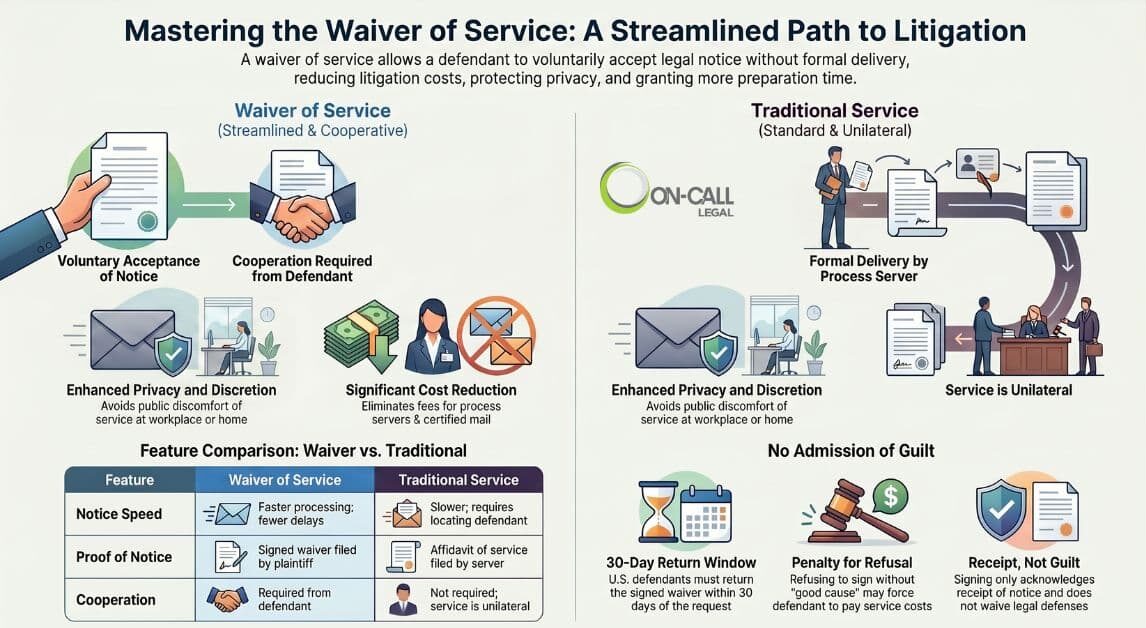
A waiver of service of process happens when the defendant voluntarily accepts service of the legal documents without requiring a formal summons from the court. Instead of hiring a process server, the plaintiff may send or deliver notice by first-class mail, prepaid methods, email, or other reliable means.
The Federal Rules of Civil Procedure allow a defendant to waive formal service of a summons, stipulating that the plaintiff must still send along a copy of the complaint, a summons, and notice of the defendant’s obligations to answer the complaint.
Proper waivers help save time and money on unnecessary costs. Waivers should only be completed voluntarily, and both parties can benefit from going forward without the formal service of process.
Waiver of service of process is commonly used in business litigation, contracts, employment issues, corporate disputes, and uncontested family law matters.
Signing a waiver of service does not mean you are accepting fault or guilt. By signing and returning a waiver of service, the defendant is only recognizing that they had notice of the lawsuit and are electing to move forward without formal service of process. The defendant still maintains all defenses available to them and may contest the allegations against them.
Rules for Waiving Service of Process
Like any aspect of law, there are rules you must follow when waiving service of summons. Below are the basics of Rule 4 for Waiving Service according to the Federal Rules of Civil Procedure:
Requesting a Waiver – The plaintiff shall send a request that the defendant waive service of process. You must also send a copy of the request to “any other agent authorized by appointment or by law to receive service of process.”
Failure to Waive – Under Rule 4(d) of the Federal Rules of Civil Procedure, a defendant residing in the United States who fails to sign and return a waiver … without good cause may be required to pay the expenses of that service. Expenses that may be awarded to the plaintiff may include fees spent on formal service of process and the reasonable expenses of any motion the plaintiff must file to collect the costs.
Time to Answer After a Waiver – A defendant who returns a waiver before being served must answer the complaint no later than 60 days after the waiver request was sent.
Pros and Cons of Waiving Service of Process

Waiving service can have its advantages and disadvantages that you should understand. Waivers can make legal proceedings simpler and easier to manage but also open certain risks of not meeting deadlines or not having proper notice. Take a look at the benefits and disadvantages of waiving service of process:
Pros of Waiving Service of Process
Waiving service is common in many lawsuits because it allows for multiple benefits. The biggest advantage is saving money on not having to pay for service of process. Traditional service costs include hiring a process server or sending documents via certified mail. If you’re suing multiple defendants, dropping fees will save costs because formal service can quickly become expensive.
Another benefit of waivers is efficiency. Processes are waived to speed up the legal process and avoid delays. This includes delays in locating a defendant or completing service formalities. During the year ending March 31, 2024, there were 347,991 civil cases filed throughout U.S. district courts. This reflected a 22% uptick from the previous year. Many courts rely on efficient processes like waivers to help reduce delay and cost of litigation.
Avoiding conflict is another reason people waive service. There are cases where serving an individual formally can cause unnecessary tension, especially if the defendant feels harassed or violated. Choosing a waiver fosters a more cooperative environment.
Privacy is also protected through waivers. Formal service of process is typically done in public places, which can be uncomfortable for everyone involved.
Cons of Waiving Service of Process
Although there are many benefits to waiving service of process, there are some things you should be wary of. Losing track of deadlines is one of the biggest issues with being a defendant. Since all documents are sent via mail, you could potentially miss or miscalculate important filing deadlines, which could harm your case.
You also run the risk of someone taking advantage of you. Defendants can be coerced into signing a waiver when they don’t know what they are getting themselves into. Having an attorney present can ensure you fully understand your rights and a fair waiver of service. Just because you don’t have a lawyer doesn’t mean you can’t contact one to learn what your rights are.
Lastly, waivers aren’t always voluntary. While coercion doesn’t factor into the legal execution of a waiver, some defendants may feel forced to agree to a waiver. Although this isn’t common, pressure from the plaintiff can make a defendant feel like waiving their rights is the better option.
Waiver of Service vs. Traditional Service of Process
| Aspect | Waiver of Service | Traditional Service of Process |
|---|---|---|
| Time | Fewer delays. Allows for faster processing. | Could take time to find and serve the defendant |
| Cost | Saves you money by avoiding additional service fees. | Cost includes payment to process servers. |
| Legal Formalities | Avoids formal delivery of documents and court standards. | Must follow all legal requirements when serving the defendant |
| Privacy | More private and discreet | Service might take place at home or work |
| Proof of Notice | A signed waiver can be filed to confirm the defendant was notified. | Proof of service/affidavit must be filed with the court. |
| Risk | The defendant could neglect timeframes for returning waivers. | Provide proof that the defendant was properly served |
| Cooperation Required | The defendant needs to cooperate by signing and returning the waiver. | The defendant does not need to participate in the waiver process. |
How to Properly Execute a Waiver of Service of Process

Executing a waiver correctly is crucial to ensure everything is compliant with your state laws and court rules. A waiver is used to streamline the legal process and avoid conflict. However, both parties should understand what they’re agreeing to when signing a waiver of service. Here is the step-by-step process we recommend for executing a waiver at OnCall Legal:
- The Plaintiff files their litigation and organizes a waiver of service request.
- The request should be directed to the defendant, his agent authorized to accept service, or any agent authorized by law to receive service of process.
- A copy of the complaint, summons, waiver, and instructions will be attached.
- Deliver documents via first-class mail, prepaid means, e-mail, or other reliable delivery methods.
- Upon receiving the documents, the Defendant should review the paperwork and decide whether they would like to waive service.
- If the Defendant decides to waive service, they must sign the waiver and return it within the specified time.
- Plaintiff files proof of waiver with the court. This establishes that the service requirements have been met.
Who Can Sign the Waiver
The person signing the waiver should be the defendant. However, if someone else is allowed to accept service on behalf of the defendant, they can sign the waiver instead. An agent authorized by appointment or by law can sign the waiver on behalf of the defendant.
An authorized person may include an officer of a corporation, managing agent, association member, attorney, or any other person authorized to receive service.
Required Information on the Waiver Form
Including enough information on the waiver is necessary to make the document valid. Information that is typically included on waivers:
- Plaintiff’s and defendant’s names
- Court and case number
- Date the request was sent
- Copy of the complaint and summons
- Notice explaining the effects of signing the waiver
- Instructions on deadlines for response
- Defendant’s or attorney’s signature
- Your contact information to return the waiver
Make sure the waiver includes who is involved in the litigation and notifies the waiver recipient of their rights.
Deadlines and Timeframes
Under the Federal Civil Procedure Rules, a defendant has 30 days to return a waiver request. This timeframe is from when the request was sent. If you’re located outside of the United States, you will typically be given 60 days to return a waiver request.
After the defendant returns the waiver, they will not be required to answer the complaint until 60 days from the date the request was sent. This is more time than the defendant would typically have under traditional service.
Defendants outside the United States may receive up to 90 days to respond after waiving service. If you do not meet these dates, you could be subject to a default judgment or other unfavorable court action.
Keep these deadlines in mind so you do not incur default judgments or other penalties. Here are some mistakes to avoid when executing a waiver of service:
- Refusing to complete the waiver request.
- Not returning the waiver by the provided deadline.
- Signing an incomplete waiver.
- Misunderstanding the response deadlines
- Waiver Waives Legal Defenses On Signing
- Failing to consult counsel when needed
Legal Implications and Consequences of Waiving Service

Waiving service does have some important legal implications you should know about. Once you waive service, it does not mean you no longer have to participate in the lawsuit. Below are some legal implications of signing a waiver:
Court Deadlines Extend – By returning a waiver, the court typically grants more time for the defendant to answer the complaint. This allows the defendant more time to gather records and formulate a response.
Voluntary Agreement – Once the Defendant signs the waiver, he or she is agreeing to receive notice of the lawsuit. The waiver gives the Defendant actual notice of the litigation. However, this does not mean a defendant cannot contest jurisdiction, venue, or affirmative defenses.
Good Cause – As stated above, failure to return a waiver without good cause may cost the defendant. This means that the defendant may have to pay for costs associated with the formal service of process.
Unable to Locate Defendant – If a defendant cannot be located or refuses to waive service, the plaintiff may attempt service through traditional means.
Risks of Waiving Service of Process
As mentioned above, there are some risks you run when waiving service. Here are some of the risks involved with waiving service:
Missing Court Deadlines – If you are the defendant, it is your responsibility to know the deadlines set by the court. Even if you waive service, there may be deadlines included in the waiver paperwork. Failure to meet these deadlines can leave you open to penalties by the court.
Inadequate Counsel – Without consulting your attorney, you could unknowingly waive certain rights. Or, you may not fully understand your obligations as a defendant. Legal counsel can help you understand what waiving means and assist you with analyzing the documents provided by the plaintiff. Having an attorney will ensure your rights are protected.
Varies by Location – Waivers are not executed the same way in every state. Just because a waiver is valid in one state doesn’t mean it will be valid in another. This can cause unnecessary headaches if you or the plaintiff are located in different states.
Proof of Service – Since waivers are voluntary, there is no proof of service like you would receive with traditional methods. If the plaintiff needs to prove to the court that such a defendant was notified of the lawsuit, they’ll need to use actual service of process.
Incorrect Completion – Waivers must be filled out correctly by both parties. If the defendant does not return the waiver on time, the plaintiff will be forced to use traditional service of process.
Alternatives to Waiver of Service
If you do not want to waive service, there are always other methods you can use to serve legal documents. The court understands this and allows for numerous methods of service to prevent the risks that come with waivers. These methods include:
The most direct and often used way is hand service. It allows a process server to physically give the defendant a copy of the complaint.
Service by mail – Documents can be served by certified mail. The defendant will be required to sign the documents.
Substitute Service – If a defendant is nowhere to be found, paperwork can be left with another person in the household or business. Whoever you leave the documents with must be at least 18 years or older.
Service by Publication – You can even serve someone by publishing a notice in the newspaper. This is typically used when a defendant can’t be located after substantial effort.
E-Service (Electronic Service) – Electronic service is another great way to serve documents.
Ready to Make Your Service of Process Needs Easy?
A waiver of service should be executed properly to avoid any knowledge gaps between the parties. As long as you know your rights and responsibilities regarding a waiver, you should not have any issues. If you’re a plaintiff looking to complete service quickly, or a defendant that just received a waiver request, professional help can assist you every step of the way.
OnCall Legal has been assisting clients with service of process needs for over 15 years. Our experienced process servers know the rules and regulations that your local courts follow. Let us take the stress out of serving legal documents and handle your needs with accuracy and professionalism. Contact us today to see how we can help you!
FAQs
Our team at OnCall Legal has over 15 years of experience assisting law firms, corporations, and individuals with meeting service of process standards across the country. We have first-hand knowledge of the common questions that arise around exemptions, service procedures, and compliance requirements from that experience. Here are the answers to some of the most often asked questions.
Who Can Sign a Waiver of Service?
An authorized individual or defendant can sign a waiver of service. An authorized individual can be an attorney, an agent appointed to accept service, or any agent authorized to receive legal documents on behalf of the defendant.
What Happens if I Refuse to Waive Service?
The plaintiff will eventually perform service of process. If you ignore the waiver request completely, the plaintiff can formally serve you at your residence. You could be made to pay the expenses of service if you fail to return a waiver without good cause.
How Does Waiving Service Affect My Court Deadlines?
You will typically receive more time to answer the complaint. For example, in federal courts you have 60 days from the date the request was sent to file an answer.
Can an Attorney Sign a Waiver on Behalf of a Client?
Yes. If the attorney is authorized to act on behalf of the defendant, they can sign a waiver of service.
Are There State-Specific Rules or Variations in the Waiver Process?
Yes. State laws will have rules that vary from the Federal Rules of Civil Procedure. If you are filing suit or responding to a waiver request, it is best to consult an attorney to learn what your state requires.
What Impact Does the Waiver Have on Response or Motion Deadlines
A waiver usually gives the defendant more time to file an answer or respond to a motion. Be sure to read all deadlines in the waiver packet.
Can the Waiver of Service of Process Be Refused or Contested?
A defendant can refuse a waiver request. If a defendant refuses to waive service, the plaintiff must serve them directly.
Legal Disclaimer
This article contains general information and should not be construed as legal advice. This article is intended to provide guidance and does not create any attorney-client privilege between you and our company. If you require legal advice, please consult a licensed attorney in your jurisdiction.



On-demand legal services with arranging services from eFiling to organizing and preparing your subpoena for records and/or personal appearance and much more.