
Does the Sheriff Serve Papers on the Weekend? What You Should Know
Quick answer
In the United States, legal documents are usually served by sheriffs and professional process servers during business hours from 8 a.m. to 5 p.m., Monday to Friday. While this means most people expect service to occur only on weekdays, some states, like California, do allow sheriffs to serve court papers on weekends. However, their ability to serve papers outside standard business hours depends on state law and the local sheriff’s office. Hiring a professional process server, who can work outside official hours, is often the most reliable option when weekend service is required.
On-Call Legal Process Servers is your trusted expert process server for all services of process in California. Our nationwide process servers have over 15 years of experience and are available to help coordinate assignments to help you deliver your court papers across the country, at any time, including weekends. Book a free consultation with us today to discuss your process service.
In this blog, you’ll learn whether sheriffs can serve documents on weekends, what their working hours are, and the difference between using a sheriff and hiring a private process server.
Weekend Service Policies of Sheriffs Across the United States
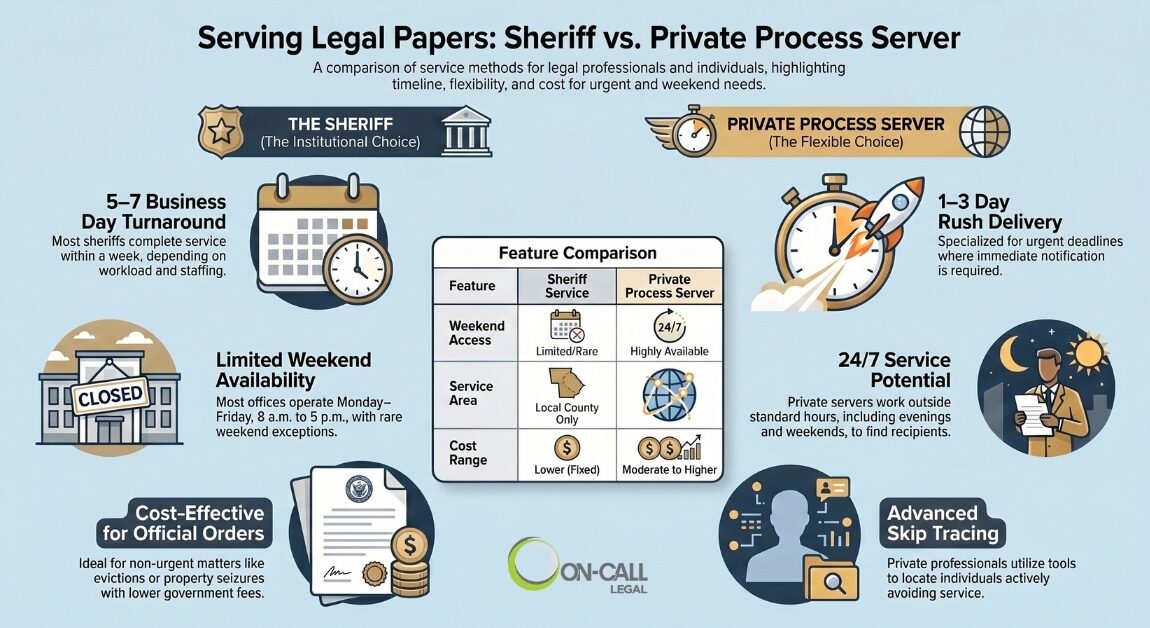
Whether a sheriff can serve legal papers on a Saturday or Sunday depends on where the service takes place. Across the United States, sheriff’s departments generally operate during standard business hours, but some counties permit deputies to serve court documents after hours or on weekends when necessary. Other jurisdictions restrict service entirely on Sundays or holidays unless there is a court order involved, especially in sensitive legal matters like eviction notice enforcement or temporary orders.
This variation creates confusion for many people involved in the legal process. Some assume sheriffs are available 24/7 because law enforcement operates around the clock, but service of process follows separate court rules and administrative procedures. In many counties, a sheriff may only attempt service during designated hours, while private process servers often have broader flexibility to serve papers at a recipient’s home, workplace, or another approved location.
According to a senior litigation support specialist at OnCall Legal, “One of the biggest mistakes people make is waiting until the last minute to arrange service. Weekend restrictions can easily cause parties to miss critical deadlines if they do not plan ahead.”
Weekend service policies can also affect legal proceedings in practical ways. If papers served are delayed because the sheriff’s department is closed over the weekend, a court date may need to be postponed or legal filings adjusted. This becomes especially important in small claims cases, restraining orders, landlord-tenant disputes, and other time-sensitive legal matters where due diligence and proper service are required before the court can proceed.
Typical Sheriff Office Hours and Exceptions
Most sheriff’s offices across the country follow fairly predictable schedules for serving papers and handling process service matters. However, exceptions can apply depending on the county sheriff, emergency circumstances, or court directives.
- Most sheriff’s departments operate between 8:00 a.m. and 5:00 p.m., Monday through Friday.
- Weekend service is sometimes available for urgent legal documents such as restraining orders or emergency custody matters.
- Certain states restrict service on Sundays unless approved by the court.
- Holiday service is usually limited unless the legal matter involves an immediate risk or emergency orders.
- Some counties allow deputies to attempt service outside business hours when multiple attempts during the week have failed.
- Sheriff’s service of documents may be delayed during periods of high workload or staffing shortages.
Does the Sheriff Serve Papers on Weekends?

In some states, sheriffs can serve legal papers on weekends, but it depends on the laws of the state or region. In California, process servers, including sheriffs, are permitted to serve legal documents on weekends. On the other hand, process servers in Florida are not allowed to serve papers on Sundays. While sheriffs can serve court papers on weekends, how available they are for service of process may depend on the county’s policies and workload. If you require service on a weekend, contact your local sheriff’s office in advance to confirm their operating hours and any specific procedures they may have.
Alternatively, hiring a professional process server can offer more flexibility, as they often operate outside standard business hours, including weekends. If locating the individual to serve is challenging during regular business hours, this can be especially helpful. Note that local regulations and court rules can vary from state to state or in different local jurisdictions. Therefore, it’s advisable to consult local authorities or legal professionals to confirm the rules applicable in a specific jurisdiction.
What are the Sheriff’s Duties When Serving Legal Papers?
The sheriff’s primary duty in serving papers is to ensure that individuals or parties involved in a legal matter are officially notified as required by law. This procedure is called service of process and is critical to preserving the integrity of legal proceedings. Their responsibilities include:
- Delivering legal documents to the appropriate individuals or entities, adhering to state laws and court requirements.
- Proper documentation of the details of service, including date, time, and method of delivery.
- Filing someone with a return of service with the court to verify the successful delivery of the legal papers.
- Maintaining neutrality by acting as an impartial party in the legal process, without influencing or taking sides in the case.
- Attempting multiple service attempts at different times or locations if the recipient is unavailable.
- Enforcing court orders related to the documents they serve, which may include enforcing an eviction notice or seizing property.
Types of Legal Documents Typically Served by Sheriffs
Sheriffs are tasked with serving various legal documents, which may include summons and complaints, subpoenas, eviction notices, restraining orders, writs of execution, garnishment orders, and notices of foreclosure. Their responsibilities include ensuring that these documents are delivered in accordance with legal requirements. Note that each jurisdiction may have specific rules regarding how to serve someone with each of these types of documents. Hence, if you’re hiring a process server instead of a sheriff, please confirm that they serve each document properly.
How Long Does It Take for the Sheriff to Serve Papers?
For a standard service of process, sheriffs usually complete the service within 5 to 7 business days after receiving the documents. Some jurisdictions provide expedited or rush service for urgent cases, enabling completion within 1 to 3 days. Nevertheless, the exact time it takes for the sheriff to serve court papers can vary depending on several factors, including the jurisdiction, the type of document, and the availability of the person being served.
If the person to be served is difficult to locate or avoids service, the service process may take longer. Documents requiring personal service (hand-delivered) may take longer compared to substitute service. High demand or limited staff may also slow down the service. If you need to serve legal documents without delay, consider hiring an experienced process server who can complete the task more quickly than sheriffs, especially for time-sensitive matters.
What to Do if You Need Papers Served on the Weekend

If you need legal papers served outside of regular business hours, you can contact the Sheriff’s Office to inquire about their weekend operations. If the sheriff’s office does not usually operate on weekends, ask if they can make special arrangements for you. In some cases, like in states that restrict service on Sundays, you may need a court order allowing weekend service. You can also consider alternative service methods such as substitute service, service by certified mail, or e-service if allowed.
Alternatively, it might be best to hire a private professional process server, as they often work outside standard hours, including weekends. Private process servers may also be more readily available to locate and serve the recipient during non-business hours. But before you proceed, be sure that serving the papers on the weekend will not give the recipient legal ground to file for insufficient service. For instance, you can find out what hours a process server can serve you in California for the process service to be valid. Additionally, confirm that the process server is authorized to serve papers in your jurisdiction.
Understanding the Role of Process Servers versus Sheriffs on Weekends
Although sheriffs and process servers both participate in the service of process, their roles are very different. Sheriffs are government officials who often handle legal matters tied to court enforcement, including eviction notices, writs, subpoenas, and court-ordered service. Private process servers, on the other hand, are independent professionals hired to deliver legal documents quickly and efficiently.
One major difference is scheduling flexibility. Sheriffs typically work within county procedures and business hours, while certified process servers can often accommodate time-sensitive requests, after-hours service, and weekend assignments. That flexibility becomes essential when someone is difficult to locate or when a legal team needs complete service before a court date.
Another distinction involves efficiency and specialization. A dedicated process server may spend significantly more time locating the person, documenting service attempts, and following specific instructions from attorneys. Sheriffs often handle many competing duties within the legal system, which can limit how aggressively they pursue service attempts.
Why Use a Private Process Server Instead of a Sheriff?
Using a private process server instead of a sheriff for serving legal papers can offer several advantages, depending on your needs. Below are possible reasons a private process server might be a better option for you.
- Private process servers often have more flexible schedules and can serve papers quickly, including evenings and weekends. Contrarily, sheriffs may have a backlog of cases, leading to delays in serving your documents.
- Process servers can operate outside regular business hours, making it easier to serve hard-to-reach individuals. They can also accommodate specific instructions, like serving at a workplace or during specific times.
- They often make more attempts to locate and serve the individual than sheriffs, who may have limited time for follow-ups.
- Many private servers offer additional services like skip tracing to identify individuals who are difficult to locate.
- You can communicate directly with the process server for updates and special requests.
- While sheriffs are impartial, some parties may perceive private servers as more discreet or professional, especially in sensitive cases like restraining orders or lawsuits.
- While sheriffs typically limit their service to their local area, private servers have the ability to serve papers in multiple jurisdictions.
Although using a professional process server seems a better option in many cases, you should also know when to use a sheriff. If cost is a concern, sheriff’s services are usually more affordable. Additionally, sheriffs are also commonly used for official court orders like evictions or property seizures. The choice ultimately depends on your case, timeline, and budget.
Identification Requirements for Process Servers
Many people wonder whether process servers must identify themselves before serving papers. The answer depends on state law and the circumstances of the service, but in many jurisdictions, process servers are expected to identify themselves truthfully once service is completed or if directly questioned.
That said, they are not always required to announce immediately that they are serving legal papers before confirming the recipient’s identity. This helps prevent individuals from intentionally avoiding service. According to a senior process server at OnCall Legal, “Proper service is not just about handing over documents. It also involves following legal requirements carefully so the service holds up in court if challenged later.”
Sheriff Service vs. Private Process Server Service on Weekends
| Service Type | Weekend Availability | Cost Range | Identification Requirement | Geographic Coverage |
| Sheriff Service | Limited in many counties | Lower government-set fees | Official law enforcement identification | Usually limited to the county |
| Private Process Server Service | Commonly available | Moderate to higher, depending on urgency | Must comply with state process server laws | Often statewide or nationwide |
| Legal Courier/Messenger Service | Varies by jurisdiction | Moderate | Depends on the authority to serve process | Usually regional |
How Delays in Serving Papers Can Affect Legal Proceedings
When a delay occurs in serving legal documents, the court may postpone the hearing or court date until the service of process is completed. Delays in serving summons or complaints can extend the time before the defendant is required to respond. In time-sensitive cases, such as evictions or restraining orders, delays may cause the plaintiff to miss critical deadlines, potentially forfeiting their legal rights.
If papers are not served within the statutory time limit, the case may be dismissed without prejudice, requiring the plaintiff to refile and start the process over. Remember that repeated attempts to serve papers or refiling fees can increase the financial burden on the party initiating the process. Additionally, if papers are not served properly, the court may rule the service invalid, leading to further delays or the nullification of a default judgment.
Legal Exceptions or Extensions in Case of Delays
In certain situations, courts may grant exceptions or extensions to accommodate delays in serving papers. Examples of such cases include:
- Extensions for Good Cause – Courts may grant additional time if the plaintiff demonstrates that they made reasonable efforts to serve the papers but faced unavoidable obstacles, such as the recipient avoiding service, incorrect addresses, or remote locations.
- Substituted or Alternative Service – If personal service is not possible, the court may allow serving papers to another responsible adult at the recipient’s home or workplace. They can also facilitate the publication of a notice in a newspaper if the recipient cannot be located after diligent efforts.
- Tolling of Deadlines – In some cases, the court may pause (or “toll”) deadlines if delays are caused by factors outside the plaintiff’s control, such as natural disasters or administrative issues.
- Re-Issuance of Summons – If the statutory deadline passes, courts may allow the plaintiff to reissue the summons to reset the service deadline, provided there’s a valid reason for the delay.
- Emergency Orders – For urgent matters (e.g., restraining orders), courts may issue temporary orders even if service is delayed, provided the plaintiff demonstrates immediate harm or risk.
- Stipulations by Parties – In some cases, both parties can agree to extend the timeline for service and can inform the court accordingly.
Need Someone to Serve Papers on the Weekend?
The ability of sheriffs to serve court papers on weekends is influenced by their availability, local laws, and their workload. Private process servers are often faster and more flexible, especially for urgent situations. It’s important to know your options and understand the rules in your area so that you can make the best decision.
Whether you’re an attorney or a legal professional, it’s crucial to properly deliver your court documents to prevent legal challenges. Hiring an experienced process server who understands the legal process in your area is advisable.
At On-Call Legal Process Servers, our professional process servers are committed to providing you with all-inclusive support services, such as obtaining, preparing, serving, and documenting your court papers quickly and accurately. Reach out to us for a free consultation today to get started.
FAQ
With over 15 years of experience navigating the legal system and working directly with attorneys, law firms, and individuals, We’ve seen just how crucial it is to understand your options before you begin the process. These answers will help you move forward confidently, avoid delays, and choose the best service method for your legal matter.
What if I Need Someone Served Immediately?
If you need immediate action, a professional process server is usually the fastest option because they can work outside the usual hours of a sheriff’s department. Sheriffs typically serve papers only during standard business hours, so urgent cases may not be prioritized. When time is critical, hiring a dedicated process server ensures the legal documents are delivered quickly and properly filed.
Are There Any Exceptions Where the Sheriff Serves Papers on Weekends?
Some states allow a sheriff to serve legal documents on weekends, but others—like Florida—restrict Sunday service entirely. Even in states that permit it, the sheriff’s office may require special permission or advance arrangements depending on workload. Always verify with your local sheriff’s office if your county permits weekend paper serving.
Can I Choose Between a Sheriff and a Private Process Server?
Yes, you can choose either option in most legal proceedings, unless the court specifically requires service through the sheriff. Many people prefer a professional process server because they offer more flexible service hours and faster turnaround. Sheriffs, however, may be required for certain court orders such as evictions or writs.
What Happens if the Sheriff Can’t Find the Person to Serve?
If the sheriff is unable to locate the person, they may attempt service at various times or locations, but they typically limit the number of such attempts. When personal service fails, you may need to request substitute service or hire a private process server who can perform skip tracing to find the individual. The court may also allow alternative methods like certified mail if the judge agrees.
Does It Cost Extra to Have the Sheriff Serve Papers Over the Weekend?
Some counties charge an additional fee for weekend attempts because they fall outside standard business hours. Other sheriff’s offices simply don’t offer weekend service at all, which means the cost becomes irrelevant.
How Long Does It Typically Take for Someone to Get Served?
Sheriff’s departments typically take five to seven business days to complete service, but the timeline varies by location and workload. Private process servers often complete the process faster because they work beyond the usual hours and prioritize urgent cases.
What Happens if Someone Doesn’t Get Served Papers?
If the person isn’t served, the court may delay or reschedule the case because proper service is required to move forward. Unserved legal papers can even lead to a dismissal if deadlines pass without valid proof of service. Whenever service fails, you’ll need to try again, request substitute service, or explore alternative methods approved by the judge to keep your legal process moving.


Disclaimer: This article provides general procedural information about legal support services in California and is not legal advice. On-Call Legal is a legal support services company and not a law firm. Requirements vary by court, by county, and by case type, and rules change over time, so anyone with a pending or contemplated matter should consult a licensed California attorney. For how our content is written and reviewed, see our Editorial Policy.

On-demand legal services with arranging services from eFiling to organizing and preparing your subpoena for records and/or personal appearance and much more.