
Process Server Tricks of the Trade
Process server tricks are legal, strategic techniques used by a process server to deliver court documents efficiently, verify the correct person served, and ensure the legal process holds up in court. These tricks of the trade are not shortcuts—they’re professional methods grounded in law, timing, and observation. When done right, they help complete service accurately while preventing delays that could derail legal proceedings.
With over 15 years of experience, On-Call Legal Process Servers has built a reputation for consistently successful process serving across the country. Our nationwide process servers understand how process service works in real-world situations, from evasive individuals to restricted access properties, and we know how to handle them the right way. If you need reliable service for legal paperwork, schedule a free consultation with us today to get started with a trusted team.
In this article, we’ll break down the most effective process server tricks, legal boundaries, and actionable strategies that help professionals complete service successfully.
Table Of Contents
- What Tricks Do Process Servers Use?
- Key Tricks Of The Trade For Process Servers
- 1. Researching the Subject
- 2. Route Scheduling
- 3. Understanding the Legal Process
- 4. Dressing Appropriately
- 5. Gaining Access to Properties
- 6. Subtle Observation Techniques
- 7. Building Rapport
- 8. Using Concise and Understandable Language
- 9. Handling Difficult Situations
- 10. Joining Professional Associations
- 11. Leveraging Online Resources
- Technology Utilization in Process Serving
- How to Maintain Ethical Standards as a Process Server
- Identifying and Hiring Certified and Special Process Servers
- Can a Process Server Trick Someone to Accept a Document?
- Step-By-Step Process for Successful Service
- What Are Some Common Challenges and How to Overcome Them During Service Attempts?
- Need a Professional Process Server Today?
- FAQ
- What Happens if a Process Server Can’t Find You?
- What Hours Can a Process Server Serve You?
- Do Process Servers Work On Weekends?
- How Many Times Can a Process Server Come to Your House?
- How Late Can a Process Server Come to Your Home?
- Are Process Server Tricks Legal?
- How Can I Hire a Certified Process Server?
- What Should I Do if the Recipient Avoids Service?
- Can Process Servers Enter Private Property Without Permission?
- Legal Disclaimer
Role and Responsibilities of a Process Server

A process server’s job might seem straightforward: deliver papers, get a signature, move on, but there’s a lot more going on in the background. At its core, process service works to ensure that anyone facing legal action gets properly informed. The process server delivers court papers to the correct address and verify that the person served is indeed the right individual, not a “John Doe” who happens to be home.
That might mean taking multiple trips to a residence or business, collecting as much information as possible from neighbors, or waiting near a Wi-Fi-enabled coffee shop until the subject shows up. The goal is to ensure legal paperwork is delivered lawfully, so the court can stand behind it. Once service is complete, the server fills out a form stating that the document was handed over correctly. That proof is critical as it becomes part of the legal record.
Without process servers, legal proceedings could grind to a halt. They ensure fairness by giving people the opportunity to respond, no matter how inconvenient it may be. And when the work is done right, it protects the right to due process for everyone.
What Tricks Do Process Servers Use?
Mastering process service involves acquiring a specific set of skills or tricks that revolve around three crucial areas: Planning and Preparation, Embracing Discretion and Professionalism, and Effective Communication Strategies.
Planning and preparation involve meticulous research, efficient route scheduling, and understanding the legal process. These elements establish the foundation for a successful process serving. Discretion and Professionalism are also key to navigating through various environments and interactions, including dressing appropriately, gaining access to properties, and subtly observing subjects.
Lastly, effective communication strategies play a vital role in building rapport with the subjects, explaining complex legal concepts in an understandable manner, and managing difficult situations with grace. Together, these skills form the bedrock of an effective process server’s job.
Why Do These Tricks Matter?
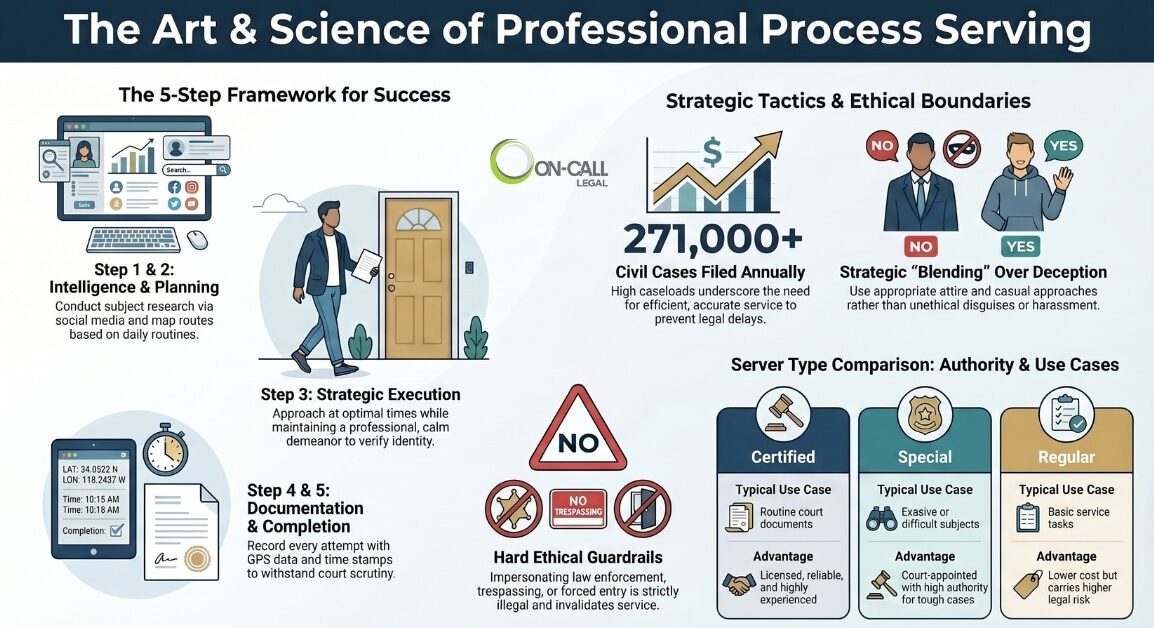
These strategies, honed by experienced process servers over the years, are designed to help navigate through such challenges. They help ensure that process servers maintain their high standards of professionalism, personal service, and ethical conduct while delivering reliable and timely service. According to the U.S. Courts 2025 Judicial Caseload Indicators report, in 2025 alone, over 271,000 civil cases were filed in U.S. District Courts, with nearly 400,000 cases still pending, underscoring how critical timely and accurate process serving is to keeping legal proceedings moving forward.
By mastering these techniques, process servers are not only able to surmount obstacles more effectively but also uphold the integrity of the legal system and safeguard the rights of all parties involved.
In essence, these ‘tricks’ are not merely shortcuts or quick fixes. They are vital skills and strategies that enhance a process server’s efficiency, effectiveness, and overall success in the profession. They serve as the guiding compass that directs the process server through complex situations, ultimately fostering an environment of complete fairness and justice.
Key Tricks Of The Trade For Process Servers
Knowing the tricks of the trade for process serving is important, as they help ensure efficient, accurate, and lawful delivery of legal documents, which is essential for maintaining the integrity of the legal process. Mastering these tricks can also significantly enhance a process server’s effectiveness and reduce the likelihood of delays or legal challenges. Here are some key tricks of the trade that process servers use:
1. Researching the Subject
To fulfill their duties effectively, process servers must begin by conducting comprehensive research on the person or party being served. This can include information about the subject’s whereabouts, daily routines, and even their favorite haunts. Resources such as social media platforms, public records, and other online resources can provide a wealth of insights that aid in the process.
2. Route Scheduling
Efficiency is paramount in the life of a process server. Therefore, they should plan their routes in a manner that maximizes efficiency. Factors such as traffic patterns, distance between locations, and the optimal time to catch the subject at the location should be considered. This ensures the best use of the process server’s time and resources.
3. Understanding the Legal Process
Most states have their own unique set of rules governing the process of serving. Process servers must familiarize themselves with these laws to ensure that service is carried out in a legally compliant manner, thereby upholding the integrity of a consistently successful process.
4. Dressing Appropriately
Process servers should choose their attire carefully, aiming to blend in with their surroundings and avoid drawing unnecessary attention. Whether it’s business attire for a corporate setting or casual clothes for residential areas, the chosen dress code should not hinder the successful delivery of legal papers and documents.
5. Gaining Access to Properties
Gated communities, apartment complexes, or office buildings can present access challenges to the correct address (You don’t want to show up at the door of the wrong house!). By communicating respectfully with security personnel and often by presenting a badge or identification, process servers can facilitate a smooth entry to these properties.
6. Subtle Observation Techniques

A successful process server must sometimes become a keen observer. By maintaining a low profile, they can confirm the subject’s identity, location, and routine without arousing suspicion. Techniques such as inconspicuous positioning or casual conversation can be effective ways of gathering necessary contact information.
7. Building Rapport
First impressions matter when trying to deliver sensitive legal documents. A friendly demeanor, genuine interest in the subject’s concerns, and empathetic communication can establish trust, thereby facilitating cooperation from the subject.
8. Using Concise and Understandable Language
Legal jargon can often be overwhelming for the layperson. Process servers should aim to simplify complex legal concepts, ensuring that subjects comprehend the nature and importance of the court documents being served. This not only respects the recipient’s right to understand but also reduces the likelihood of conflict or misunderstanding.
9. Handling Difficult Situations
Many process servers face occasional hostility or difficult confrontations. In such scenarios, it’s essential to maintain composure and use de-escalation techniques. Acknowledging the subject’s feelings can help defuse tension, and if needed, a strategic retreat may be the safest option. It’s important to remember that personal safety should always be the priority.
10. Joining Professional Associations
Joining professional associations is a rewarding investment for process servers. These associations provide access to industry-specific resources, educational opportunities, and networking events, advocating for members and promoting ethical practices. Membership in such organizations strengthens relationships with other process servers, legal professionals, and bolsters credibility with other industry experts. This ultimately provides a competitive edge in the market.
11. Leveraging Online Resources
The internet provides a wealth of resources for process servers. By actively engaging in online communities such as blogs, forums, and other social media sites and groups, process servers can stay abreast of industry trends, share experiences, and seek advice. These online platforms offer a myriad of strategies to overcome common challenges, enhancing professional growth.
Technology Utilization in Process Serving

Modern technology has emerged as a significant game-changer in the realm of process serving. Its integration has not only increased efficiency but has also revolutionized the way process servers conduct their operations. This section will delve into the various ways that technology aids process servers, making their job easier, more accurate, and much more effective.
Use of GPS Mapping Applications
GPS mapping applications are essential tools in the process server’s arsenal. They provide real-time traffic updates, road conditions, and public transportation schedules that help in route planning. By optimizing travel, process servers can serve more documents in a shorter period, thereby increasing productivity and reducing costs.
Utilization of Surveillance Equipment
In certain scenarios, process servers may need to gather evidence to verify a subject’s identity. Advanced surveillance equipment, such as long-range lens cameras and hidden body cameras, can play a pivotal role. They help capture crucial evidence while maintaining the server’s anonymity, ultimately contributing to the success of the service process.
Digital Record Keeping
Digital record-keeping is a cornerstone of efficient process serving. Electronic databases allow process servers to manage case files, service records, and other essential documents digitally. They can easily update information from virtually any location, ensuring all records remain accurate, up-to-date, and secure. This not only streamlines operations but also enhances the accuracy and reliability of the process serving.
How to Maintain Ethical Standards as a Process Server

Maintaining ethical standards as a process server starts with understanding that this role is more than just delivering papers; it’s about protecting the integrity of the legal process. Every document you serve has weight. Someone’s future, finances, or freedom may be tied to it. That means how you do the job is just as important as getting it done.
First, know the law inside and out. Most states have clear rules about how process service works – where and when you can serve, who can accept the documents, and what actions cross the line. You’re not allowed to impersonate a law enforcement officer, and you can’t lie about the nature of the delivery. Disguises are also considered unethical and are frowned upon in the industry. They are unacceptable among most professional process servers, as, according to the law, you ought to be transparent when delivering documents. This also leads to establishing trust with clients and presenting yourself as a serious, trustworthy process server. Misleading someone can backfire fast and make the service invalid in court.
Second, respect the people involved, even if they’re doing everything they can to avoid you. Avoid trespassing, aggressive tactics, or harassing behavior. You might wait at a residence, speak to neighbors, or check the wi-fi activity around the house, but you should never force your way through someone’s door or create conflict. It’s about staying professional, even when things get tense.
Finally, document everything. Keep accurate, timely notes on every attempt, every conversation, and every location. This isn’t just for your own protection; it’s to prove that the legal paperwork was properly delivered if the service is ever challenged. And keep learning. Many process servers attend industry trainings or join professional associations to stay current. It’s one of the best ways to become a better process server while avoiding legal troubles.
At the end of the day, ethical process servers don’t just follow the rules; they stand by them. That’s what earns trust, builds a reputation, and keeps the entire legal system running smoothly.
Identifying and Hiring Certified and Special Process Servers
Not all process servers are the same, and hiring the right type can make a major difference in difficult cases.
A certified process server has met state requirements and is authorized to perform service professionally. A special process server is typically appointed by the court for a specific case, often when standard service attempts fail.
Comparison of Process Server Types
| Type | Definition | Certification Requirements | Legal Authority | Typical Use Cases | Advantages |
| Certified Process Server | Licensed professional server | State-approved certification | Broad authority | Routine service of court documents | Reliable, compliant, experienced |
| Special Process Server | Court-appointed individual | Case-specific approval | Limited to the assigned case | Difficult or evasive subjects | High authority for tough cases |
| Regular Process Server | Non-certified individual | Minimal requirements | Varies by state | Basic service tasks | Lower cost but higher risk |
Choosing the right professional ensures your service is completed efficiently and legally.
Can a Process Server Trick Someone to Accept a Document?
The truth is, process servers can get creative, but there’s a fine line between clever and illegal. If someone tries to evade service, a process server might knock on a door holding a package or pose as a delivery person – some even carry baked goods or wear a uniform that blends into the environment. These tactics, while sometimes surprising, are legal in most states as long as the person served is correctly identified, the process server is transparent about the service, and the delivery of legal paperwork is done without coercion.
However, pretending to be a law enforcement officer is never okay. The same goes for misusing a neighbor’s information, entering private property without permission, or misleading someone about the nature of the court papers. These kinds of tricks can backfire fast and lead to serious legal troubles. If the server is challenged in court and found to be deceptive, the document might be considered invalid, and the whole legal process can disappear as a result.
That’s why quality process servers rely on preparation, timing, and knowledge of the law rather than deception. They may use a tactic like slipping a note under the door or waiting with a pizza box, but they’ll always make sure they’re communicating truthfully and acting within legal boundaries.
How Do You Spot a Fake Process Server?
In a time when scams are on the rise, knowing how to spot a fake process server can protect you and your business from serious headaches. Most people aren’t familiar with how real process service works, and scammers take advantage of that. So, how do you know if a process server is legitimate?
First, check their identification. Real process servers typically carry a business card, badge, or some form of company credentials. If the person refuses to identify themselves, that’s a red flag. A real server should be able to tell you where the papers are coming from — what court, which company, and what the papers are about. If they’re vague or evasive, trust your instincts and seek advice from legal counsel.
Additionally, be cautious if someone pressures you to accept documents without explanation or threatens legal consequences on the spot. That’s not how legal paperwork is delivered. Process servers are not law enforcement officers, and they can’t arrest or detain you. They also don’t demand money. If someone is demanding immediate payment or using intimidation, you’re likely dealing with a scam.
Another clue is where they show up. If a person claims to have documents but appears at your job or tries to hand something to your child, verify everything before accepting. When in doubt, ask for the name of the sender or call the court directly. Most states have regulations on how and where documents should be delivered, and breaking those rules could mean the service is invalid.
Additionally, being informed is your best defense. Ask questions, verify credentials, and trust your gut. If something feels off, it probably is.
Step-By-Step Process for Successful Service
At OnCall Legal, we’ve developed a step-by-step framework based on years of real-world experience. This process helps ensure every service is completed efficiently, legally, and with minimal delays. It’s the exact system we recommend for consistently successful results.
Step 1: Case Review and Information Gathering
This is where every successful service begins—and where many failed attempts could have been avoided. A professional process server takes the time to review all available details before making the first move, including the subject’s full name, last known address, contact history, and the type of legal paperwork being served. The goal is to eliminate guesswork and avoid showing up at the wrong house or attempting service on the wrong person.
At this stage, it’s also important to gather as much information as possible using online resources, public records, and even social media sites. Small details—like a recent job change or a tagged location—can dramatically improve accuracy. A better process server knows that preparation isn’t optional; it’s the foundation of a consistently successful outcome.
Step 2: Strategic Planning
Once the information is verified, the next step is building a smart, realistic plan. This is where process server tricks of the trade start to take shape, as timing, location, and potential obstacles are carefully mapped out. Instead of making random attempts, the server plans when and where the subject is most likely to be available.
This might include identifying peak times at a residence, planning a workplace visit, or preparing for restricted access locations like gated communities. A well-thought-out plan also considers backup strategies—what to do if there’s no answer, if the subject tries to evade service, or if access is denied.
Step 3: Smart Service Attempts
Execution is where planning meets real-world unpredictability. A professional process server applies proven tactics—approaching at the right time, verifying identity carefully, and maintaining a calm, professional demeanor throughout the interaction. This is also where adaptability matters most.
If the subject doesn’t answer the door, the server may return later, observe patterns, or attempt service at another location. If the individual is evasive, subtle observation techniques or alternative approaches may be used to confirm identity before handing over the court documents.
Sometimes, simple tactics—like approaching casually or blending into the environment—can make all the difference. But every tactic must remain legal and ethical. The goal isn’t to trick the person unfairly; it’s to ensure the delivery of legal paperwork is completed correctly and stands in court.
Step 4: Documentation and Verification
A service isn’t truly complete until it’s properly documented. This step ensures that the entire process can withstand legal scrutiny if challenged. Every attempt, successful or not, should be recorded with accurate details, including time, date, location, and what occurred during the interaction.
Verification is equally important. The server must confirm the identity of the person served, whether through direct acknowledgment, matching known details, or other lawful methods. Mistakes at this stage, such as serving the wrong person, can cause serious delays or even make the legal process disappear.
Using tools like GPS tracking, photos (when appropriate), and detailed notes helps create a strong, defensible record of service.
Step 5: Follow-Up and Completion
Even with the best planning, not every service is completed on the first attempt—and that’s completely normal. Follow-up is where persistence pays off. A skilled process server continues attempts at different times and locations, refining their approach based on what they’ve learned.
If the subject continues to evade service, the server may escalate strategies, such as additional skip tracing or coordinating alternative service methods when allowed by the court. Communication with the client is also critical at this stage, ensuring they stay informed about progress and next steps.
Completion isn’t just about handing over papers—it’s about ensuring the service is valid, documented, and ready to support the legal action moving forward. This final step ties everything together, turning effort and strategy into a legally sound result.
What Are Some Common Challenges and How to Overcome Them During Service Attempts?
Every process server encounters obstacles. From evasive individuals to locked doors and incorrect addresses, these challenges are part of the job—but they can be overcome with the right approach.
One of the most common issues is evasive behavior. Some individuals actively avoid being served by ignoring the door, changing routines, or providing false information. In these cases, persistence and strategy are key. Attempting service at different times, verifying new addresses, and using observation techniques can eventually lead to success.
Locked doors and restricted access are another frequent challenge. Gated communities, apartment complexes, or office buildings can make it difficult to reach the subject. Here, communication with property managers or security personnel can help gain lawful access.
Refusals are also common. A person may refuse to accept the documents, but in many jurisdictions, as long as the identity is verified and the papers are presented, the service can still be considered complete.
Practical countermeasures include:
- Making multiple attempts at different times
- Verifying the correct address to avoid the wrong house
- Using alternative service methods when approved
- Staying patient and adapting strategies
These challenges are part of the process, but with the right tactics, they can be successfully navigated.
Need a Professional Process Server Today?
Mastering the ‘tricks of the trade’ is integral to the role of a professional process server. These skills and techniques, encompassing meticulous planning, effective communication, and proficient use of technology, are crucial to serving legal documents effectively and efficiently.
These tricks not only ensure the smooth operation of the legal system but also uphold the right to due process, thereby fostering a more just society. They enable process servers to navigate the complex landscape of their profession, enhancing their contributions to an efficient legal system. As the profession evolves, process servers need to engage in continued learning and uphold high ethical standards. By doing so, they can maintain their effectiveness, credibility, and integrity, ensuring their vital role in the legal system continues to support justice for all.
With a team of experienced process servers and a proven track record, OnCall Legal is trusted nationwide for reliable service. Backed by decades of experience and a proven track record in process serving, we ensure your documents are delivered promptly, securely, and with the utmost professionalism. Contact us for a free consultation, and let us help you deliver your legal documents efficiently.
FAQ
Process servers play an important role in the legal process, but many people still have doubts about what their job is and how they do it. Whether you’re expecting court papers or just want to understand how process service works, these common questions reveal the tactics, timing, and legal limits involved.
What Happens if a Process Server Can’t Find You?
If a process server can’t locate you at your known address, they’ll typically use tactics like skip tracing, checking social media, speaking with neighbors, or verifying your last-known residence or workplace. In many states, if you continue to evade service, the court may allow alternative methods, like leaving the legal paperwork with someone at your home, posting it on your door, or even mailing it.
What Hours Can a Process Server Serve You?
Most states don’t restrict process serving to specific hours, but it’s expected to happen during reasonable times, typically between 6 a.m. and 10 p.m. However, if a person is hard to reach, the process server might show up early in the morning or late in the evening, especially if they believe the subject is deliberately trying to avoid being served. Serving papers too late at night may be considered harassment in some jurisdictions, so professionals must be cautious.
Do Process Servers Work On Weekends?
Yes, as many process servers work weekends. In fact, weekends can be one of the best times to find someone at home, especially if they’ve been avoiding weekday service at their residence or business.
How Many Times Can a Process Server Come to Your House?
There’s no set legal limit to how many attempts a process server can make. They’ll usually return several times, often at different hours or on different days, until they complete the delivery. The number of attempts depends on the urgency of the legal action, the type of document, and whether alternative service has been authorized by the court.
How Late Can a Process Server Come to Your Home?
Process servers can legally approach your door in the evening, sometimes as late as 9 or 10 p.m., depending on local laws and what’s considered “reasonable.” If someone is actively avoiding service, visiting at night can be a tactic to ensure delivery.
Are Process Server Tricks Legal?
Yes, as long as they follow legal guidelines and ethical standards. Tricks of the trade are simply professional strategies used to complete service efficiently. Illegal tactics can lead to legal troubles or cause the case to fail.
How Can I Hire a Certified Process Server?
Start by looking for a certified process server with verified credentials and experience. Check their reputation, service areas, and ability to handle complex cases. Working with a professional company like OnCall Legal ensures reliability and compliance.
What Should I Do if the Recipient Avoids Service?
If someone tries to evade service, continue attempts at different times and locations. A professional process server can use skip tracing and other legal strategies to locate them. Persistence and proper documentation are key.
Can Process Servers Enter Private Property Without Permission?
In most states, process servers may approach a residence but may not force entry or trespass. They must follow local laws and respect property boundaries. Violating these rules can invalidate the service.
Legal Disclaimer
This article is for informational purposes only and does not constitute legal advice. Process serving laws vary by state and jurisdiction, and specific situations may require professional legal guidance. Always consult with a qualified attorney or licensed professional process server to ensure compliance with applicable laws.


On-demand legal services with arranging services from eFiling to organizing and preparing your subpoena for records and/or personal appearance and much more.