
How Do I Know if a Process Server Is Legitimate?
The simplest way to know if a process server is legitimate is to ask for state-issued credentials, confirm the case number with the court clerk’s office, and verify with the law firm that supposedly hired them. A real process server delivers actual court documents, obeys the legal rules of the jurisdiction, and never demands money on the spot from the person being served. If any of those checks fail, you are not dealing with a legitimate process server.
OnCall Legal Process Servers has over 15 years of experience handling service of process for attorneys, law firms, businesses, and individuals across California and nationwide. Every server we dispatch is registered, bonded, and trained to follow each jurisdiction’s specific rules, with proper Affidavits of Service filed on time. Contact us today to discuss your service needs.
This article walks through what a process server is, how to verify a process server’s credentials, the questions to ask before hiring, the legal requirements by state, the warning signs of process server scams, and what to do if you suspect a scam.
Table Of Contents
- What Is a Process Server?
- Role and Responsibilities of a Process Server
- How To Determine if a Process Server Is Legitimate?
- How to Verify a Process Server’s Credentials
- Questions to Ask a Process Server Before Hiring
- Understanding Service Attempts and Timing
- Legal Requirements and Process Server Laws by State
- Signs of a Legitimate vs. Fraudulent Process Server
- Process Server Scams: What to Watch For
- What Information Should Not Be Disclosed to a Process Server
- Common Reasons a Process Server May Contact You
- What Happens if You Don’t Answer the Door to a Process Server
- What Happens if Documents Are Not Served Properly
- Do You Have To Identify Yourself to a Process Server?
- Things a Process Server Needs To Do When Serving You
- Common Red Flags in Process Servers
- How To Find a Qualified Process Server?
- Need Reliable Service?
- FAQ
- Can a Process Server Lie About Who They Are?
- What Are the Risks of Hiring an Uncertified Process Server?
- What if a Process Server Refuses to Identify Themselves?
- Do Process Servers Wear Badges or Uniforms?
- Does a Process Server Have To Identify Themselves?
- What Should a Certified Process Server Provide as Proof?
- How Many Attempts Does a Process Server Typically Make?
- What if a Fake Process Server Came to My House?
- What Tricks Do Process Servers Use?
- Will a Process Server Call You Before Serving You?
- What Happens if You Never Answer the Door to a Process Server?
- Can a Process Server Serve You at Your House?
- Legal Disclaimer
What Is a Process Server?

A process server is a professional whose job is to serve legal papers, summonses, subpoenas, complaints, eviction notices, family-law papers, and similar court documents to the parties involved in a legal action. Their work exists so that every person named in a case actually receives notice and is given a chance to respond. Due process depends on it.
The basic outline of a process server covers three roles that often get conflated: certified process servers, private investigators or independent contractors who serve papers, and county sheriffs or marshals. They are not interchangeable.
Role and Responsibilities of a Process Server
The primary responsibility is to deliver legal documents to the named recipient in the manner the court requires. That breaks down into a handful of tasks:
- Locating the person to be served (skip tracing, current address research)
- Confirming the recipient’s identity at the door
- Delivering the documents according to state-specific rules, in person where required, by substitute service where allowed.
- Completing and filing the Affidavit of Service or Proof of Service that proves the documents were delivered.
- Documenting multiple service attempts where the first try fails, to establish due diligence
Process servers do not collect debts, take payments, threaten arrest, or pretend to be law enforcement. Anyone doing those things is not a process server.
Types of Process Servers (Certified, Private, Sheriff)
Three categories serve papers in the United States:
Certified or registered process servers. Private professionals registered, licensed, or certified under their state’s process server laws. The standards vary widely from state to state.
Private process servers and process serving company employees. Independent professionals who may or may not be required to register depending on the jurisdiction.
Sheriffs and marshals. In most counties, the sheriff’s office will serve civil papers for a fee. Some jurisdictions reserve specific service types (such as certain eviction notices) for the sheriff.
A reputable process server is one whose category and credentials match the requirements of the local court where the case is filed.
Why Certification Matters
Where a state requires certification, using an uncertified server creates a real legal risk: the service can be challenged, the proof of service can be thrown out, and the case can be delayed or even dismissed for improper service. Certification is also the easiest way to verify a server is who they claim to be. A real process server with state credentials can be looked up in a public registry. A fake one cannot.
How To Determine if a Process Server Is Legitimate?
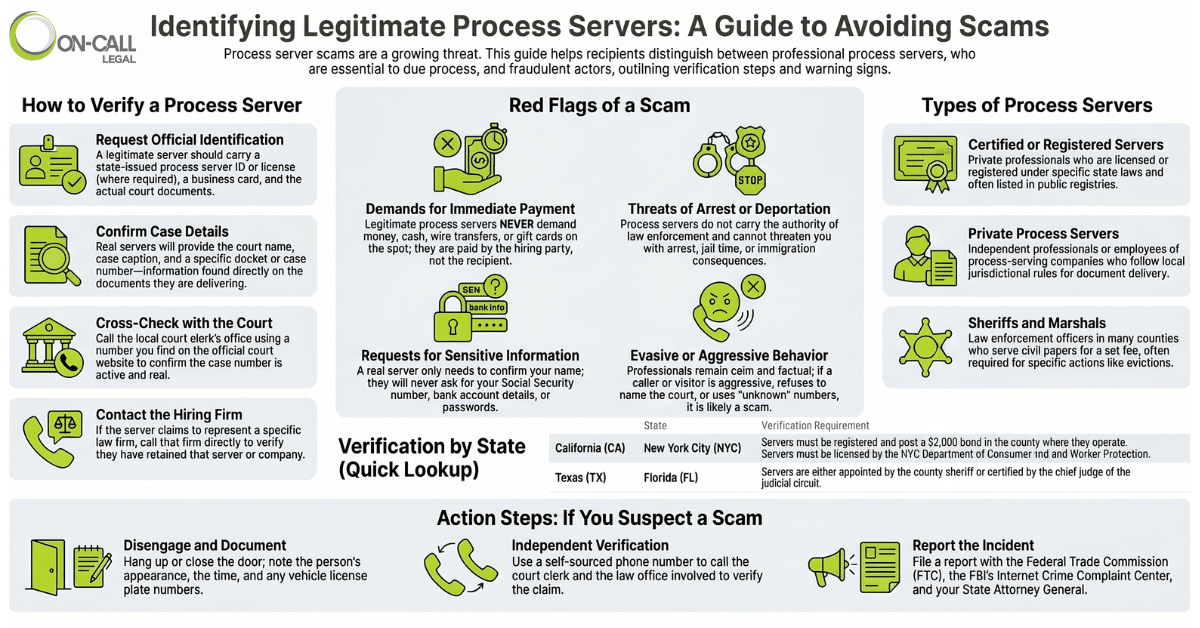
Confirming a process server is real takes about five minutes and can save a lot of trouble. Scam calls and fake process servers are common enough that the FTC has issued public warnings, and the steps below outline what to ask and verify.
Ask for Identification
A legitimate process server should carry a state-issued process server ID or license (where required by the state), a business card, and the documents they are about to serve. They will not refuse to show it to them.
Verify the Credentials
Many states require process servers to be registered or licensed. California, Alaska, Arizona, Illinois, Montana, Nevada, Oklahoma, Texas, and Washington all have some form of state or county registration system. Check with your county clerk’s office or the relevant state licensing body. If the server claims to be sent by a particular law firm or court, directly contact that firm or the court clerk to verify.
Watch the Behavior
A professional process server is calm, factual, and willing to answer reasonable questions. They will not threaten you or demand cash on the spot, and they will identify themselves.
Look Up the Company
If they claim to work for a process serving company, look the business up online. A real firm has a verifiable address, a working phone, and either reviews or a membership in a professional association, such as NAPPS or CALSPro. A “company” with no internet presence is a reason to slow down.
How to Verify a Process Server’s Credentials

If someone claims to be a process server, you have every right to confirm it before accepting anything. Use the following sequence; it works whether the server is at your door or you are vetting one for hire.
- Ask for identification. A legitimate server should carry a state-issued process server ID or license, a business card, or both. The ID should show the server’s name, the county or state they are registered in, and (where applicable) a license number.
- Ask for case details. Real process servers will name the court, the case caption, and provide a docket or case number. They will not refuse to share that information; it is on the documents they are about to hand you.
- Verify the case with the court. Call the clerk’s office of the local court named on the documents and confirm the case number is real and active. This step alone eliminates almost every scam.
- Verify the server’s licensing. Where the state requires registration or licensing, the issuing authority maintains a registry. Confirm the server’s status with that authority before proceeding.
- Confirm with the hiring party. If the server says they were retained by a specific law firm or attorney, call the firm and verify. A real server will give you the information needed to make that call.
- Watch the behavior. A professional process server is calm, factual, and willing to answer reasonable questions. Aggression, evasion, or demands for money on the spot are all signs you are not dealing with a certified process server.
Where to Check Licensing and Certification
https://www.oncalllegal.com/process-server-laws-in-california/
The right place to verify depends on the state.
California. Process servers must register and post a $2,000 bond in the county where they operate, under the California Process Server Act (Business and Professions Code §22350 and §22360).
New York (NYC). Process servers operating in New York City must be licensed by the NYC Department of Consumer and Worker Protection. The license can be verified through the department’s online lookup.
Texas. Process servers must be certified by the Texas Supreme Court through the Judicial Branch Certification Commission. The Commission maintains a public roster of certified servers.
Florida. Process servers are either appointed by the county sheriff under Florida Statute §48.021 or certified by the chief judge of the judicial circuit under Florida Statute §48.27. Each county sheriff maintains the local certified-server list.
Other states. Many do not require statewide licensing. Where licensing is not required, verify the server through the hiring law firm, the local court, or membership in a professional association such as NAPPS (National Association of Professional Process Servers).
What To Do if You Suspect a Process Server Is Not Legitimate?
If something feels off about the person at your door, slow down. Note their appearance, words, document name and case number (or lack thereof), time of day, and any visible vehicle plate. Do not sign or accept the documents until you have verified the server’s identity.
The fastest way to verify is to call the court or the law firm the server claims to represent, using a phone number you look up yourself rather than one the server gives you. The court clerk can confirm whether a case is on file under that case number. The law firm can confirm whether they retained the server. Either call takes a few minutes and almost always settles the question.
If the server cannot or will not give you the case number, the court name, or the name of the firm that hired them, that is enough on its own to walk away. You do not have to engage further. Report the encounter to your state attorney general’s office, the Federal Trade Commission, and local law enforcement so the next person who gets the same call has more information to work from.
Questions to Ask a Process Server Before Hiring

If you are hiring a process server, whether for a single case or as a regular vendor for a law firm, these are the questions worth asking up front. A reputable process serving company will answer all of them without hesitation.
- Are you registered, licensed, or certified in this county or state? Where the law requires it, the answer must be yes, with documentation.
- How many years of experience do you have serving legal papers? Years of work with a clerk’s office and the courts are the best measure.
- What’s your policy on service attempts and reattempts? A serious server will describe how many attempts they make, on which days, and at what times.
- Do you carry liability insurance and a bond where required? Both protect your case if something goes wrong.
- What geographic areas do you cover? Confirm they can actually reach the recipient, or that they work with a network that can.
- How will you document service? The right answer involves a notarized or signed Affidavit of Service, with detailed notes on each attempt.
- What do you charge, and what are your payment terms? Real process servers bill the hiring party (the plaintiff, the law firm). They do not collect money from the person being served.
- Will you provide updates throughout the service process? Professional servers send proactive updates on attempts, status, and completion.
Red flags in the responses: vague answers about licensing, refusal to provide an Affidavit of Service, requests for cash, or any suggestion the server can “guarantee” service. There are no guarantees in service of process; there is only documented due diligence.
Understanding Service Attempts and Timing
How quickly papers actually get served depends on the difficulty of locating the recipient, the rules of the jurisdiction, and the deadlines of the underlying case. As a rough guide, how long it takes to serve someone usually runs from a day or two to a few weeks, with rush service available for urgent matters. If you need delivery at a specific time, for example, before a hearing date, tell the server up front.
The number of attempts also varies. Most professional servers will try three times on different days and at different times of day before moving to substitute service or returning the documents as unservable.
Legal Requirements and Process Server Laws by State
Process server laws are set state by state, not federally, and the differences matter. Some states require statewide licensing. Others leave registration to the county. A handful require no formal credentials at all but still enforce strict rules about how, when, and by whom service can be completed.
A few patterns hold across the country:
- A process server typically must be 18 or older and not a party to the case.
- The server must follow the state-specific rules for personal service, substitute service, and service by mail or publication.
- The server must complete a sworn proof of service (an affidavit of service in most states) that the court will accept as evidence that the documents were delivered.
State-by-state examples already discussed above (California, NYC, Texas, Florida) illustrate the variation. The practical point: hiring a server who knows the local rules of the county where the case is filed is what keeps the service from being challenged later. National process serving companies maintain networks of local servers for exactly this reason: local expertise plus nationwide coverage.
Signs of a Legitimate vs. Fraudulent Process Server
Use the table below to quickly compare a certified process server against an uncertified or fraudulent one. The differences track licensing, conduct, and the type of paperwork involved.
| Factor | Certified Process Server | Non-Certified or Fraudulent |
|---|---|---|
| Certification status | Registered, licensed, or certified under state or county law | No registration on file; cannot be verified through any official channel |
| Licensing requirements | Met and current; bond posted where required | Not met; no bond; sometimes claims certification without documentation |
| Typical costs | Billed to the hiring party (plaintiff, law firm) | Demands cash or wire transfer from the person being served, a scam tell |
| Reliability of service | Documents multiple attempts; files a sworn Affidavit of Service | Will not provide written proof; cannot describe the case in any specific detail |
| Legal recognition | Service is recognized by the court; case proceeds normally | Service is invalid; case can be challenged or dismissed; recipient may file a motion to quash |
If a server fails the comparison on more than one factor, treat the encounter as a likely scam. Stay calm, do not give personal or financial information, and verify with the court and the supposed hiring attorney before signing or accepting anything. Report scams to your state attorney general’s office, the Federal Trade Commission, and local law enforcement.
Process Server Scams: What to Watch For

Process server scams are common enough that the FBI and the FTC have issued public warnings. The scale of the broader category is substantial: The FTC received 845,806 imposter scam reports in 2024, and consumers reported losing $2.95 billion to these scams. The agency notes that imposter scams frequently involve people falsely claiming to be government representatives or other trusted authorities. The FBI’s Internet Crime Complaint Center has reported hundreds of millions of dollars in losses tied to government impersonation in recent annual reports.
The pattern is consistent: a phone call from an unknown number, a voicemail message claiming you’ve missed a court date or have an outstanding debt or judgment, and pressure to send payment immediately to “resolve” the matter. Fake process servers rely on scare tactics, fear, and urgency because they cannot rely on actual court paperwork. They take advantage of the legitimacy of real process service to scam people who don’t know what real service looks like.
A real process server hands you the documents; they do not collect on them. A real process server will not call from an unknown number with a voicemail stating that you must call back about a pending lawsuit. A real process server will not demand a Social Security number, bank account information, or a wire transfer to make the case go away.
If you receive a scam call:
- Hang up. Do not engage, do not confirm your identity, and do not press buttons.
- Look up the court name they used and call the clerk’s office directly using the public phone numbers listed on the court’s website. Ask whether any case has been filed against you.
- Report scam calls through official channels. The Federal Trade Commission, your state attorney general, the FBI’s Internet Crime Complaint Center, and local authorities all take complaints.
- Block the number, but do not assume the scammer will not try again from a new line.
What Information Should Not Be Disclosed to a Process Server
A real process server may ask for your name and confirmation that you are the person named in the documents. That is all the identification they need. They do not need, and should never be given, your Social Security number, bank account information, online passwords, immigration status, or any other sensitive personal information. Fraudsters posing as process servers often try to extract exactly this kind of data, so the rule is simple: confirm your name if you choose to, and decline to share anything else.
Common Reasons a Process Server May Contact You
Legal papers take many forms, and process servers may be looking for you in connection with any number of court cases. The most common reasons people get served papers:
- Civil lawsuits (personal injury, contract disputes, business litigation)
- Divorce cases and other family-law matters
- Child support actions, modifications, or enforcement
- Eviction notices and unlawful detainer actions
- Subpoenas in cases where you are a witness, not a party
- Debt collection lawsuits (the lawsuit itself, not informal debt-collection threats)
- Small claims complaints
- Restraining orders or other protective-order paperwork
- Sealed documents from certain confidential proceedings, delivered under specific handling rules
Being served does not mean you have done anything wrong. It means someone has filed a case in which you are a named party or witness, and the law requires you to be notified. In some situations, papers may also be left with family members or another responsible adult at the home, under the substitute-service rules described below.
What Happens if You Don’t Answer the Door to a Process Server

Ignoring a process server does not stop the case. In many states, a server who is unable to make personal service after several attempts can move to substitute service: leaving the documents with another adult at your home, posting them on the door, or sending them by mail, depending on the rules of the jurisdiction. Some courts allow service by publication in a newspaper as a final option. Acting quickly when you realize someone is serving you, rather than avoiding it, almost always works in your favor.
If you avoid service entirely, the plaintiff can usually obtain a default judgment against you. That is worse than answering the door. Once a default judgment is on the books, it can be used to garnish wages, place liens on property, and damage credit. The risk is not theoretical: a Pew Charitable Trusts report on debt-collection lawsuits found that more than 70 percent of debt-collection cases in state courts end in default judgments, overwhelmingly because the defendant never responded.
If you have been served and you disagree with the case, the right move is to contact an attorney and respond by the deadline on the documents, not to avoid the server.
What Happens if Documents Are Not Served Properly
Improper service is a defense to the case. In California, for example, a defendant who was not properly served can move to set aside a default judgment, file a motion to quash the service of summons, or otherwise challenge the court’s jurisdiction over them. Improper service can also delay the case, cost the plaintiff additional fees, and in some circumstances result in dismissal.
For the plaintiff and the law firm, this is the practical reason to use a registered, certified, or otherwise verified process server. The cost of a service that someone later throws out is far higher than the cost of doing it right the first time.
What Makes a Subpoena Invalid
A subpoena can be invalid for several reasons:
- Improper service (wrong recipient, wrong method, missed deadlines)
- Failure to allow the recipient enough time to comply
- Requests for material that is privileged, irrelevant, or outside the scope of the case
- Failure to include the information the rules require, caption, signature, witness fee where applicable
- Failure to comply with privacy rules (for medical records, financial records, or other protected information that triggers special procedures).
The party served with an invalid subpoena can object in writing, file a motion to quash, or seek a protective order. Whether a particular subpoena is valid depends on the state’s rules and the case’s specific facts, so an attorney’s guidance is usually worth getting.
Do You Have To Identify Yourself to a Process Server?
In most states, you are not legally required to identify yourself to a process server. They do not carry the authority of law enforcement and cannot demand personal information from you. That said, if you are the named recipient of the documents, refusing to confirm your identity will not stop the legal process from moving forward. A server who reasonably believes they have served the right person can still complete service, and the case will proceed.
What Information Should Not Be Disclosed to a Process Server?
A real process server may ask for your name and confirmation that you are the person named in the documents. That is all the identification they need. They do not need, and you should not give, your Social Security number, bank account information, online passwords, immigration status, or any other sensitive personal data.
Fake process servers often try to extract exactly this kind of information by pretending to need it for “verification.” The rule is simple: confirm your name if you choose to, and decline to share anything else. Real service of process does not require any of the details a scammer would ask for.
Things a Process Server Needs To Do When Serving You
A legitimate process server has a small set of clear responsibilities. They have to identify themselves when asked. They have to deliver the documents in the manner the court requires, which in most cases means in person. They must file a sworn Proof of Service or Affidavit of Service with the court, detailing when, where, and how the documents were delivered. (Note: in most jurisdictions you are NOT required to sign anything when served, despite what some scammers claim.)
Training and certification standards vary by state. Where certification is required, process servers complete a state-approved course, pass an exam covering service rules and procedure, and renew their registration on the schedule the state sets. The point of the credentialing is to ensure the person serving your papers actually knows the rules that make the service hold up in court.
The laws governing the service of process exist to protect due process. Every defendant deserves real notice of a case before it moves against them. When the rules are followed, the service is valid; when not, it can be challenged, delayed, or thrown out.
Common Red Flags in Process Servers

The patterns below appear repeatedly in fake-process-server reports. Any one of them is a reason to stop, verify, and withhold all information.
- Refusing to identify themselves or show a state-issued ID
- Demanding cash, gift cards, or a wire transfer on the spot
- Calling from an unknown number with a voicemail message saying you must “call back about a pending case”
- Threatening arrest, deportation, or immediate legal consequences if you don’t pay
- Asking for your Social Security number, bank account details, or passwords
- Refusing to name the court, the case number, or the law firm that hired them
- Showing up at unusual hours without arranging timing for a business or attorney’s office
- Aggressive or unprofessional behavior that does not match how courts expect their officers to conduct themselves
- No verifiable business presence (no working phone, no real address, no online footprint)
A real process server is calm, brief, factual, and gone in a few minutes. Anyone who departs from that pattern is worth a second look before you sign or accept anything.
How To Find a Qualified Process Server?
Ensuring the proper and lawful delivery of court documents requires hiring a certified process server. One effective way to find a qualified process server is to ask other legal professionals or your fellow professionals in the area for recommendations.
You may also uncover trustworthy process-serving companies with a strong reputation among clients and a track record of providing consistent service by conducting online research. Look for process servers that are experienced, qualified, and knowledgeable about the specific laws and regulations that are relevant to your location.
Consult On-Call Legal Process Servers to find the best registered agent for the process. We can help you find skilled process servers who can efficiently handle your legal requirements.
Need Reliable Service?
Legitimate process servers are the backbone of due process, and verifying their credentials is what protects you from improperly served papers, default judgments, and outright scams. A real server identifies themselves, hands you actual court documents, and files a sworn Affidavit of Service with the court. Working with a vetted, registered process-serving company is the simplest way to make sure the documents in your case get served the first time correctly.
OnCall Legal works with a nationwide network of experienced process servers and registered process servers, every one of them trained on the rules of the jurisdiction they serve in. Over the past 15 years, our team has supported attorneys, businesses, and individuals through court filings, subpoenas, skip traces, and personal service across every county in California. Schedule a free consultation with us today.
FAQ
With years of experience working alongside professional process servers, we’ve answered just about every question people have about the serving process. Below are clear, practical answers to some of the most common concerns we hear, so you’ll know exactly what to expect in certain situations and how to protect yourself if something feels off.
Can a Process Server Lie About Who They Are?
A process server cannot lie about being law enforcement or a government official. However, in certain situations, they may use harmless tricks, like posing as a delivery driver, to complete service legally.
What Are the Risks of Hiring an Uncertified Process Server?
The service can be challenged and thrown out. The case can be delayed by weeks or months. A default judgment based on improper service can be set aside, which means the plaintiff has to start over. In some states, using an uncertified server where certification is required is itself a violation. The cost of doing it right the first time is much lower than the cost of fixing improper service later.
What if a Process Server Refuses to Identify Themselves?
If someone won’t provide ID or credentials, consider it a warning sign. A fake server may avoid questions, but a real professional will identify themselves once documents are delivered.
Do Process Servers Wear Badges or Uniforms?
No, legitimate process servers don’t wear badges or police-style uniforms. They usually dress professionally, and if someone flashes a badge, stay calm—it’s a sign you may be dealing with a fake server.
Does a Process Server Have To Identify Themselves?
In most states, yes, when asked. The exact rule varies, and there are narrow situations where a server may use harmless ruses to complete service legally (posing as a delivery driver, for example). But a process server cannot pretend to be law enforcement or a government official, and if you ask directly, they must identify themselves.
What Should a Certified Process Server Provide as Proof?
A state or county process server ID, a business card, the documents themselves (which name the court and case), and after service, a signed and often notarized Affidavit of Service filed with the court. They should also be able to describe how many attempts they made, where, and when.
How Many Attempts Does a Process Server Typically Make?
Most professional servers make at least three attempts on different days and at different times before moving to substitute service or returning the papers as un-servable. Courts look at the documented attempts as evidence of due diligence.
What if a Fake Process Server Came to My House?
If a fake server shows up, don’t panic. Stay calm, refuse to provide personal details, and call the court or the law firm they claim to represent to verify their legitimacy.
What Tricks Do Process Servers Use?
Process servers may use creative but legal tactics, like visiting at different hours or approaching casually, to complete delivery. These are not scams, just practical methods to serve papers in certain situations.
Will a Process Server Call You Before Serving You?
Yes, sometimes a process server may call to confirm your identity or arrange a good time. But if the same call involves threats or demands for money, that’s not legitimate service.
What Happens if You Never Answer the Door to a Process Server?
Avoiding a process server won’t stop your court case from moving forward. If you never answer, they may attempt service at work or use alternate methods allowed by law.
Can a Process Server Serve You at Your House?
A process server can serve legal documents to you at your residence. Process servers are permitted to use several acceptable techniques to deliver court documents legitimately. For example, when it comes to subpoenas, they can be served in person, in accordance with the standard instructions, or by mail, which is another legal way permitted by California law.
Legal Disclaimer
This article is general information about process service in the United States and is not legal advice. State and local rules vary, and the right answer in any specific case depends on the facts and the jurisdiction. For advice on a specific service, consult a licensed attorney.


On-demand legal services with arranging services from eFiling to organizing and preparing your subpoena for records and/or personal appearance and much more.